Culture

Culture

The good, the bad and the ugly in books, exhibitions, cinema, TV, dance, music, podcasts and theatre.

Self Esteem is the star of this David Hare musical

Theatre

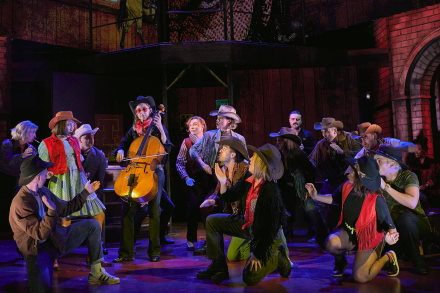
Teeth ’ n’ Smiles is not quite a musical. David Hare’s 1975 play about rock’n’roll includes a handful of tunes performed by a group of failing musicians. It feels like several dramas rammed together. One strand concerns the aimless witter of instrumentalists who lounge around backstage discussing drugs and groupies. Another strand follows the lead singer, Maggie, and her destructive appetites for booze and casual sex. The third element concerns the band’s manager, Saraffian (Phil Daniels), who knows nothing about showbusiness and seems keen to advertise his ignorance to the world. Saraffian is a Dickensian figure who talks like Fagin and believes that pop stars should resemble school prefects.

The joy of American romanticism

The Listener

Grade: A– For some record collectors, the fun lies in comparing recordings of standard repertoire. For others, it’s more about exploring – discovering works that are extinct in the concert hall, but which the inscrutable economics of recording make viable. If you’ve a habit of forming modest crushes on wallflowers and unfashionable composers, the news that Chandos is recording the orchestral music of Edward MacDowell (1860-1908) will bring a pleasant flush of blood to the cheeks. MacDowell, in short, is what American classical music sounded like before there was such a thing as American classical music – before Copland, Gershwin and all that jazz. Romantic, in other words; very, very Romantic.

The art of Schiaparelli

Arts feature

It’s a great shame that Elsa Schiaparelli is less widely known than her rival Chanel. Perhaps that’s down to how difficult her name is to pronounce. Is it ‘shap’, ‘skap’ or ‘skyap’? Tristram Hunt, director of the V&A, answers with a quip from Schiaparelli herself: ‘No one knows how to say it, but everyone knows what it means.’ The V&A’s new exhibition Schiaparelli: Fashion Becomes Art traces the web of influences around one of the great couture houses of the 20th century. Like Coco Chanel (I hate to compare them), Elsa Schiaparelli created clothes for the modern, independent woman – it is now conventional to say so but they ‘pushed boundaries’.

This Hockney show is disorientatingly enjoyable

Exhibitions

When so much contemporary art is riven with obscurity and angst, it is disorientating, at first, to encounter something as straightforwardly enjoyable as Hockney’s latest exhibition. Aged 88, the artist went out into his garden in Normandy with his iPad to make a visual diary of the year 2020. A hundred or so of the iPad sketches he made have been put together here, blended into a frieze, a walk-through panorama of the seasons rendered with Vivaldi-like virtuosity. As we move along the curve of this frieze, we see nature through Hockney’s bright yellow spectacles As we move along the curve of this 90-metre frieze, we see nature through Hockney’s bright yellow spectacles. He distils the garden to its dramatic essences.

China wants robots to look after the elderly

Radio

An AI data centre – imagine a factory of buzzing wires and computing equipment cooled by industrial fans – can consume as much power as a city. It has been estimated that, not too long from now, we’ll require 92 cities’ worth of extra power just to meet the demands of artificial intelligence. Ergo, the heat is on – but so, it is said, is a new cold war. On Radio 4 last week, Misha Glenny was exploring how the rapid evolution of technology is shaping the rivalry between the US and China. It turns out that the race for pre-eminence – in AI, at least – is as close as the 1973 Grand National. Red Rum (China) has the current lead, but that lead is ‘razor-thin’ and is thought to owe something to the nature of American tactics.

Goodwill will not save Claudia Winkleman’s new chat show

Television

Claudia Winkleman has a chat show on the BBC. I’m struggling to understand why this is a story but I listened to an entertainment-industry podcast recently which tried to explain. Apparently, chat shows are ratings death; hardly anyone watches them, so TV execs are very reluctant to launch new ones. But because of Traitors, Winkleman is now huge, bigger even than Ant and Dec, so against their better judgment they decided to give her a shot. If Winkleman’s chat show flops and doesn’t get recommissioned she shouldn’t blame herself, just the genre They’re probably regretting it, though. Everyone wants Claudia to do well because she seems nice.

For those of a nervous disposition, is Sinners worth it?

Cinema

Ryan Coogler’s Sinners won four Oscars and was nominated for 16 and I’d yet to see it. Sometimes the labels associated with a film can be off-putting and, for me, ‘horror’ and ‘vampires’ have the same effect as, say, ‘experimental’ or ‘like a poem’ or ‘directed by Michael Bay’. It’s now landed on the streamers and it seemed like an omission that needed correcting, so I spent around ten hours with it. It’s only 135 minutes but should you hit pause every time it gets scary that’s how it might roll. Please don’t sell me a vampire film when it’s a zombie one, even if I don’t like either The film is a genre-mashing beast, told with gusto from the off – and you get nearly an hour of pause-free time, even if you know what’s coming down the track.

Anthemic angst from The Twilight Sad

Pop

The only thing misery loves more than company is a backbeat. While capturing pure happiness surely remains the Holy Grail of any artistic endeavour, the blues is the bedrock of popular music for a reason. Sure enough, as we ready for the clocks to go forward, two albums arrive which could hardly be said to be full of the joys of spring, although they approach personal crisis – and catharsis – in very different ways. It’s The Long Goodbye, the sixth album by Scottish indie-rock band the Twilight Sad, is their first in seven years. During that hiatus lead singer and lyricist James Graham was dealing with his mother’s decline and eventual demise from early onset dementia, while also becoming a father.

Royal Opera’s Siegfried is magnificent

Opera

Covent Garden’s new Ring cycle has reached Siegfried, and once again, you can only marvel at Wagner’s Shakespeare-like ability to anticipate modern preoccupations. Want to talk about the manosphere? Well, here’s opera’s most profound study of the playful, disruptive, world-making energy of the adolescent male psyche. The least interesting thing that you can say about Siegfried is that he’s an impulsive oaf. Well, duh. Have you never met (or if you’re really unfortunate, been) a teenage boy? Wagner could hardly make it more clear. Siegfried’s upbringing has been toxic. He has been isolated from humanity, and his only inkling of love has been brutally transactional.

Ovid puts today’s radicals to shame

Arts feature

It’s a crisp afternoon, and in a darkened room in central Amsterdam a woman is being smothered in snakes. Projected on to three walls is a massive video close-up of her face. She is young and beautiful  and remarkably composed: just a nose twitch here, an eyelid flutter there, as a python wriggles across her mouth or languidly caresses her cheekbone with its tail. In the room behind me, another woman stares fiercely back. Her shoulders are bunched with muscle, arms stiff at her sides, like a nightclub brawler about to nut someone. But it’s the bull’s horns sprouting from her forehead, and the mane of matted fur marching down her back, that make it hard to meet her gaze.

Lazy: America is Beautiful, Chapter 1 reviewed

Theatre

Neil LaBute is one of America’s most provocative and interesting playwrights. His best-known work, The Shape of Things, was made into a movie starring Rachel Weisz and Paul Rudd. America the Beautiful consists of nine plays in three chapters, the first two of which are being staged at King’s Head, the third at the Greenwich Theatre. This complex arrangement sends a signal that LaBute is a mercurial and elusive artist whose fans must chase across London to savour the full richness of his talent. The lesbian stares and leers aggressively while her victim cowers and bleats in protest The first show, Chapter 1, consists of three unconnected skits about sexual jealousy.

Charming: The Other Bennet Sister reviewed

Television

The Other Bennet Sister is to Pride and Prejudice what Tom Stoppard’s Rosencrantz and Guildenstern Are Dead is to Hamlet. The events of the original novel are all there, but the focus is on a character Jane Austen mostly neglected and occasionally scorned. One effect is that the other sisters, including the sainted Lizzy, come across as smug and snooty According to Mary Bennet’s opening voiceover: ‘It is a sad fact of life that if a young woman is unlucky enough to come into the world without expectations, she had better do all she can to ensure she is born beautiful. To be poor and handsome is misfortune enough; but to be penniless and plain is a hard fate indeed.

Glorious: Resident Evil – Requiem reviewed

More from Arts

Grade: A Lordy. The Resident Evil survival horror series is three decades old. It probably qualifies by now as Sitting Tenant Evil. Picture it snacking on flies in just the sort of dingy, hasn’t-been-tidied-for-30-years rent-controlled apartment that would make a good setting for a scene in the game. We’re still waiting for the instalment in which the Umbrella Corporation – a biotech firm that makes Purdue Pharma look like a model of caution and probity – faces a class-action lawsuit (X button to file an amicus brief; circle button to object in cross-examination), so for now here’s more of the glorious same. After all these years, it’s still capable of being ace.

Why the Goldberg Variations fill me with dread

Classical

Is Sir Andras Schiff becoming the Ken Dodd of the piano? In his later years, you’ll recall, the Yorick of Knotty Ash took to delivering marathon one-man routines that finished long after midnight. A couple of years back, Schiff expressed a similar wish: why should he have to tell us in advance what he was going to perform? And fair enough, because even with no advertised programme, the Wigmore Hall was sold out. Clearly, a lot of people will gladly pay to hear Schiff play anything at all, and part of me hoped he’d launch into Chopsticks or Richard Clayderman’s Ballade pour Adeline. But no, Schiff had a far crueller joke up his sleeve. He walked out without a word and began the ‘Aria’ from Bach’s Goldberg Variations. A purr of happy recognition ran through the room.

The alluring mess of CMAT 

Pop

The last time I saw CMAT – Ciara Mary-Alice Thompson – was in the middle of a grey afternoon at a festival. She brought a charismatic refusal to be embarrassed to the day, and walked off with rather more fans than she had walked on with. Three albums in, she’s become a big deal – big enough to have screens at the side of the stage for the 10,000 people watching, who knew almost every word of her songs. CMAT’s appeal, I think, is that her aesthetic is that of an ordinary woman acting out and acting up the Charli XCX image. The latter had said that her ‘brat’ aesthetic was: ‘Just, like, a pack of cigs, and, like, a Bic lighter, and, like, a strappy white top. With no bra. That’s, like, kind of all you need.

Today’s ballerinas are too perfect

Dance

‘Ballet is woman,’ Balanchine once gnomically pronounced. A remark not to be taken too literally, but essentially true. Like every afflicted balletomane, I can map out my lifelong passion for the art in terms of my adoration from afar of a succession of ballerinas – any awe I feel for their male counterparts is something quite different. First for me came Margot Fonteyn, of course – though I saw her only through the autumn of her career, when her body was stiffening and she relied on some divine inner grace to make an effect. (Meredith Daneman’s magnificent biography illuminates this weirdly complex woman, with her steely self-control, enormous generosity and poisonous political views.

A Ramses show that has little to do with Ramses

Exhibitions

Ramses and the Pharaohs’ Gold is, let’s not shy away from it, a profit-seeking exhibition mounted by an entertainment business. Neon opened its high-tech space at Battersea Power Station last year with dinosaurs, and has partnerships with the likes of Harry Potter and Marvel. The gold mask fronting Ramses’s publicity has nothing to with Ramses. Neither does the other gold and jewellery on display: his tomb was looted long ago, and all that remains is his recycled cedar box, sarcophagus and the king himself. A notable offer in the expansive retail zone is the chance to have your name drawn on papyrus by a robot. But go forewarned, and you will enjoy the experience.

Meet the world’s finest string quartet

Arts feature

Once upon a time in communist Hungary – 1975, in fact – four students at the Liszt Academy decided to form a string quartet. That’s always an interesting choice. For a gifted and ambitious young musician, it takes a special kind of self-knowledge to pool your artistic future with three colleagues. But it’s what followed that makes the Takacs Quartet so fascinating. A relocation from the eastern bloc to the free West, the retirement of all but one of the founding members – and yet 51 years later the Takacs Quartet is still, recognisably, the same group. Some would say that it’s currently the finest string quartet in the world.  But throughout the story, there has been one constant: the group’s cellist, Andras Fejer.

Harry Styles has a cute voice

The Listener

Grade: B In which the foppish Davy Jones figure from the manufactured band One Direction (Zayn Malik being Peter Tork; One Direction didn’t have a Mike Nesmith) sheds the soft-rock pop-lite that has served him so well and goes with what he fondly believes is challengingly funky EDM, a genre which I do not believe plays to his strengths. So what you get is lyrics as fabulously inane as on ‘Watermelon Sugar’ but very little of the pleasant tunes which accompanied that and his many other hits. There are some interesting rhythmic textures for sure, and a surfeit of old-skool playground synths. There is also a surfeit of repetition, a necessity for the oeuvre and a polite nod towards rap.

Life could be worse – you could be Jonathan Ross

Television

‘Oh dear, you look like an old person,’ said Girl, greeting me in the interval of the Bach choir’s St Matthew Passion at the Royal Festival Hall. I took her point. Moments earlier I had been lamenting to the Fawn: ‘It seems like only yesterday when I had lovely long hair and you rode pillion to rock gigs on my Guzzi.’ And now here we were surrounded by music lovers of a noticeably certain age and not feeling at all out of place. Still, it could be worse. At least I’m not Jonathan Ross. In my youth Wossie was a sort of role model. I coveted his fame, his cheeky chappy banter, his Jean Paul Gaultier suits. What could possibly be more delightful a career than being on TV, talking to movie stars and being paid lots of money for it?

I miss post-internet art

Exhibitions

I got my first paid writing gig back in the early 2010s, for an online magazine fixated on the then-current phenomenon we were already calling ‘post-internet art’. The journal was all but unreadable, its house style both po-mo and po-faced to the extent that contributors were obliged to adopt pseudonymous bylines. I went with ‘Screamin’ Jay Jopling’, which counted for a rare laugh. Yet the tone was very much in tune with the art we covered. Whether it was video, sculpture, photography or pretty much any other medium, it was chiefly concerned with the intrusion of digital technology into – the style guide’s punctuation, not mine – ‘real’ life.

Cynthia Erivo’s Dracula is tiresome

Theatre

Interest in Dracula seems to go on for ever. Kip Williams has chosen Cynthia Erivo to star in his new version of the yarn about a clique of blood-quaffers who bite their victims’ necks and lick the seepings. The show is staged as a read-through of Bram Stoker’s text supplemented by costumes, wigs and a few orchestral hits recorded on tape. Erivo plays all 23 roles and her performance is simultaneously filmed and broadcast to the audience on TV screens dotted around the theatre. This creates two problems. First, Erivo can’t see or interact with the crowd because she’s encircled by wardrobe assistants and cameramen who swarm around her like gnats. Secondly, the audience are expected to look at the screens and not at the stage. This is odd.

Recordings have stunted us

Classical

Bring me my bow of burning gold; or failing that, the opening notes of Elgar’s Second Symphony. That’s how I’ve always imagined them anyway, those three swelling B flats –  a mighty drawing back of the bow before Elgar propels his arrows of desire into the restless heart of this greatest of British symphonies. Thinking back, though, I’m not sure I’ve ever felt quite that tension in a live performance – not from Pesek in Liverpool or Barenboim at the Proms, and not from this most recent encounter, with Mark Wigglesworth and the Bournemouth Symphony Orchestra in Bristol. So where am I getting it from? Recordings, presumably, and the long-embedded imprint of two boyhood idols, John Barbirolli and Vernon ‘Tod’ Handley.

David Byrne has done it again

Pop

The title of David Byrne’s most recent album and current tour is Who Is The Sky?. The phrase works two ways. Read literally, it has the playful 1960s feel of a Yoko Ono film or some absurdist Fluxus piece; firmly on brand, in other words, for someone as steeped as Byrne in New York’s downtown art lore. Read it aloud, however, and it becomes ‘Who Is This Guy?’, a more pointed title for an artist who has always seemed – to reference an old Talking Heads song – one of rock’s more slippery people. At the second of two recent Glasgow dates, both interpretations seem to fit. In Talking Heads, Byrne was a jerky, remote presence, aloof to the point of alien.

The art of ageing

Arts feature

More than 30 contemporary artists have contributed to the Wellcome Collection’s latest exhibition, which asks what it’s like to age at a time of unparalleled longevity. But as so often happens at the Wellcome’s exhibitions, it’s the ephemera that draws the eye first.  ‘These 2 men are the same age,’ says a leaflet advertising Kellogg’s All-Bran breakfast cereal. ‘One has driving power – energy – the will to succeed. The other is listless – tired all the time – it is an effort for him to plod through each day’s work.’  The point being that ageing is, to a not inconsiderable degree, something we do to ourselves, and something we do to each other. It is a process, not an event.

Stunningly original: Sound of Falling reviewed

Cinema

Mascha Schilinski’s Sound of Falling, which won the Jury prize at Cannes, explores the lives of four generations of women growing up in the same rural farmhouse in Germany over the course of a century. It’s non-chronological, impressionistic, profoundly art-house and even though I am a fervent fan of linear storytelling – what can I tell you? I just love a beginning, middle and end – this is compelling and mesmerises even when it confounds. I think it’s saying that the past inhabits us all, which isn’t stunningly original, but the film itself is.