Culture

Culture

The good, the bad and the ugly in books, exhibitions, cinema, TV, dance, music, podcasts and theatre.

Brooklyn’s answer to Nathan Barley has struck gold

Exhibitions

I was on the way to Cecily Brown’s exhibition at the Serpentine last week when I heard that Kensington Gardens had been locked down. Word was that terrorist drones armed with ‘radioactive material’ were on course to blitz the Israeli embassy, presumably taking out a large part of west London with it. Scary though this was, it was also –  as far as I’m aware – a wholesale fiction: an elaborate psy-op some would-be jihadist had staged to convince us that, yes, it could happen here. That it didn’t, and probably couldn’t, was irrelevant; what struck me was the fact that the security services didn’t consider it wholly improbable.

Terrifically atmospheric: Rose of Nevada reviewed

Cinema

Rose of Nevada is the third film in Mark Jenkin’s Cornish trilogy and if you have seen the first two (Bait, Enys Men) you will have booked your cinema ticket already. Rooted in characters shaped by the histories and tensions of Cornwall’s fishing folk, Jenkin’s film-making is uniquely tactile, textured and sensory. It has been said you can’t watch one of his features without feeling the rust on your hands and the salt in your hair. I would even add that it may be a while before you find your land-legs again.

The artistic collapse of Welsh National Opera

Opera

On the first night of Welsh National Opera’s new Flying Dutchman, the company’s co-directors walked on stage to salute their departing music director Tomas Hanus. There were cheers, of course; Hanus has been a courageous MD and his Wagner was thrilling. But no one has been appointed to succeed him, and that morning WNO had announced a 2026-27 season that amounts to a near-total artistic collapse, with just two full-scale operas. A major international company has been reduced to a community arts provider, and a Pollyanna press release announcing ‘a powerful statement of renewal’ did nothing to quell the feeling that the lights are going out on Cardiff Bay. It’s not just Cardiff, either.

The perfect game for any thwarted sadist

More from Arts

Grade: B+ Some of us lost a lot of our early twenties to a god-game called Dungeon Keeper, in which you built and maintained a dungeon and filled it with tricks, traps and monsters to kill the goody-two-shoes heroes who periodically tried to invade it. Minos is a descendant of that game, and a welcome one. Similar isometric projection, similar vibe, similar moral outlook. You control the minotaur (not very bull-like, is this Asterion, though: more of a faun as imagined by a thirsty anime fan) and, with the help of Daedalus, prepare your labyrinth to see off successive waves of invaders who pour in without so much as a by-your-leave.

AI could never replace me

Television

There are two main schools of thought on AI in the Delingpole household. I, as the resident batshit-crazy reactionary tinfoil-hat loon, think that it is evil, indeed quite possibly satanic, and that everything would be much better if only we went back to horse transport, herbal salves and abacuses. And Boy Delingpole, representing technologically literate youth, thinks I’m an idiot, that AI is the future and quite mind-blowing in its potential to change everything. Probably we’re both right. Personally, I don’t feel quite as threatened by AI as perhaps I should. More by accident than design, I seem to have ended up in one of the very few jobs that AI isn’t going to steal.

Excruciating tedium from Pina Bausch

Dance

You’re never too old to dance we are told nowadays. This encouraging injunction has been taken up by everyone from the likes of Mikhail Baryshnikov and Alessandra Ferri, who have found wondrously creative ways to compensate for their declining virtuosity and stamina, to septuagenarians who insist on bopping to Abba at their grandchildren’s wedding parties. I confess that in the interests of research I took to ballet classes when I was well into middle age: it was not a pretty or edifying sight. There is a lot to be said for oldies sticking to the military two-step. The Australian choreographer Meryl Tankard has a different view of the matter. Kontakthof is the work of the sainted Pina Bausch, dating from 1978.

The first woman to climb Mt Blanc took 18 bottles of wine and 24 roast chickens 

Radio

The dark side of the Moon, a broken loo and a floating jar of Nutella: such was Artemis II. When Helen Sharman joined the Mir space station in 1991, becoming the first Briton to visit space, the appetite was rather for oranges. Not only were they ‘rare in the Soviet Union then’, Sharman recalls on a new podcast, but they lent the cramped space a reassuringly fresh aroma. The Art of Adventure hosts an interview about a different exploration each week, from George Mallory’s expedition to Everest in 1924, to Ernest Shackleton’s ill-fated Endurance, and Sharman’s space flight. It has been steadily climbing the charts, which is a feat in itself, given that it’s hosted by a shop, rather than the likes of Goalhanger.

Big Mistakes is hysterical – but not in a good way

Television

When following up a successful sitcom, should a writer head off into new territory or not? That was the question facing Dan Levy after Schitt’s Creek and John Morton after WIA – and now we have their answers: ‘yes’ and ‘not really, even with a change of country’ respectively. Curiously, both seem to have made the wrong choice. ‘Schitt’s,’ Levy has explained, ‘was so warm and sweet and cuddly. My natural curiosity was to go somewhere else more dangerous’; specifically, to provide ‘a story that’s thrilling but never not funny. That became the big challenge of the writers’ room.

The joy of Belle and Sebastian

Pop

Do Belle and Sebastian have the most polite audience in pop? Normally when a pop singer leaves the stage to promenade through the audience, they are besieged. Even in seated venues most stars ​will make sure to take a security guard with them. I once saw bouncers drag women in red dresses away from Chris de Burgh at the Royal Albert Hall. Not with Belle and Sebastian. When Stuart Murdoch stepped off the stage, barely anyone even stood up. One chap had a little dance with him but no one reached out for a touch of his hand. He climbed from the arena floor to the stalls that circle it, and made his way into a row, where everyone swivelled their seats to let him pass. Yet as soon as he gave them permission, dozens of them were up on stage dancing with this joyful band.

Heart-melting loveliness from John Rutter

Classical

Anyone for a spot of acoustic science? Apparently the distinctive colour of a musical note is concentrated almost wholly in the attack: the first split-second; the beginning of the sound wave. Obscure or somehow cut off, that first bite of a note or chord and what’s left sounds – well, not the same as everything else, exactly, but a great deal more samey. It’s like wine-tasting while holding your nose. Everything becomes neutral, and suddenly it’s remarkably easy to fool the senses. The Italian composer Salvatore Sciarrino seems to enjoy playing these games. In Le voci sottevetro (1999) – four arrangements of works by the homicidal madrigalist Carlo Gesualdo – a quick splash of tuned percussion does the job of hiding the start of a line.

Tracey Emin at her most operatic

Exhibitions

I feared this summing-up of Tracey Emin’s career might be self-congratulatory – biennale here, damehood there. But it’s Emin at her most operatic, facing mortality after surviving extensive surgery for bladder cancer in 2021. Blood and suffering are its subjects: the broken body, and the ascension of the spirit. The Young British Artists are getting on for 60, and Emin embraces it. Arranged in the centre of the exhibition is a ‘corridor to the afterlife’, inspired by an Egyptian tomb, dark and narrow. Along one side are sexy Polaroids she took of herself 26 years ago, along the other, gruesome hospital selfies. You might not want to look too closely at the latter, but the dialogue between the two is strong. ‘You thought you had problems?

The torture of Michael Frayn’s Copenhagen

Theatre

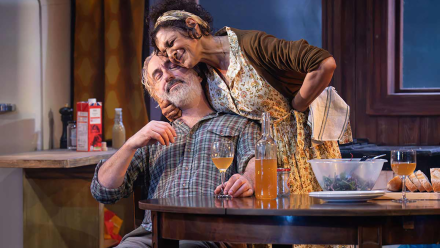
Copenhagen by Michael Frayn is a problem play. It debuted at the National in 1998 and ran for two years in the West End before transferring to Broadway. Since then, no UK producer has mounted a revival. Something must alarm investors. It’s a very chatty show. Three actors with three wooden chairs appear on a plain stage reciting dialogue about a meeting in Denmark in 1941 between the physicist Niels Bohr, his missus, and a family friend, Werner Heisenberg. The discussion focuses on the main developments in atomic science during the 20th century. Mrs Bohr, played by Alex Kingston, is there to offer a female angle on the ruminations of the two mega-nerds.

In defence of museum charges

Arts feature

It occurs to me only now that I might have spent far too much time in France. Indeed, so familiar with Paris did I claim to be that, in 2023, I was contacted by an agency in need of someone who could conduct specialised ‘art tours’ for small groups of foreigners. Most of these clients were Americans, largely from the Midwest, but there was also a number of well-to-do Chinese and the odd Indian. They wanted much the same thing: they’d seen the Eiffel Tower and been ripped off on the Left Bank; they’d eaten at Lipp and some had even bussed out to grottier banlieues to get a real-life taste of La Haine. What they really wanted, however, was someone to hold their hand around the museums.

A Tate show with dreamy, elusive power

Exhibitions

One of the miracles of art history is how painting, so often written off, keeps on coming back. Right now we are in the middle of just such a resurgence, and one sign of the current vitality of the medium is the emergence of painters such as Hurvin Anderson. Admittedly, Anderson – who was born in 1965 – has been emerging for a long time now. But, with the opening of a big retrospective at Tate Britain, his status as a major figure in modern British art is clear. Anderson is completely individual yet visibly connected to the tradition – indeed, to several traditions – and capable of creating huge, wall-filling canvases into which you can sink and float away, but which also make you think and feel.

HBO Max isn’t worth subscribing to

Television

HBO Max is the latest streaming channel trying to lure you into yet another of those £10 a month subscription contracts you only remember having signed up for about three years later when you’re trying to work out why you are so skint. Its showpiece series is The Pitt which attracts ten million viewers per episode and has been called ‘the best medical drama on television in years’. This is a category of excellence I find about as enticing as ‘most amusing form of cancer’ or ‘most ineradicable variety of testicular lice’. But, just for you, I watched to see what the fuss is about.

Don’t blame Kanye for his abject idiocy

The Listener

Grade: C– Kanye? No, I can’t, quite. I will always quietly overlook the idiotic political sensibilities of the conformist millennial legions who comprise our pop charts – the keffiyeh-clad Hamas wannabes, the BLM halfwits, the greenies, the men-can-be-women wankpuffins – in order to let their music be judged on its own merits, free from boomer political disdain. But songs such as ‘Heil Hitler’ and all those swastikas? Well, they are just a stretch too far for me. The man is an abject moron. Some will say, so what? There have been loads of abject morons down the years in pop. Why draw a line in the sand for Kanye West? Good question. And it turns out it’s not his fault.

The National Theatre needs help

Theatre

In The Print is a docudrama about the bitter war between Rupert Murdoch and the unions in the mid-1980s. Murdoch was determined to computerise the production of his UK titles and to terminate the far left’s stranglehold on his business. Daily papers are vulnerable to last-minute strikes and his thieving employees made no secret of their larcenous tactics. The print workers, known as ‘inkies’, earned £1,000 a week for 16 hours’ work and their union, Sogat, behaved like a bunch of racketeers. They laughed at Murdoch by submitting wage claims for employees called ‘Donald Duck’ and ‘Ronald Reagan’. Murdoch fought back with smart, imaginative tactics that Sogat, under Brenda Dean’s leadership, couldn’t handle.

An outstanding Turn of the Screw

Opera

Never let it be said that The Spectator fails to follow up an arts story. Long-term readers will recall that in the edition of 6 March 1711 Joseph Addison investigated the supply of live sparrows for the first production of Handel’s Rinaldo. ‘What, are they to be roasted?’ he asked, reasonably enough. No, they were ‘to enter towards the end of the first Act and to fly about the Stage’. Still, you need to keep an eye on these theatrical types and although there was certainly birdsong in the latest revival of Rinaldo – the end-of-term opera at the Royal Academy of Music – I can report it was recorded. No sparrows were cooked in the making of this opera. Mind you, Handel purists took a bit of a battering.

A hypnotic new adaptation of The Stranger

Cinema

François Ozon’s The Stranger is an adaptation of Albert Camus’ 1942 novel about a clerk who – spoiler alert* – senselessly murders an Arab in broad daylight on a hot Algerian beach. Why did he do it? ‘It was because of the sun’ is all he can suggest. Existential ennui: that’s what’s at play here, which isn’t generally a great draw at the cinema. It would come way down on most people’s lists. But miraculously, Ozon has managed to make a film about boredom without making a boring film. If nothing else, the radiant black and white aesthetic will grab you from the off and then never let go. Visually, it’s divine. The novel – which was published as The Outsider in this country – opens with the line: ‘Mother died today. Or maybe yesterday; I can’t be sure.

A mesmerising new work from English National Ballet

Dance

Crystal Pite is one of a handful of truly original choreographers today, extending the boundaries of her art form without going all doolally about trendy gender issues, AI or neuroscience. She is rooted in something more universal – the tension between conflict and connection, between what draws us together and what keeps us apart. ‘We want to individuate,’ she says. ‘Yet we want to belong.’ Out of this grows Body & Soul, in which individuals fight their way out of great swarms and cocoons, only to be sucked back into an inexorable flow that snakes and stiffens, multiplies and divides.

The truth about artists’ optical aids

Arts feature

The first thing you see on entering this major new Viennese exhibition is not one of Canaletto and his nephew Bernardo Bellotto’s majestic paintings of London, Venice or Vienna, but a camera obscura. The magical art of both artists depended upon this simple but effective device, which exploits pin-hole projection – an optical phenomenon that had been known since antiquity.  The decision to open the show at the Kunsthistorisches Museum with a deceptively boring little wooden box amounts to a curatorial throwing down of the gauntlet. Because – although I find it hard to fathom – there are still art historians and critics out there who refuse to countenance the fact that great artists used optical aids.

The Drama makes no sense

Cinema

The Drama is the latest from Norwegian writer-director Kristoffer Borgli whose films (Sick of Myself, Dream Scenario) always cause a stir, and this is no exception. It stars Hollywood big-hitters Robert Pattinson and Zendaya as a happily engaged couple whose forthcoming wedding may not go ahead after one discovers a disturbing truth about the other. What is this disturbing truth? It would be a spoiler to tell you – even though the details are splashed all over the internet and have already created a backlash. (Don’t look it up. Or do. I’m not your boss.) It is intended to shock but it may not be as shocking as it thinks it is – or even very convincing.

It’s time to redefine what we mean by classic rock

Pop

Classic rock used to be an American radio genre made up of bluesy guitar bands from the past. It spawned Fathers’ Day compilation albums, a magazine and endless lists where ‘Stairway to Heaven’, ‘Bohemian Rhapsody’ and ‘Free Bird’ argued among themselves about which was the public’s favourite. But that’s not classic rock any longer; that’s heritage rock, music by the dead or dying. When the radio format was invented, the bands it celebrated were largely extant, or only recently departed; the oldest of the musicians were not yet 40. Their music was both current and nostalgic because new groups were still nicking from them, and their songs weren’t yet period pieces.

How sure are we that all the Michaelina Wautiers at the RA are by her?

Exhibitions

Roll up, there’s a new old master in town. Or a new old mistress, if you prefer. Michaelina Wautier (1614-89) is revealed here as a painter who excelled within the genres of her time: flower painting, portraiture, emblematic tronies, and, if the scholars are right, classical epic, too. The new Royal Academy show cracks open the received idea of what a Flemish woman operating in the decades immediately after Rubens and Van Dyck could achieve. Her c.1650 self-portrait at the easel is a confident statement. She is enthroned under a mantel of lusciously painted black velvet, which looks restrictive, but emerging from it comes her agile, three-dimensional painting hand. Her beauty is incidental, an aspect of her concentration and skill.

Over-cautious and clumsy: The Downfall of Huw Edwards reviewed

Television

It’s not easy for a drama to be over-cautious and clumsy at the same time. Or to turn a real-life story that shocked (and, let’s face it, titillated) the nation into an oddly flat piece of television. So how did the much-hyped Power: The Downfall of Huw Edwards manage to do both? The answer, I’d suggest, is by failing to interrogate – or even engage much – with its own material. Instead, it opted to simply pass on the facts drawn from its own research, making only the most half-hearted and sometimes contradictory attempts to explain them. The programme began with Edwards (Martin Clunes) in his voice-of the-nation pomp, as he announced the Queen’s death.