Culture

Culture

The good, the bad and the ugly in books, exhibitions, cinema, TV, dance, music, podcasts and theatre.

Acceptable for a hangover day: Fly Me to the Moon reviewed

Cinema

Fly Me to the Moon is a romantic comedy starring Scarlett Johansson and Channing Tatum set during the 1960s space race but, unlike Apollo 11, this isn’t going anywhere we haven’t been before. The extent to which the film does take flight is largely thanks to Johansson’s charisma, even though I couldn’t help shake the feeling they’d fired up a Maserati for a job that basically required a pootle to the shops and back. Tatum, meanwhile, doesn’t have to do much but stand around and look beefy – but he does excel at beefiness. (The shoulders on this fella!) Tatum is 82 per cent shoulders,18 per cent neck. (This is aguess; don’t hold me to it) The film opens in 1969 with Johansson as Kelly Jones, a Madison Avenue marketing genius.

Forget monetary policy, the Bank of England’s greatest crime was architectural

Arts feature

In 1916 the Bank of England committed what Nikolaus Pevsner was to call the greatest architectural crime to befall London in the 20th century. It decided to demolish much of its own building, designed by the great Georgian neoclassical architect John Soane. Soane’s lost masterpiece is the subject of the latest series from the essential architecture podcast About Buildings and Cities. The podcast, started in 2016 by presenters Luke Jones and George Gingell as a hobby, has slowly become a fan-funded staple for architects, offering a re-evaluation of the received wisdoms about the canon and some affable banter along the way. He built a rich ‘internal world’, lit by roof lanterns that crown dramatic vaulted spaces Soane worked on the Bank of England for almost 50 years.

Morally repugnant: Boys From the Blackstuff, at the Garrick Theatre, reviewed

Theatre

Yosser Hughes is regarded as a national treasure. He first appeared in 1982 in Alan Bleasdale’s TV drama, Boys from the Blackstuff, which followed a crew of Liverpool workers who lay tarmac (‘black stuff’) for a living. When their contract expires the lads are left shocked and helpless even though job security is not a perk of their profession. The atmosphere of the show, adapted by James Graham, may come as a surprise to those who know Yosser by reputation only. Far from being a worker’s champion, Yosser is a crook, a hypocrite and a class-traitor. He and his friends moonlight for cash while claiming state benefits, which are, of course, levied on the wages of honest workers. And they pilfer from Liverpool docks which increases the prices paid by customers who aren’t cheats.

If you can stand the stress, The Bear is still possibly the best thing on TV

Television

The Bear has been called ‘the most stressful thing on TV’ and I think that’s probably a fair description. It’s set in a Chicago restaurant and – as has become de rigueur in all films and TV series about restaurants – the kitchen scenes are invariably fraught, jerkily shot, uptight, pent-up, explosive, inflammable, past boiling point, chaotic, horrific and generally conducive to the prevailing notion that while war might be hell it’s an absolute picnic when compared to being a chef. It’s also, if you can bear the stress part, possibly the best thing on TV. At least it has been for the first two series, which have built on that ‘cuisine is hell’ cliché to create a strong, character-driven drama that is often rich, rewarding, moving and surprising.

The mesmerising Olympic posters designed by the likes of Warhol and Whiteread

Exhibitions

You could be forgiven for assuming that the citizens of Paris weren’t exactly bursting with joy at the prospect of this summer’s Olympic Games. They’re annoyed at everything: road closures, public transport price hikes and – would you believe it? – the prospect of their country being taken over by extremist cranks before the month is out.  Bref, or indifference towards the Games is the prevailing attitude – and should you need (flimsy, anecdotal) evidence, I offer you the fact that when I visited an exhibition devoted to the Olympics the day before the first round of voting in the election last week, I had the space entirely to myself. Beyond a single wall down by the Seine, you won’t see the artist posters displayed much around Paris It was a shame.

Complain all you like but Glastonbury has delivered the goods again

Pop

There’s yet to be a Glastonbury line-up that hasn’t provoked a chorus of naysaying. Refrains like ‘looks rubbish. I wouldn’t go’ and ‘not like it used to be’ are de rigueur. Dismissing the headliners as ‘crap this year’ rivals football as the nation’s favourite sport. Yet there’s something to be said for trusting the Glastonbury bookers: check out, say, the lower-tier bands on the 1994 poster and see how many greats they discovered before they were famous – Radiohead, Pulp, Oasis... Nowhere else in the world could hand written signs for toilets induce a Proustian yearning to return Glastonbury’s prestige and legendary ‘vibe’ are now such that the festival is bigger than any of the artists playing there.

Camila Cabello’s new album presents an existential threat to songwriting

Pop

It is always interesting to observe the ways in which pop stars try to negotiate first growing up, and then growing old. From teen scream to respected mainstay to elder states(wo)man is not an easy path to walk without a few stumbles. At certain times, it requires making some blatantly strategic moves. Cabello wants so badly to grow up that she evolves from a past incarnation practically into thin air Few readers will remember that the first solo single George Michael released after dissolving Wham! was called ‘I Want Your Sex’, a forgettable bump-and-grind with a steamy video designed purely to shift audience expectations away from all things teenybopper and towards a more adult-orientated market. The song was banned by the BBC during daylight hours.

Buy this for Beethoven’s beguiling arrangements of British folk songs

The Listener

Grade: B+ Beethoven was proud of his Triple Concerto for Violin, Cello, Piano, pointing out that no one else had attempted such an experiment. He was writing at the height of his youthful powers and the work is stuffed with earworms. Yet I can’t think of any later composers who copied that particular model, and you can’t blame them. This is essentially a concerto for piano trio and full orchestra – not an easy combination, because the soloists keep having to pass the baton to each other while bracing themselves for the next orchestral tutti. Nicola Benedetti, Sheku Kanneh-Mason and Benjamin Grosvenor make a really good job of it; Kanneh-Mason’s cello glows as memorably as it did in his Elgar Cello Concerto.

How we became addicted to vaping

Radio

For those of us with a poor grasp of time, who can still recall when a night at the pub could be sharply revisited by a Proustian wave of stale smoke arising from yesterday’s clothes, it can almost feel as if vaping crept up on us out of nowhere. One moment, it seemed, all the authorities had firmly agreed that Nick O’Teen was a creepy pusher hooking innocent kids on gaspers, and were pledging to legislate and tax cigarettes into oblivion; the next, great hordes of schoolchildren were apparently free to suck constantly on little vials of liquid nicotine with sugar-rush names such as Cherry Fizzle and Blue Razz Lemonade. What happened?

Sly, sexy and smart: The Nature of Love reviewed

Cinema

The Nature of Love is a French-Canadian film about an academic who considers herself happily married but then encounters a builder and sparks fly. I’ve made it sound like one of those Confessions... films, or an airport novel, but it isn’t. It’s sly, sexy and smart and, even though it’s billed as a romantic comedy and skips along nicely, it also asks some important questions, such as: once a relationship becomes humdrum has it moved to a deeper plane? Or is that the lie we tell ourselves? To compensate? Written and directed by Monia Chokri, the film stars Magalie Lépine Blondeau as Sophia who, like Glenn Powell’s character in Richard Linklater’s Hit Man, is a philosophy professor.

The art of Japanese woodblock printing

Arts feature

Van Gogh owned a copy of Utagawa Kunisada’s woodblock print of the ‘Yoshiwara Poet Omatsu’ (1861), which is currently on display at the Watts Gallery. It depicts the poetess who rose from humble origins in an elegant kimono at her dressing table and was part of Kunisada’s series of paintings titled Biographies of Famous Women, Ancient and Modern, but Van Gogh may not have known that. By the time he started amassing Japanese prints – he splurged on 600 of them in the winter of 1886 – they had become collectibles sought after by avant-garde artists for their clear lines, bright colours and the immediacy of their cropped figure compositions anticipating photography.

‘Zings off the stage’: My Fair Lady, at Leeds Playhouse, reviewed

Opera

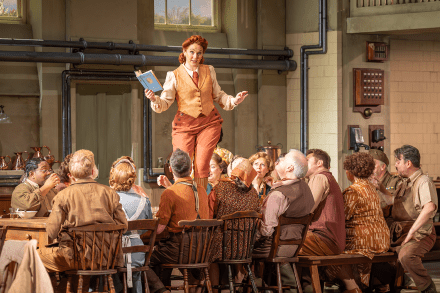
If you want to kill a musical, make it into a movie. Cats, Phantom of the Opera, South Pacific… cinema history is littered with dud remakes of world-conquering theatrical sensations. But it’s almost worse when a film musical succeeds on its own terms, and – like a mask eating into the face – proceeds to write over the original show in the collective memory. I once saw a newspaper describe a West End revival of The Sound of Music as a ‘stage version of the classic movie’, which is a bit like describing Pride and Prejudice as a novelisation of the hit BBC drama. Her coloratura is like sunlight on water.

Can Douglas Is Cancelled hold its nerve?

Television

Like many sitcoms, W1A featured a middle-aged man convinced that he’s the only sane person left in the world. Usually, of course, this merely goes to show how delusional the bloke is – but the subversive twist here was that Ian Fletcher, the BBC’s head of values, seemed to be right. Playing Ian, Hugh Bonneville therefore spent much of his screentime radiating a bemused dismay at the madness around him. The only question is whether the show will hold its nerve or whether Douglas will prove toxic after all Now, as the main character in the comedy drama Douglas Is Cancelled, Bonneville is at it again.

Cowboys and clichés: Horizon – An American Saga reviewed

Cinema

Horizon: An American Saga is a Western directed by Kevin Costner. It also stars Kevin Costner and is co-written by Kevin Costner and has been bankrolled by Kevin Costner – so if it’s Kevin Costner you’re after, happy days. This is Chapter One, and there are three more chapters to come, so even though it’s a whopping three hours long it’s only a quarter of a film. Sienna Miller doesn’t get to do much except look golden. She deserves better, I think Now I have to say something positive about it because, you know, Costner re-mortgaged his house to fund it and everything. Sienna Miller is a positive. I liked the way that, even when her character was under extreme duress (in 1856), she still looked like she’d just come from an appointment at Toni & Guy.

The genius of Frederick Ashton

Dance

To defend my case that Frederick Ashton ought to be acknowledged as one of the major artistic geniuses of the last century, I would adduce three crucial pieces of evidence, garnered from the Royal Ballet’s ‘Ashton Celebrated’ festival at Covent Garden this month. Oberon and Titania’s love is an open contest between two unyielding wills: it can’t be danced gently The first is ‘Les Rendezvous’, dating from 1933 and one of his earliest enduring creations. Set in a Victorian park in which some harmless young people meet to flirt and circulate, it provides an object lesson in how to make something supremely but unaffectedly stylish out of a wafer-thin premise.

‘Punishingly dull – but the crowd loved it’: Next to Normal, at Wyndham’s Theatre, reviewed

Theatre

The Constituent is a larky show about violence against female politicians. A strange subject for a comedy. Anna Maxwell Martin plays a vapid but well-meaning MP, Monica, who receives unwelcome attention from a sinister dropout, named Alec (played by James Corden). Alec’s backstory is quite a puzzle. He used to work as an MI6 spymaster in Afghanistan, where he persuaded senior Taliban commanders to operate as double agents. While off-duty he seduced an NHS ward sister who happened to be nursing soldiers on the battlefield in Kandahar. If you want a celebration of spineless masculinity, look no further That, at least, is the story he gives Monica. Alec says he married the nurse but they split up after having kids. Then he started job-hunting.

‘Left me stunningly bored’: Brat, by Charli XCX, reviewed

The Listener

Grade: C I don’t doubt the ingenuity. The mastery of a technology which now exists as a substitute for melody, heart, soul, rhythm and meaning. I get the manifesto, too – a pop music that in a certain shallow sense reflects the modern predilection for meta-fiction: novels which mash up all the genres, so that your detective story suddenly becomes magic realism and a little later, sci-fi. I understand, too, that this is probably the closest our Gen Zers have to a music which they can call their own, given that the technology required to produce it would cause an embolism in a Gen X listener or a Boomer. So I get all that. The trouble is, what if, when all is said and done, it’s basically rubbish?

Meet the musicians trying to revive French-language pop 

Arts feature

The other day, I went to see a nouveau riot-girl band called Claire Dance play in a disused factory in Bagnolet on the edge of Paris. They were great: the kind of sonic kick in the nuts I’d been waiting more than a decade for an all-female band to deliver. I half-wondered whether it was just my own imperfect command of French that left me clueless as to their message. ‘C’était tout een eenglish,’ came the response from the guitarist afterwards. How come they never considered accompanying such emotionally charged music with lyrics in their mother tongue? ‘It’s considered cringe,’ she replied. ‘We only like English music.

Riveting and exhilarating: Miss Julie, at Park90, reviewed

Theatre

Some Demon by Laura Waldren is a gem of a play that examines the techniques of manipulation and bullying practised by shrinks on anorexics. The setting is an NHS referral unit where Sam, an 18-year-old philosophy student, arrives with a minor eating disorder. Like every patient, Sam is told that her personality is immersed in a civil war and that two implacable forces – the ‘diseased self’ and the ‘whole self’ – are fighting for control of her destiny. It’s a brilliantly simple trick that any bully can learn in a few minutes. If the patient says something unwelcome, the shrink ascribes the statement to the ‘diseased self’ and adds: ‘I don’t negotiate with the disease.

Why you should never watch sci-fi series on streaming channels

Television

Jason Dessen, the hero (and, as you’ll discover shortly, anti-hero) of Apple TV’s latest sci-fi caper Dark Matter, is a physics professor at a second-rate university in Chicago. You can tell he’s not that good at his job because he introduces the concept of Schrödinger’s cat (surely the only interesting bit in the entirety of physics) five minutes before the end of a lecture. ‘Oh and the cat dies,’ he says to the uninterested students as they file hurriedly out of class. With no time constraint, sci-fi series on streaming channels can keep spinning you along for all eternity Still, at least he’s happy. His teenage son might have been genetically engineered to fit the phrase ‘but he’s a great kid’ and his hot wife Daniela is beyond perfect.

The most original sea painter since Turner? Lowry

Exhibitions

In 1958 an elderly gentleman staying at the Castle Hotel in Berwick-upon-Tweed gave the receptionist a doodle he had made on the hotel’s notepaper. She kept it in a box and 43 years later, on the advice of Antiques Roadshow, sold it at auction for £8,000. ‘I don’t think anyone since Turner has looked at the sea with such an original eye’ A contemporary photograph shows that gentleman in his trademark trilby, dark suit and tie – no casual wear for L.S. Lowry – standing on the pier with Berwick in the background. Lowry (1887-1976) is not best known for his paintings of the sea, but there are 21 – including the receptionist’s sketch – in this interesting little exhibition in the Northumbrian town which he regular visited, and they cast him in an unaccustomed light.

Does it matter how posh pop stars are?

Pop

‘A working class hero is something to be.’ Rishi Sunak and Keir Starmer must have missed the conflicted, sardonic edge to John Lennon’s lyric, from his 1970 song ‘Working Class Hero’, given their rush to scrub away the whiff of privilege in the crudest manner imaginable. Sunak, desperately, by means of bemoaning a childhood forever blighted by lack of access to satellite TV; Starmer by dully hammering home that he is the son of a toolmaker. A country pile, a double-barrelled girlfriend and a mock-regal drawl were valued plunder in 1960s pop As in politics, so in music. In both fields, class anxiety has become inverted. The fear now is to appear too privileged. It wasn’t always thus.

Rushdie on how the best magical realism transcends fantasy

Radio

Ask the man in the street to quote a line from one of Salman Rushdie’s novels, and he might struggle. Ask him whether he’s heard the phrase, ‘Naughty but nice’, specifically in the context of cream cakes, and you will probably make his day. It was Salman Rushdie who came up with that slogan in his early career as an adman. Remember the ‘irresistibubble’ tag for Aero chocolate bars? He was responsible for that, too. ‘I feel at bottom that I’m still that boy from Bombay and everything else has been piled on top of that’ If there’s any embarrassment on Rushdie’s part (and why should there be?) that some of his best-known words are from the sides of buses, it was undetectable as he sat down with John Wilson on This Cultural Life last week.

A sugar rush for the eyes: Glyndebourne’s The Merry Widow reviewed

Opera

In 1905, shortly before the world première of The Merry Widow, the Viennese theatre manager Wilhelm Karczag got cold feet and tried to pull it. He offered Franz Lehar hard cash to withdraw the score, and when that failed, he rushed it on under-rehearsed, using second-hand sets from an older show. Or so the story goes anyway. Karczag couldn’t know that within a decade The Merry Widow would become the most successful piece of musical theatre in human history up to that point: an all-conquering global brand that gave its name to hats, corsets, cigarettes and a rather nice cocktail (equal measures gin and vermouth, splashed with absinthe, Bénédictine and bitters, in case you’re curious). In the 1920s an American firm even marketed Merry Widow condoms.

Stylish and potent: The Bikeriders reviewed

Cinema

Jeff Nichols’s The Bikeriders is based on the book by photojournalist Danny Lyon, first published in 1968, about his years embedded with a lawless motorcycle gang in Chicago. Nichols (Take Shelter, Mud, Loving) has imposed a fictional narrative arc and while it’s bogus in some respects and the arc quite familiar to anyone acquainted with stories about male subcultures – the fatal flaw of loyalty etc – it is well-crafted, stylish, has some potent scenes and a fantastic cast. The film stars Tom Hardy, Austin Butler and Jodie Comer, who manages to wipe the floor with both of them.

‘I want every production I do to be the funniest’: an interview with Cal McCrystal

Arts feature

There are certain things that you don’t expect at the opera. Laughter, for example. Proper laughter, that is; not the knowing sort that ripples politely across the auditorium five seconds after the punchline appears in the surtitles. We’re talking unconstrained laughter; laughter that gives you an endorphin rush and sends you straight online to tell your friends that they must see the show. But that’s Cal McCrystal’s whole business. He’s the director who devised James Corden’s delirious plate-spinning capers in the National Theatre’s One Man, Two Guvnors and whose face (in motion-capture) provided the elastic expressions of a small Peruvian bear in Paddington. ‘I want every production I do to be the funniest I’ve ever done.