Culture

Culture

The good, the bad and the ugly in books, exhibitions, cinema, TV, dance, music, podcasts and theatre.

Shared Opinion | 31 October 2009

Columns

Watch what you say. There may be people around who haven’t really been listening ‘Say what you like about servicemen amputees,’ said the comedian Jimmy Carr on stage last week, ‘but we’re going to have a f–—g good paralympic team in 2012.’ Odd to see Patrick Mercer, of all people, calling on him to resign. From what, though? From leaving the house? Maybe Mercer thought this self-employed stand-up comedian was somebody else. Some sort of junior minister for Agriculture and Fisheries, perhaps. Scottish, obviously, with a name like Jimmy. Maybe one of those fat ones who used to hang around with Michael Martin, who all have faces like sanctimonious haemorrhoids. ‘He said what? Well, he should bloody resign. Like I had to.

Lovers in the Levant

More from Arts

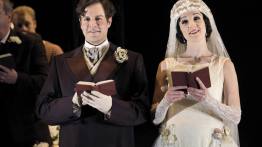
Twelfth Night Courtyard Theatre, Stratford-upon-Avon It’s a welcome refreshment after the RSC’s recent dramatisations of hard drinking and mass starvation in Russia to be landed on the sun-soaked coast of Mediterranean Illyria, and especially so in the company of a new and exquisitely beguiling Viola. Director Gregory Doran has been to much scholarly trouble in updating Shakespeare’s pirate-infested Illyria to Byron’s Albania. There, when visiting the court of a notorious warlord, Byron rhapsodised ‘The Turk, the Greek, the Albanian and the Moor/ Here mingled in their many-hued array’. Doubtless there were atrocities enough around the corner, but Doran has always been strong on devising exotic Mediterranean settings for Shakespeare’s comedies.

Troubled Wexford

More from Arts

The new Wexford Opera House has certainly raised the profile of opera in Ireland. You cannot argue with a prize-winning building that is one of just four large purpose-built opera auditoriums in these islands, alongside Glyndebourne, Covent Garden and the Wales Millennium Centre. Built with Irish taxpayers’ money, it would be a sick Irish joke to mothball the place within a year of its grand successful opening. Yet the Wexford Festival’s obsession with traditional dress-code (black tie, long frocks) adds to the feeling that opera belongs to a class with alien tastes. Meanwhile, even the Abbey Theatre — which scoffs the lion’s share of Irish performing-arts subsidy — has no permanent ensemble.

Pillow talk

More from Arts

Wonderland: The British in Bed (BBC2, Thursday) consists of long periods of boredom interrupted by moments of extreme embarrassment. The notion is to get couples — old, young, black, Sikh, gay — to sit up in bed next to each other, in nighties and jimjams, and talk about their lives as partners. Presumably, the notion is that in these relaxed circumstances, even with a camera crew at the foot of the bed, they will be inclined to tell us all. But they don’t. For a start, they hardly talk about sex, except in the most general way. The fact that they’re in bed, accompanied only by a cameraman, a soundman, a director and a battery of lights, doesn’t lead them to say things like, ‘But what really gets me going is when he...

In love with Hamlet, Dylan, Keats . . .

More from Arts

Ben Whishaw sits unrecognised, wearing a black T-shirt and drinking red wine in a dark corner of the Royal Court’s café. He has just come off stage from rehearsing Mike Bartlett’s new play Cock — in which he plays a chap who takes a break from his boyfriend and accidentally meets the girl of his dreams — and he’s still all buzzed up. I had been warned that giving interviews isn’t Whishaw’s favourite occupation. But it certainly doesn’t show here. There’s no sulkiness or distractedness on his part. Perhaps his recent jaunt around the US, to promote his hotly tipped performance as John Keats in the film Bright Star, has acclimatised him to the rigours and demands of a celebrated life.

Starry night

More from Arts

The Rise and Fall of Little Voice Vaudeville Life is a Dream Donmar Midnight in a northern slum. The pubs have closed and a boozy, blousy, past-it single mum is trying to seduce a handsome young talent scout. He deters her advances until he hears her teenage daughter, alone in her bedroom, singing jazz classics. The girl is an undiscovered star who can impersonate all the great 20th-century divas, Ella, Edith, Shirley, Dusty, Lulu. The talent scout decides to launch her career and prise her from the clutches of her bullying, drunken mother. Jim Cartwright’s 1992 play is an ingenious comic update of Cinderella. From the producer’s point of view it’s supremely difficult to revive.

Innocence betrayed

More from Arts

An Education 12A, Nationwide An Education is based on the memoir by the journalist and interviewer Lynn Barber, with a screenplay by Nick Hornby, and, although the word from all the various festivals has been that it is wonderful, I know you will not believe it unless you hear it from me so here you are: it is wonderful. I am even hoping that now we’ve had the book and the film it isn’t the end of Ms Barber spin-offs, and that there may be a dedicated theme park or, failing that, at least an action doll. I don’t know what form it would take exactly, but would expect it to really kick butt, and probably smoke quite a lot.

Always a Luddite

More from Arts

I have just inherited my College’s collection of long-playing records, now redundant, with permission to retain, give away, otherwise dispose of if and as possible. I have just inherited my College’s collection of long-playing records, now redundant, with permission to retain, give away, otherwise dispose of if and as possible. The cumbrous piles, gradually easing into categories, have littered my rooms all summer; their dispersal is piecemeal and slow. Put together with love and knowledge from the late-Sixties on, the collection eventually totalled some 300 records. But are they so redundant? Though the universal triumph of the CD has swept away the LP as surely as the LP superseded the 78 rpm, the jury has crept back to reconsider questions of quality and fidelity.

Children in need

More from Arts

‘I want people to feel quite shocked,’ said Professor Tanya Byron in her opening lecture for Radio Three’s annual Free Thinking festival. ‘I want people to feel quite shocked,’ said Professor Tanya Byron in her opening lecture for Radio Three’s annual Free Thinking festival. This year’s theme is the 21st-century family and Byron, the clinical psychologist and presenter of the television series The House of Tiny Tearaways, was addressing an audience in Gateshead where this year’s festival is based. The purpose of ‘free thinking’ is to focus on a subject and take it to its extremes, in the hope that some creative ideas might emerge.

Museological capriccio

Arts feature

There are not many palazzi in Florence still occupied by their original families. There are not many palazzi in Florence still occupied by their original families. Some, like the Medici, Pitti and Corsi-Horne, have become museums, while others, like the Ciofi-Giacometti — now the five-star Relais Santa Croce — have become hotels. ‘Make do and mend’ is a basic Florentine motto: why build a museum when you can convert an old palazzo, town hall (Palazzo Vecchio), magistrates offices (Uffizi), police station (Bargello) or granary (Orsanmichele)?

Shock and awe | 24 October 2009

More from Arts

In the Spirit of Diaghilev Sadler’s Wells Inbal Pinto & Avshalom Pollak Dance Company: Hydra Queen Elizabeth Hall In a dance world asphyxiated by a lack of inventiveness, it is refreshing to be confronted by creations that can still provoke, shock and amuse. This is the case with Javier De Frutos’s Eternal Damnation to Sancho and Sanchez, premièred last week at Sadler’s Wells amid audible and visible signs of disapproval and approval. Regarded by some as a gratuitously offensive publicity-seeking stunt, the work is more than a mere succès de scandale.

Crime watch

More from Arts

Oh. My. God. Can it really be, like, 16 years since it was 1993? I very much fear it can and the reason the thought is so bothersome is that I remember thinking, even back then, ‘Blimey, I really am getting on a bit. Can’t do pills nearly as often as I used to. The yawning grave beckons. Etc.’ This all came back to me while watching Murderland (ITV1, Monday) in which Robbie Coltrane plays someone a bit like Fitz from Cracker — only with most of the vices (drinking, chain-smoking, gambling) removed. Coltrane has denied there’s any connection, pointing out that this new character is a detective, not a criminal psychologist, and that the new series is more multiple-viewpoint psycho-drama than police procedural.

The case for the defence

More from Arts

The past ten years have been peculiar times for the arts. Under the Labour government pots of money were thrown at culture. But strings came with this funding, requiring art to serve political ends. While there has been cash it has been less for culture and more for schemes promoting social inclusion, community issues and urban renewal. Rather than rebel against these demands the Arts Council has been at the vanguard. As a consequence, artists needing support have had to jump through hoops asking more about their sexual identity than about the art form. This has contributed to high-profile failures, as the purpose of projects became disorientated.

Lovelorn masterclass

More from Arts

Werther; The Adventures of Mr Broucek Opera North The Truth about Love Linbury Studio Massenet’s Werther is a tricky opera, in fact may well not be susceptible of more than a production which leaves you feeling that you could easily live with its not very numerous highlights. One of its chief problems is highlighted in Gerald Larner’s incisive notes to the new Opera North production: ‘The problem with a Werther opera is that no libretto, unless it completely traduces Goethe’s original, can compensate for the obvious disadvantage that, because Charlotte is either engaged or married to Albert and is determined to give Werther no encouragement, there can be no mutual declaration of love, no full-scale duet for the two protagonists.

Living in the moment

More from Arts

Frank Auerbach (born 1931) is flavour of the month. A museum exhibition of his early paintings has opened at the Courtauld (until 17 January 2010), a substantial monograph by William Feaver has just been published (Rizzoli, £100) and a commercial show of recent paintings at Marlborough Fine Art runs until 24 October. Meanwhile, the notoriously retiring and work-obsessed artist has been seen at Private Views and has even granted one or two interviews. Does this mean that Auerbach is relaxing the habits of a lifetime? Not really. He still works seven days and five evenings a week, gets up extremely early and puts in long hours in the same smallish studio he has occupied since 1954.

Celebrating extremes

More from Arts

Robert Mapplethorpe: A Season in Hell Alison Jacques Gallery, 16-18 Berners Street, London W1, until 21 November Robert Mapplethorpe’s 1985 self-portrait with little devil’s horns is one of the most instantly recognisable self-portraits in modern photography. Short-haired and cherubically handsome, his face turns back to the camera, an inappropriately appealing daemon, complete with a ‘devil-be-damned’ look in his eye. It’s half full of wit, half haunted by an almost childlike vulnerability. It’s one of three brilliant self-portraits here in this retrospective, A Season in Hell, which takes its title from Mapplethorpe’s photographs of 1986 which he produced for a new translation of Rimbaud’s poem.

Ready for anything

Arts feature

Henrietta Bredin talks to Simon McBurney about his latest challenge: doing Beckett for the first time I am standing in Simon McBurney’s kitchen, discussing pigs (he’s not only kept them but also slaughtered them, butchered them and made over 20 different sorts of salami), memory and language (both capacious and exact in his case), watching him brew coffee (freshly ground, delectably strong), grill toast and spread marmalade (home-made, dark and delicious) and realising that his insatiably curious intellect, his grace and economy of movement are as compelling in a domestic setting as they are on stage.

Crash, bang, wallop

More from Arts

The Power of Yes Lyttelton My Real War 1914–? Trafalgar Studios Here comes Hare. And he’s got the answer to the credit crunch. His energetic, well-researched and richly informative new work opens with an actor playing the writer himself (curious frown, Hush Puppies) as he sets out to discover why the markets jumped off a ledge last autumn. The result is less a play and more a commission of inquiry. Over many a lingering lunch Hare has leaned his inquisitive ear towards senior bankers, top journalists and leading economists. He then distilled their testimony into this fact-crammed pageant. The City’s major players saunter across the Lyttelton stage, their silk-lined suits softly whistling, to deliver gobbets of wisdom and insight. Gradually, the picture takes shape.

Moving pictures

More from Arts

Dance Umbrella Cloud Gate Theatre of Taiwan, Barbican Theatre Cabane P3, University of Westminster Cloud Gate Theatre of Taiwan is not new to the UK dance scene. Yet, as stressed in an inflated, self- celebratory programme note, Wind Shadow marks a neat move away from the performance formulae seen in their previous productions. Created in 2006 by Lin Hwai-Min in collaboration with the visual artist Cai Guo-Qiang — who played a significant role in the opening and closing ceremonies of the 2008 Olympics — the work strives to be an example of ‘moving installation art’. As such, it comes across as a series of moving pictures that both surprise and shock the viewer with moments of incomparable lyricism and powerfully unsettling imagery.

Ferocious fauna

More from Arts

Two things puzzle me about vegetarians. Whenever they come to visit us, we always provide a vegetarian dish for them. But if you go to a vegetarian’s home, no one says, ‘I know you won’t like this lentil and halloumi lasagne, so we’ve cooked you steak and chips.’ Never. As for those who don’t eat meat on moral grounds, what’s their response to those animals who eat their comrades in the struggle against oppression? And they don’t mess around with battery farming either. Life (BBC1, Monday) had some of the most powerful images of ferocious fauna that have ever appeared on our screens.

Mixed message

More from Arts

Turner and the Masters Tate Britain, until 31 January 2010 Professor David Solkin, this exhibition’s curator, opens his introductory chapter in the catalogue (a substantial tome, packed with scholarly exegesis, special exhibition price £19.99 in paperback) in the following way:  The first 15 words of that quote should be emblazoned over the lintel of every art school in the land, though it would mean that the teachers therein would have to be capable of demonstrating its truth; tragically, I’m not convinced that many of them are capable of doing so.

Best place to be

More from Arts

Someone somewhere recently asked me in a public forum whether I would prefer to be a singer, the conductor or a member of the audience at the concerts we give. He himself was of the opinion that he would rather be a singer, saying that the music we do is so complicated that only someone on the inside of it can appreciate exactly what the composer has achieved. If he’s right, the audience don’t stand a chance. I rushed to my own defence, saying that the guy out front has the best of all worlds, as one would expect if he is to control the performance. He is receiving the sound without distortion, so placed that the voices will come to him equally strongly.

Yiddish vitality

More from Arts

Schmooze, schlep, schlock — all words that have such an evocative, onomatopoeic meaning and all from Yiddish, a language without a country, an army or a navy, which refuses to die even after one-third of its native speakers were annihilated by the Nazis. Schmooze, schlep, schlock — all words that have such an evocative, onomatopoeic meaning and all from Yiddish, a language without a country, an army or a navy, which refuses to die even after one-third of its native speakers were annihilated by the Nazis.

Sinking morale

More from Arts

The Royal Horticultural Society is like the Church of England. It seems always to have been there, a fixed, reassuring point in a changing world. Even to those who do not belong to it, it seems a Good Thing and it is hard to imagine national life without it. Among those who know it, it inspires affection and exasperation in about equal measure and, like the C of E, it is troubled. In early September, the director-general of the RHS, Inga Grimsey, suddenly resigned and will leave next January. The resulting media attention alerted the world to the fact that the directorate was halfway through a ‘restructure’, cutting 10 per cent of salary costs, a loss equivalent to 80 full-time posts.

Sunday Evening Country: The Louvin Brothers

Elvis Presley once said that the Louvin Brothers were his favourite country musicians. But he nver recorded one of their songs. Perhaps because, like almost everyone else who ever had any dealings with the Alabama-born and raised brothers, he'd been cussed out by Ira Louvin.  Charlie said that his elder brother was all kinds of messed up by religion. Perhaps. But whether they were singing gospel, traditional murder ballads or their own compositions there were few better examples of harmony singing than Ira and Charlie Louvin. Here they are performing I Can't Keep You in Love With Me. Which was, for Ira anyway, kinda true: after he tried to strangle his third wife with a telephone cord, she shot him five times with a .22 pistol.