Olivia Cole

Farewell to the Calloways: See You on the Other Side, by Jay McInerney, reviewed

From our UK edition

Many of Jay McInerney’s characters had their glory days in the 1980s and 1990s of his vivid early novels, with all of the excesses and freedoms that he captured, most famously in his 1984 debut Bright Lights, Big City. As familiar as New York’s landmarks and favourite haunts remain, the city of 2020 can seem a bewildering landscape for his creations, even before the darkened lights of the pandemic. The Calloways are the literary ‘It couple’ about whom McInerney first wrote in the elegiac Brightness Falls (1992). Now, in See You on the Other Side, friends and acquaintances get hit by #MeToo with the kind of randomness reserved for corked wine or a careless investment.
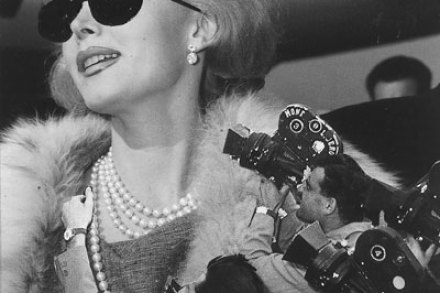
A life among movie stars can damage your health

From our UK edition

Mothers of America             let your kids go to the movies! get them out of the house so they won’t know what you’re up to it’s true that fresh air is good for the body                               but what about the soul that grows in darkness, embossed by silvery             images... So wrote Frank O’Hara in ‘Ave Maria’, in 1964.

Seeking forgiveness for gluttony, sloth and other deadly sins

From our UK edition

Professor Guy Leschziner writes that he was raised in a secular household that was ‘entirely irreligious’ yet with ‘a strong sense of morality, of right and wrong’. As an eminent neurologist and a rational atheist, it’s striking that his study of the extremes of human behaviour should reach for such Biblical terms. Is there an element of ghoulishness here? Seven Deadly Sins has a structure of which David Fincher, director of the gruesome film Seven, might approve.  To zero in on the sins is undoubtedly a darkly entertaining approach, if not for the squeamish. Having been a consultant at Guy’s hospital for more than 25 years, Leschziner has seen ‘the full spectrum of human morality’: inexplicable altruism, generosity, kindness, love.

Unrecorded lives: Tell Me Everything, by Elizabeth Strout, reviewed

From our UK edition

There was a time when Elizabeth Strout’s fans had to wait a few years for the next book; but Tell Me Everything follows fast on her two previous novels – part of what she has termed a ‘marathon’ of writing in her sixties. It has been an extraordinary creative flowering: a diverting pleasure for admirers of her psychological perceptiveness and her ability to transport us instantly to Crosby, her fictional town in contemporary Maine. Strout once described her characters as rolls of fabric, with her novels as her patterns to cut out. Much material is used in each novel, yet there is a lot of spare, too. It’s the fullness of these characters and their inner lives that give her work its depth.

On the Yeats trail in Galway

From our UK edition

The Go Galway bus from Dublin sounds an unlikely pleasure, but it is both comfortable and punctual. There is free Wi-Fi if you want it, but it would be criminal to do anything other than gawp at the view. Two and a half hours pass quickly when you are travelling at sunset, passing between rain clouds with rainbows falling out of the sky. While my trip was, as they say, for ‘the craic’ (a good friend’s 40th), I couldn’t come to Galway without making time for a W.B. Yeats pilgrimage. His patron Lady Augusta Gregory had her home near Gort, in the south of the county: Galway is saturated in his poetry; or perhaps I mean his poetry is saturated in Galway. But in the county today, there is both chaotic reverence and wilful disregard.

Paddington Bear talks to Spectator Life about manners, marmalade and Portobello Road

From our UK edition

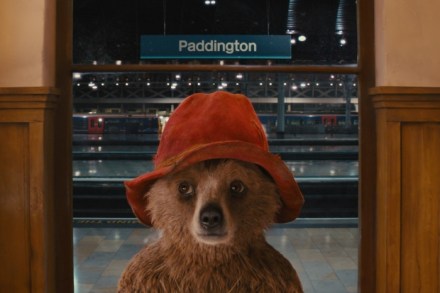
This is an extract from Spectator Life, available with next week's issue of the Spectator: You adapted very well to life in London — were you concerned about how you might get on working in Hollywood? I was rather worried at first, but then I discovered I only had to go as far as Elstree to do my filming, which meant I was able to come home each night to 32 Windsor Gardens. I did offer to go on the bus but I think Mr King was a bit worried I might get lost so they sent a special car to pick me up every day. Spectator Life has heard that film producers can be quite fierce creatures. What advice have you for other animals looking to pursue projects in the film industry? Mr Heyman is a very nice man, so I haven’t had much experience of fierce producers.

‘Artmaking is a drug’ – interview with poet Paul Muldoon

From our UK edition

A fellow festival-goer at the recent Calabash literary festival in Treasure Beach, Jamaica, enjoyed chatting to a gentle Irish poet called Paul. He told her he ‘dabbled’ in poetry, and she was seconds from asking if he was planning on reading any of his work at the open-mike session. When Paul Muldoon, the poet in question, came to give his reading, it was soon quite clear that he is, in fact, a famous poet. He opened with ‘Comeback’, a poem about a washed-up rock band for ever on the brink of their next great hit: ‘We’d pay in cash/For a kilo of Khartoum/And come back to trash/Another hotel room/And make a comeback baby/A comeback don’t you see?/It’s time to make a comeback baby/Come back baby to me.

Editor’s letter

From our UK edition

Ahead of the Scottish referendum in September, and as the country prepares for the Commonwealth Games, Spectator Life caught up with a new generation of fine Scottish actors who seem destined for Hollywood, from Joanna Vanderham, star of The Paradise, to Laura Fraser of Breaking Bad and Richard Madden and Rose Leslie, who you may recognise from Game of Thrones.  We also took the chance to canvass their views on independence. Speaking of new talent, I’m delighted to feature the novel Shotgun Lovesongs by Nickolas Butler, a midwestern story of family, fame and friends. It’s one of my favourites in a long time, and if you are packing for a beach or, like Melissa Kite, a yoga retreat, it’s a must to squeeze into your bag.

Spectator Life: meet the ‘hot Scots’ with fiery views on independence

From our UK edition

Ahead of the referendum in September, and as the country prepares for the Commonwealth Games, the spring issue of Spectator Life has a distinctly Scottish theme. In the spirit of Gerard Butler, Ewan McGregor, and James McAvoy, in what we affectionately term our ‘hot Scots’ feature, we put a spotlight on a new generation of Scottish actors who seem destined for equally great things, from Joanna Vanderham, star of The Paradise and the recent Henry James adaptation What Maisie Knew, to Laura Fraser of Breaking Bad and Richard Madden and Rose Leslie, who you may recognise from Game of Thrones. Also featured is Chloe Pirrie who first caught my eye at the Moët BIFAS – the indie equivalent of the BAFTAS – where she won the prestigious newcomer award.

Introducing Spectator Life Spring 2014

From our UK edition

From Homeland to Game of Thrones and House of Cards, it’s an observation often made that we’re in a golden age of television. If there's a TV renaissance afoot, and a renewed appreciation of what good writing, subtle character development and long form drama can achieve on a small screen, David Hare's Johnny Worricker trilogy, which started in 2011 with Page Eight, is without doubt one of the best things to have been made for British TV in recent years. Our cover star Bill Nighy plays a modern day MI5 agent, and the production has a cast list from Rachel Weisz to Michael Gambon, Christopher Walken, Ralph Fiennes, Helena Bonham-Carter and Winona Ryder, which could only be described as out of the ball park.

Editor’s letter

From our UK edition

The late Anthony Minghella described our cover star, Ralph Fiennes, as a ‘held, slightly unknowable person’. Though I’ve long admired his work, I got to know him a little bit better when we met to talk about The Invisible Woman, his unforgettable account of Dickens’s secret life with his mistress Ellen Ternan. Fiennes both stars and directs, which he terms a ‘brilliant, scary’ feeling.   It’s a strategy that has produced some great American films (last year’s Argo, directed by Ben Affleck, or Clint Eastwood’s Million Dollar Baby, or Robert Redford’s Quiz Show), but it’s a particular pleasure to celebrate a Rada-trained, homegrown talent taking on Hollywood on his own exacting terms.

Introducing Spectator Life Summer 2013

From our UK edition

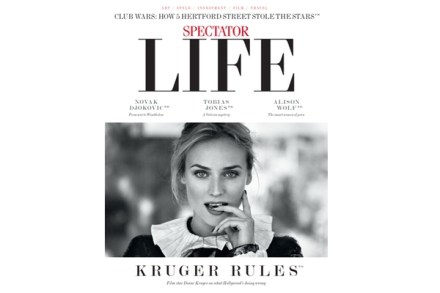
From fashion to festivals, Life's summer issue arrives with your Spectator this week. On our cover this time is the film star Diane Kruger — Helen in Troy, and a scene-stealer in Quentin Tarantino’s Inglourious Basterds. A woman whose talent and sense of style I have long admired, when I met her in New York, she told me in no uncertain terms why Hollywood needs more parts for grown-up women. Kruger's career started as a model in her teens. 'If I thought about my daughter being 15 and saying, "Can I go away and live in Paris?" she reflected, 'I'd be like, "Fucking get to your room and don't leave your room for another year!"' Her feistiness turned me into even more of a fan.

The staircase too scary for Bruce Willis, and other Oscar party stories

From our UK edition

From a wedding to an awards ceremony, no self-respecting Los Angeles beano can take place without endless fixtures around the main event. The Oscars barely get a look in between a clutch of warm-ups and afterparties. The Friday night (Oscar night being Sunday) is traditionally the preserve of the agents, the most high-profile of whom throw open the doors of their Hollywood homes to their clients — and no one else. It was a rarity, then, that at the party given by the super-agent Ari Emanuel, stars (‘Talent’, in the argot) schmoozed and ate macaroni cheese with a certain number of the not-so-famous (‘civilians’). Marooned somewhere between Dustin Hoffman and Wales’s most glamorous export, Catherine Zeta-Jones, I felt horribly conspicuous.

Celebrating extremes

From our UK edition

Robert Mapplethorpe: A Season in Hell Alison Jacques Gallery, 16-18 Berners Street, London W1, until 21 November Robert Mapplethorpe’s 1985 self-portrait with little devil’s horns is one of the most instantly recognisable self-portraits in modern photography. Short-haired and cherubically handsome, his face turns back to the camera, an inappropriately appealing daemon, complete with a ‘devil-be-damned’ look in his eye. It’s half full of wit, half haunted by an almost childlike vulnerability. It’s one of three brilliant self-portraits here in this retrospective, A Season in Hell, which takes its title from Mapplethorpe’s photographs of 1986 which he produced for a new translation of Rimbaud’s poem.

The Spectator’s 40 Poems You Should Know

From our UK edition

That poetry is the "new rock 'n' roll" is an oft-uttered sentiment. But as its power to transport, provoke, console and seduce has been a constant for thousands of years now, I prefer to regard it as the old rock 'n' roll. The original, if you will... And it's in this spirit that we've prepared a festival of poetry for Spectator readers - only you won't need to bring along wellies or a tent. Tomorrow's issue of the magazine - print edition only - launches our special selection of 40 Poems You Should Know.   Picking the 40 entries was a tall order - not because it's hard to find worthy headline acts, but because there are too many to choose from.

Is Oxford voting for a celebrity or a poet?

From our UK edition

People who wouldn’t dream of having anything so trashy as Grazia on the coffee table, who claim not to be the slightest bit interested in the state of Brad and Angelina’s marriage, are often gripped by the seamy, rowdy lives of our poets and writers. They’re a source of glamour and gossip for more high-minded readers. Little wonder then that the gay and confessional poet Carol Ann Duffy said that she thought ‘long and hard’ about stepping on to this crowded stage of literary Brangelinas.

How to put the nation’s pupils off great art for ever

From our UK edition

‘Bathers at Asnières’ is a dreamily double-edged impressionist painting: an idyll as tricksy as the tiny dots, instead of brushstrokes, that Seurat used to paint. Young Parisian workers are stretched out like cats in the sun, or swimming in water so cool that you can almost feel it, and yet in the background the chimneys puff away, calling them back to work. At the National Gallery the other day, I overheard an official gallery guide addressing a heap of near-comatose teenagers: ‘This is a very large painting,’ she said, ‘and it was painted about 100 years ago.

Meet the new eco-toffs: Champagne Swampies

From our UK edition

Olivia Cole says that the row over Heathrow’s third runway has revealed that despite the credit crunch there is a resilient class of celebrities and toffs with expensive green tastes Do you remember Champagne Socialists? Well, there’s a new version of that old clique, with the same curious mix of self-importance and self-indulgence but with a 21st-century green agenda. I call them Champagne Swampies. Swampy was the environmental protestor who became a cult figure in the mid-1990s, huddled in a tunnel by the proposed Newbury bypass, never washing his hair. His 2009 variants, the Champagne Swampies, share his concern for the environment, and they’re out in force at the moment protesting about the proposal for a third runway at Heathrow.

Dancing through danger

From our UK edition

Olivia Cole on Victoria Hislop’s second novel Married to a permanently well-lunched Englishman, Sonia Cameron, the half-Spanish heroine of Victoria Hislop’s second novel The Return, seeks escapism — first in a local dance class (to which she becomes unexpectedly addicted) and, more compellingly, in a chapter of her family history by which she becomes distracted whilst in Granada improving her salsa.

All at sea in Shanghai

From our UK edition

The conquering white male, guiltily plundering, seduced by exoticism and abundance but never quite sure that he’s not just the clueless foreigner being taken for a ride: so we have Tony Parson’s pugnacious hero Bill, clad in his designer suit. He is the ambitious corporate lawyer, billing for every hour he breathes, hoping to ‘make partner’ faster in Shanghai than in London but of course accidentally finding ‘partner’ instead in the form of the alarmingly beautiful but endearingly goofy Li Jin Jin, despite the existence of Becca and Holly, his picture-in-wallet perfect blonde family. The half-enchanted Western writer, of course, treads a well-travelled road, but My Favourite Wife is a very knowing update.