Culture

Culture

The good, the bad and the ugly in books, exhibitions, cinema, TV, dance, music, podcasts and theatre.

Chance encounter

Opera

Is it possible to write a great opera, or a great work of art of any kind, about Auschwitz? One thing is clear: it would have to be truly great. The very idea of a fairly good work, or for that matter a fairly bad one, with such a subject is absurd. And not only absurd, but also revolting. Take Bernhard Schlink’s novel The Reader, which was published to much acclaim 14 years ago, but which was soon seen to be a meretricious concoction by discerning readers, just on account of its attempting to illuminate the Holocaust by relating it to subsequent events and ‘relationships’. The most moving and powerful writing on the subject is Primo Levi’s If This Is a Man, and that is factual and baldly so.

Unrequited love

Theatre

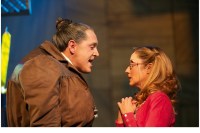
It’s a record breaker. The Trafalgar Studio is staging a rare revival of Christopher Hampton’s breakthrough play, written when he was 18, which made him in 1966 the youngest writer ever to have his work staged in the West End. This record has now stood for so long that it could probably do with a lie-down. The plot, meticulously fashionable and youth-orientated, focuses on an unrequited affair between Ian and his flatmate Jimmy. Hampton’s conception of personality is underdeveloped. And overdeveloped, too. Most of his characters are handsome, vague, middle-class numbskulls, posh little tadpoles wriggling around a cosy pond. But the central character, Ian, is a brilliant study of brooding, adolescent misogyny.

Triple triumph

More from Arts

There is no better way to kick off a new ballet season than with a choreographic triple whammy. Which is what the Royal Ballet did last week, reopening with a sparkling performance of Jewels, Balanchine’s triptych. The last time I saw the company engage with the same three-part work, I lamented its far too poised and somewhat lacking-in-drive approach to Balanchine’s choreography. Things seem to have improved, though, as last week the dancing stood out for its vibrant attack and attention to detail — paramount qualities for the rendition of a work made up of three choreographically and musically different compositions.

Mind the gap | 1 October 2011

Cinema

Ho-hum. Another week, another batch of secret agents, and while I have nothing against secret agents personally — they are generally willing to die for their country, which is nice, although probably quite tiring — The Debt never equals the sum of its parts. It has a blinding cast (Helen Mirren, Tom Wilkinson, Ciarán Hinds) and there are some good things to be said for it but it never fully compels or meshes as the emotionally driven, multilayered, grown-up thriller it yearns to be. Plus, it is certainly in the running for my annual, much uncoveted Most Preposterous Third Act Award.

Eastern promise | 1 October 2011

Radio

Sad to say that none of the ex-pats who were interviewed in India for Home from Home (Radio 4, Friday) talked about missing the BBC. Their removal to the subcontinent from the UK might have left them with a longing for a pint of Guinness, but not a word about Jazzer and the Grundys, Nicky Campbell or even John Humphrys. It was as if British radio had never touched their lives, in spite of growing up here. Hardeep Singh Kohli, the turban-wearing broadcaster with a broad Glasgow accent whose taste for highly spiced food derives from his family ancestry in the Punjab, went in search of British Indians who have gone back to live in India — PIOs as they are known there (People of Indian Origin).

Tale of the unexpected | 1 October 2011

Television

I imagine there is software that helps you write biopics for television. First you pick the childhood from a drop-down menu, selecting [poor but respectable] [very poor] [so poor that all your belongings will fit into a single wheelbarrow which your mother pushes from a grim slum to the nearby hell-hole]. Father deserts family [yes] [no]. Star is determined to make it big but [is sent from one agent to another with mocking laughter in their ears] [meets an impresario who is sceptical at first then turns incredulously to accompanist and says, ‘My God, she’s got something!’]. Then there are the other staples which must be included by law. The trip to the Glasgow Empire, where the previous act has had fruit thrown at them.

Classical affair

Music

Before Stephen Fry walked on to the stage at the Barbican on Monday to take part in a discussion on the place of classical music in today’s society, he asked his Twitter followers to suggest new names for what he sees as an off-putting label, ‘classical’. The replies that flowed in were typically informed and astute: ‘shit, outdated, irrelevant, dead’. ‘This is the scale of the problem we face,’ he lamented. James Rhodes (above), the concert pianist with a knack for shunning the stereotype of the straight-backed, tailcoated performer, put it another way: ‘Walk into HMV (if you can find one), and if you ask for classical music, they shunt you down to the basement like you’ve asked for midget pornography.

A quick journey into nightmare

As our television screens luxuriate again with images of Downton Abbey, one of its cast members is starring in an altogether grittier production in the heart of West London. Last time we saw Kevin Doyle, he was pleading a lung condition to escape being sent to the Battle of the Somme. Here he starts off as another lugubrious chauffer, awakening in an even more chaotic world than that of the Somme, before morphing into the charismatic, careworn but chatty interrogator in the torture cells of a faceless, totalitarian state. The occasion is the first professional revival in London of Harold Pinter’s double-bill, Victoria Station and One for the Road since its opening in 1984.

I know it’s over and it never really began

Teenage obsessions are a strange and terrible thing. How, exactly, does an album - which is, after all, nothing more than a recording of some music - seem to embed itself so completely into our identity? How does it become something so crucially important that we can’t imagine our world without it? With hindsight I feel rather embarrassed about the effect that Nevermind had on me. I was 14 when it came out. Back then, kids were divided into “Moshers” - those who liked rock -  and “Ravers” - those who liked dance music -  and I was, at best, a fledgling mosher flirting with bands like Guns ’n’ Roses to my great, great shame.

Medieval frescoes

Exhibitions

Rome contains many hidden treasures, but the most remarkable of the lot is concealed on the Caelian Hill, above the Colosseum, in the medieval monastery of Santi Quattro Coronati. It’s a cycle of frescoes dating from around 1250. It is extremely rare for painting from this period to survive anywhere, but it’s even rarer in Rome, where the rebuilding of the city by the Counter-Reformation popes destroyed almost all medieval painting. The paintings are in a vast vaulted gothic hall, the walls of which — about 800 square metres of them — were originally completely covered in frescoes. About half the original paintings remain: an earthquake, and the construction of additional windows, have destroyed the rest.

Going private

Exhibitions

One of the greatest Renaissance paintings remaining in private hands, Hans Holbein the Younger’s ‘The Darmstadt Madonna’, was sold discreetly this summer. It was not offered at auction but sold by private treaty sale — auction-speak for a negotiated private sale rather than a public auction — in a deal brokered by the art consultant and former head of Sotheby’s Germany, Dr Christoph Graf Douglas. This seminal panel painting, begun in 1526, was commissioned by Jakob Meyer zum Hasen, Mayor of Basel, who is portrayed alongside his family praying at the feet of the Virgin and sheltered by her cloak. It is the artist’s first major altarpiece to represent a new and Italianate form of ideal beauty.

‘An obsolete romantic’

Exhibitions

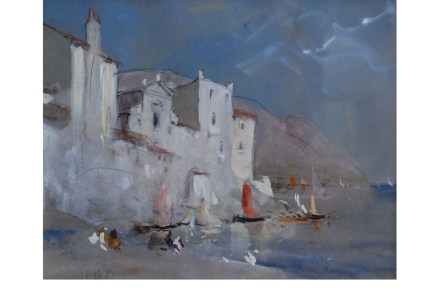
In 1982 Sven Berlin placed a sealed wallet labelled ‘Testament’ on top of a rafter in his studio with instructions for it not to be opened before his 100th birthday on 14 September 2011. Inside was a key to the identities of the characters in his notorious roman à clef about post-war St Ives, The Dark Monarch, published 20 years earlier and immediately withdrawn after four of those characters sued for libel. None of them was a major artistic figure and by today’s standards the libels were laughable, but Berlin’s exposure of the petty politics behind the St Ives idyll — which he later compared to ‘going for a bathe and swimming into a shoal of barracudas’ — caused permanent damage to his artistic career.

The Wiki Man: Bring back the madcaps

The Wiki Man

I recently watched another one of those delightfully obscure BBC4 archive documentaries. This one was called Bristol on Film. I like archival film footage for what it reveals unintentionally: the incidental details which have nothing to do with the film-maker’s original intent, but which 60 years later reveal how profoundly the world has changed. Like the sign once glimpsed in 1950s Ramsgate: ‘Lift to the seafront 2d — perambulators and wheelchairs 4d’. There was one such moment in the Bristol programme. It was footage of the Queen inspecting the first Concorde prototype at Filton. What astonished me was that it was filmed in black and white.

I don’t get it

Cinema

The basic problem with I Don’t Know How She Does It is that we are meant to sympathise with a rich woman who has an absolutely amazing life and great hair and is nannied to the hilt and I Don’t Know How To Do That. How do you do that? Can you take classes? If so, where? Actually, it’s a shame, and disappointing, and I sort of can’t help taking it personally. I had my son in 1992, when I was working on a national newspaper — stick with me; this anecdote almost has a point — and when I told the managing editor I would be requiring maternity leave, he sighed disappointedly and said, ‘I do wish you girls would keep your legs together.

Painful triangle

Opera

The Royal Opera’s season isn’t awash with new productions, in fact until Christmas only has two thirds of one, but that was what it got under way with: all three short operas of Puccini’s Il Trittico, with Gianni Schicchi revived, and Il Tabarro and Suor Angelica fresh; they are all produced, and mainly very well, by Richard Jones, but each with a different designer. For the gritty naturalism of Il Tabarro (The Cloak), Ultz provides a range of blacks and greys, hardly redolent of the Paris where the opera is set, but adequately lowering to the spirits. Tabarro begins with a swaying Debussy-esque figure, conveying the movement of the river and barges, but, also, cleverly in this production, the eternal procession of weighed-down stevedores.

Losing the plot | 24 September 2011

Theatre

A world première at the Almeida. My City written and directed by Stephen Poliakoff. Is it any good? Well, let’s see. Plot, first. It’s not that Poliakoff can’t write a plot; he can’t even think one up. Instead he sets himself a high-minded riddle and examines its possibilities. Take an archetype, ‘the kid-fearful-of-the-dark’, turn it inside-out and you get ‘the adult-fearful-of-the-light’. That’ll do for starters. Bung in a few extra brushstrokes and you’re off. An insomniac teacher (Tracey Ullman with too much grey hair) bumps into two former pupils and tells them about her odd little secret. Every night she trudges London’s streets encountering weirdos and listening to their offbeat chitchat.

Mammoth enterprises

Theatre

Next month it will be five years since the death of my former boss, Peter Hepple, and I still miss the man who saved my career and very possibly my sanity. Peter was for 20 years, from 1972–92, the editor of the Stage newspaper, often affectionately known as the actors’ Bible. But he contributed to it for more than half a century. His first article appeared in 1950, a review of the long-forgotten male impersonator Ella Shields who was topping the bill at the Queen’s Theatre, Poplar. His last, a piece on stage psychics, appeared posthumously in the week of his death. Peter would review almost anything that moved, from strippers to Strindberg, from high opera at Covent Garden to cheesy tribute bands in working men’s clubs.

Understanding Boulez

Music

What was it Sir Thomas Beecham said about Stockhausen? ‘I’ve never conducted any of his music, but I once trod in some.’ So far as I know, Beecham never commented on the work of Pierre Boulez, but I’m sure his verdict would have been the same. Both composers adopted a modernist language that is politely described as ‘uncompromising’. Until his death in 2007, Stockhausen stoutly maintained this refusal to compromise (except on the question of accepting subsidies, always a flexible principle for the avant-garde).

Musical chairs

Radio

It’s such a relief to come back from a trip to America, to switch on the first available radio and fall into Francine Stock talking about Nicholas Ray on The Film Programme. Americans have lost the radio habit. You won’t find sets in any, let alone every, room in the house. No one I know there listens to radio except in the car, where all you can find are music stations devoted to just one type of music, country, Cajun or classical, or the terrifying fire-and-brimstone lectures of the evangelist broadcasters. In the run-up to the presidential election, they’ll be joined by a flurry of far-right ear-bashers, dedicated to rustling up support for the Tea Party among the freeway cruisers. No nightly sequence of live concerts. No programmes like Analysis or In Touch.

How to behave

Television

‘I don’t suppose the war will leave any of us alone by the time it’s done,’ prophesied one of the characters in the new series of Downton Abbey. Oh, dear, I’m sure she’s right. So I wonder which will be the character who comes back with shellshock, which one with no legs, and which one a hero. For the last, I’m guessing Matthew Crawley, the worthy but slightly dull heir to the worthy but slightly dull Earldom of Grantham. That would be nice: then, after many travails and obstacles, cold, aloof (but really quite hot) Lady Mary will get to realise in the final episode that, yes, of course, he was the man for her all along. At the big wedding the redoubtable Dowager Countess (Maggie Smith) will say something very funny and acerbic.

Metal head

Music

CNN recently referred to Birmingham as ‘the unlikely birthplace of heavy metal’. The Birmingham Museum and Art Gallery is hosting an exhibition entitled Home of Metal (until 25 September). All the gnarly-mouthed, guitar-thrashing kings of metal hail from the Black Country: Black Sabbath, Judas Priest, Napalm Death. Walsall boy Noddy Holder, lead singer of semi-metal band Slade, thinks it is because, in the Sixties, many Black Country men worked in sheet metal. ‘The pounding of machinery contributed to the atmosphere of what became metal,’ he says. As for that distinctive wail, Holder says it’s down to the ‘smoke and soot’ that makes the Black Country black. ‘That must have given rise to our style of singing.

Battle lines | 17 September 2011

Exhibitions

The introductory room to Women War Artists at the Imperial War Museum confronts the visitor with a large canvas of a women’s canteen in 1918 by the little-known Flora Lion. It’s an honest painting, workmanlike but dull. Hanging to its left is Laura Knight’s famous ‘Ruby Loftus Screwing a Breech-ring’ (1943), and in between is a monitor playing a wonderful film clip of Dame Laura and Ruby going to see the painting at the Royal Academy. Ruby, overcome by emotion, kisses Dame Laura; Dame Laura bobs about, smoking furiously. Of course, Laura Knight on film and in paint grabs the attention; Flora Lion is inevitably sidelined. And that sets the tenor of the show, which is rather a shame, as there is work of real interest among the more obscure names.

Saturday Morning Country: Steve Earle | 17 September 2011

Here's an improbably, even impossibly, young Steve Earle jamming with a bunch of great old boys at Guy Clark's place way back in the day. It's a groovy side of country and, you'll observe, one fuelled by ample quantities of booze, tobacco and dope. Quality all the way. And, blimey, Steve's just a kid singing the Mercenary Song...

Rebellious Prommers

Television

The Promenaders have excelled themselves this year. I thought initially they were slightly more docile and slightly less dotty than usual, but no. Not only at the Last Night, but also at the Israel Philharmonic Prom on 1 September, they found their voice — so strongly that the BBC actually suspended the broadcast of the latter. One Prommer told me the atmosphere that night was verging on the violent. The members of the Israel Philharmonic must have wondered what had hit them. With this concert they were concluding a lengthy worldwide tour, which had passed without a murmur. Suddenly, in the Albert Hall, every piece they played was interrupted with raucous singing, the Webern Passacaglia, for example, with the ‘Ode to Joy’.

Marvel of compression

Cinema

This adaptation of John le Carré’s 1974 novel is so beautifully executed and so visually absorbing and so atmospherically hypnotic that I wonder this: would it have been awfully greedy to have hoped to have wholly understood it, too? I thought the plotting might be an issue — what do I know about spying? Me, who is nervous travelling beyond Brent Cross? Me, who has never broken down in Budapest, spouting all I know about Moscow? — so I took my father to the screening, who is keen on le Carré, and he was able to debrief me. Although, you know what? It kind of didn’t matter, and I kind of didn’t care. I was transfixed by every frame anyhow.