Culture

Culture

The good, the bad and the ugly in books, exhibitions, cinema, TV, dance, music, podcasts and theatre.

Exploiting agony

Opera

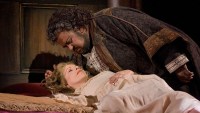
Verdi’s art reaches its summit in Otello, and in doing so reveals both his greatness and a paradox that seems inseparable from it. The plot is harrowing, more so than any of his other operas, and Verdi exploits its agonising capacities to the full. The glorious love duet which concludes Act I is something to make the most of, for that is the end of happiness, as the act’s final bars suggest. From then on it is a series of dreadful scenes in which the chief characters, deliberately or not, create as much suffering as possible — suffering which, at least at crucial points, the audience is bound to share in a satisfactory performance.

Extreme actions

Theatre

OK, I was wrong. I’ve said it a million times but I now realise it’s perfectly feasible. Antique dramas can make sense in a modern location. Nicholas Hytner sets Timon of Athens slap bang in the middle of present-day London. The action begins in a mock-up of the National Gallery’s Sainsbury wing, complete with that dull, forbidding grey hue that some miserable nutcase chose for the walls. Ominously, hanging centre-stage, is El Greco’s swirly pink vision of Christ ejecting the moneylenders from the temple. A launch party is in full swing. Champagne flows. A gang of yuppies, toadies, spivs and freeloaders has gathered to toast the opening of the ‘Timon Wing’. Glamorous sycophants hover around the millionaire philanthropist crying, ‘Timon, Timon!

Ferry and Marr dream team

Bryan Ferry CBE was on form last night, for his only UK appearance this year, at Guildford’s terribly middle-class Guilfest — the only festival I have ever seen that had a Pizza Express on site. The sixty six year old rocker still has it, even if he did have to ruin the look with a cashmere scarf after the sun went down. Mr Steerpike was not alone in wondering why the set had an edgier feel to it than the greying Roxy Music fans might have been used to. All was revealed toward the end when Ferry announced the extra guitarist with the badly dyed black hair, and the worst outfit on the stage, was none other than Smiths strummer Johnny Marr. I hear that Marr has collaborated on Ferry’s new album, due out next year.

A life less ordinary

Arts feature

‘I know it sounds arrogant but I think it’s undeniable that it has become fixed in the culture like a stately home,’ says Mark Haddon of his book The Curious Incident of the Dog in the Night-Time.   Arrogant or not, he is probably right. Haddon’s novel about an autistic boy’s attempt to solve the mystery of who killed his neighbour’s dog has sold more than two and a half million copies since its publication in 2003 and seems to have been read by everyone. As we chat in the basement of the Ashmolean Museum in his hometown of Oxford, Haddon doesn’t come across as an egomaniac. When he discusses Curious Incident he’s more like a proud parent marvelling at his child’s success.

Relaxing with the ignoble

Television

Unless I have slept through another of the year’s once-in-a-lifetime experiences — which is rather more likely than possible — the days since the Wimbledon final have passed without call for bunting, cheering, spangling or any other kind of cross-gartered preparedness. We seem to occupy a lacuna; to have swum into the eye of the 2012 Events’ Cyclone. Here we are invited, until the Games begin, to rest our flag-waving arms, uncross our patriotic fingers and reacquaint our senses with something other than Pride-and-Glory. With immaculate timing — while Centre Court was still being put to bed — Wallander returned to BBC1 (Sunday).

Double vision

Theatre

Michael Frayn is a schizophrenic. His creative personality bestrides the English Channel. When he’s at home he writes traditional West End farces with amusing titles and plenty of jokes. When he sits at his European desk he comes up with dour, static, talk-heavy historical dramas with boring titles and no jokes at all. Democracy, written in 2003, is a classic Euro-bureau production. Frayn invites us to examine Willy Brandt’s stewardship of West Germany in the early 1970s. Willy is referred to throughout as ‘Villy’ which, for some reason, sounds even more silly than just Willy. Chancellor Villy has a couple of problems. He’s an idealist and he wants the free world to embrace the eastern bloc and to give the misunderstood Soviets a big, warm, sloppy hug.

Culture notes: 00 heaven

More from Arts

It took Ian Fleming just eight weeks to write his first James Bond novel but the legacy of his eponymous spy has been far less fleeting. Fifty years after 007 first made it on to the big screen in Dr No (see Sean Connery, above) a Barbican exhibition is celebrating with a stunning display of Bond gadgets, clothes and paraphernalia, such as Jaws’ metal teeth (until 5 September). Designing 007: 50 Years of Bond Style has more than 400 such items, playfully arranged in rooms recalling Bond’s own stomping ground: a casino, M’s office, and so on. There is Ursula Andress’s white bikini, Scaramanga’s golden gun, even an Aston Martin DB5, although sadly the Sean Connery leaning nonchalantly against it is a replica.

Male order

Cinema

For those of you who scan speedily to the bottom of reviews to see if a film is worth seeing — don’t worry; I always do it myself — I thought I would do you a favour and put the last paragraph first, as follows: Is Steven Soderbergh’s Magic Mike worth seeing? Yes. But also ‘no’. But mainly ‘yes’. So it’s a ‘yes’ with some ‘no’ caveats. I can now see this isn’t so helpful. Best scan, I’m afraid. Still, at least you know I’m on your side.

Humorous intent

Music

Elderly pop tunes, as we all know, have a tendency to remind you of things you may not wish to remember. Wings’ ‘Band on the Run’, for example, gives me the taste of cold beef, chips and beans in the Nag’s Head in Oxford circa 1978. It was on the jukebox there, I was an undergraduate and just about managing not to starve to death. On Radio 2 the other day, Ken Bruce played ‘Life’s Been Good’ by Joe Walsh, and I could suddenly feel the bitter cold of my tiny student room with its two-bar electric heater and the mould slowly creeping along the walls towards my bed, where it would surely engulf me. But hang on, didn’t I buy the single? I had a look and there it was.

Dirty, ugly things

Sometimes fiction can be more accurate than published facts. Ten years ago a film, Dirty Pretty Things, told about the plight of illegal immigrants into Britain and the least-explored scandals of all: the black market trade in human organs. It was an aspect of Britain’s secret country, the black market occupied by a million-plus souls that produces a tenth of our economic output. Most of these people work illegally, perhaps in criminal endeavour or perhaps honestly, but in fear of immigration police. It is, by definition, an unregulated environment in which all manner of evil can be incubated. It is becoming clear now that one of these evils is the return of slavery.

Prophet of alienation

Exhibitions

Nothing gains headlines for art quite like high prices. A few weeks ago, one of the versions of Munch’s famous image of ‘The Scream’ was sold at auction for £74 million, which couldn’t have been bettered as advance publicity for the Tate’s new show. Admittedly, there is not a single version of that key painting in this exhibition (owners are jittery about loaning them — particularly since one was stolen from Norway’s National Gallery in 2004), but there are plenty of other treats for admirers of this Scandinavian ray of sunshine. Among his favourite subjects were sickness and death, lust and jealousy, fear of sexual disease and even fear of life.

Grim realities

More from Arts

It was somewhat weird that Pina Bausch’s Palermo Palermo opened on the same night as Spain’s victory over Italy in the Euro 2012 final. After all, the Sicilian capital was long dominated by the Spaniards. Yet in Bausch’s Tanztheater vision of Palermo there are no references to such history, bar a few Spanish-looking steps set to the Spanish-influenced Sicilian music in part one’s frenzied finale. What one gets instead are more or less explicit flashes of the city’s more contemporary and often grim realities: from the mafia ritual of kissing the boss’s hands, to garbage piling up in streets, via evocations of Sicilian mourning, immigration and emigration.

Hooked by chance

Radio

I know we’re all supposed to be taking advantage of the new technologies and listening to whatever we fancy on the radio whenever we like. But I reckon you have to be under 25 to really get the hang of listening by download, podcast and stream rather than at the switch of a button. When, in any case, are we supposed to find the time to download it all and catch up with what we’ve missed? It’s like the conveyor belt in The Generation Game. By the time you realise you’ve missed something vital and/or desirable, the next week’s goodies are on offer. That’s why I’m still a switch-it-on-and-see-what’s-on listener, for most of the time. Chance, serendipity, happenstance are much more interesting than anything preplanned.

Art of myth-making

Music

The story of Allegri’s Miserere has probably become the most engrossing myth that great art of any kind has to offer. From the mists of time when it was first heard, through the threat of terrible punishment — excommunication — to those who might betray it, to the touch of divine intervention that Mozart brought it, it has everything to stimulate the pens both of those who want to rationalise it and those who are more inclined to fabulate on an inspiring theme. It helps that the music itself is so powerful, to which many figures, past and present, have paid tribute: Mary Shelley, for example, described how ‘the soul is carried away into another state of being’.

Disquieting truths

Theatre

Fear is a new drama by Dominic Savage and it’s one of the nastiest plays I’ve ever seen. It’s also one of the most scrappily written. Yet the subject matter and the clunky script make it weirdly captivating. We meet a pair of teenage muggers who hang around posh bits of London scoping out victims and totting up their ‘net worth’. A typical yuppie banker sports about five grand’s worth of portable accessories: Swiss watch, smart phone, designer briefcase, bespoke shoes, wallet full of cash. And these two muggers are expert valuers of lucrative prey. When they strike, they seek more than just upmarket goods. They want revenge as well.

The play’s the thing

Arts feature

History, geography, politics, news, entertainment: the world is at our fingertips, staged before our eyes through the click of a mouse. Before the age of the internet was that of television, and radio before that. In the 19th century, you went for your weekly fix of politics, news, opinion and enlightenment to papers such as The Spectator — its name a nod back a further 100 years, to the first of the great periodicals that emerged from the coffee-house culture of the early 18th century. According to the influential historian and sociologist Jürgen Habermas, it was in that coffee-house culture of the Whig world of Joseph Addison and his Spectator that a new space for debate was created: the ‘public sphere’.

Not much cop

Television

Among the many reasons I shall miss Simon Hoggart’s presence as my Spectator co-TV critic is that I used to rely on him to take the heat off me. Since landing this gig all those years ago, I’ve always felt something of an imposter owing to my extreme reluctance to sit down and watch any more TV than I absolutely, strictly have to watch. Simon, on the other hand, was so conscientious he’d often review three or four programmes in a week. If this were the second world war, I’d be the equivalent of some Cairo desk wallah, while Simon would be a Soviet punishment battalion. But just because Simon’s gone doesn’t mean I’m going to change tack.

Teenage dream

Cinema

It’s Katy Perry! In 3D! And you’re almost certainly not going to see it! But for most of those who are, this is probably as good as cinema is going to get this year, or perhaps ever. Indeed, this documentary about Ms Perry’s rise to pop hyper-stardom is — to steal the title of her third studio album — a teenage dream. For many teenage girls (and younger), this is a chance to see their heroine’s life in exacting high definition. For many teenage boys (and older), it will be something else entirely. And in 3D too! But first some background information for those who are unfamiliar with Katy Perry and her work.

Troy story

Opera

In the late 1970s the Royal Opera announced that it would be performing Berlioz’s Les Troyens and Wagner’s Ring in alternate years, the idea being that the two great 19th-century operatic epics would prove equally popular. We never found out whether they would have done, since while the Ring cycles continued, Les Troyens never got off the ground, and has not been performed complete at Covent Garden for 40 years. My hopes for the new production were extremely high, and only moderately dashed by Jonas Kaufmann’s withdrawal from the role of Enée, one of grand opera’s least rewarding: as a character he is no less unsympathetic than Aeneas always is, and most of his music, especially his big aria of remorse and self-justification, is strenuous and unconvincing.

Rating movies

Cinema

If, like me, you thought the British Board of Film Classification was staffed by red pen-wielding fuddy-duddies, think again. At the entrance to its office in Soho Square, I’m greeted by its youthful, engaging press officer. Wearing what I think young people call ‘killer heels’, and treating me to an anecdote about how she copes with the ‘boring’ Euro 2012 football by drinking lots of wine, she couldn’t be less like Mary Whitehouse if she tried. She introduces me to David Austin, head of policy. He’s not even wearing a collar and tie, never mind a censuring grimace.

Madrid’s golden triangle

Arts feature

Under the statue of Charles III in the Puerta del Sol a hellfire preacher is competing for custom with a mariachi band. ‘Porque la paga del pecado es muerte!’ he shouts. ‘Ay, ay, ay, ay,’ they sing, ‘porque cantando se alegran, cielito lindo, los corazones.’ The weather is with the preacher: the cielo is not lindo. The El Greco cumulonimbus overhead flickers with lightning as God adds a rumble of thunder to the mix. Apart from the angry heavens and the five police vans lined up opposite — for prevención, they tell me — there’s little sign that Spain is on the brink. The leaning towers of Bankia may be tottering, but to judge from the queues outside the Prado the culture industry has not been affected.

Culture notes: Good as gold

More from Arts

An enthralling exhibition at Goldsmiths’ Hall, Gold: Power and Allure (until 28 July), which charts Britain’s history and celebrates exquisite artistry and craftsmanship, awaits those who venture into the City this summer. The grand opulence of the Hall is a superb setting: the deep plum-red, gilded and mahogany furnishings and the grand marble Staircase Hall enhance the magnificence of the display and serve to remind us that gold was not only worth its weight (unlike paper bank notes), but also played an important psychological role in Britain’s dominance on the world stage. More than 400 gold objects, from 2,500 BC to the present, are on display.

Hippie haven

Theatre

A mad leap into the dark on the South Bank. And I’m all for mad leaps into the dark. A big-name cast has been assembled for a new play by an untested writer at the 900-seater Lyttelton theatre. Cripes. Stephen Beresford is a Rada graduate who knows his way around the dramatic repertoire. And he seems to have approached his first commission from the National in a spirit of dazzling insouciance. ‘Hey, I’ll just nick everything from Chekhov: the plot, the setting, the characters, the relationships and the atmosphere. And no one’ll notice!’ Well, there are smarter ways to go poaching. If you steal from a lesser dramatist, you can improve what you’ve stolen. But if you mug a genius, his genius will embarrass you.

Power failure

Television

You wouldn’t necessarily use the word subtle to describe a programme in which a well-dressed, well-spoken woman describes a speech that’s been altered as ‘pencil-fucked, completely’ but Veep (Monday, Sky Atlantic) is subtle, sinuously subtle. In his way Armando Iannucci is as creative with the English language as James Joyce. He is proof that doing an English degree at Oxford is not necessarily, to adapt another of his phrases, ‘like using a croissant as a dildo — it doesn’t do the job and it leaves a lot of mess’. His neologism in The Thick of It — ‘omnishambles’ — is now as much a part of our political vocabulary as ‘white paper’ or ‘liar!

Tangled web

Cinema

The Amazing Spider-Man isn’t so amazing, actually, and is a reboot of a remake, or a remake of a reboot, or a remake rebooted, and remade, rebootingly. It’s hard to keep up with these franchises when they swish back and forth all the time, determined to squeeze every last penny out of cinemagoers who should have more sense, yet don’t seem to mind sitting though the same film over and over. This has an excellent cast: Andrew Garfield, Sally Field, Martin Sheen, Emma Stone. It is 3D. The CGI is state-of-the art. And, fair play, it does try to inject meaningful emotion.

In love with words

Radio

No wonder Clive James thought he was writing his own obituary when he was interviewed by John Wilson for the Radio 4 series, Meeting Myself Coming Back (Saturday night). Wilson played him a clip from a recent Mastermind programme on which one of the Specialist Subjects was...Clive James. ‘I was halfway between being amazed and appalled,’ he told us. ‘I’m already being treated like some kind of historic monument.’ His mistake was to have agreed to do the programme in the first place. The series is made by the Archive on 4 team, whose job is to ferret around in the BBC’s repository of lost conversations, old achievements, forgotten soundtracks like audio archaeologists searching for mummies in the Valley of the Kings.