Culture

Culture

The good, the bad and the ugly in books, exhibitions, cinema, TV, dance, music, podcasts and theatre.

Fright night

Arts feature

Here comes Jane Asher. She swings through the doors of a small Chelsea hotel, chucks her bag on the floor, and sits down with an expectant look. Her voluminous red hair has attractive hints of something blonder on top. Her eyes are pale blue, and extraordinarily intense, and she has a fulsome rack of plump white teeth that hint at large appetites. But her figure is as trim as a teenager’s. We meet a few weeks before she begins rehearsing Charley’s Aunt, the classic Victorian farce in which she plays a Brazilian dowager, Donna Lucia d’Alvadorez. Does she think it’ll be more fun because the script is a bundle of laughs? ‘No, there are always those technical things that are just as tricky to do. And if it’s not funny, it’d be a disaster.

Under the skin | 19 September 2012

Exhibitions

John Berger (born 1926) is one of the most intriguing and richly controversial figures in British arts and letters. Actually, since he lives full-time in France, he can scarcely be considered English in any meaningful way, and is indeed an international figure, widely regarded outside this country as one of Europe’s greatest intellectuals and quite often as some sort of cultural guru. Here he is thought of as a Marxist art critic, a dangerously potent broadcaster and a writer or novelist who defies categorisation. One suspects he is a bit of an embarrassment to the arts establishment, so he tends to be ignored.

The place to be

More from Arts

A display of drawings by 20th-century sculptors is a welcome event, and the multi-levelled, multi-functional Kings Place provides just the right ambience, the building echoing the concept and providing a satisfying mix of enjoyment, surprise and irritation. To stage Sculptors’ Drawings (until 12 October) has been a long-held ambition of Pangolin’s Rungwe Kingdon and he has assembled over 200 works, including Eduardo Paolozzi’s ‘Collage’ (above), plus a scattering of 3D pieces. It sounds straightforward, but this being the art world, and sculpture a broad kirk, no chance to complicate has been foregone.

American beauty | 19 September 2012

More from Arts

Tragically, the number of ballet directors who can orchestrate good programmes and good openings is dwindling these days. Helgi Tómasson, of San Francisco Ballet, is one of the few who are still in the know, judging by the terrific bang with which his company opened last week in London.  Divertimento No.15 might not be one of George Balanchine’s greatest works, but it remains a delectable compendium of all the distinctive traits dance-goers love in Balanchine’s composition. Craftily entwined with and within Mozart’s music, the 1956 dance is one of the choreographer’s many tributes to the grand old era of the Imperial Russian Ballet — whence he came.

A lost illusion at the Last Night of the Proms

Columns

It was the last night of the Proms and the first I’ve ever attended. I’ve watched it on TV, of course, and even been to a Last Night of the Proms party, where we all watched the television, swigging sparkling wine and singing along to Rule Britannia. But to be there, actually among the audience at the Royal Albert Hall, would be something special, I thought. And it was. Ever since receiving an invitation to join a friend whose party were occupying a whole box I’d felt excited about it, and I was not disappointed. There’s something about real events — a thrill that has perhaps sharpened in an era when, thanks to information technology, ‘virtual’ attendance gets cheaper all the time.

Underpowered Ibsen

Theatre

The tone is the thing. Ibsen is among the heaviest of the heavy-going playwrights and his masterpiece, Hedda Gabler, is an unbearably tense psychological thriller that ends with one of the biggest shocks in the theatrical repertoire. The play takes us into a doomed marriage between Hedda, a brilliant and eccentric depressive, and George Tesman, a dull-as cheesecake university lecturer. Director Anna Mackmin has read the Old Vic audience correctly. They’ve spent all day at the office, raising enough funds to buy tickets, and they’re not interested in a three-hour Nordic brain-bruiser. Instead, they want a frothy, offbeat marital comedy with a few sad bits. And that’s what they get.

Divine Diana

Cinema

I don’t care much for fashion — ask anyone; I’ve even lately surrendered to the fleece — and don’t care for fashion magazines at all. They have nothing to say to my life. They’ve never even featured ‘top ten fleeces of the season’, as far as I know. But this isn’t to say I don’t enjoy the odd mischievous trip behind the scenes. I loved The Devil Wears Prada, starring my friend Meryl, with whom I have dined. I loved The September Issue, the fly-on-the-wall about American Vogue and Anna Wintour, although the only thing I can now remember is being fixated with Ms Wintour’s bob which, one day, will surely join under the chin, as if she’d grown her own snood.

Artistic response

Exhibitions

Van Gogh to Kandinsky presents a rare and exciting opportunity to see some 60 paintings as examples of landscape symbolism from major international institutions and private collections. The exhibition extends beyond the usual north European definitions of this subject, with the coupling of the emotionally charged graphic-colourist van Gogh with the increasingly reductive and programmatic application of colour-to-form associated with late Kandinsky. It challenges, therefore, conventional categorisations of modern European art. Who would think, moreover, that Lord Leighton, Hammershøi, Monet and Mondrian could share a common thesis, let alone inhabit the same gallery rooms? In lesser hands, such an ambitious project could have descended into chaos and visual incoherence.

Connecting threads

Arts feature

The past few months have been busy for Jock McFadyen. Substantial commercial shows of his work have been held in London and Edinburgh, he has been elected a member of the Royal Academy, and a retrospective of four decades of his painting is currently on view at the Fleming Collection in Berkeley Street, Mayfair (until 17 October). Although Scottish by birth (he was born in 1950 in Paisley and brought up on the outskirts of Glasgow), he has lived most of his life in London. All the men in his family worked in the shipyards, but his father took a job in England when McFadyen was 16, so he came south in 1966 and stayed on to become an artist. He made his name in the 1980s with a brand of tough Hogarthian realism that focused on East London low-life.

A civilised way of death

Exhibitions

‘Luxury high-rise duplex: lower floor comprising entrance hall with recessed guard posts, grand reception area, kitchen with crockery store, larders and walk-in fridge, armoury and staff WC; upper floor comprising master bedroom with two en-suite bathrooms, staff accommodation, guard rooms and safe deposit. Property provided with the latest hi-tech security systems and 24-hour manned guarding.’ Apart from the lack of a cinema and a gym, this property sounds just the ticket for the jittery billionaire looking to invest in London real estate. But its location is not the fringes of Hyde Park or the South Bank, it’s the side of a mountain near Xuzhou in northeast China, and its accommodation is designed not for the living but for the dead.

At home with the Pre-Raphaelites

Exhibitions

Andrew Lloyd Webber cried when he first came to Wightwick Manor, and standing in the Great Parlour of this magnificent Victorian villa you can see what moved him to tears of joy. Lloyd Webber loves the Pre-Raphaelites (he’s always had the common touch) and Wightwick is a living monument to the one artistic movement that England can truly call its own. There’s William Morris wallpaper on the walls and Charles Kempe stained glass in the windows — and beneath the minstrels’ gallery is Edward Burne-Jones’s ‘Love Among The Ruins’ (which has this month travelled to London for the biggest Pre-Raphaelite exhibition since the 1980s).

Sisters

More from Books

These two, DOROTHY AND CLARICE DENCH — A pair of local spinster sisters, as I guess — Both died, two years apart, aged ninety-five. Yet ‘We are only here a little while’ Is carved, with names and dates, into this bench: A saying of theirs, perhaps, that raised a smile When each new birthday found them still alive, That friends recalled with wry tenderness? Did they walk their dogs here every day Then stop at ‘their’ bench and sit gratefully, Half-hearing distant cries (Howzat? or Play!), Half-watching men in whites move on the green As ‘Flush’ and ‘Bingo’ barked at long leg-drives That rolled, to dry applause, towards the screen?

Royal rocks

More from Arts

It’s a smallish dark room but, wow, what a lot of sparklers. There are more than 10,000 diamonds set in tiaras, crowns (Diamond Diadem, above), brooches, swords, earrings and necklaces, on display at Buckingham Palace in a special exhibition Diamonds: A Jubilee Celebration (until 7 October). These stunning pieces were acquired by six monarchs over three centuries. Many of the stones have been recut or made into new settings, such as the Fringe Brooch, belonging to Queen Victoria. The larger stones in this brooch are believed to have come from one of the two jewels given to her by the Sultan of Turkey. She wrote in her journal of 8 May 1856 that she decided she could not wear one of the jewels and wished to have it reset.

Classic celebrations

Radio

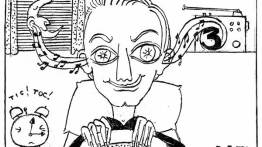
It’s 20 years since Classic FM launched itself on the airwaves with a blast from Handel’s ‘Zadok the Priest’. Its mission was to play ‘the world’s greatest music’ non-stop to an audience for whom the classics was a no-go area. On paper it’s worked a treat. The station now claims five million-plus listeners, who love its blend of Vivaldi, Prokofiev and John Barry interspersed with adverts for dental implants, Age UK and classicfm.com/romance. Last Friday was devoted to its birthday celebrations.

Identity crisis | 13 September 2012

Television

The greatest moment in the history of television — and one which will surely remain unsurpassed for ever — was the final episode of The Sopranos. Part of its genius was to reward all of us who had stuck with it so loyally for the previous 85 episodes by allowing us to make up our own minds how it ended. Did Tony get wasted by those hitmen-like figures we saw entering the restaurant where he was having the rapprochement dinner with Carmela? Well, maybe. Or did the Feds finally get their wiretaps and informants properly organised and put Tony away for ever? Or did he — as I prefer not to stop believing — waste all the people who’d come to kill him and then get off, on a technicality, whatever charges the Feds threw at him.

Star quality

Cinema

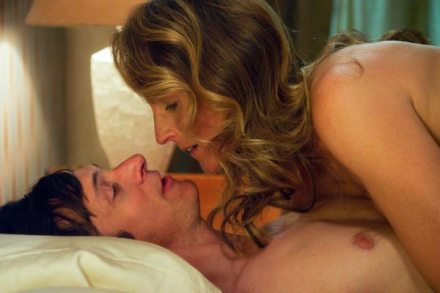
Hope Springs is a comedy drama about a long-term marriage that has effectively stalled, and is one of those films that is only as good as its stars. Luckily, in this instance, the stars are Meryl Streep and Tommy Lee Jones. Meryl, we know about. I once had dinner with Meryl, and have talked of little else since, until I realised it got on everybody’s nerves, but have gaily continued nonetheless. She is the greatest film actress of her generation, our generation, any generation. She could play my left shoe, if she put her mind to it. She may even be playing my left shoe right now. How would I know? But Mr Lee Jones? (I don’t feel matey enough to call him by his first name.) He has a face like an old-style leather football that’s been left out in the rain, year after year.

Song and strife

Theatre

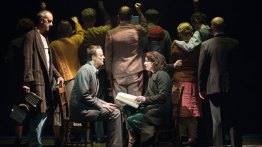
Without You is a show that requires a bit of prior explanation. However, if you’re a gay jobless thesp living in New York in 1994, and your Mom’s dying of cancer back home in Illinois, and you’ve landed a role in Rent, a new musical about Aids, then you’re already up to speed. You have all the data required. In fact, you’re probably Anthony Rapp, the author of this musical autobiography which has just arrived from Edinburgh. Rapp tells two tales through narrative and song. First we hear about Rent which, you may be aware, is a smash-hit musical based on La bohème and relocated to New York during the HIV epidemic. This house-move intensifies its kitsch morbidity by a factor of about a thousand.

Fame game

Music

The summer is over, the Olympians have gone, and Lord Coe has been put back in his box for another year. But some memories will linger on, like a stubborn cold. Music fans, in particular, will struggle to forget George Michael’s performance in the closing ceremony. Other acts came out and played their most famous song for a TV audience of somewhere between nine and ten billion, according to industry insiders. George, wilful to the last, gave us his execrable new single. No one wanted to hear it, everyone was just waiting for it to end, but George wanted to play it, and afterwards he wanted us to buy it. Maybe you need to be that famous to misjudge your audience so acutely. Anyone whose ego does not travel separately would realise that people only want to hear the hits.

Science fiction as reality

More from Arts

What’s that in your pocket? Magic or art? The near ubiquitous iPhone may be rammed with very new technology, but it is a witness of very old, even mysterious, values. Few of us understand its inner workings, even as we indulge ourselves daily with its impressive powers to astonish. ‘My life,’ Daniel Harris wrote in Cute, Quaint and Hungry, his witty critique of consumerism, ‘is suspended above an abyss of ignorance. Virtually nothing I own makes sense to me.’ This is a familiar feeling. If we had to start over, few of us would know how to light a fire, still less design and manufacture a beautiful smartphone. If civilisations are remembered by their most significant artefact, the iPhone is our memorial. Arthur C.

Martini Man

More from Books

Blondes, brunettes, ginger nuts, I’ve had ’em all, sunshine. Could be Janet the cleaner or that Irish cook at the day nursery. A dead cert’s Aunty Pat. What Aunty Pat? His wife puts two and two together. But in the back of his minivan? Unsnaring her heel from his bosun’s chair, ruining her Wolford’s on a gripper rod. From a dust sheet, wood slivers and flecks of paint adhere to her pasty arse, her perfume made nameless by linseed. He lies back thinking of cricket bats and summer fences. Tells her how it works for kneading old putty: softening it up, bringing it to life. Got to look after your hands: the golden rule for any tradesman.

Peacocks and passion

More from Arts

Not many peacocks could handle an 8,000-strong festival audience. But such is the gentle atmosphere of the annual End of the Road music festival — set in the historic Larmer Tree Gardens, north Dorset — that the resident peacocks get on just fine with their weekend visitors. Last weekend was the seventh outing of the festival and, true to form, the line-up did not have something for everyone’s musical taste. Listening to unfamiliar music was half the joy of the weekend. Still, the curators have a strong musical bias so it is a good thing I enjoy Americana, modern folk, blues and indie pop; otherwise there were the peacocks for entertainment. Headliners included Grizzly Bear, Beach House and Grandaddy.

That’s entertainment

Television

Comparisons may be odious but sometimes they are irresistible — and, frankly, more fool the BBC for screening Treasures of Ancient Rome on the same night as The Shock of the New (Monday, BBC4). Here is Alastair Sooke on the spread of the Roman Empire: ‘Rome’s generals romped around the Med, sacking cities willy-nilly...

This world really is a stage

Cinema

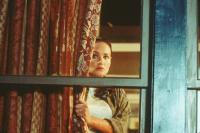
Joe Wright’s adaptation of Anna Karenina is so bold and audacious its bold audacity becomes the story, rather than the actual story itself. This is both a strength — it is always visually dazzling, inventive and surprising — and a weakness, as it is so goddamn distracting. The entire action, more or less, is set in an old decaying theatre beneath a proscenium arch with its own backstage, balconies and rat runs, and an origami-ish ability to fold in on itself, or fold out on itself to become ballroom or bedroom, and even horse-race track. According to Wright, this makes sense as high society in Tsarist Russia was all about performance, and fakery — their whole world was truly a stage — but it is also mise en scène gone totally mental.

Chance encounter | 6 September 2012

Theatre

If you’re thinking of putting on a West End show, here’s what you need. Half a million quid. That should cover it. Unless it’s a musical, in which case you’ll need five or ten times as much, depending on how munificent/crazy you happen to be. Investors tend to be fretful, superstitious types who rarely make rational decisions about the start date of their theatrical ventures. No producer is willing to send 500 grand’s worth of dramatic wonderment into the skies if his rivals aren’t launching similar attractions in the same week. So the West End calendar is either overcrowded or utterly barren. Every year there are two dead zones. One is the end-of-Edinburgh lull, from which we’re just emerging.