Culture

Culture

The good, the bad and the ugly in books, exhibitions, cinema, TV, dance, music, podcasts and theatre.

Addicted to Chekhov

Arts feature

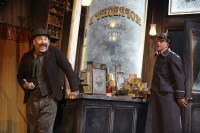
One departs and three more come charging in. It’s always rush-hour for Chekhov in the capital. As the Young Vic’s production of Three Sisters is drawing to a close, the Vaudeville is preparing to host a star-studded version of Uncle Vanya. Up the road, at the Novello, another Uncle Vanya is about to arrive from Moscow. And rehearsals are already under way for The Seagull, starring Matthew Kelly, at Southwark Playhouse. For years, we’ve been recreational users of Chekhov. We’re now in danger of becoming hopeless addicts. How come we’re hooked? Chekhov’s career as a dramatist was short and full of trouble. Early plays flopped.

Neglected master

Exhibitions

Every so often, about once a decade, the work of Mark Gertler (1891–1939) is rediscovered and exhibited. I remember seeing excellent shows of his work at the Ben Uri Art Gallery in 1982 and in 2002, and at Camden Arts Centre in 1992. Each time a well-selected body of his paintings is gathered together, we are reminded of the extraordinary talent of this young artist, who tragically took his own life. Yet for many of those who care about art, Gertler is still best remembered as the wild bohemian obsessed with the Bloomsbury siren Dora Carrington. Certainly, Gertler’s 1913 portrait of her, a striking example of his Neo-Primitive tempera style in the key of blue, and one of the many treats of this exhibition, doesn’t quite explain the attraction.

21st-century Disney

More from Arts

When, in 1940, Walt Disney released Fantasia, his radical arrangement of animations set to classical music, he fancied that he might add new segments to it every few years so that it could grow with its audience. Alas, it was not to be. The cost of installing the new ‘Fantasound’ technology in cinemas, plus a public mood made inhospitable by war, meant that his fantasy was soon a box-office flop. So he would, no doubt, have been delighted to see Fantasia, accompanied by the London Philharmonic Orchestra, moving with the times 72 years later, as part of the Royal Albert Hall’s Live in Concert series.

Time switch

Radio

It seems an astonishing statistic but 99.6 per cent of radio is broadcast live, delivered straight from the studio mike to your personal loudspeaker: 99.6 per cent! Compared with TV, which must be at least 80 per cent recorded, this is an extraordinary indicator of how radio is the on-message medium right now, able to deliver immediate content, live and interactive. Yet a lot of radio listening is not done in real time these days, but later, after transmission, via the internet, the iPlayer, podcasts and downloads. We could experience a live connection but find ourselves switching on to a recorded moment. This is all about to be revolutionised with the launch earlier this month of a new version of iPlayer.

Racial tensions

Theatre

Covent Garden, 1833. Edmund Kean, the greatest tragedian of his age, has collapsed while playing the title role in Othello at the Theatre Royal. His son, Charles, is all set to take over and has just prised the lid off a trusty tin of boot polish ready to smear dark grease all over his peachy white cheeks. But, instead, a black American actor, Ira Aldridge, is engaged to play the lead. Kean’s company are aghast by this affront to their man’s talent and authority. But his fiancée, Ellen Tree, who plays Desdemona, is smitten by the charismatic American and tries to embrace his realistic new emotional acting style. This is the starting point for Lolita Chakrabarti’s wonderful new play, Red Velvet, at the Tricycle theatre.

No laughing matter | 25 October 2012

Opera

About two of the operas I saw in Leeds this week there is a serious question as to whether or not they are comedies. The third, Gounod’s Faust, is clearly not meant to be; I’ll be writing about it next week. The new production of Mozart’s Don Giovanni by Alessandro Talevi is jokey and fast — or, anyway, the arias and ensembles are fast, the recitatives less so — but it’s not particularly funny, and what humour there is would certainly not have been available to da Ponte and Mozart: peasants rocking and rolling in the finale to Act I, for instance.

Blind spot

Music

Do you have a mysterious and slightly embarrassing musical blind spot? One of mine is for Dvorák, whom I don’t need to be told is a great composer. Maybe it was overexposure to the New World Symphony as a child; or maybe I’m unreasonably irritated by his Czech bounciness, just as some people write off Vaughan Williams because he reminds them of that jibe about the ‘cowpat school’. Anyway, it’s a problem. One way to tackle a blind spot is to listen to a superlative recording of a work by your ‘difficult’ composer. So, a couple of weeks ago, I bought a CD of Dvorák’s Cello Concerto played by Pieter Wispelwey and the Budapest Festival Orchestra conducted by Ivan Fischer.

B-Troop

More from Books

A degree in maths might have helped. ‘Correction of the Day,’ wind charts, slide-rules, log tables, maps of the terrain, OP reports — all combined (again and again) to make four 25-pounders point the right way. B-Troop, ‘officer material,’ we learned our parts: don’t get VD; take care when choosing your friends; prefer gin and tonic; wear a hat at weekends; believe in the Empire (ignore what you know in your hearts). There was never much sense of who we were — except once, when the Colonel said ‘You gents are lucky to be here.

Jimmy Savile Is Innocent…

Now then, now then. How is this for the most inappropriate publicity stunt going? The Bread and Butter gallery in Islington is opening an exhibition tomorrow provocatively called 'Jimmy Savile Is Innocent'. Artists are invited to bring works on the subject to the opening tomorrow night: ‘In an age when the dead can't defend themselves Jimmy Savile has been found guilty. Lets remember that Jimmy is innocent and can only be found guilty by a court of law, perhaps its time for a posthumous trial?’ Trial by artistes. Is that better or worse than trial by media?

Green fingers

Arts feature

The last time I visited Kew was to see the installation of Henry Moore’s sculptures in 2007. Moore’s monumental bronzes made an enormous impact on the botanical gardens, so much so that the gardens were in danger of becoming merely a backdrop for the sculpture. Although a good many people came to see the exhibition, it was felt by the authorities at Kew that the crowds took away a greater appreciation of Henry Moore than they did of the Royal Botanical Gardens. So, when another sculptor was invited to show at Kew, the intention was that he or she would be involved more closely with the aims of the institution. Who better than David Nash (born 1945), known worldwide for his work with trees?

Bizarre visions

Exhibitions

If you want to see how myths arise from misunderstandings, the Tower of Babel provides a textbook example. In ancient Assyrian babilu means ‘door of God’ and thus correctly describes the Babylonian ziggurat erected to the god Marduk by Nebuchadnezzar II and later seen in ruins by Herodotus. But in Hebrew the word bâlal means ‘to confuse’, hence the confusingly different account in Genesis.

The hate of the new

Exhibitions

The title of the new show at the Palazzo Strozzi is a little confusing. Most of the artists in Italy in the 1930s weren’t beyond fascism; they were in it up to their necks. They didn’t really need much persuading by Mussolini to come up with pictures like Luciano Ricchetti’s 1939 painting ‘Listening to a Speech by the Duce’: enraptured, bare-footed Italian peasants in headscarves sit dangling babies on their knees, hanging on Il Duce’s every word. Today lots of Italians still don’t like to admit it, but much of Florence, and Italy, were really rather keen on Mussolini, and Hitler, too.

Blurring boundaries

More from Arts

Each of the Buddhist monks’ faces tells a variation on the same story. One simmers with fury, another sags with despair, a third is locked in a stoical gaze. The sign they are holding is written in Mandarin — its message the latest piece of sadistic invention by the Red Guards promoting Mao’s Cultural Revolution. ‘To hell with the Buddhist scriptures, they are full of dog farts.’ This is just one tiny photograph in the Barbican exhibition Everything Was Moving (until 13 January 2013). The project takes a gargantuan bite into world affairs in the Sixties and Seventies, so that through the eyes of 12 photographers we revisit such provocative topics as apartheid, Ukraine under Soviet rule, the American civil rights movement, and Mao’s China.

Falling about and apart

Television

One of the many pleasures of television is that it allows us to forget our manners: we can treat it with an impolite offhandedness that would not be considered sociable — or sensible — in the run of everyday life. This isn’t a vicarious enjoyment of bad behaviour that we see on screen, but an actual enjoyment in loosening our own collars: when I watch television I can be fickle (a one-night stand with Downton Abbey), greedy (a Simpsons triple-bill), blunt (‘That sweater is repulsive’), or lazy (Nigel Slater’s Dish of the Day instead of the real thing) without guilt or consequence.

Shrub of life

Cinema

You know how it is: you wake up in your knock-down corrugated shack, surrounded by chickens and dogs and pigs, before staggering out into the morning sun to press the animals against your ear, listening to their heartbeats. No, sorry, I’m getting ahead of myself. You probably don’t know how it is, and neither did I before watching Benh Zeitlin’s Beasts of the Southern Wild. But this is what this film does to its viewer right from the off. It depicts a world so vivid and immediate that two dimensions naturally become three, without the need for any fancy Hollywood stereoscopics. It is, actually, our six-year-old heroine Hushpuppy (Quvenzhané Wallis) who tunes into the ba-dum, ba-dum of the animals’ hearts.

Dazzling Donizetti

Opera

The Met Live in HD series for 2012–13 got off to a brilliant start with a new production of Donizetti’s L’Elisir d’Amore, the most warm-hearted of comedies — in fact, a work so genial that I’m always surprised it doesn’t lapse into insipidity. This production by Bartlett Sher made that seem less of a danger than usual, because although it would be an exaggeration to say he had rethought the piece, he did make it into a more three-dimensional work than usual, Donizetti edging more towards Bellini and away from Rossini, whereas Don Pasquale is the other way round. There are fewer laughs in Sher’s production than you might expect, but far more involvement with the characters.

Westminster playground

Theatre

Wow. This is a turn-up. Politicians and actors rarely see eye-to-eye. Thesps regard Westminster as sordid, petty, corrupt and corrupting. Politicians, for their part, like to dismiss the theatre as pretentious, irrelevant and fake. So here’s a play that brings them together. This House, written by James Graham, and directed by Jeremy Herrin, is a triumph on many levels. It takes the most squalid and depressing era in recent political history —1974–1979 — and turns it into a frothy and hilarious melodrama. James Graham’s inspirational idea is to use Labour’s fragile majority as his sole dramatic motor.

A step away from buying toothpaste

More from Arts

Fifty years ago it was not possible to bid at auction via the telephone — that first historic telephone bid was made for a Monet at Christie’s in 1967. Now the auction house’s Great Rooms, and indeed every other international saleroom, is lined by banks of telephones and digital screens, and absentee clients may also bid from anywhere in the world online, live through an interactive bidding portal or via iPhone and iPad apps. It seems that one moment advances in technology allowed Elizabeth Taylor to sit by her pool in Bel Air in her swimsuit and bid on the telephone for Duchess of Windsor diamonds in Geneva, the next, that part of her estate could be dispersed around the globe courtesy of Christie’s inaugural online-only auction.

Fact and fantasy

More from Arts

Britain’s country houses were constantly in the news a generation ago. In 1974 The Destruction of the Country House, an exhibition at the Victoria and Albert Museum curated by Roy Strong, Marcus Binney and John Harris, offered a dismal chronicle of the houses that had disappeared in the past century. It proclaimed their importance to the national heritage, boldly urging that country house owners ‘deserve consideration and justice as much as any other group within our society as they struggle to preserve and share with us the creative richness of our heritage’. This invocation bore fruit in the mid-1980s when Kedleston Hall, Calke Abbey and Weston Park, all threatened with dispersal, were preserved by the National Heritage Memorial Fund.

Sermon | 18 October 2012

More from Books

Son, never boast of the bird you have done. Masters of the art of crime never serve A scrap of time. They may shit on everyone. They keep their noses clean. A fable says, There was a crooked horse who kicked an ass For being an ass, and down the line He got stitched up by his mule.  Here’s the moral: Never disapprove, never harbour a scruple. Cater to all tastes.  One will help you rob A bank-vault if you let him rape a little boy. A ritual murder binds people together. Where’s the chick as close as an accomplice? Differentiate between being and appearance And become as far as possible indistinguishable From your mark.  Love is not a problem.  Love Will find a way to provide you with an unassailable Alibi.  Robin Hood had it all wrong.

Back to the future | 11 October 2012

Arts feature

Two pop-up art fairs border Regent’s Park in London. To the south is Frieze London, an edgy fair-cum-fairground offering the thrills and spills of the latest and most innovative trends in global contemporary art. Launched a decade ago, it was unique among ambitious international art fairs in proving an instant and overwhelming success. Last year some 68,000 visitors walked through its doors. This year sees the launch of Frieze Masters, sited at the northern end of The Broad Walk, also running 11–14 October. Frieze Masters sets out to offer a fresh perspective on historical art — paintings, works on paper and sculpture — by highlighting the eternal dialogue between the old — at times extremely old — and the new.

Wheels of change

More from Arts

Bicycles can be powerful images in cinema. Like the 1948 masterpiece Ladri di Biciclette, Wadjda, the first film ever to be filmed in Saudi Arabia, is about a child and a bike. But whereas two wheels in Vittorio De Sica’s brutally neorealist film represented the shackles of poverty, here they embody freedom. Or at least the whisper of it. Wadjda, which will be screened at the London Film Festival on 11 and 14 October, has at its helm Saudi Arabia’s first female director, Haifaa Al-Mansour. This is a feat not just because this is a country where women are not allowed to drive (Al-Mansour often had to hide in a van while filming in Riyadh), but also because cinemas themselves have been largely banned in the gulf kingdom for 30 years.

Teen spirit

Radio

A vital sign that radio is so much more vibrant these days than tired old TV is the way the networks are rebranding themselves, extending their range, developing their programme base. On Radio 1 on Monday night Keeping Mum took on the subject of young adult carers in a feature that could easily have been on Radio 4. Greg James, the Radio 1 DJ, hosted, but he was soon overshadowed by his young co-presenter, Pippa Haynes, who last year was recognised as a Radio 1 Teen Hero in a celebrity bash at Wembley Arena. Pippa, now 18, looks after her mother, who has spinal injuries, and her mentally ill sister, and has done since she was four. ‘Why is there no support?

Don’t look now

Cinema

I don’t know quite what I was thinking when I went to see this film as it is full of everything I personally hate. Low-life gangsters. Drugs. Violence. Liberal use of ‘pussy’ and the c-word, which I loathe so much I cannot say it myself. My son, when he was little, once overheard it somewhere and asked me what it meant and I said it was a sort of German bundt cake, but crispier, and for years I lived in terror he would be presented with a German bundt, but crispier, and exclaim, ‘Wow, great c-word!’ — but this isn’t about the film, is it? So, the film. Yes, it’s full of everything I personally hate but this does not, necessarily, make it a hateful film. It is well acted.

Teenage fanclub

Music

As I entered the O2 Academy in Oxford last Saturday, something felt strange. The air was thick, the bar was crowded and the DJ was already playing in anticipation of the headline act. It all seemed perfectly normal. Yet, something was amiss. And then my friend turned round to me; her face pale, a mildly disturbed look in her eye. ‘Why is everyone here aged 12?’ Oh, yes. While 12 is possibly a slight exaggeration, it was clear that a substantial portion of the audience at Azealia Banks’s seventh UK show in her 2012 Fantasea tour were teenage girls, all dressed in Banks’s signature style: wool hats, cut-off shorts, dark lipstick. In many ways, it made perfect sense.

Meltdown in Valhalla

Opera

What begins with the borrowing of some capital ends 14 hours later with cataclysmic disaster. It is a drama thousands and thousands in the western hemisphere watch these days — from Seattle to New York, from London to Milan, and from Munich to St Petersburg. Ticket prices are high, although sponsorship money flows in luxuriant quantities hand-in-hand with public subsidies; after all, the show (which originally was intended to be produced only once, the set consumed for ever in the last scene’s flames) is notoriously expensive to produce. The show in question is, of course, Wagner’s Der Ring des Nibelungen, arguably the greatest and surely the longest piece in the repertoire that the opera houses of the world have to stage in order to be taken seriously.