United kingdom

The literary appeal of the English upper classes

From our US edition

“However British you are, I am more British still,” said the American expatriate novelist Henry James, explaining his fascination with all things aristocratic and Anglo. It’s a type of fascination that’s only gathered steam over the years. A grand representative of the establishment, Lady Anne Glenconner, sold thousands of copies of her first book, Lady in Waiting, in the US, and recently discovered that her (admittedly predominantly homosexual) American fanbase has taken to throwing Lady Glenconner-themed costume parties. Meanwhile, Carla Kaplan, whose biography of Jessica “Decca” Mitford, Troublemaker, went on sale at the end of last year, discovered that Decca, known as “the Queen of the Muckrakers,” has a manic following among cowboys and long-haul truckers.

Is there a free-speech defense of Grok’s deepfakes?

From our US edition

There are scenes in blockbuster teen movies from the 1980s and 1990s that wouldn’t fly today. I think of Revenge of the Nerds, that classic raunchy coming-of-age tale about pocket protector-wearing geeks no woman would ever touch with a three-foot slide rule. You might recall the heroes of the story install hidden cameras in a sorority house in order to spy on naked, skinny, blonde cheerleaders. In triumph, the Byronic dirtbag yells, “We’ve got bush!” In our purportedly more enlightened age, Hollywood has forsaken making risqué teen comedies for vulgar imps; instead the vulgar imps have taken their raunch to the lawless internet. The powers of AI have multiplied their mischief. Their latest prank is to tell Grok, an AI chatbot on X.

grok

AI marketing is driving me to distraction

From our US edition

For years, retailers have been behaving like needy friends. My phone would ping. “Hi there!” an email would read, “We’ve missed you.” Who could this be? I would wonder happily, before realizing that the warm and loving message was from someone in the marketing department of the emporium from which I’d once bought a couple of pairs of expensive shoes. Emma usually, or Olivia. With the advent of artificial intelligence, though, personalized, over-the-top PR is getting much, much worse. At least in the past you’d needed an actual Emma to send these emails, some girl who’d gone into marketing, typing enthusiastic nonsense all day. There was at least a human who had “reached out” – they always “reach out.” AI is just so needy.

Inside the Cambodian cybercrime compounds run by Chinese gangs

From our US edition

The scrappy Cambodian border town of Poipet, long associated with vice and criminality, was shaken shortly before Christmas by the sound of F-16 fighter jets screaming overhead. The Thai Royal Air Force was, astonishingly, bombing a series of casinos. At least five fortified compounds were damaged, which were part of a vast industry that has conned millions of people across the world out of billions of dollars. This was “a war against the scam army,” Thailand’s army said. Scamming is a mainstay of Cambodia’s economy. The country earns an estimated $12 billion annually from online scamming alone, around half the value of its formal economy. Poipet is just one small outpost of a Chinese organized crime network, many elements of which have links to the Chinese Communist party.

Will Congress shield the US from foreign attacks on the First Amendment?

From our US edition

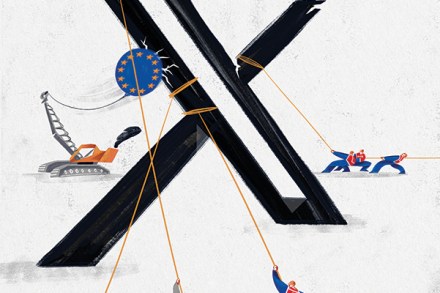
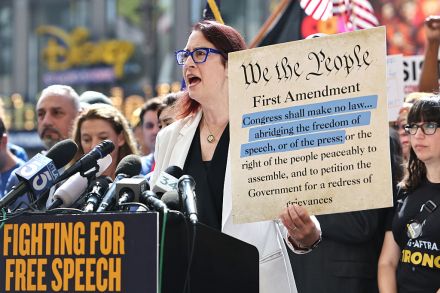
Britain’s Online Safety Act is part of an escalating censorship war between Europe and the United States. It was sold to the British public as legislation that would protect children; in practice, it is a far-reaching internet censorship statute with explicit extraterritorial reach. The OSA purports to grant the UK’s communications regulator, Ofcom, the power to do what no one on Earth has the lawful power to do: compel US websites to censor themselves and their users. This affects everyone, not just tech firms. If the UK can impose British speech rules on US companies, then the First Amendment stops being law and becomes a suggestion. At least 29 nations, mostly America’s allies, have enacted similar laws.

European leaders have changed their tune on war

From our US edition

Ten days after Thanksgiving, news watchers were exposed to one of the more culturally incongruous images in recent history: Ukrainian President Volodymyr Zelensky and French President Emmanuel Macron beaming in front of the British Prime Minister’s house at 10 Downing Street, giving each other the locked-thumbs handshake familiar to African-American jazz musicians and professional athletes of the 1970s. Right on, brother! At that moment, according to Ukrainian media, thousands of Zelensky’s soldiers had been encircled by Russian troops near the city of Pokrovsk (or Krasnoarmiisk, as it may well soon be renamed). Large gaps were appearing in the Ukrainian front, desertions were rising and Russians appeared to be opening a new front east of Kharkiv.

european leaders

The West has become ungovernable

From our US edition

My favorite opinion poll of recent times was the one which showed that Donald Trump is disliked by more than 90 percent of Danes. This is a glorious achievement and one of which the President should be proud, and perhaps boast about from time to time – averse though he may be to boasting, of course. This was the lowest favorability rating for Trump anywhere in Yerp and I suppose is partly occasioned by his determination to pry Greenland from the grasp of these ineffably smug Scandis because they have no idea what to do with it and have mismanaged its meager affairs for decades. A personal admission: I cannot stand Danes.

What’s wrong with the West?

From our US edition

It is 25 years since Theodore Dalrymple published Life at the Bottom: The Worldview that Makes the Underclass. In this now famous set of essays, Dalrymple, who worked as a psychiatrist in British prisons, describes the damage done to the poorest in society by the West’s progressive middle-classes, who encourage criminals to see themselves as victims and cheer on the destruction of the traditions and norms that once guided working-class life. On the other side of the Atlantic – and the other side of the middle-class divide – the writer Rob Henderson came to the same conclusions as Dalrymple.

What England’s old folk songs can teach us

I grew up in the 1980s but in many ways it was more like the 1880s. We lived with my grandmother on the Northumbrian coast and the routine of our days echoed the routines of her youth, perhaps her mother’s and grandmother’s, too. We were like an elephant family in an African game park, following our matriarch around ancient migratory routes, oblivious to the rise and fall of regimes outside. Lunch (no elbows on the table), a walk to the sea, sherry time (Amontillado dry); then my grandmother and my clever younger brother would play Piquet while the children of lesser focus played with the open fire. And we sang around the piano, my grandmother playing, folk songs and ballads from the northeast: "Barbara Allen"; "The Raggle-Taggle Gypsy," "The North Country Maid," "The Golden Vanity.

Peter Thiel predicts the future

Peter Thiel has been described variously as “America’s leading public intellectual,” the “architect of Silicon Valley’s contemporary ethos” or as an “incoherent and alarmingly super-nationalistic” malevolent force. The PayPal and Palantir founder, a prominent early supporter of Donald Trump, is one of the world’s richest and most influential men. Throughout his career, his principal concern has always been the future, so when The Spectator asked to interview him, he wanted to talk to young people. To that effect, three young members of the editorial team were sent to Los Angeles to meet him. What follows is an edited transcript of their conversation.

Taki’s life as a writer

From our US edition

It was roughly 55 years ago, at the tail end of the 1960s, that I took the monumental decision to become a writer. It wasn’t exactly an agonizing one. By then I’d been on the European tennis circuit for a decade, and was kaput. Joining the circuit at 19, I traveled nonstop seeing the world. I was never tired or hungover no matter how much I partied – and I partied relentlessly. And, needless to say, there were constant thump-thumps in the heart, as at every opportunity I pursued beautiful women. I had a great advantage in this regard. As one of the worst players on the circuit, I was usually free to chase the fairer sex by the second day of the tournament. To the losers go the spoils! Except in those days the females who followed tennis looked more like losers than the losers.

Immigration policy should discriminate

From our US edition

Many years ago, a friend described one of my serious literary novels as “clever.” I was offended – but I shouldn’t have been. The friend was from across the pond, where I now understand “clever” means smart. For Americans, cleverness implies a shallow, facile intelligence. Applied to people, it hints at sly, calculating deviousness or cunning. It has no positive moral qualities, as westerners understand them. Tax evasion can be “clever.” Let’s move on to “culture” – a big, fuzzy word we throw about with careless abandon, that often summons images of traditional clothing and cuisine. But parsed in its most profound sense, culture might best be defined as “what a people admire and what they deplore.

What Ukraine really needs from Europe

From our US edition

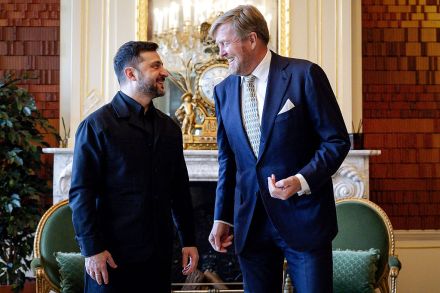
If bear hugs were army divisions and brave words cash euros, Volodymyr Zelensky would have ended his tour of European capitals this week the best-armed and best-funded leader in the world. "We stand with Ukraine," vowed British Prime Minister Sir Keir Starmer after hosting a summit for Zelensky and top European allies at Downing Street on Monday. "We support you in the conflict and support you in the negotiations to make sure that this is a just and lasting settlement." Germany’s Chancellor Friedrich Merz declared that "nobody should doubt our support for Ukraine" and added that "the destiny of this country is the destiny of Europe." France’s President Emmanuel Macron promised that Europe has "a lot of cards in our hands.

Is Prince Harry about to spend a lot more time in Britain?

From our US edition

For lovers of self-destructive hubris – a quality that the Duke and Duchess of Sussex surely possess in spades – the saga of Prince Harry’s security is surely the gift that keeps on giving. His attempts to obtain British taxpayer-funded armed protection whenever he brings his family back to the UK have been expressed with much fervor and repetitiveness. And now, in this season of miracles, it looks as if he might have got his wish after all.  It seemed certain, after various expensive and amusingly humiliating courtroom defeats, that Harry’s desire to hire members of the London Metropolitan Police as his private security detail whenever he is back in the country of his birth would be denied.

Scoop: Farage pulled out of Tucker Carlson interview

From our US edition

Is Britain’s upstart Reform party really as committed to free speech as they would have us believe? Tucker Carlson was meant to converse with leader Nigel Farage on his trip to London last week. But, Cockburn hears, Farage pulled out after the stateside controversy about Carlson’s recent choice to chat with “groyper” leader and bête noire Nick Fuentes. Who knew the leading light of the British right would be so sensitive about “platforming?” Top Farage advisor James Orr, who also serves as an Anglo-whisperer for Vice President J.D. Vance, made excuses on Reform’s behalf. “It’s the donors and consultants, always,” Carlson told Cockburn about the choice to pull out. “If you want to save your country, you have to ignore them.

Prince Harry

Why shouldn’t Trump deport Prince Harry?

From our US edition

There are many things Americans admire about Britain – Shakespeare, Churchill and parliamentary democracy (on a good day). Above all, we admire the monarchy: that ancient, faintly miraculous institution which maintains its dignity even as the rest of the West dissolves into hashtag-fueled hysteria. What we do not admire, however, is being used as a backdrop for Prince Harry’s increasingly frantic attempts to remain relevant. No, I do not actually wish for President Trump to deport Harry to the Tower of London – although the image is, I confess, delicious, and might conceivably enjoy rare cross-party support on both sides of the Atlantic.

Are America’s women heading for the exit?

From our US edition

Life is apparently so disagreeable in Donald Trump’s America that 40 percent of women aged between 15 and 44 want to leave. That is four times higher than the 10 percent who wanted to quit the US in 2014. According to Gallup, which conducted the poll, nearly half the nation’s younger women have “lost faith in America’s institutions.” This disenchantment accelerated after the Supreme Court’s 2022 decision to overturn Roe v. Wade, which enshrined the constitutional right to abortion. Younger American men are bearing up better. Only 19 percent share women’s distaste for the Donald, a 21 percent differential which is the largest recorded by Gallup since it began asking the question in 2007.

Women

Fact check: are the NYT’s experts right about UK immigration?

Yesterday’s release of immigration figures by Britain's Office of National Statistics didn’t make for particularly pleasant reading. While net migration had fallen to around 200,000 in the 12 months to June, much of this was down to an unusually high exodus of people, with 693,000 leaving the country over the same period. Many of those leaving were under the age of 30. That news, however, seemed to prompt something approaching gloating over at the New York Times, which published a piece yesterday headlined: "The British Public Thinks Immigration Is Up. It’s Actually Down, Sharply." To labor the point, the piece was accompanied by a picture of anti-migration protestors in Scotland. The not-so-subtle subtext being: what a bunch of gammon thickos the anti-migration lot are in the UK.

immigration

The strange death of England

Whatever happened to Britain, or the UK, or England, or whatever they're calling it? We can't even agree on what it's called. But what happened to England, the England that, if you're over 50, you grew up learning about, the England that controlled the world, the England that ran the largest empire in human history at the end of World War One?  Britain, which is an island in a pretty inhospitable climate, controlled literally a quarter of the Earth's surface – and not controlled in the way the United States controls the rest of the world with an implied threat or with economic ties through trade, but with administrators and people sitting at desks with eyeshades, counting things.

Andrew Mountbatten-Windsor should ignore Congress

As an American who respects the constitutional role and historical continuity of the British crown, I view the recent congressional request to interview Andrew Mountbatten-Windsor with disgust. In early November, several of the most progressive Democratic members of the US Congress sent a letter asking him to participate in a “transcribed interview” regarding his past association with Jeffrey Epstein, with a response deadline of November 20. While Congress is free to seek information, the request carries no compulsory authority over a foreign national residing in the United Kingdom. In this context, the decision to issue such a demand – despite its unenforceability – is less an exercise of legitimate oversight than a symbolic, politically motivated gesture.

andrew