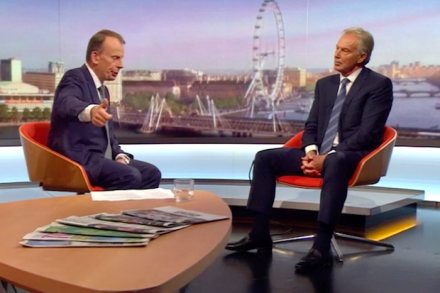
Tony blair

In defence of British institutions

‘Terms and conditions will apply.’ That, or something near it, was Dan Rosenfield's initial response when Boris Johnson invited him to become Chief of Staff in No.10. Naturally, Mr Rosenfield was tempted. But he wanted assurances that he would have the authority to run a serious political outfit. He was not interested in becoming a zoo-keeper. That was not a problem. The zoo has been closed down. The Dominic Cummings era is over. Boris's willingness to hire a completely different character, following the appointment of Simon Case as Cabinet Secretary and Head of the Civil Service, suggests that the PM can recognise and value seriousness in others, even if he himself has problems in displaying it. Yet there are bigger issues in play.
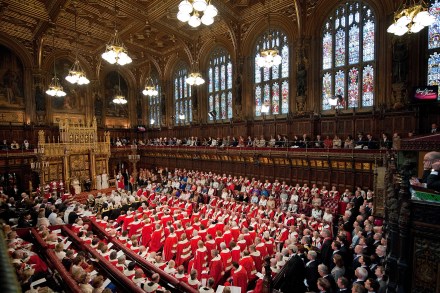
(photo: Getty)

The real Rupert Murdoch, by Kelvin MacKenzie

For more than four decades I have been around Rupert Murdoch. In that time he employed me in both London and New York, invested in my business ideas and ultimately fired me. It was always rock ’n’ roll around Rupert and that’s the way I liked it. So you would have thought that when the BBC made its current three-part documentary on him, it might have come to me for my views. Oh no. I presume it didn’t want to take the risk I might say something warm and supportive. It did, however, film Trevor Kavanagh, the Sun’s political columnist, for hours on end. He was warm and supportive. But all that was left on the cutting room floor. The BBC only wanted the bile. Instead, it concentrated its filming on the usual suspects.

Sunday shows round-up: Transport Secretary’s Spanish self-isolation shows ‘risk for everyone’

Dominic Raab - 'Swift decisive action' needed on new quarantine rules The government updated its rules on foreign travel yesterday so that anybody returning to the UK from Spain has to self-isolate for 14 days. The new guidance reflects the discovery of 971 new coronavirus cases in Spain in one day, prompting fears of a second wave in the country. Sophy Ridge interviewed the Foreign Secretary Dominic Raab and asked him to justify the rapid imposition of the new quarantine guidance: https://twitter.com/RidgeOnSunday/status/1287301425295437824?ref_src=twsrc%5Etfw SR: Why was the decision taken with so little notice? DR: ...We took the decision as swiftly as we could. We can't make apologies for doing so. We must be able to take swift, decisive action...

The delicate balance between God and Caesar in modern Britain

At a well-reported political meeting at London’s Queen’s Hall during the first world war the preacher and suffragette Maude Royden used a phrase that would pass into history. ‘The Church shall go forward along the path of progress,’ she argued hopefully, ‘and be no longer satisfied to represent the Conservative party at prayer.’ ‘Conservative’ would soon slip to ‘Tory’, and one of the most popular and potent political epithets of the 20th century was born. There was (and is) much evidence for Royden’s famous phrase. An Anglican-Conservative complex dominated much 19th-century politics when most English — indeed much British — politics could be effectively divided along the lines of church or chapel.

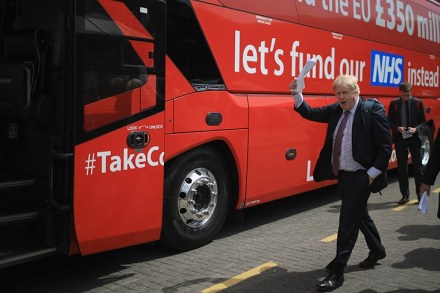
Boris Johnson is the real heir to Blair

Boris Johnson is to 'take personal charge' of a new crackdown on crime and gangs. So reports Steve Swinford of the Times, one of the Lobby’s best reporters. While this is a good and new story, for a jaded and ageing ex-hack like me it crystallises a vague feeling that’s been nagging at me for a few weeks and prompts this realisation: Boris Johnson is turning into Tony Blair. These days Blair is often remembered as the quintessential metropolitan liberal politician, a champion of globalisation, economic openness and, above all, the EU. I became a Lobby reporter in 2001 and my memory of the Blair government that I covered is was rather different. On the economy, he oversaw an expansion of state spending and state provision.

Ben Schott: I’m Tony Blair’s brother (according to Google)

The globe (Golden and otherwise) has rightly fallen h-o-h for Olivia Colman who, before The Crown, The Favourite and Peep Show, had an early role as Bev in the ‘Bev-Kev’ ads for AA insurance. But I was there at the very beginning, when she starred opposite her husband-to-be in a 1995 Cambridge production of Alan Ayckbourn’s Table Manners, directed by the incomparable Kate Pakenham. I was in charge of the sound and lights, which weren’t very elaborate, given the 80-seat Corpus Playroom could be lit with a 100-watt bulb. But I did have one minor creative triumph.

Democracy redux: the lessons of 2019

Britain’s parliamentary democracy is easily mocked: the medievalisms, the men in tights, the ayes to the right. But it has been preserved because it tends to work. It focuses minds and makes order out of chaos. Yet again we have a general election result that almost no one predicted — and one that offers plenty of lessons for those with an eye to see them. The communities so often patronised as ‘left behind’, typically in northern and coastal towns, have now demonstrated that they are powerful enough to decide elections. During the Blair and Cameron eras they were written off as a declining demographic: older, poorer, less educated and often stuck in the past. The ‘modernising’ politicians, it was argued, needn’t worry too much about them.

Does Tony Blair think free speech isn’t for everyone?

Not content with agitating against democracy with his relentless Remainer shenanigans, now Tony Blair appears to be aiming his fire at freedom of speech. Seriously, is there no civilisational liberal value this man doesn’t want to take down? A new report for Blair’s think-tank, the Tony Blair Institute for Global Change, says hard-right groups should be subjected to censorship even if they are not involved in any kind of violent activity. The report says the government should draw up a list of ‘designated hate groups’ — you mean a blacklist? — and these designated groups should be prevented from appearing in media outlets or engaging with public institutions.

Bill of health

It would be daft for someone to offer you £1.8 billion and you turn it down. That sort of money isn’t to be sniffed at. This is how much Boris Johnson announced he would give to the NHS as an extra funding boost. And I don’t want to seem churlish or ungrateful — after all, those of us who work in the health service are always banging on about how NHS resources are near breaking point. But I have some reservations. The first is the most basic — I’m not sure this is quite the cash windfall it’s made out to be. While Boris has assured us that ‘this is £1.

Sunday shows round-up: A no deal would be ‘potentially devastating’ for Northern Ireland, Blair says

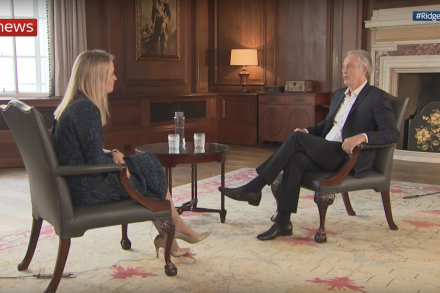
Tony Blair - No deal 'potentially devastating' for Northern Ireland Sophy Ridge began the morning with a wide-ranging interview with Tony Blair. The conservation inevitably turned to Brexit, something to which the former Prime Minister has long been opposed. Blair strongly criticised those politicians calling for a 'no deal' outcome after March 29th, arguing that they had 'played fast and loose' with the Northern Irish peace process from day one: https://twitter.com/RidgeOnSunday/status/1094525776861581312 TB: If we have a hard Brexit - no one could responsibly propose this. It would be economically very, very dangerous for Britain, and for the peace process in Ireland, it would potentially be devastating...

The Norway v People’s Vote fight

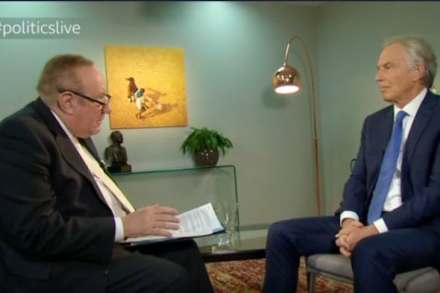
One of the bitterest divides in British politics right now is between advocates of a second referendum and those who favour the Norway option. They both want to be the last alternative standing to no deal; and are happy to trash each other in the process. On Politics Live tonight, Tony Blair, the most prominent advocate of a second referendum, laid into the Norway option. He derided it as a ‘pointless Brexit’, as it would leave the UK following the rules of the single market but with less say in how they are made. Nick Boles, the principal Tory advocate of Norway plus, then hit back in his own interview with Andrew Neil.

The people vs Brexit

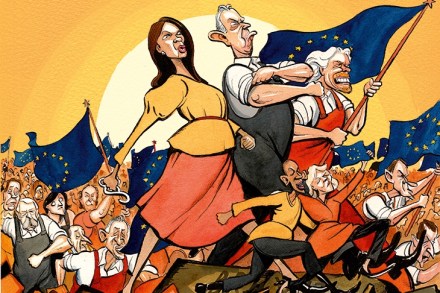
The very best impressionists do not simply mimic the mannerisms, speech patterns and facial expressions of their targets — they also cleverly satirise the beliefs, character and political dispositions of those targets. Most of us would not remember Mike Yarwood with great fondness because he was quite unable to do any of that. It was enough for Mike simply to raise his shoulders and laugh when evoking Ted Heath; there was no depth to the performance, nothing which gnawed away at Heath’s petulance and obstinacy and insecurity. So we should be grateful for Rory Bremner, who has pulled off a superb impression of a smug, simpering, Remainer London luvvie. With great acuity, he ticked all the boxes.

Tony Blair continues the campaign against Brexit

The campaign against Brexit continues today with Tony Blair’s speech in Brussels. I personally think that this campaign is unlikely to succeed, it is simply too much of a replay of the In campaign’s arguments from the 2016 referendum. But if this attempt to reverse the referendum result is to have any hope of succeeding, Blair’s leg is the most important. For he is asking the EU to make the UK an improved offer, to show that it is trying to address the concerns that led to so many people voting to Leave. Every time the European Union has asked a country to vote again on a treaty it has provided some concession to make it more palatable second time round.

Blair and Corbyn’s popularity contest

As expected, Tony Blair's latest Brexit intervention has proved universally unpopular. Brexiteers have hailed his criticism as the best advert for leaving the EU in weeks, while Corbynistas have gone on the offensive over his harsh words concerning the dear leader. Despite all this, Tony Blair can at least still count on one man to back him up: himself. In an interview with ITV, it was put to Blair that Corbyn actually did better than the former Prime Minister in the 2017 snap election than Blair in 2005. The reasoning goes that Corbyn won a higher percentage of the vote, at 40pc to Blair's 35.2pc. Somewhat unsurprisingly, Blair didn't take too kindly to this way of looking at things: 'On that basis Theresa May would be a more successful prime minister than Margaret Thatcher.

Brexit was a vote against Blairism

Tony Blair thinks he has discovered a form of words that could lead to the reversal of the EU referendum result. When the vote was taken voters did not know the exact terms of our departure. When they become clear, people might change their minds. The mistake in this line of spin is that the vote to leave was taken whatever the terms might be. It was said time and again during the campaign that the worst outcome – trading with the EU under the rules of the World Trade Organisation (WTO) - would be just fine. In fact, there were many who saw this outcome as the ideal to aim for. It is, after all, the framework for trade between the vast majority of the world’s nations.

Is Labour’s clever* Brexit strategy running on borrowed time?

We're four days into 2018 and Tony Blair has kindly graced the nation with his first Brexit intervention of the new year. Proving old habits die hard, the former Prime Minister has written a blog criticising the government's handling of Brexit. Blair claims Theresa May is on course to negotiate a deal that is the 'worst of all worlds' – allowing the Government to claim Brexit victory but in reality meaning the UK has lost its seat 'at the table of rule-making'. However, the main target for his ire is Jeremy Corbyn's Labour. Blair claims the party's confusing 'cake and eat it' approach of leaving 'the' single market but being in 'a' single market means 'the handmaiden of Brexit will have been the timidity of Labour'.

Feeding the frenzy

Tony Blair once remarked, during one of the periodic feeding frenzies that engulf British politics, that public life was becoming a game of ‘gotcha’. These days feeding frenzies, like Atlantic hurricanes, seem to strike with increasing frequency. No week passes without someone, somewhere calling for this or that minister to quit. When a minister does resign the focus quickly switches to whomever is next in line. No sooner has the defence secretary gone than Damian Green enters the frame, until Priti Patel obligingly puts her head on the block, only to be followed by Boris Johnson, and so on. Now, three weeks on, Damian Green is again back in the spotlight. At the time of writing his prospects do not look good.

Books Podcast: The art of the political speech

In this week’s Books Podcast I’m talking to the Times columnist and former speechwriter for Tony Blair, Philip Collins, about one of my favourite subjects: rhetoric. His new book When They Go Low, We Go High is a fascinating look at political oratory from Pericles to (Michelle) Obama, and a vigorous argument for politics itself as a bulwark against the false promises of populism. We talk about what it was like writing for Blair, the greatest speech he wrote that was never delivered, how a speechwriter can trick a Prime Minister into announcing a policy he didn’t expect to announce - and why he’s proud to be a “Centrist Dad”. You can listen to our discussion here: And do subscribe on iTunes for more like this, every Thursday.

Sunday shows round-up: Blair says Britain can limit immigration without leaving the EU

Tony Blair - Britain can limit immigration without leaving the EU Former Prime Minister Tony Blair has been trying to find a way to reduce immigration to the UK without leaving the European Union. The Institute for Global Change, the organisation that Blair set up earlier this year, has published a report on this very topic. Outlining his proposals to Andrew Marr, Blair also called on sympathetic MPs to unite against Brexit in order to prevent 'economic and political damage': https://youtu.be/rcimyFouCus AM: A lot of people already this morning have said 'It's a little bit rich coming from you given how you opened the doors back in the 2000s to mass immigration and changed lots of communities. TB: We shouldn't exaggerate this...

Bad news for the Tories: Corbyn has learned to love the centre

When Tony Blair was selling out the Labour Party by introducing a minimum wage, paid holiday leave and free nursery education, the hard left reckoned it had his measure. Semi-Trots and leftover Bennites, since decamped to one of the many exciting acronyms British Leninism has to offer, filled monochrome magazines and academish journals with tracts denouncing Blair as a Tory, a Thatcherite and both a neoliberal and a neocon. The charge sheet was echoed with righteous indignation by proud purists on the backbenches and in the columns of the Guardian and the Independent. New Labour was so far to the right it was indistinguishable from the Conservatives. What was the point, they asked, of a Labour Party that simply aped the policies of its opponents?