Schools

The Chinese takeover of Britain’s public schools

Roedean is now known as ‘Beijing High’. Cheltenham Ladies’ College is ‘Hong Kong College’. In the country’s most elite boarding schools, pupils say that they are one of just a handful of English children. Others note that Chinese has become the dominant language in hallways and dormitories. Many English parents can no longer afford a boarding school education for their children. And the pressure of recently introduced VAT on fees, as well as above-inflation rises year on year, means the number able to cough up will dwindle further. By contrast, China and Hong Kong’s growing economy and cultural obsession with education provides a surfeit of parents with the cash needed to secure the educational prospects of their children.

The joyless reading app being forced on my son

It was only recently that I fully appreciated how the books I read as a child formed me. A pregnant friend asked me about my parenting philosophy and I realised it amounted to ensuring my son would survive a tour of Willy Wonka’s chocolate factory. I never had the money of Veruca Salt’s daddy to indulge his every desire, but I came down hard on chewing gum, gorging on chocolate and, above all, staring at a screen.  Despite my son’s complaints that I was acting like a father from Victorian times, it seemed to have worked, and, as the Oompa--Loompas predicted, not being glued to a screen encouraged him to become a reader, out of boredom if nothing else. If the house was quiet, too quiet, I would usually find him reading a book in a corner.

Pubs, schools and water in crisis: my economic forecast for 2026

Forecasting is a mug’s game, as the Bank of England governor Mervyn King once said. But I’ll sketch a few trends for 2026 nevertheless, starting on a positive note in the stock market before moving on to some of the many choices on an à la carte menu of gloom. The FTSE 100 index will have ended 2025 almost 20 per cent higher than it started – slightly better than the US S&P 500 index – and the consensus of fund managers is that (having closed for Christmas at 9,870) it will carry on upwards, perhaps even towards 11,000. Why? In short because many UK blue-chips in traditional sectors such as banking, housebuilding and mining have been undervalued for too long, because interest-rate cuts will help, and because stock markets have a mind of their own.

Is our education system radicalizing young men?

From our US edition

My 11-year-old son joined the elementary school band, and so I went to the parents’ orientation night held at a local high-school. As the night went on it became obvious why young men rage against the larger social system and why they might find a character like Nick Fuentes attractive. The classrooms were inundated with DEI messages and trans pride flags. On the walls there were posters, stickers and decorations that all invoked the various totems of diversity. Black Lives Matter messaging, decolonization messaging, LGBTQ+ messaging and basically every sort of race and gender social justice messaging you can imagine was present.

young men

So what if Nigel Farage was the school bully?

There may well be, somewhere in this nation of ours, a long-established succession of sensitive, emotionally aware 14-year-olds who can appreciate and denounce the impact of bullying. But, honestly, none of them went to my school.  It doesn’t sound like there were many of this cadre at Dulwich College half a century ago either. At least, not if we believe the recent Guardian ‘scoop’ which claims, thanks to the testimony of Nigel Farage’s fellow pupils (much of which was made public years ago), that the Reform leader was a racist, hate-fuelled youth who taunted anyone of a different faith or ethnicity.

The catastrophic dumbing down of German education

German teachers are a privileged species. Most of us enjoy the status of a Beamter, a tenured civil servant. We can be dismissed only after a serious criminal conviction, we are exempt from social insurance contributions, and even our mortgage rates are lower. Such comfort discourages dissent. Yet, after more than 25 years as a pampered Beamter, I find myself overwhelmed, not by the teaching load or the students, but by the accelerating erosion of academic standards. Having taught English, history and Latin at four different Gymnasien, the equivalent of a grammar school, I have learned that challenging students is frowned upon by both bureaucrats and politicians. Nearly all my colleagues agree that standards have plummeted.

The parents gaming special educational needs

As a foster carer and adopter, I’ve spent more mornings than I care to count coaxing my 13-year-old daughter into her uniform and then into the car. She has fetal alcohol spectrum disorder, the UK’s most underdiagnosed neuro-developmental condition, which leaves her with a brain wired for impulsivity, memory lapses and emotional storms that no local school can contain. Each day, I drive her across several counties to the only specialist placement that can meet her needs. Four hours a day, every week day. While I’m grinding through the traffic, taxpayers are footing bills that could fund whole classrooms. Councils and schools spent a record £2.26 billion on special educational needs and disabilities – ‘Send’ – transport last year.

Bring back elitism

Elitism has had a bad press in recent years. The concept has, alas, been tainted by its association with the numerous elites who have corrupted it by allowing self-interest and prejudice to become self-perpetuating. It’s been sullied by its association with old school ties and masonic-style handshakes – by closed networks which work to exclude those who happen to fall outside the pre-determined in-group. So no wonder we don’t like it any more. Who would? But its gravest sin of all has been its role in pulling up the drawbridge to protect privilege in general, through a kind of unspoken fish-knife test. If you don’t know what it’s for, you don’t get in. One way people used to storm the castle of privilege was through grammar schools, of course.

Mamdani declares war on excellence

From our US edition

New York Assemblyman Zohran Mamdani has a bold plan for the city’s schools: phase out the Gifted and Talented program in elementary education. His rationale is that these programs create disparities and feed inequality. It’s a familiar progressive argument. If some students are excelling, others must be suffering. If a child is recognized as gifted, it’s unfair to those who aren’t. The logic is as simple as it is destructive: equality means sameness, even if sameness means mediocrity. There is nothing wrong with recognizing giftedness. In fact, it’s common sense. If a child demonstrates unusual ability in math, science, writing, or the arts, you nurture it. You don’t bury it under a misguided notion of “equity.” Excellence, like athletic talent, must be cultivated.

Zohran Mamdani

Is Randi Weingarten America’s most divisive woman?

From our US edition

In the aftermath of the assassination of Charlie Kirk, a moment when leaders across the political spectrum should be dialing back the rhetoric and fostering unity, Randi Weingarten has charged ahead with her divisive agenda. As president of the American Federation of Teachers (AFT), she has doubled down on promoting her new book, which brands conservatives as "fascists." This inflammatory approach comes at a time when the nation is reeling from violence, yet Weingarten shows no signs of restraint. Her recent appearances underscore this troubling pattern. On MSNBC, while hawking her book, Weingarten suggested the US is under “Nazi occupation,” claiming she now wears a paperclip as a symbol of resistance.

Randi Weingarten

Why Chicago Teachers Union lionized a terrorist

From our US edition

When I first saw the Chicago Teachers Union's post honoring Assata Shakur, I thought it was a headline from the Babylon Bee. But no, this one was real, and beyond parody. The union, entrusted with educating Chicago's children, used its official social media account to mourn the death of a convicted cop killer, calling her a "revolutionary fighter" and "leader of freedom." Shakur was found guilty of murdering New Jersey State Trooper Werner Foerster in 1973 and later escaped prison, landing on the FBI's Most Wanted Terrorists List with a $2 million bounty. To make matters worse, CTU Vice President Jackson Potter doubled down, declaring on X that "Assata was a freedom fighter!"The tone-deaf post is a glaring sign that the CTU can't be trusted to educate children.

Assata Shakur

Back-to-school photos have become a vulgar wealth flex

How was National Standing on Doorsteps Week for you? For most, it’s a case of grabbing a picture two or even three days after la rentrée, when you remember that you’ve missed the annual obligation to record the progress of what Mumsnetters call the ‘DCs’ (darling children). Assemble them by the front door, roar at the one who’s kicking off to SMILE and look at ME, lament that you failed to get your sons’ hair cut before they went back as overnight they’ve come to resemble Hamburg-era Beatles, press the button and then bundle them into the car.

Why America’s schools are failing

From our US edition

It seems that every few years America rediscovers that its children can’t read. In 2024, only 30-31 percent of eighth graders were deemed proficient in reading, and our numbers in history and math are even worse. Since 2020, no state has reported improvement across subject areas.It’s tempting to blame “the pandemic” for these declines, but in reality, Covid only accelerated trends that were already underway. For decades before 2020, US students were struggling to reach proficiency, and the truth is that the problem isn’t today’s culture-war skirmishes over pronouns, politics and school closures. It’s the more mundane question of how children are taught to read, to count and to remember.Let’s take phonics, for example.

Schools

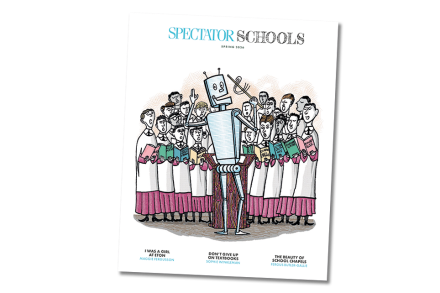
Spectator Schools: autumn 2025

In this week’s Spectator Schools supplement, Ysenda Maxtone Graham interviews Sir Nicholas Coleridge as he completes his first year as Provost of Eton. He speaks to her about the changing face of the school, Labour’s ‘pernicious’ tax on learning and the possibility of admitting girls (‘Never say never’).  In The Spectator’s Oxbridge files, we reveal a league table showing how well state schools – grammars, sixth-form colleges and others – compete with independent schools when it comes to Oxford and Cambridge offers.

The false economy of cutting the Combined Cadet Force

What could be more fun for a 14-year-old boy than messing about in the woods with a gun? My school’s Combined Cadet Force offered precisely that, marching us through the Brecon Beacons and organising mock skirmishes with SA80 rifles (albeit using blanks). When we weren’t trying to shoot each other, we were fighting over OS maps and compasses, trying to find which bit of woodland we were supposed to be sleeping in. One group found a dead body on the side of a Welsh mountain. Another spent an evening drinking vodka and smoking cigarettes with a strange man in a caravan. At some point in the small hours, he got a little too handsy and they all ran back to their bivvies. I was hugely envious when they told us this as we ate powdered eggs, cooked in a mess tin over burning hexamine tablets.

Sir Nicholas Coleridge: ‘Girls at Eton? Never say never’

T he historic graffiti at Eton College, chiselled into its stone walls, wooden panelling and ancient oak desks, serves as a reminder to any Etonian that he’s merely the latest in a long line of boys stretching back to 1440 who have passed through the school and occasionally bent the rules. Two names chiselled together into a wall of the Cloisters are ‘H. COLERIDGE’ and ‘E. COLERIDGE’. ‘Not me!’ says Sir Nicholas Coleridge, Eton’s 43rd Provost, when I visit him on the last day of the summer term, ‘or any of my sons. They’re dated 1817, luckily, so we can’t be blamed.’ ‘The imposition of VAT has been a very damaging thing for education.

Pity the poor offspring of the pushy Pollys

What do tech bros and pushy parents have in common? They’re both fond of citing Samuel Beckett’s most famous quote: ‘Fail again. Fail better.’ For parents, the line is invariably deployed when their ‘gifted’ child has underwhelmed at a crucial juncture. Let’s park the inconvenient fact that Beckett’s line has nothing to do with self-help. Just go with it and nod sympathetically while inwardly enjoying their elaborate contortions in an attempt to save face. Perhaps my favourite example is a West London mother (we’ll call her Polly). Her boy’s failure to get into Cambridge (‘It wouldn’t have been the right place for him anyway, so we’re pretty relieved!’) has proved to be a gift that continues giving.

Should boarding schools be phone-free?

No development has shaken up the cloistered and carefully controlled world of English boarding school life quite as much as the invention of the smartphone. Traditionally, schoolboys might write home once a week. Perhaps they might be able to smuggle in a dirty magazine or other contraband, but for the most part boarders on school grounds were safely tucked away. Today, thanks to smartphones, children are sent to school with access to pornography, internet chatrooms and easy contact with their parents. What horrors might a group of 13-year-olds get up to in a dorm if left unattended with internet access? Should boarding school children be permitted to phone home each night? What horrors might a group of 13-year-olds get up to in a dorm if left unattended with internet access?

The independent schools crisis is only just beginning

Ever since the sudden and cruel imposition of VAT on independent school fees at the start of the year, much of the media focus has been on the number of school closures. The first to go have been prep schools and schools in rural areas far from London and the south-east. Trust me, this is really only the beginning. Savvy parents have always known a reduction in those shiny buildings won’t matter that much in the end Only a very small number of independent schools will be completely immune from the current financial pressures and – in the next couple of years – that will start to become increasingly obvious. While many might not close, there will be more mergers and acquisitions, and a scramble for schools to enjoy the benefits and protections of being part of a larger group.