Napoleon

How Macron was outfoxed by a dead Napoleonic general

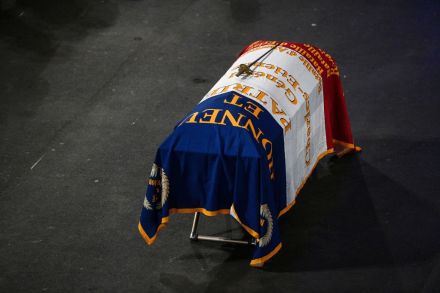
Skeletons don’t always lurk in cupboards, some of them hide under dance floors waiting for a particularly rousing party to dislodge them. Such is the story of one of Napoleon’s favourite generals, César Charles Étienne Gudin de La Sablonnière, whose missing remains were discovered under a dance floor in Smolensk in 2019, over 200 years after his death from a cannonball during the French invasion of Russia in 1812. Yesterday, his one-legged skeleton was repatriated to France via a private jet chartered by the Russian oligarch, Andrei Kozitsyn. Not a bad way to travel for a Napoleonic soldier. The discovery of Gudin’s remains and their passage home unearths some complicated truths for President Macron.
How Napoleon changed the world

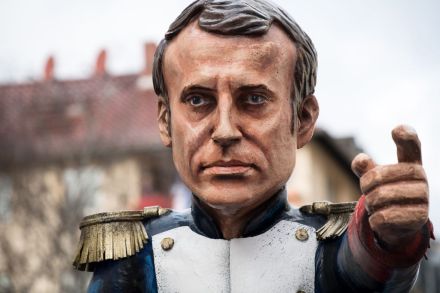
Two hundred years ago today, Napoleon Bonaparte closed his eyes for the final time. A man born to relative obscurity in Corsica, he was lifted by merit to become Emperor of the French and conqueror of Europe. But the fault of his ambition and the might of his enemies ultimately led to his defeat at Waterloo. Napoleon died in British captivity on St Helena. Even in death, though, it is hard to doubt that Napoleon not only shaped the modern world, but still influences it today. France's current president Emmanuel Macron is often compared to Napoleon. As John Keiger has pointed out on Coffee House, Macron appears to share Napoleon's obsession with the British. But it would be a mistake to think it is only Frenchmen who look to their country's most famous leader for inspiration.

Kubrick’s Napoleon – the greatest movie never made

Two centuries ago — on 5 May 1821 — Napoleon Bonaparte died in a rat-infested house. The fallen Emperor had spent his final years exiled on the British outpost of St Helena. Yet Napoleon’s ignominious last act was only the beginning of his legend. A recent data-driven study, published by Cambridge University Press, crowned him the second most significant figure in history, after Jesus no less. Stanley Kubrick, the virtuoso director of 2001: A Space Odyssey and The Shining, considered Napoleon the most interesting individual who ever lived. Kubrick’s passion project — never produced — was a biopic of the conqueror. He predicted it would be the ‘best movie ever made’. Napoleon’s life has everything a storyteller could want.

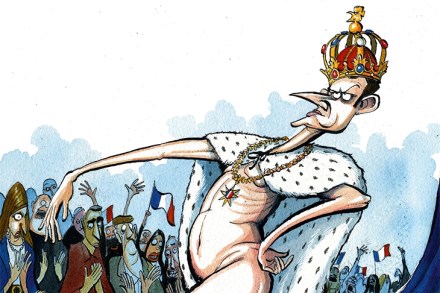
Macron’s Napoleon complex

May 5th this year will be the two hundredth anniversary of Napoleon’s death on Saint Helena, the tiny island in the south Atlantic where the British confined the Emperor to Longwood House after defeat at Waterloo in 1815. After much hesitation, Emmanuel Macron has decided that France will commemorate the Emperor’s place in French history. Though the most recognisable historical figure in all surveys of the French, almost no public spaces or institutions bear his name. Monarchy and Republic cancelled him. Bonaparte divides. He is at once the figure who tamed the Revolution, drastically reformed France and yet the dictator who overran Europe and reinstated slavery.

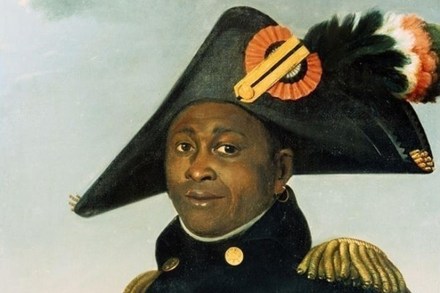
Toussaint Louverture: the true hero of Haiti

In Haiti you have to be careful which founding father you admire. The average Haitian will think first of Toussaint Louverture when talking about their island’s revolt against France in the late 18th century, and about the original idea of a full-fledged Black republic: Toussaint the stable, the intense, the military genius, courageous, careful. But for others, the real hero of the revolution is Jean-Jacques Dessalines, or Papa Dessalines, who is said to have connived with the French to remove Toussaint from power. Once France had exiled Toussaint, Dessalines turned on the French, rejecting their ‘peace’ and authority. He prosecuted the revolution to its bloody end, but without the restraint that Toussaint had often demanded from his fighters.

Prince of Europe’s long peace

From our US edition

This is a giant Teutonic forest of a book, to be progressed through with determination as if by seasoned infantry; it is as far as biography can get from a Viennese waltz. But it has its rewards. It is an extensive and wellresearched chronicle of Klemens von Metternich’s monumental career — 39 years as foreign minister of the Austrian Empire, the last 27 of them also as state chancellor, and an extensive diplomatic career prior to all that. Wolfram Siemann presents and argues for a new and rather liberal interpretation of ‘the Metternich system’ instead of the normal view of Metternich’s influence as rigid and reactionary.

metternich

Death at the top

Agatha Christie’s spirit must be loving this poisonous new historical entertainment. Eleanor Herman has already enjoyed the success of Sex with Kings and Sex with the Queen, thoroughly researched, gossipy revelations of promiscuity among monarchs and their noble retainers during the Renaissance. She is an American author and broadcaster, born in Baltimore, now living in Virginia, but, at 58, she still concentrates her professional attention on the historic immorality and disastrous vulnerability of western European royalty. In the Middle Ages, when monarchs commanded virtually absolute power, rivalry for every top job was sufficiently intense to motivate assassination, and the least difficult way to commit it was with poison.

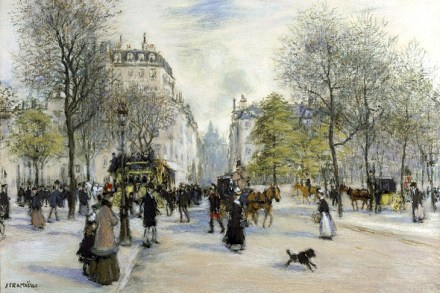
Baron of the boulevards

Rupert Christiansen’s City of Light opens on the evening of 5 January 1875, with the inauguration of Paris’s new opera house, designed by Charles Garnier ‘in a style of unabashed grandeur’, with its gilded and mirrored salons, shimmering candelabra and marbled colonnades, mosaics, statues, frescoes and ‘flaming gas torches enhancing a central stairwell that turned the ascending and descending audience into an impressive spiralling spectacle’. The building had been under construction for almost 15 years at vast cost and symbolised the extravagance of the Second Empire, a period in French history which lasted for 18 years, from Napoleon III’s coup in 1852 to the Franco-Prussian war of 1870.

Books of the year – part one

Andrew Motion Short stories seem to fare better in the US than the UK, and among this year’s rich crop, Deborah Eisenberg’s Your Duck is My Duck (Ecco, £20.70) is outstanding. Everything about Eisenberg’s writing is highly controlled — watchful, well-made — and everything it describes teeters on the verge of chaos or collapse. It makes for a brilliant mixture of a book — at once compact and capacious, eerily familiar and extremely strange. Roger Lewis One of my favourite authors is Laura Thompson. Her biographies of sundry Mitfords, of Agatha Christie and Lord Lucan (recently revised in the light of the unpleasant Countess’s demise) are brilliant and forensic.

Saviour of the world

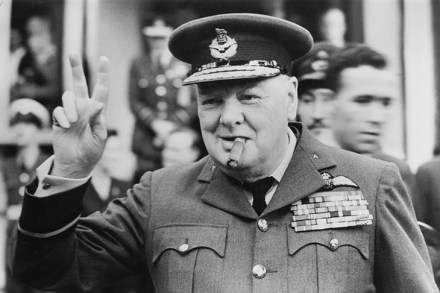
Churchill must be the most written-about figure in public life since Napoleon Bonaparte (a subject, incidentally, to which Andrew Roberts has already contributed a substantial and prize-winning biography). As the publisher obligingly warns us, there have been over 1,000 previous studies of Churchill’s life, including some dross, but many works of serious importance. To add anything worthwhile to this mountain requires that the author should be determined, courageous and have something new to say. No one has ever doubted Roberts’s determination and courage; the question remains whether he has anything new to say. Rather to my surprise, the answer has to be ‘yes’. Roberts has been assiduous in his research.

On the run from Corunna

There is only one Andrew Miller. In the 20 years since his debut novel Ingenious Pain won both the James Tait Black Memorial Prize and the IMPAC Dublin Literary Award, he has written a series of books which have captured the imaginations of readers and critics alike. Oxygen (2001) was shortlisted for the Booker, while in 2011 Pure, the tale of a young engineer in pre-revolutionary Paris clearing the notoriously overstuffed Holy Innocents’ Cemetery, won the Costa Book of the Year award. Miller is read around the world; as a British author of (mostly) historical fiction that is both popular and literary, his peers are Hilary Mantel and, perhaps, Sarah Waters.

Napoleon dynamite | 14 June 2018

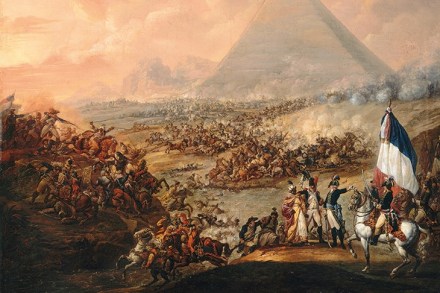
The Musée de l’Armée at Les Invalides in Paris has a new exhibition that I believe to be the best and most extensive on the Emperor in three decades. Anyone interested in Napoleon Bonaparte, early 19th-century military history and strategy, the Grande Armée’s campaigns from 1796 to 1815, monumental battle paintings, First Empire beaux-arts, uniforms, weaponry or cartography, has only until 22 July to visit the truly breathtaking Napoleon: Strategist. On entering, you walk past the large busts of six of the seven great captains of history that Napoleon said he admired and wished to emulate: Alexander, Hannibal, Julius Caesar, Henri de la Tour d’Auvergne, Marshal de Saxe and Frederick the Great.

London calling | 26 October 2017

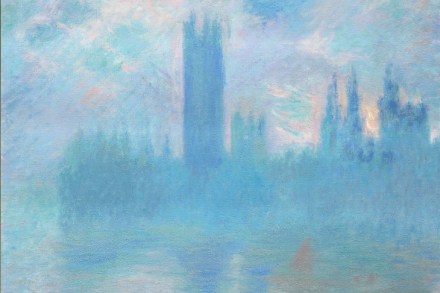
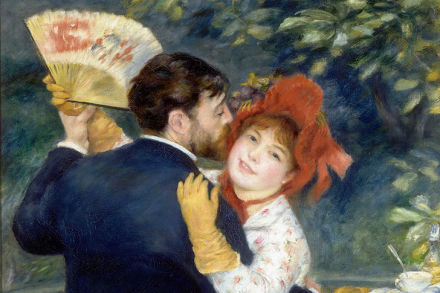
Madame Monet was bored. Wouldn’t you have been? Exiled to London in the bad, cold winter of 1870–71. In rented rooms above Shaftesbury Avenue, with a three-year-old son in tow, a husband who couldn’t speak English, and no money coming in. Every day roast beef and potatoes and fog, fog, fog choking the city. ‘Brouillardopolis’, French writers called it. Camille Monet had offered to give language lessons, but when she hadn’t a pupil — and Claude hadn’t a commission — she let him paint her, listless on a chaise-longue, book unread on her lap. Her malaise was ‘l’exilité’ — the low, homesick spirits of the French in England.

Conning the connoisseurs

Rogues’ Gallery describes itself as a history of art and its dealers, and Philip Hook, who has worked at the top of Sotheby’s for decades, is well versed in his subject. Sadly for the prurient, this is not an exposé of the excesses of the market from one of its high priests; and Hook says that where possible he has avoided writing about the living. It is hard not to feel a bit disappointed. For an alarming moment in the introduction, it seemed as if he was preparing to write an academic treatise about how dealers influence art and taste.

Light in the East

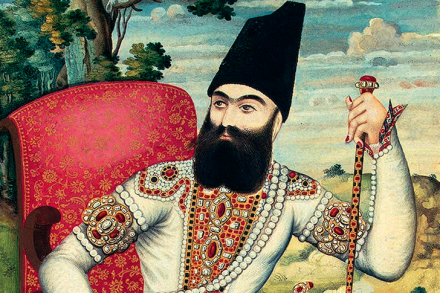
Christopher de Bellaigue, a journalist who has spent much of his working life in the Middle East, has grown tired of people throwing up their hands in horror at Isis, Erdogan and Islamic terror, and declaring that the region is backward and in need of a thorough western-style reformation. As he argues in this timely book, the Islamic world has been coming to terms with modernity in its own often turbulent way for more than two centuries. And we’d better understand it, because it’s an interesting story, and often a positive one — the way vast crowds streamed onto the streets of Cairo, Istanbul and Tehran in demonstrations against authoritarian rule over the past decade, for example. Western-style participatory democracy remains the dream of the man and woman in the souk.

Wall eyed

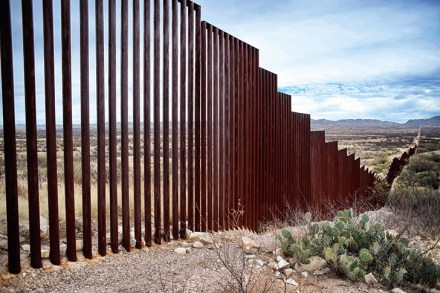
Any impressively long wall is bound to cause us to recall the midfield dynamo and philosopher John Trewick. In 1978 Big Ron Atkinson took his bubble-permed West Bromwich Albion team to China on some sort of goodwill tour. The lads’ diplomacy evidently rested in their feet, for when Trewick was asked by the BBC crew documenting the tour what he thought of the Great Wall, he replied: ‘When you’ve seen one wall you’ve seen them all.’ Good try, John, but not quite accurate. He would, however, have been on the money had he alluded to the common state of mind among men who commission immense walls (paranoiac) and to the loss of life that is, without exception, occasioned by the construction of the things (considerable).

A very special relationship

You learn startling things about the long entanglement of the British with Spain on every page of Simon Courtauld’s absorbing and enjoyable new book, which is not a travelogue but a collection of historical vignettes arranged geographically. Did you know, for instance, that the first Spanish football team was founded by two Scottish doctors working for Rio Tinto in Huelva, and that in 1907 a team of seminarians from the English College in Valladolid defeated one representing Real Madrid? Or that the first visit by a reigning British monarch to Spain occurred when Queen Victoria went to have lunch with Queen Maria Cristina at the Aiete Palace in San Sebastián, travelling by train from Biarritz and returning the same afternoon?

Napoleon dynamite

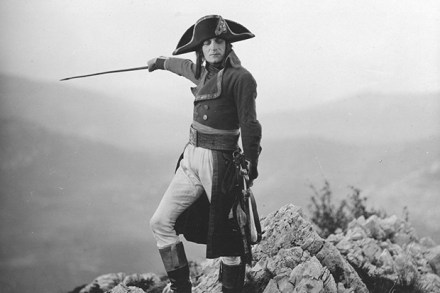
I shall never forget my first encounter with Abel Gance’s Napoleon. I saw it under the most unpromising circumstances — fragments of the great original, shown on a home projector, 25 years after its original release. Yet those fragments changed my life. I was 15, still at school in Hampstead, and already obsessed by the cinema. My parents had given me a projector for my 11th birthday. Since the only films available to me were silent films, I found myself immersed in the rarefied atmosphere of a forgotten art. As home movies were being abandoned in favour of television, I found a surprising number in London’s junk shops. Among the best were the French silent films. My admiration for them, however, was subject to the occasional shattering blow.

Diary – 1 September 2016

European unions come and go. Back in 1794, one of the more improbable ones was founded when Corsica joined Britain as an autonomous kingdom under the rule of George III. It didn’t last long, and by 1796, after an ignominious Brexit from the island, the Corsicans once again found themselves under French rule. Today, the episode is chiefly remembered for the injury sustained by one particular officer during the initial British capture of the island: it was during the siege of Calvi that Nelson lost the sight in his right eye. ‘Never mind,’ he wrote to his wife, ‘I can see very well with the other.

High life | 21 July 2016

From my bedroom window I can see a little girl with blonde pigtails riding her bicycle round and round for hours on end. She’s German, looks ten years old and lives nearby. Next month I am finally moving to my new home, a beauty built from scratch amid farmland. Cows, deer, the odd donkey graze nearby, a far better bunch than the one Gstaad attracts nowadays. I am, however, king of the mountain. My place is the highest chalet on the Wispille, one of the three mountains that dominate the Mecca of the nouveaux-riche and the wannabee. Life is swell, as long as the old ticker keeps ticking. An approaching birthday tells me that it’s time to take stock, do something of consequence, begin taking life seriously at last.