Margaret thatcher

The View from 22 — Francis Maude and Liz Truss on Margaret Thatcher

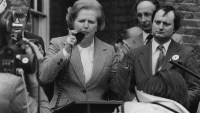
How does Margaret Thatcher's legacy impact Tory MPs today? This week's Spectator magazine contains a 16-page supplement considering the premiership of Baroness Thatcher, both high and low points. On this week's View from 22 podcast, Francis Maude debates whether Thatcher was the original moderniser. One of the few ministers to serve under both Thatcher and David Cameron, Maude offers his insights into what Thatcher thought of the present-day Tory party, why she actually avoided some particular battles, and how she is seen by the Prime Minister, who Maude suggests is completing the Thatcherite project. The Children and Families minister Liz Truss — a self-proclaimed Thatcherite — also joins us to discuss what the 2010 intake of Tory MPs think about Margaret Thatcher.

The Tory modernisers are Margaret Thatcher’s true heirs

Margaret Thatcher’s death has inevitably prompted intense reflection among Tories about what lessons the party should learn from her time in office. ‘We must finish the job’ is the refrain on the lips of Thatcherite ministers, and there are more of those today than there were a year ago. The experience of office has had a radicalising effect on the Cameroons. To be sure, today’s circumstances are not the same as those of 1979 or ’89. Her exact policy prescription is not what is required. This is something that Thatcher, a politician who relished fresh thinking, would have appreciated. But what the party does need is the spirit of Thatcherism, that understanding of what a centre-right party should be in the modern age.

Cecil Parkinson, Charles Powell, John Simpson and Steve Hilton remember Margaret Thatcher

Cecil Parkinson: Underestimated – but unbowed Even among Mrs Thatcher’s original shadow Cabinet, there were those who simply did not believe that she would be capable of dealing with the problems of a declining country. To a man they were wrong. Each underestimated the determination of Margaret Thatcher. She did not regard the manifesto on which she had been elected as a set of pledges designed merely to win an election and to be abandoned when the going got tough. She intended to honour hers: to reduce the role of the state; to transfer power to the people. Trade union members were given the right to elect their leaders at regular intervals and to vote before being called out on strike.

The grape, the grain and Margaret Thatcher

It is impossible to think about anything else. Her death was more of a shock than a surprise. She had, alas, outlived the quality of life, so the immediate sadness is more appropriate to the human condition than to her own passing. But when such a mighty figure moves on, the world seems diminished. Margaret Thatcher and drink: not an easy juxtaposition. She took little interest in any of life’s pleasures except work and she had little sense of humour. ‘Humour’ derives from the medieval humours, so a sense of humour ought to imply a balanced personality. There was nothing balanced about her: just as well. We should all give thanks for the lack of balance which enabled her to strike so relentlessly in pursuit of her objectives, all of vital national importance.

Why are lefties so sycophantic to Margaret Thatcher?

I’ve been scratching my head for the past half hour trying to work out how I would react if I were a Conservative MP and a BBC reporter stuffed a microphone in front of me and told me that Arthur Scargill had just died. I know I wouldn’t punch the air, but a syrupy tribute? I think not. It would go something like this: ‘I’m sorry to hear that. Scargill was a charismatic leader to his followers but one whose legacy was to destroy the industry he loved, and all for his own ego.’ Would I expect to be hauled over the coals for saying that? Surely it is not unreasonable to react to the death of a political figure with a genuine assessment of their foibles. Yet the left’s reaction to the death of Lady Thatcher was bizarrely schizophrenic.

Margaret Thatcher: faultless on the Falklands but a disaster at home

I’m afraid we have to use Nelson Mandela as an example once again. He is proving very useful in his dotage, old Nels, as a comparison for stuff. A sort of benchmark. So, when the BBC’s Eddie Mair kebabed Boris Johnson and called him a ‘pretty nasty piece of work’, it seemed to me relevant to ask if he would level the same sort of charge at Nelson, were Eddie ever to be afforded an interview with the sainted man. Nelson’s organisation, remember, blew things up with bombs, and people died: he was a terrorist — whereas in effect all Boris did was schtupp some ditsy babe and tell Michael Howard a porkie pie. But it is unimaginable that Mr Mair would have been as rough on Nelson as he was on Boris; he would, instead, have been utterly reverential.

All the Iron Ladies

The day Mrs Thatcher became Leader of the Opposition was a nightmare. Her victory over Mr Heath meant that I had to do a cartoon featuring her for the next day’s Daily Telegraph. But her arrival had been so swift that I barely knew who she was, and had almost no idea what she looked like. I had a problem. I don’t remember getting the photographs from her file in the picture library to draw from. My memory begins as I sat at my desk and looked through them. They were all close-ups of her teeth and upper gums, bared in smiles, under various pantomime ugly-sister hats. In those days, all Tory women wore peculiar hats most of the time. I did not have enough to go on. I struggled for hours to draw her likeness and I still feel the pain of my failure.

Working for Mrs Thatcher

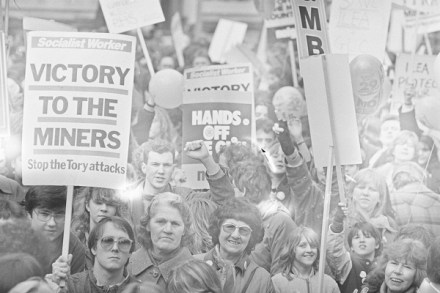
A doctor providing geriatric care once told me of the damage Mrs Thatcher had done to the NHS. He used to employ a simple test to find out whether his elderly patients had become seriously gaga. He would ask them who the Prime Minister was: as their minds weakened so the only name they came up with was Winston Churchill. But after Mrs Thatcher had become Prime Minister even the most confused of his elderly patients gave the right answer. Now of course his test can work again. Right through until the middle of the next century, elderly people in nursing homes will be assuring polite young doctors that Mrs Thatcher is the Prime Minister. I joined her Downing Street staff at the beginning of 1984 during the miners’ strike.

Trying to get the mad, broody chicken off her addled eggs

A friend who is not normally receptive to left-wing or republican ideas suddenly exclaimed at dinner in my house the other day that he was bored, sickened and disgusted by the Queen and all the royal family, and thought it was high time they were removed. In the mood of the moment, nobody seemed disposed to disagree, although compassionate noises were made from some quarters about the Queen Mother and the Waleses. In the ensuing discussion, everyone observed that they were not aware of having felt this way before, but agreed that they felt it now — that is to say, at about 9.45 p.m. on Saturday, 12 August 1989. There had been nothing to annoy us about the royal family in the news. It traditionally keeps a low profile at this time of year.

Three faces of Thatcher

Politicians can be divided into two categories; those whose public face is different from their private face and those for whom they are the same; put another way, those who feel it necessary in public appearances to put on an act, and those who manage to remain themselves. Among the latter are (or were) such disparate characters as Jack Kennedy, Willy Brandt, Jo Grimond, Edward Heath, Neil Kinnock; and among the former Adolf Hitler, Winston Churchill, Richard Nixon, Harold Wilson and Arthur Scargill (if you don’t like that list, you are welcome to make your own). Prominent among the last-named is our Prime Minister, but she is almost unique in having not two faces but three.

After the Brighton bomb

It is worth pointing out yet again that Mrs Thatcher really was very brave last Friday. It would have been no disgrace to her if, once she had realised how narrow had been her escape, she had felt weak and — as did a few of the Tory wives in the Grand Hotel — had sat down and cried. There would have been nothing cowardly in cancelling what remained of the Conference in honour of the dead and injured. But the fact that she did neither of these things and the way that she conducted herself that day confirms that she has an extraordinary amount of that particular kind of courage which rises to an occasion, appearing more magnificent the greater the challenge.

Mrs Thatcher goes to Brussels

‘Délégation Royaume Uni. Salle 4’ announces a scruffy piece of paper projected onto the black and white television screens of the Centre Charlemagne. The journalists hurry upstairs for the latest from Mr Bernard Ingham, Mrs Thatcher’s press secretary. Mr Ingham is not conspicuously communautaire. He tells us who spoke in the session — Mr Lubbers, Herr Kohl, Mrs Thatcher and ‘Mr Papandreou — I always call him Mr Papadopoulos’. A nodding acquaintance with recent Greek history would have made Mr Ingham realise that such a slip, though easier on the tongue, is as politically uncomfortable as calling M. Mitterrand ‘Marshal Pétain’. But then Mr Ingham is not paid to spread sweetness and light.

Mrs Thatcher’s triumph

There was never a more disenchanted victory. The moment the size of the Tory swing was known, the doubts began, not least among those hundreds of thousands who had voted Conservative for the first time in their lives. Would the unions allow Mrs Thatcher to govern? Would the promised tax cuts be blown in betting shops and strip clubs, instead of fructifying in the pockets of the people? Would investors once again be fatally attracted to the hustlers and twisters? Was there any way of bridging the growing gulf between North and South? Did the British people as a whole have any stuffing left in them? Could any government muster the zest to halt the de-industrialising of Britain? Was this to be yet another false dawn, a surrender to a fresh set of illusions?

Clear choice for the Tories

If I start with a reference to the sorry condition of the Tory party, I hope readers will not immediately turn to another page. If only the Tories can take a fairly cool look at themselves, it will quickly be apparent that the condition is not as serious as all that; and that it is certainly capable of repair. Housman’s ancient ‘three minutes of thought’ will suffice to show that there is only one direction in which the Tories can go. Once their collective mind is concentrated on that fact the rest will be, if not easy, at least far advanced in ease from the complicated and tragic business of the present run-up to what looks like being a bitter leadership contest. A commonsense analysis of this confused situation would run as follows.

Her brilliant career

In 1975, when Keith Joseph dropped out of the race for the Tory leadership and his campaign manager stepped into his place, almost no one took it seriously. She was ‘precisely the sort of candidate… who ought to be able to stand, and lose, harmlessly’ said the Economist. Only one publication in Britain backed her then, and our endorsement is reprinted in our supplement. The values she represented are the ones The Spectator has championed for decades: small government, low taxes and personal freedom. And a preference for those who enter politics to do something, rather than be someone.

‘If only people could see the real Margaret Thatcher’: Lords pay tribute

Today's debates in Parliament about Baroness Thatcher were supposed to be a tribute to the first female Prime Minister. If you were looking for the most faithful rendition of this, you should have been sitting in the House of Lords, not the Commons this afternoon. In the Other Place, the debate is always rather more civilised and measured, though it has grown rather rowdier in recent years. But today the speeches painted a fascinating picture of Margaret Thatcher, not least because many of them came from those who worked with or in opposition to her when she was in power. Some were notable by their silence: Lord Howe arrived with notes, but left without speaking. Lord Heseltine was nowhere to be seen.

‘She was Steve Jobs, Richard Branson, Lady Gaga; all rolled into one’ – Steve Hilton on Margaret Thatcher

Tomorrow's Spectator includes a three-page symposium on Margaret Thatcher from a selection of her friends colleagues, admirers and sparring partners. Here's the full version of what Steve Hilton - No.10's strategy officer from 2010-2012 - has to say about our first female Prime Minister. I was lucky enough to meet Mrs Thatcher (as I will always think of her) on a few occasions, and one in particular stood out. We talked about Communism, and my family’s experience in Hungary. I was feeling incensed at the time because of the way in which the ruling elite dabbled in capitalism for their own personal enrichment, but denied the opportunities of enterprise to most people. 'Yes!” she exclaimed, 'I hate that. Hate it. That’s how elites always behave!

The guru speaks

A Maggie-tastic jam-packed Spectator tomorrow. Amongst the tributes, the words of Steve Hilton stuck out: ‘I saw her as thrillingly anti-establishment; as much of a punk, and as brilliantly British, as Vivienne Westwood, who once impersonated her on the cover of Tatler. Margaret Thatcher had the virtues most valued in today’s culture: innovation, energy, daring. She was Steve Jobs, Richard Branson, and Lady Gaga all rolled into one — and a thousand times more consequential than any of them. In today’s techno-business jargon, she was the ultimate political disruptor: determined to shake things up, unleash competition, challenge and confront vested interests. To be transformative, being reasonable doesn’t get you very far.