Margaret thatcher

How Margaret Thatcher transformed politics and this country

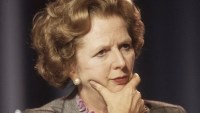
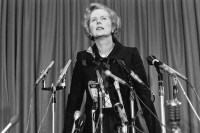
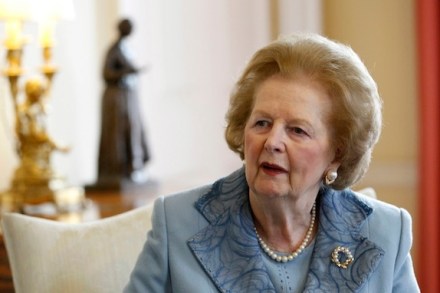
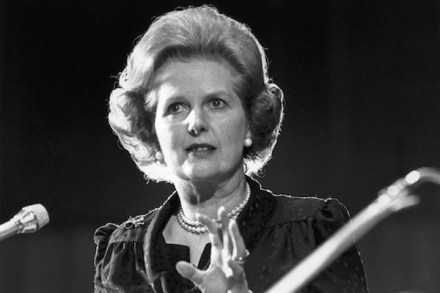
Margaret Thatcher is the most significant British political figure of the past 50 years. In her time in office, she transformed the British economy, promoted the vigorous virtues and offered strength and support to the dissidents of Eastern Europe and. On top of all this, she was — of course — Britain’s first female Prime Minister. In future, people will find it hard to believe just how nationalised Britain’s economy was before the Thatcher revolution. As she said in her 1982 conference speech, ‘How absurd it will seem in a few years' time that the State ran Pickford's removals and Gleneagles Hotel.’ With the benefit of hindsight, it is easy to underestimate the state of crisis that this country was in before Margaret Thatcher’s election in 1979.

Archive: Margaret Thatcher: clear choice for the Tories

The Spectator was the only national publication to fully support Margaret Thatcher in the first ballot of the Tory leadership contest. Patrick Cosgrave explain why in this political column from 23 January 1975: If I start with a reference to the sorry condition of the Tory Party, I hope readers will not immediately turn to another page, on the grounds that this record has been played too often. For I want to add that, if only the Tories can take a fairly cool look at themselves, it will quickly be apparent that the condition is not as serious as all that; and that it is certainly capable of repair. Housman's ancient "three minutes of thought" will suffice to show that there is only one direction in which the Tories can go.

Tributes pour in for Margaret Thatcher

Margaret Thatcher died this morning following a stroke.  Downing Street said this afternoon that the former Conservative Prime Minister's funeral will have the same status as the Queen Mother and Princess Diana, with full military honours, a service at St Paul's Cathedral, followed by a private cremation. She will not lie in state, in accordance with her wishes. The flag over No.10 is flying at half mast and  the tributes are flowing in. David Cameron's tribute is posted below. Here are some others:- Barack Obama: 'With the passing of Baroness Margaret Thatcher, the world has lost one of the great champions of freedom and liberty, and America has lost a true friend.

Matt Hancock vows to fight low pay, but fails to emphasise the importance of low inflation

Matt Hancock, the business and skills minister, addressed the Resolution Foundation’s low pay debate this morning, an indication of how seriously the Tories are taking the rising cost of living. He delivered a resounding defence of the minimum wage. He said that the evidence was overwhelming: the minimum wage did not harm employment levels: and declared that the Conservatives should ‘strengthen’ the minimum wage. He said that the minimum wage should be enforced, and hinted that the Low Pay Commission might be reinforced. He said that working more hours was not necessarily the right answer, contrary to those who hold that Britain needs to harder and longer.

The new Design Museum: Prince Charles will prefer it. But should we?

Twenty-five years ago I went to St James’s Palace to ask the Prince of Wales if he would open the new Design Museum. Before us was the model of the building, an elegant, austere, uncompromised white box that was very much along Bauhaus lines. We knew that ‘modern’ no longer meant ‘of-the-moment’ but had become a period style label. Even at the time we acknowledged the layers of irony in this historicist gesture. The Prince, sounding pained, I recall, asked, ‘Mr Bayley, why has it got a flat roof?’ And that was the end of that. Next time it will be different. The Design Museum is moving from a creatively reused banana warehouse near Tower Bridge to a creatively reused Commonwealth Institute on the edge of Holland Park.

Lessons from Ronnie and Maggie

Ramesh Ponnuru has written a splendid op-ed for today's New York Times. Splendid, not because it is new or especially original, but because, alas, it's central message needs repeating until, eventually, even the more dunderheaded class of Republican Congressman hears the message. And it is a simple message. Namely, that asking 'What would Ronald Reagan do?' is almost about as useful as mining Martin van Buren, George II or Charlemagne for policy advice that will help solve today's problems. I exaggerate of course, but only for effect. We are not now as we were then. Or, as Mr Ponnuru puts it: Republicans are very good at tending the fire of Ronald Reagan’s memory but not nearly as good at learning from his successes.

When will we able to have a mature conversation about the health service?

Nigel Lawson described the NHS as the closest thing to a national religion that this country has. The NHS is certainly like a national religion to the extent that it is pretty much impossible to have a rational debate about it. There is often a choice posited between the NHS and no healthcare at all. One can see this mindset in today’s Guardian article on the news that the Thatcher government in 1982 held Cabinet discussions about fundamental rethinking the size and shape of the state.

What would Thatcher do if she was in power now?

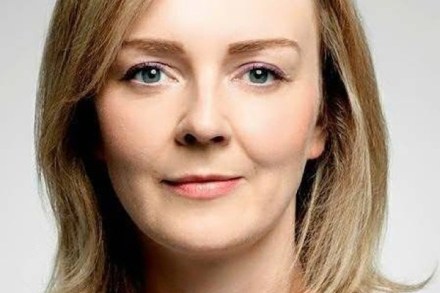
It is testament to Margaret Thatcher’s remarkable influence on British politics that 33 years after she won her first general election victory she still has such a hold on our political discourse. One of the things that the Tory party needs to do is understand both why Thatcher was so successful and how she changed Britain. In an interview with The Spectator this week, Elizabeth Truss, the new education minister who proudly describes herself as a ‘bit of a Thatcherite’, offers an interesting take on the question.

George Osborne’s combination of austerity and social libertarianism is repellent

George Osborne’s spirited bid in The Times (£) earlier this week  to appropriate the Obama victory for the Tories is a curious mirror image of the Labour Party’s arguments to the same effect. Both ignore the reality that the US is the US, not us, and Obama is Obama; formulas for election success aren’t a peel-off/stick-on tattoo, to be transferred between one body politic and another. But the article was interesting for what it told us about the Chancellor himself, quite apart from a slightly nerdy obsession with American elections. The fifth and decisive point in his piece was all about how social liberalism plus fiscal conservatism was the key to electoral success.

Margaret Thatcher and the Tory party’s change on Europe

Charles Moore’s biography of Margaret Thatcher promises to be the most important British political book in decades. Tonight, we got a preview of it when Charles delivered the Centre for Policy Studies’ second Margaret Thatcher lecture. The subject was Thatcher and Europe. I won’t say too much about it because we’re running a version of it in the coming issue of The Spectator. But one thing that Charles demonstrated was that even when Thatcher was campaigning for British membership of the European Community, as then was, she was never in favour of the European project. One of the other thing that Charles’s lecture brought out was the shift in the balance of power in the Tory party on Europe.

Lady Thatcher’s advice on cross-party friendship

A big-tent turnout on Saturday evening for the fourtieth birthday of Conor Burns, the Tory MP for Bournemouth West. Burns, fresh from his heroic rebellion against Lords reform, packed the State Rooms of the Palace of Westminster with a big crowd of rising Tory stars and some old stagers including Lord Lamont and Sir Mark Thatcher. Burns is a close friend of Baroness Thatcher; and although the great Lady was unable to join, she did some send some pearls of wisdom in her place. Burns reported that when he had told Lady Thatcher that his friend and speech-giver Thomas Docherty, who has been Burns' voting pair since they both arrived in Westminster in 2010, sat on the opposition benches she replied: ‘Good, it means you can trust him.’ Sound words, as ever.

Randy Andy

Westminster's favourite shaggy-haired do-gooder Andrew Mitchell has been spilling his heart out to Total Politics about Maggie: ‘To me, she was a goddess. When she walked down the  corridors, I used to stand stiffly to attention and hope she would pass by.’ Far too much information from the International Development Secretary, who is known to keep a bowl of condoms in on his ministerial desk, as part of a worldwide health campaign, of course.

From the archives: Defending the Falklands

To mark the 30th anniversary of the start of the Falklands War, here's Ferdinand Mount's column from the time: The last armada, Ferdinand Mount, 10 April 1982 A debacle speaks for itself. All things that inescapably follow — the humiliation, the indignation, the ministers hurrying in and out of Cabinet, the spectacular sitting of Parliament on a Saturday, the calls for the resignation of Mr John Nott, Lord Carrington and anyone else standing in the line of fire — are not only themselves part and parcel of the debacle; they help to explain why it happened. The Falkland Islanders are the last victims of our refusal to be honest with ourselves; we have clung to the rhetoric of empire long after we have lost the desire or the ability to maintain its reality.

Hilton’s return hinges on Cameron’s radicalism

It is a sign of the influence that Steve Hilton has on the Cameron project that there have been more column inches devoted to his departure from Downing Street than there would be to most Cabinet resignations. But even after he heads to California in May, Hilton will still be part of the Cameron brains trust. He is already scheduled to work on the Prime Minister’s conference speech. Hilton has, I understand, been mulling the idea of taking a sabbatical since last summer. His decision to go ahead and take next year off seems to have been motivated by a variety of factors. But those closest to him stress that family reasons genuinely were key. This is not to say that Hilton is not frustrated.

From the archives: Why England and France will never be best friends

To mark David Cameron’s get-together with Nicolas Sarkozy today, we’ve dug up this essay from the Spectator archives by Lord Powell. As foreign policy advisor to Lady Thatcher and Sir John Major, Powell provides a first-hand insight into the incompatibilities that separate our two nations. A fundamental incompatibility?, Charles Powell, The Spectator, 3 September 1994 A few summers ago, I accompanied Margaret Thatcher to a meeting with President Mitterrand in Paris. The weather was sunny and the mood equally so. The agenda was rapidly disposed of and the President proposed that we adjourn to the Elysée garden. Once there, he took Mrs Thatcher — as she then was — off for a stroll while Jacques Attali and I subsided on a bench in the sun.

Gorby: Putin’s like Thatcher

The Times has a fascinating interview (£) with former Soviet leader, Nobel Laureate and two-time Man of the Year Mikhail Gorbachev. He strikes an optimistic tone about the future of democracy in Russia, praising the ‘Moscow Spring’ protesters and saying ‘This is the right moment to start creating as part of this new situation a strong democratic party.’ But perhaps the most eye-catching comes when he compares Vladimir Putin with Margaret Thatcher: ‘Mr Gorbachev recalled Mrs Thatcher, Prime Minister at the time, telling him that she was leaving a summit in Paris early to deal with the challenge to her leadership from within the Conservative Party.

The significance of the Iron Lady

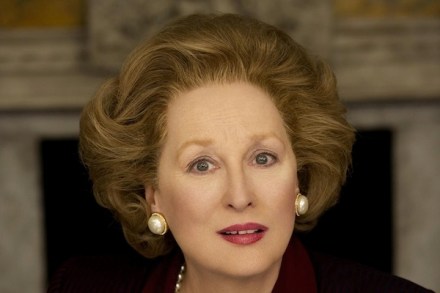
Charles Moore’s essay on the Iron Lady in today’s Telegraph is required reading. Here’s how he starts: ‘The best way to understand why a feature film about Margaret Thatcher might work is to imagine trying to make one about other 20th-century British prime ministers. How about Safety First (Stanley Baldwin), A Period of Silence (Clement Attlee), Crisis? What Crisis? (James Callaghan) or In No Small Measure (John Major)? It doesn’t do, does it? Even Tony Blair, already the subject of several films, invites a satire treatment, not a life story. There is a case, perhaps, for David Lloyd George. There is the towering subject of Winston Churchill. And then there is Margaret Thatcher. Of course she should have a biopic.

The Gospel according to Delors

An old enemy of England nestles in the pages of today’s Daily Telegraph. Charles Moore travelled to Paris to meet Jacques Delors, the architect of the euro and advocate of Europe’s ‘social dimension’. Moore found defiance where one might have expected humility, perhaps even repentance. Delors insists that the fault was in the execution not the design of the euro.

Happy Birthday, Mrs T

It is, you may have heard, Margaret Thatcher's 86th Birthday today. By way of a congratulatory toast to the Iron Lady, here's a thought-filled article that T.E. Utley wrote about her politics, for The Spectator, some 25 years ago: Don't call it Thatcherism, T.E. Utley, The Spectator, 19 August 1986 There is no such thing as Thatcherism. The illusion that there is is in part a deliberate creation of Mrs Thatcher's enemies. They have proceeded on the age-old maxim that there is nothing (certainly not private scandal) more likely to injure the reputation of a British politician than the suggest that he has an inflexible devotion to principle. This maxim is only partly true, but is an unshakeably established belief, a fact which helps to make it truer than it otherwise would be.

In defence of Liam Fox

The feeding frenzy over Liam Fox tells us a great deal more about what is wrong with the Conservative Party than it does about Dr. Fox. The Defence Secretary has been an ass. He admits that he allowed “distinctions to be blurred” between his “professional responsibilities and [his] personal loyalties to a friend”. But if someone has known you and counselled you and worked for you over the years it is all but impossible to maintain such distinctions when you are in power. You just have to cut them off, brutally. Fox’s biggest weakness, and one which was well known before this, is that he is too kind. You might say he is too human. It made him a good doctor. But in the higher echelons of politics or business it is a fault.