David hockney

Would the ancients have appreciated David Hockney?

David Hockney has died, and there has died with him an artist whose work has given those of us who are not artists a very great deal of pleasure, in striking contrast to most art that wins prizes these days. The ancient Greeks did not have a word for ‘art’. The closest they got to it was tekhnê (cf. ‘technical’), brilliantly defined by Aristotle as ‘the trained ability to produce something under the guidance of rational thought’, always difficult to discern in the work of most modern artists. So in the ancient world, the artist was on the same level as (say) a dentist – someone whose purpose it was to serve the ordinary public to the best of his technical capacity.

David Hockney was a style icon

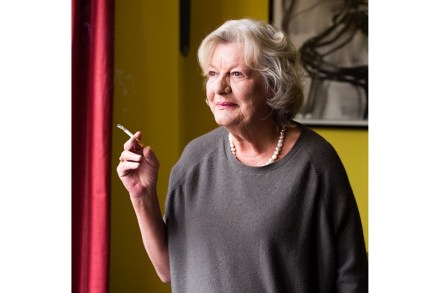
How appropriate that the late David Hockney favoured that ash blonde hair colour, given that the chain-smoker was said to get through 100 cigarettes a day? And not just any old fags: the long, slender and upmarket Davidoff Magnum Classic, of which he was said to keep a store of 2,000 at home for emergencies. Hockney said they helped him concentrate. But this everyday accessory was also a yellowed two-fingers to anyone who wanted to close down what he saw as his right to live as he chose. More than that – and let’s hope no school kids are reading – they imbued him with an old Hollywood, rebel cool, especially in more anti-tab times. ‘You can’t have a smoke-free Bohemia,’ as he once noted.

‘I think I’ve found a real paradise’: David Hockney interviewed

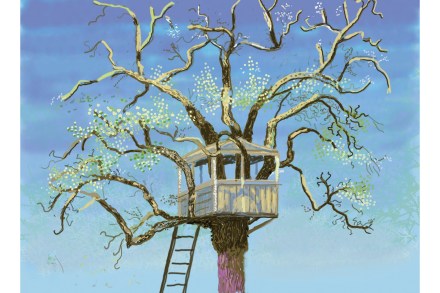
David Hockney has died, aged 88. During lockdown in 2020, Martin Gayford, the author of ‘Conversations With Hockney’, spoke to him for the magazine. Spring has not been cancelled. Neither have the arts ceased to function. David Hockney’s marvellous exhibition at the National Portrait Gallery may be sadly shut, but the artist himself is firing on all cylinders. ‘I was just drawing on this thing I’m talking to you on,’ he announced when I spoke to him via FaceTime the other day. He was sitting in the sunshine outside his half-timbered farmhouse in Normandy. ‘We’re very busy here,’ Hockney explained, ‘because all the blossom is just coming out, and there’s a lot more to come. The big cherry tree looks glorious right now.

Only prigs and bores could object to the incongruity of Portmeirion

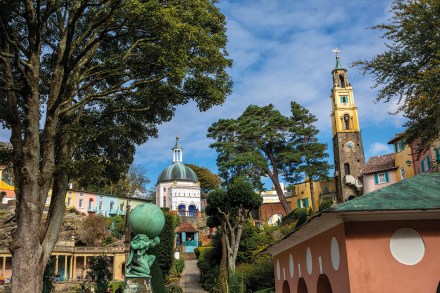
The only answer to the question ‘What connects Brian Epstein, Frank Lloyd Wright, Portofino and Stevenage?’ is ‘Portmeirion’, a conceptualised village on the north Wales coast. You could call it a folly, except it is living, not dead; and it exerts a lasting fascination. Traditional modernists deplore its flamboyant historicism – ‘retro-kitsch whimsy’ – but Jan Morris, a neighbour, said that only prigs and bores are truly hostile. Portmeirion needs a lot of explaining, as Sarah Baylis does in this first independent study of an enchanting project. It is well-researched, but not an academic reference book nor a continuous narrative. Instead, it is an eclectic album of comment and recollection, and thus perfectly sympathetic to its subject.

Tim Shipman, Ben Clerkin, Maxwell Marlow & Hermione Eyre

24 min listen

On this week’s Spectator Out Loud: looking back to 1973, Tim Shipman wonders how bad the energy crisis could get; Ben Clerkin interviews Steve Hilton, the former Cameron aide running to be California’s next governor; Maxwell Marlow explains how to solve the student debt crisis; and finally, ‘disorientatingly enjoyable’ is the verdict of Hermione Eyre as she reviews David Hockney at the Serpentine. Produced and presented by Patrick Gibbons.

Tim Shipman, Ben Clerkin, Maxwell Marlow & Hermione Eyre

The greatest decade for British painting since Turner and Constable? The 1970s

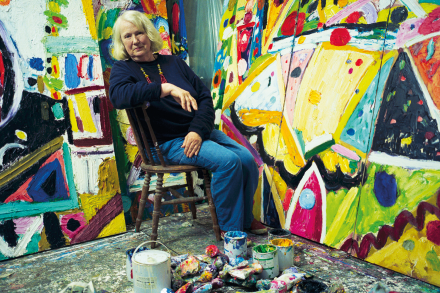
Slowly the canvas was unfurled across the concrete floor of a warehouse on an industrial estate in Suffolk. On and on it went, a flurry of paint marks and brush strokes, yellow, green and occasionally blue, like a cornfield at harvest time. By the time we got to the end some seven metres of it lay stretched out at our feet. It was the first time anyone had seen this unknown magnum opus by Gillian Ayres since it was rolled up in 1974 – and it looked sensational. Recently I’ve been reflecting on the 1970s for a couple of reasons. One is that I’m working on a book about art in London at that time, the other is that I’ve been helping to organise an exhibition of Ayres’s work from that era at the Heong Gallery, Downing College, Cambridge. Of course, as L.P.

The art of sexual innuendo

Paula Rego’s 2021 retrospective at Tate Britain demonstrated that, among art critics, ambiguity is still highly prized as a measure of merit. Martin Gayford: ‘No one, including its creator, can be aware of everything that’s going on.’ Laura Cumming at least gave examples. Of ‘The Cadet and his Sister’ (1988), she commented: ‘Bondage – physical, emotional, familial – is always in the air.’ The adjectives in that nervous parenthesis are insurance, the critic spreading her bets. The picture shows an older, bigger sister, formally dressed, with her cadet brother in uniform, wearing white ceremonial gloves. Behind them, a careful vista of trees. The painting depicts a milieu of public formality. Except that she has removed her gloves to tie his shoe laces.

The joy of hanging out with artists

Lynn Barber is known as a distinguished journalist, but what she always wanted to do was hang out with artists. This book feels like a marvellous cocktail party, packed with the painters and sculptors Barber has interviewed over the years: Howard Hodgkin, Phyllida Barlow, Grayson Perry, Maggi Hambling. Sarah Lucas and Tracey Emin eye one another warily from opposite sides of the room; Salvador Dali’s ocelot weaves between the guests; everyone, naturally, is smoking. Lucian Freud is a no-show – though having refused Barber’s many interview requests, he did send a scrawled note explaining he had no wish to ‘be shat upon by a stranger’. Feuds and gossip are the making of any gathering, and A Little Art Education is not a book of art criticism.

My lunch with Salman Rushdie

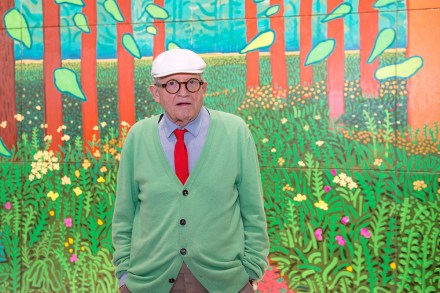
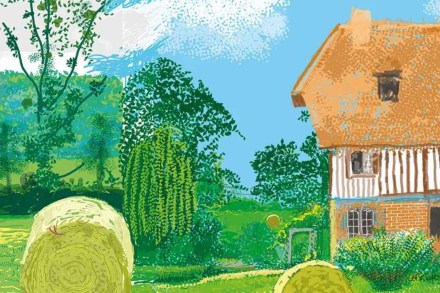
I have just come back from spending some days with David Hockney at his house in Normandy. We are making a film about him – the longest film about a single subject I have ever attempted. Like Monet’s, Hockney’s environment is his subject. The great sequence of ‘The Four Seasons’ is from his grounds. He finds all the different blossoms he needs there, and there is a river and a pond. His friend has turned an old barn into a magnificent studio. David is in his mid-eighties but is as sharp as he was the first time I interviewed him for The South Bank Show in 1978.

Hockney’s Rake’s Progress remains one of the supreme achievements

With Glyndebourne’s The Rake’s Progress, the show starts with David Hockney’s front cloth. The colour, the ingenuity, the visual bravura: 46 years after this production’s first appearance in 1975, it’s still capable of halting you in your tracks. So drink it in. No blockbuster art exhibition will ever give you such ideal viewing conditions, or so much time with a single artwork. And no mock-up or faded video will ever be able to restore to Hockney’s sets and costumes the meaning and the impact that they possess when they’re peopled by living performers and accompanied by Stravinsky’s score. Come for the backdrops, stay for the opera. This is one revival that nearly does send you out whistling the scenery.

The joy of socially distanced gallery-going

Not long after the pubs, big galleries have all started to reopen, like flowers unfolding, one by one. The timing reminded me of an anecdote that Lucian Freud used to tell about a Soho painter friend he took into the National Gallery after it had shut (as some senior artists are entitled to do). They arrived after closing time in the drinking holes of Soho, and the painter friend was staggering and swaying so much that Lucian — who was not easily rattled — became alarmed that he was going to put one of his flailing arms through a Rembrandt. I wonder how those art-lovers of yesteryear would have coped with socially distanced visits. I think they may be an improvement, at least in some respects.

How John Constable got masterpiece after masterpiece out of a tiny corner of rural Suffolk

Before his marriage John Constable returned regularly in early summer to his native village of East Bergholt. When he wrote from there to his wife-to-be, Maria Bicknell, he almost always exclaimed that Suffolk was ‘in great beauty’. His enthusiasm was never more eloquent than on 22 June 1812, when he declared: ‘Nothing can exceed the beautiful appearance of the country at this time, its freshness, its amenity — the very breeze that passes the window is delightful, it has the voice of Nature.’ I often think about Constable (1776–1837) as I pace across the water meadows on my daily constitutional — partly because this too is an East Anglian landscape not unlike the one he was writing about: flat, leafy, watery, abounding in willows.

On Van Gogh and Rembrandt

Being in the south of France obviously gave Vincent an enormous joy, which visibly comes out in the paintings. That’s what people feel when they look at them. They are so incredibly direct. I remember in some of his letters Vincent saying that he was aware he saw more clearly than other people. It was an intense vision… [H]e must have been doing some very concentrated looking. My God! After working for a long time, I get very tired eyes. I just have to close them… Photographs of those fields around Arles that Van Gogh painted wouldn’t interest us much. It’s a rather boring, flat landscape. Vincent makes us see a great deal more than the camera could.

Time and motion

Andy Warhol would probably have been surprised to learn that his 1964 film ‘Empire’ had given rise to an entire genre. This work comprises eight hours and five minutes of slow-motion footage of the Empire State Building during which nothing much happens. Warhol remarked that it was a way of watching time pass or, you might say, the Zen of boredom. Much the same could be said of the films in Tacita Dean’s two exhibitions, Portrait and Still Life at the National Portrait Gallery and National Gallery respectively.

Fickle fortune | 21 September 2017

Here’s an intriguing thought experiment: could Damien Hirst disappear? By that I mean not the 52-year-old artist himself — that would be sensational indeed — but the vast fame, the huge prices, the hectares of newsprint, profiles, reviews and interviews by the thousand. Could all that just fade from our collective memory into a black hole of oblivion? The answer is: yes, quite easily. Artists vanish all the time. Take the case of Hans Makart (1840–1884). He was a contemporary of Monet, Manet and Degas, but enormously more acclaimed in his lifetime than any of those. A period of Viennese life was dubbed the ‘Makart era’, a fashionable idiom was named the ‘Makartstil’. One reason for his success was that he was a master of PR.

The good, the indifferent and the simply awful

‘There is only one thing worse than homosexual art,’ the painter Patrick Procktor was once heard to declare at a private view in the 1960s. ‘And that’s heterosexual art.’ It would have been intriguing to hear his views on Queer British Art at Tate Britain. All the more so since it includes several of his own works, including a fine line-drawing study of the playwright Joe Orton, completely naked except for his socks — which he kept on because he felt they were sexy — and reclining somewhat in the manner of Manet’s Olympia. In fact, many of those included might have had reservations — Oscar Wilde, for example, one of whose characters observed, ‘The only artists I have ever known who are personally delightful are bad artists.

Internal affairs | 23 March 2017

Over 20 years ago I wrote about Giambattista Tiepolo in The Spectator. Shortly afterwards I went to visit Howard Hodgkin in his spacious, white, light-filled studio close to the British Museum. It turned out that he had read my column and was pleased that someone had been discussing this 18th-century Venetian, who was just his idea of what a painter should be: a subtle master of colour, poetic, sensual, a bit neglected — in other words, much as he saw himself. The real subject matter of an artist such as Tiepolo, I suggested that day, is not really the Madonna or the apotheosis of some minor aristocrat. It is something more elusive and personal — such as the painter’s feelings about the charm of dogs, naked bodies or dreams of flying. ‘Yes,’ answered Hodgkin.

Sunny delight

No Californian could have painted Hockney’s pools. No La-La Land artist, raised on sun and orange juice, would have done tiles and diving boards and tan-lined bottoms as the boy from Bradford did. It had to be a Hockney, brought up, the fourth of five children, in a two-up two-down. Hockney, who aged three had sheltered from bombs with his mother Laura, father Kenneth, four siblings and a lady neighbour in the cupboard under the stairs. A Yorkshire child steeped in Typhoo tea and fortified by meat and potatoes from Robert’s Pie Shop. A painter who had bicycled the Wolds in the rain, and lived in the garden shed of an Earl’s Court boarding house when a student at the Royal College of Art in London.

Ways of seeing

‘Radical’ is like ‘creative’, a word that has been enfeebled to the point of meaninglessness. Everybody seems to want to be both, but nobody has any clear idea of what might be involved. In the case of this exhibition, radical could refer either to aesthetic or political themes; neither seems quite right. Never mind, ’modernist’ has, with the passage of time, become more firmly anchored. We now know it was a movement in the arts that began in about the 1880s and ended in, very roughly, the 1950s or ’60s. It was a period in which art became preoccupied with form as a determinant — rather than the servant — of content.

Back in the USSR

For much of 1517 Michelangelo Buonarroti was busy quarrying marble in the mountains near Carrara. From time to time, however, he received letters relating how his affairs were going in Rome. These contained updates on — among other matters — how his friend and collaborator Sebastiano del Piombo was getting on with a big altarpiece which he hoped, with Michelangelo’s help, would vanquish their joint rival, Raphael. This picture, ‘The Raising of Lazarus’, has been in the National Gallery for almost 200 years now (it is No. 1 in the inventory of the collection). Next March it will be one of the centrepieces in an ambitious exhibition that inaugurates the new North Galleries, Michelangelo & Sebastiano: A Meeting of Minds (15 March–25 June).