Crime

The shoplifters are winning

It was when I saw an entire crate of orange juice exit my local supermarket that I knew something had died. The Artful Dodger school of shoplifting has officially been boarded up, its artisan poachers and pilferers as redundant to the modern world of thieving as swag bags, eye masks and soft sole shoes.  There’s no longer any attempt at discretion or skill when it comes to shoplifting in my nearest Co-op in south London. The thieves don’t enter in trench coats and furtively peruse the aisles. They stroll in, take as much as they can carry and walk out again, knowing that the worst punishment they face is being given some scatological invective from the five-foot-nothing woman of venerable age who is usually locked inside her till cubicle.

My friend the people smuggler

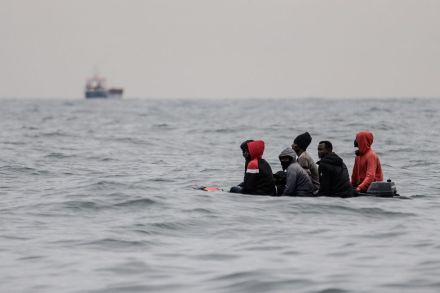
Usually when I start listening to a true-life podcast, I don’t know how it ends. That’s not the case with The Smuggler, BBC Radio 4’s new investigation into people smuggling. Across ten episodes, its Orwell Prize-winning presenter, Annabel Deas, tells the story of ‘Nick’, on the face of it an unlikely protagonist. Nick is white, English and a former soldier in the British Army. He’s also a friend of mine. We met in jail in 2021 and have stayed in contact ever since. So I know Nick’s story. I even know how it ends. Despite all this, I found myself absolutely gripped by The Smuggler. This is partly because it’s such a fascinating, and timely, topic. Migration is rarely out of the news. Keir Starmer keeps promising to ‘smash the gangs’ and ‘stop the boats’.

Can anything solve Britain’s prisons crisis?

While we were inspecting HMP Elmley on the Isle of Sheppey, a commotion broke out on one of the wings. ‘What’s up?’ one of my team asked the nearest prison officer. ‘Bloke who’s getting out tomorrow has just been told he’s being shipped to Rochester jail.’ The man was manhandled towards a prison van. ‘If I was him, I’d kick off too,’ the officer added quietly. Reducing the prison population will do nothing to stem the flow of drugs pouring into every jail in the country That week things were so desperate in the south of England that the prisoner was being forced to spend one night in a jail 20 miles away so that new arrivals could be squeezed in that afternoon.

Scuzz Nation, the death of English literature & are you a bad house guest?

40 min listen

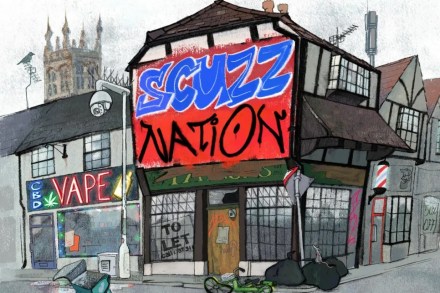
Scuzz Nation: Britain’s slow and grubby declineIf you want to understand why voters flocked to Reform last week, Gus Carter says, look no further than Goat Man. In one ward in Runcorn, ‘residents found that no one would listen when a neighbour filled his derelict house with goats and burned the animals’ manure in his garden’. This embodies Scuzz Nation – a ‘grubbier and more unpleasant’ Britain, ‘where decay happens faster than repair, where crime largely goes unpunished, and where the social fabric has been slashed, graffitied and left by the side of the road’. On the podcast, Gus speaks to Dr Lawrence Newport, founder of Crush Crime, to diagnose the issues facing Britain – and offer some solutions to stop the rot. (01:28) Next: is it demeaning to study Dickens?

Welcome to Scuzz Nation

Reform’s success in last week’s local elections has been attributed to many causes. Labour’s abolition of the winter fuel payment for pensioners. The hollowing out of the Conservative party’s campaigning base. Nigel Farage’s mastery of social media. But if you want an emblem of why voters turned their back on the political establishment let me give you Goat Man. In one ward in Runcorn, the seat Labour lost to Reform by just six votes, residents found that no one would listen when a neighbour filled his derelict house with goats and burned the animals’ manure in his garden. Despite repeated appeals to authority, no action was taken.

Is the end of ‘non-crime hate incidents’ in sight?

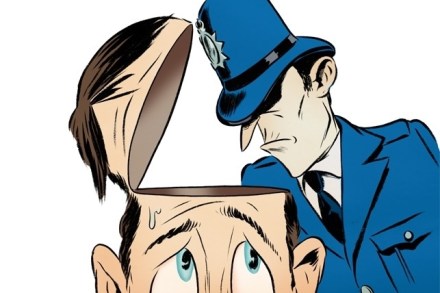
Could the end of non-crime hate incidents (NCHIs) be in sight? As the head of the Free Speech Union, I’ve been campaigning for their abolition for five years and there was a breakthrough this week with the Conservatives unveiling a plan to scrap them. Chris Philp, the shadow home secretary, is going to table an amendment to Labour’s Crime and Policing Bill that would make it illegal in almost all circumstances for the police to collect or retain personal data relating to hate incidents where no laws have been broken. For those unfamiliar with this Orwellian concept, an NCHI is a record the police make when someone accuses you of a ‘hate crime’ and they can find no evidence a crime has been committed. That sounds odd.

Would you steal from a restaurant?

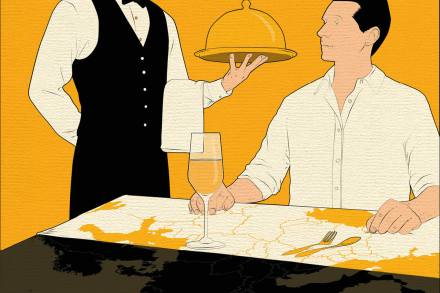
‘You wouldn’t steal a car…’ began the early noughties anti-piracy video. ‘You wouldn’t steal a television… You wouldn’t steal a handbag.’ No, but it seems from reports from restaurants, you might slip some silverware into a handbag if you’re out for dinner. In February, Gordon Ramsay revealed that nearly 500 cat figurines had been stolen in one week from his latest restaurant, Lucky Cat. The maneki-neko cat models – said to bring good luck – cost £4.50 each, which makes that a loss of more than £2,000 for the restaurant in just seven days. What is it about dining out that means we think pocketing property is acceptable?

Trump’s ‘move fast and break things’ approach to crime could finally make DC safer

From our US edition

A lot can change in a year. We have a new president, a new congressional majority, a new season of The White Lotus.  But what about crime in Washington, DC, the subject of my last piece for this magazine back in April 2024? Is our nation’s capital still racked with carjackings and homicides – or have we begun inching our way back to some form of public order? In 2023, Washington saw 274 reported homicides, making it the district’s deadliest year in two decades. There were also 959 carjackings and 3,470 robberies. Overall, violent crime was up 39 percent. We did a lot better in 2024. There were just 187 murders, a 32 percent reduction, while robberies dropped 39 percent.

dc safe

Walking in the footsteps of the Kray twins

A Sunday morning in Bethnal Green and Adam, who has been leading Kray-themed walking tours of the neighbourhood for almost two decades, corrals a congregation of eight polite, reserved, attentive customers who, with sensible rucksacks, floor-length M&S skirts, reusable water bottles and neutral-coloured, thin-laced trainers, look as far removed from pool hall brawls and basement flat stabbings as it’s possible to get without joining the Church Army or taking up cribbage. When he started giving tours of the Kray twins’ haunts, Adam tells us, it was impossible to go more than five minutes without some tipsy ageing derelict lurching out of the Blind Beggar pub to inform the group that he ‘knew the Krays personally’.

The courage of Salman Rushdie

From our US edition

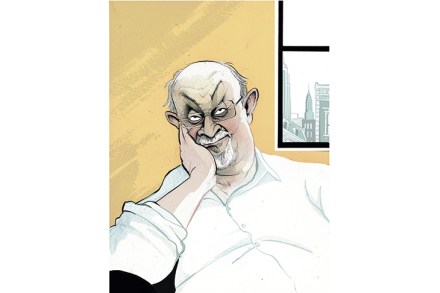
I know that our readers have led varied and colorful lives, but I would suggest that few, if indeed any, of you have spent decades cowering under the daily terror of a fatwah imposed upon you by a totalitarian state because of a literary novel that you once wrote. I would also suggest that, when Salman Rushdie — for he had that dubious privilege — emerged from a lengthy, frightening and tedious period of hiding, he chose to immerse himself in the social life of both London and the United States to show that he was not afraid, and that the threats and grimacing of extremists did not mean that he was not entitled to lead his own version of his best life. He was right to do so.

salman rushdie

Is Britain ready for blasphemy laws?

In its infinite wisdom, the Labour government appears to be reconsidering the introduction of a blasphemy law in the UK. It has picked up this idea despite it being so idiotic that it was even rejected by the last Conservative government. That well-known theologian Angela Rayner has decided to set up a council to look into the question of ‘Islamophobia’. As mentioned, there was a push to do this during the Conservative era, when a committee including some of the worst people then in public life – Dominic Grieve, Naz Shah, Anna Soubry – looked into the same thing. Their scholarship foundered, as it always will, on how you protect Muslims without simply protecting the feelings of Muslims.

Should free speech campaigners hope Andrew Gwynne is prosecuted?

David McKelvey, a former detective chief inspector in the Met Police, has called for the prosecution of Andrew Gwynne, the Labour MP forced to resign as a health minister last weekend for posting racist and sexist comments in a private WhatsApp group. ‘One rule for MPs, another for police officers?’ he asked on LinkedIn, pointing out that other officers have been prosecuted for sending less offensive messages. ‘The law must be applied fairly to all – no exceptions.’ The police have now recorded this as a ‘non-crime hate incident’ so as not to be seen playing favourites, but a better alternative would be not to penalise anyone for something said in a private message group, which, to be fair, seems to be what McKelvey has in mind.

Where will you find the most shoplifters?

Power of assembly Nigel Farage claimed he would put together the biggest political rally in British history to launch Reform UK’s local election manifesto in March. How many people will have to assemble to fulfil his promise? – The Chartists claimed to put together a crowd of 500,000 when presenting a petition demanding electoral reform to parliament in 1842. – The Stop the War Coalition claimed 1.5m for its march against the Iraq War in 2003 (although the police put it at half that). – The People’s Vote movement claimed 1m took part in its rally in March 2019 demanding a second referendum. – But when it comes to political rallies, we are amateurs.

A mole in the CIA: The Seventh Floor, by David McCloskey, reviewed

David McCloskey, whose Damascus Station was a brilliant debut, has followed it in quick succession with a Russian-based story, Moscow X, and now The Seventh Floor. The pace of all three books is matched by the speed with which they have been produced; and for all The Seventh Floor’s strengths,the haste is beginning to show. Like the earlier two thrillers, it starts with a bang – or rather a crunch, when a Russian spy, called home peremptorily from Greece by his superiors, bites into a disguised cyanide capsule before the State security apparatus can question him. Almost simultaneously, another Russian spook, named Golikov, has a clandestine meeting in Singapore with Sam Joseph, a CIA officer known to us from Moscow X.

How Eastern Europe is leaving Western Europe behind

From our US edition

I'm in the tiny riverside town of Virpazar, in the little Balkan country of Montenegro; and under the white geisha face of a late summer moon I am warily ordering the celebrated local delicacy. It is carp — caught from the nearby, slivovitz-clear waters of Lake Skadar (biggest lake in the Balkans!). But what makes me wary is the preparation. The carp is apparently marinated, and served cold, with boiled potatoes and greens. Cold slimy fish with hot spuds and spinach? It sounds like some nightmare culinary “specialty” from the old communist bloc (of which Montenegro was once a part, within Yugoslavia). I’m veteran enough to remember a few of these. “Famous” flatbreads that came with rancid lard.

Eastern

Avoids the breathless hype of so many podcasts: Finding Mr Fox reviewed

We are all surely familiar with those stories of naive young Brits who travel abroad and are persuaded by a charming new holiday friend to bring back what they’re told is an innocuous package, only to end up on the sharp end of drugs smuggling charges. The latest series of the BBC’s World of Secrets somewhat inverts those expectations: it tracks the fortunes of three innocent young Brazilian sailors and a French captain who were allegedly duped by a Norwich businessman into sailing a rackety yacht across the Atlantic with £100 million worth of cocaine hidden in the body of the ship.

Which birds are doing best in Britain?

The last straw Farmers are threatening to strike over the government’s changes to inheritance tax in what is being described as a first in Britain. Besides France, where farmers regularly protest, India witnessed a farmers’ strike in 2020, which was eventually settled after the government dropped proposed new laws. But one of the earliest farmers’ strikes was conducted by the Farmers’ Holiday Association in Iowa in 1932, by farmers protesting at consistently low prices for their products. The idea was that farmers would go on ‘holiday’, refusing to sell any of their produce. Few, however, joined, leading to pickets blocking rural roads with telegraph poles. One policeman was killed, but in an accidental discharge of his gun. The action died down after a few months.

DC officials brace for Trump’s reign

From our US edition

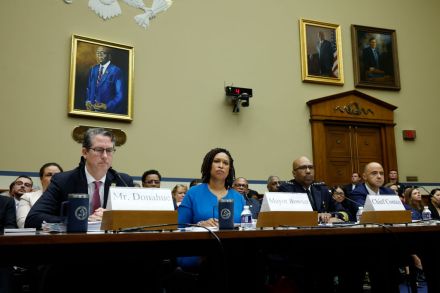
You better watch out, you better not cry... President-elect Donald Trump is coming to town. And according to a recent Associated Press report, he’s making a list and checking it twice — that's to say, he’s looking to enforce laws. It’s only November, but officials in DC are already preparing for the so-called disastrous effects of Trump’s reign come January. “We have been discussing and planning for many months in the case that the District has to defend itself and its values,” said Mayor Muriel Bowser in a briefing.  Who knows what disasters will befall us on January 6 when Congress convenes to count the electoral votes — but Bowser is prepared to request the support of the DC National Guard on that day.

muriel bowser dc

A post-Brexit entertainment: The Proof of My Innocence, by Jonathan Coe, reviewed

This is a novel that spans the Truss administration, from its heady dawn to its decline and fall 49 days later. The Proof of My Innocence starts as a satire, not so much of Truss and her world but the ideologists who thought that the prime minister’s brief, shining moment was their long-cherished future. They meet in a collapsing Cotswolds castle to hear from delegates such as Josephine Winshaw, who intones that everything now is woke: ‘Paying your TV licence was woke. Getting vaccinated was woke... buying avocados was woke, and reading novels was woke.’ Another speaker praises a reactionary novelist to a much smaller audience. Into this milieu steps Christopher Swann, a blogger. To him the radical economic libertarianism that Truss represents stems from early 1980s Cambridge.

Making sense of non-crime hate incidents

12 min listen

The government has announced a review into how to properly police non-crime hate incidents (NCHIs). This follows the experience of Allison Pearson who, on Remembrance Day morning, was doorstepped by Essex Police demanding an interview about a long-forgotten tweet. Reports of NCHIs have dramatically increased in the last year, with 13,200 recorded in the 12 months to June (around 36 a day). What qualifies as an NCHI and how can the police be expected to enforce them? Is this police overreach or a necessary measure to tackle the rise in instances of anti-Semitism and Islamophobia? Oscar Edmondson speaks to James Heale and Danny Shaw, former adviser to Yvette Cooper. Produced by Oscar Edmondson.