Al-qaeda

The caliphate strikes back

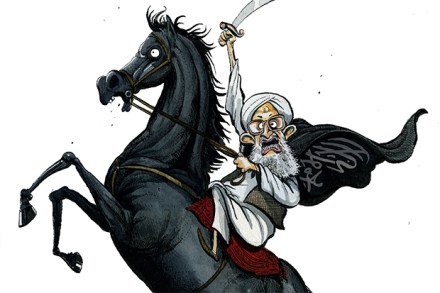
[audioplayer src="http://rss.acast.com/viewfrom22/jeremyhunt-scatastrophicmistake/media.mp3" title="Douglas Murray discusses what Isis might do next" startat=1814] Listen [/audioplayer]When the creation of a new caliphate was announced last year, who but the small band of his followers took seriously its leader’s prediction of imminent regional and eventual global dominance? It straddled the northern parts of Syria and Iraq, two countries already torn apart by civil war and sectarian hatreds. So the self-declared caliph, Abu Bakr al-Baghdadi, appeared to be just another thug and opportunist ruling over a blighted no-man’s land, little known and still less revered in the wider Islamic world.

Why I left

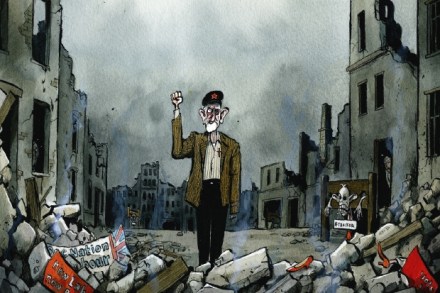
[audioplayer src="http://rss.acast.com/viewfrom22/thedeathoftheleft/media.mp3" title="Nick Cohen and Fraser Nelson discuss the death of the left" startat=32] Listen [/audioplayer]‘Tory, Tory, Tory. You’re a Tory.’ The level of hatred directed by the Corbyn left at Labour people who have fought Tories all their lives is as menacing as it is ridiculous. If you are a woman, you face misogyny. Kate Godfrey, the centrist Labour candidate in Stafford, told the Times she had received death threats and pornographic hate mail after challenging her local left. If you are a man, you are condemned in language not heard since the fall of Marxist Leninism.

Monumental heroes

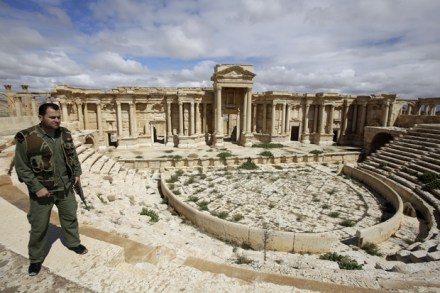
Leptis Magna was deserted when I last visited — no wonder. Tourists daren’t visit Libya these days and so I had the ruins to myself. I climbed the steps of the vast Roman theatre, looked out to where the Wadi Lebda meets the sea, then stopped. Men with AK-47s. My immediate fear was that they were Islamic State. Isis move closer to Leptis Magna every day and it would make sense for this most spectacular site to be next on their hit list. Their last great coup was on the other side of the Med, when they blew up the Temple of Baal Shamin in Palmyra, known as ‘the Pearl of the Desert’. It’s part of their cultural jihad, but they also do it for the global outrage that follows. No such thing as bad press for Isis.

Vespasian vs Islamic State

As Ahmed Rashid argued last week, it is hard to see what the West is doing in the Middle East, occasionally dropping bombs on Isis, whose effect may well be to hand Syria over to al-Qaeda. The Roman general Vespasian (ad 9–79) would propose a different strategy. The Romans had never found the Jews easy to get on with — the feeling was mutual — and semi-provincialising Judea in ad 6 had not helped matters. In ad 66 a major revolt broke out there, and the legate in Syria, Cestius Gallus, was ordered to crush it. He was driven off in disorder, and in ad 67 the emperor Nero sent Vespasian with a much larger force to restore Roman control. He attacked rebel towns, dealt out punishments and took Galilee.

Barometer | 23 July 2015

Gesture politics A royal home movie from 1933 apparently showed the future Queen, aged seven, and her mother giving a Nazi salute. Like the Swastika, the stiff-armed salute was not invented by the Nazis. In this case they took it from the Mussolini and his Fascists, who thought it came from ancient Rome. Three Roman soldiers are shown making such a gesture in Jacques-Louis David’s 1784 painting ‘Oath of the Horatii’.But the US beat both Nazi Germany and Fascist Italy by using the gesture to accompany the pledge of allegiance. Hitler himself claimed the salute was one of peace, saying it meant ‘Look! I am holding no weapon.

Al-Qaeda could end up the big winners in Syria

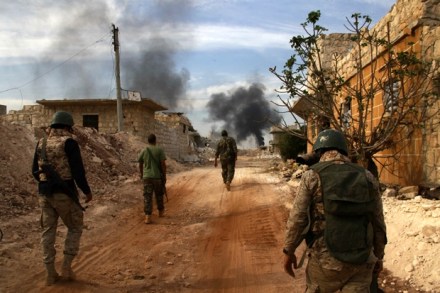
[audioplayer src="http://rss.acast.com/viewfrom22/workingwithal-qa-eda/media.mp3" title="Ahmed Rashid and Douglas Murray discuss how the West is working with al-Qa'eda" startat=38] Listen [/audioplayer]After plunging Syria into five years of a bloody civil war that has killed 300,000 and displaced 10 million, Bashar al-Assad is preparing for the endgame. He has been digging a bunker for himself, creating an enclave in the mountains around the coastal city of Latakia where his community, the Alawites, are in a majority. The Iranians are helping him set up this new retreat, but his hope of hanging on to Syria is dying.

Portrait of the week | 18 June 2015

Home Talha Asmal, aged 17, from Dewsbury, West Yorkshire, died in a suicide bomb attack on forces near an oil refinery near Baiji in Iraq, having assumed the name Abu Yusuf al-Britani. A man from High Wycombe, Buckinghamshire, Thomas Evans, 25, who had changed his name to Abdul Hakim, was killed in Kenya while fighting for al-Shabab. Three sisters from Bradford were thought to have travelled to Syria with their nine children after going on a pilgrimage to Saudi Arabia. Britain had had to move intelligence agents, the Sunday Times reported, because Russia and China had deciphered documents made public by Edward Snowden, the CIA employee who has taken refuge in Russia. Payments expected by customers of the RBS group of banks failed to enter accounts overnight.

Shifting sands in Saudi

Whatever happened to America’s desert kingdom? In the four months since Salman bin Abdulaziz al Saud became king of Saudi Arabia, everything we thought we knew about this supposedly risk-averse US ally has been turned on its head. In a ruling house long known for geriatric leadership, the new king has pushed aside elder statesmen and seasoned technocrats alike in favour of an impetuous and uncredentialled son, Mohammed bin Salman, who may be in his late twenties. Now the world’s youngest defence minister, the princeling is already second in line for the throne, prompting grumbles from Iran’s supreme leader, Ali Khamenei, about ‘inexperienced youngsters’.

Why does Isis slay hostages? To cover up the fact that it’s losing

At this point in the war between the jihadist group known as the Islamic State and a US-led international coalition, many observers are wondering how Isis keeps winning. Isis is up against western air power and powerful regional opponents, and yet has apparently seized a territory larger than the United Kingdom, and is expanding into Egypt, Libya, Algeria, Yemen, and elsewhere. It seems incredible. But the truth is that it’s difficult to say Isis is winning by any objective measure. In Iraq, the group has been put on the defensive in the provinces of Nineveh, Salahaddin, and Diyala, and may soon face a major offensive on its stronghold of Mosul. It’s true, unfortunately, that Isis is on the offensive in Anbar province, and could potentially capture new territory there.

How Islamic State commanders squeeze their hostages for every penny

 Turkish/Syrian border ‘They asked $5,000 to $10,000 for every move they made. Emirs are making a living by such means’ It was Abouday’s heavy metal T-shirt that started the trouble. Two jihadis at a checkpoint said the fire-breathing dragon showed he was a devil worshipper. In fact, he worshipped only Metallica, but he did not realise the danger he was in. People had scarcely heard of the Islamic State in Iraq and Syria back then. His mother, Faten, sat weeping at her kitchen table as she told me how she had begged him not to travel at night. After being seized at the checkpoint, Abouday was interrogated by a 20-year-old ‘emir’, or commander, a man the same age as him. Faten was told he would be sentenced to memorising the Koran.

Is London’s West End Jewish enough for David Baddiel’s musical The Infidel?

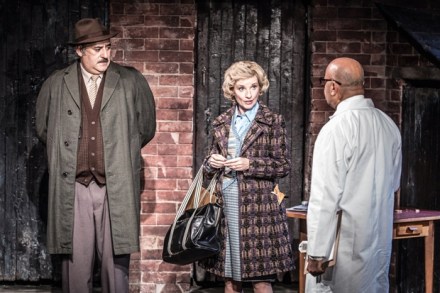
David Baddiel has turned his movie, The Infidel, into a musical. The set-up is so contrived and clumsy that it has a sweetness all its own. A golden-hearted London cabbie, named Mahmoud, discovers that he was adopted at birth and that his real parents were Jewish. This strikes him as intriguing rather than alarming, and he starts to investigate Judaism with the sort of disinterested curiosity of a man taking up astronomy after inheriting a telescope and a star-chart from an eccentric uncle. Mahmoud wants an easy life so he keeps his secret from his wife, Saamiyah, and from his son, Rasheed, who plans to marry a girl named Ji-Ji whose father is a ranting Islamic bigot.

Why Jonathan Powell thinks we’ll have to negotiate with al-Qa’eda

Jonathan Powell is best known as Tony Blair’s fixer. He was intimately involved with the Northern Ireland peace process, about which he has written authoritatively, and since leaving office has set up his own NGO which advises on negotiations with terrorists worldwide. This book, subtitled ‘How to End Armed Conflicts’, is offered as a guide to negotiators. They should find it very useful, packed with quotes and anecdotes from negotiations with, amongst others, the Tamils, ETA, the IRA, the ANC, Columbia’s FARC and, of course, that hardiest of all perennials, Israel-Palestine.

The lesson of the young men fighting for Isis: evil is in all of us

I had an interesting discussion with my friend Aidan Hartley earlier this week about whether the young men fighting for the so-called Islamic State are psychopaths. (This was before the news broke of Steven Sotloff’s beheading.) Aidan is better placed than most to answer this question, having worked as a war correspondent for many years and written a classic book on the subject called The Zanzibar Chest. His view is that the Islamic radicals attracted to IS are not run-of-the-mill jihadis, but a particularly nasty sub-species. Without in any way trying to defend the activities of terrorist groups like al-Shabaab, whose handiwork he’s witnessed close up, he thinks of them as being more like the IRA.

I like the look of this exciting new Islamic State. But why don’t they want Belgium?

There is something attractive about almost the whole of southern Europe being part of an immense and somewhat rigorous caliphate, as promised by the exciting Sunni Islamic movement formerly known as Isis. This new entity, stretching from Santander in what we currently know as Spain, to Cox’s Bazar on the Bangladesh and Burmese border, would handily encapsulate 98 per cent of the worst countries in the world, as defined by me out of rank prejudice, but also by various more scientific UN criteria.

Please, Cameron – no moral grandstanding over Iraq

If there’s a bright spot in the murky mess of Iraq, it’s that finally we have a war that it is impossible to paint in simple terms, as a battle of good against evil. This time, even our PM, the self-appointed heir to Blair, can’t grandstand about defeating ‘terror’ or protecting ‘innocent civilians’ because there’s terror and innocence on every side. He can’t pose as world policeman; stand side by side with Obama and say ‘we must not let this evil happen’, because clearly we already have. Take ISIS, the Islamist group once affiliated to al-Qa’eda who’ve become the world’s new public enemy number one. ISIS have captured parts of northeast Syria and Iraq, and have begun to eye up Baghdad.

The new Iraq war

[audioplayer src="http://traffic.libsyn.com/spectator/TheViewFrom22_12_June_2014_v4.mp3" title="Former solider Tom Tugendhat and Fraser Nelson discuss ISIS in Iraq" startat=1758] Listen [/audioplayer]Seven weeks ago, Barack Obama proclaimed that ‘it’s time to turn the page on more than a decade of war’. The people of Iraq do not have this option. They’ve seen, in Basra, Iran-backed militias take on and defeat the British military. They’ve seen highly effective jihadis, disowned by al-Qa’eda for their brutality, take control of a major city, Fallujah, just 40 miles from Baghdad. This week they have seen their second city, Mosul, fall to that same band of psychopaths.

Iran, Saudi Arabia, and the Middle East’s 30 year war

[audioplayer src="http://traffic.libsyn.com/spectator/TheViewFrom22_23_January_2014_v4.mp3" title="Douglas Murray discuss Islam's 30 year war with former solider Thomas Tugendhat"] Listen [/audioplayer]Syria has fallen apart. Major cities in Iraq have fallen to al-Qa’eda. Egypt may have stabilised slightly after a counter-coup. But Lebanon is starting once again to fragment. Beneath all these facts — beneath all the explosions, exhortations and blood — certain themes are emerging. Some years ago, before the Arab ‘Spring’ ever sprung, I remember asking one top security official about the region. What, I wondered, was their single biggest fear? The answer was striking and precise: ‘That the region will clarify.

A new Islamist alliance among Syria’s rebels has given Assad the enemy he wants

   Amman — Beirut — Istanbul I recently bumped into a senior officer with the rebel Free Syrian Army who was waiting in the passport queue at the Turkish border. I didn’t recognise him at first, out of uniform and without his entourage, and I told him so. He was following the example of the 7th-century Second Caliph, Omar bin al Khattab, he replied. The caliph was so humble he took turns with his servant riding a horse to Jerusalem to receive the city’s surrender. There was no imagery from Islamic history when I first met the officer a year ago. He was one of those ‘rebels’ western officials have in mind when they describe a ‘secular, moderate’ armed opposition.

The Free Syrian Army is being taken over by groups of jihadist thugs

Ghadi had spent the past two years on the run from the Syrian regime but it was the rebels fighting against the government, the so-called Free Syrian Army (FSA) who finally caused him to abandon the revolution and flee Damascus. He had made the mistake of speaking out against one of the big FSA brigades running the Yarmouk district of the capital. ‘They are thieves and gangsters,’ he told me. ‘One Facebook post about what they’re doing will get you killed.’ I met Ghadi in a Beirut café, after he had made the long trek over the mountains from Syria to Beirut. Other activists joined us, all bitterly disillusioned by the corruption, looting and kidnapping that has consumed the uprising.