More from Books

The burden of a glorious past

It often proves difficult to talk about modern Greece. Not just because of the relentless stream of news coming at us this past decade in relation to the crisis; but also because Greece, both its ancestry and its more recent passions, can mean quite different things to different people. It’s a history universally revered in its ancient glory, commonly ignored in its millennium-spanning Byzantine imperial expression and often maligned in its modern incarnation as a nation state. Small in both geographical and financial terms, the Hellenic Republic has attracted more attention than is perhaps justified, often for all the wrong reasons. But do we truly understand Greece beyond the headlines? And let’s be honest, does it matter if we do or not?

An unlikely heart-throb

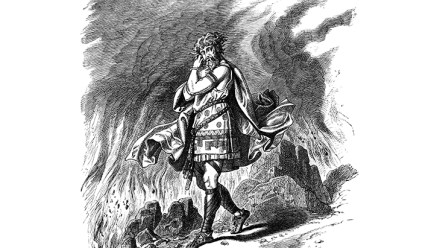
If western philosophy is no more than ‘footnotes to Plato’, so, arguably, is the myth of its founding hero, Socrates. While there is good evidence for certain aspects of Socrates’ life — his preoccupation with ethics, question-and-answer technique and his trial and death in 399 BC — most of it is shrouded in uncertainty. His only contemporary depictions are in a few satirical comedies by Aristophanes.

The lady with the limp

‘This seems to be in your rough area. I mean, it contains wooden legs and everything…’ my commissioning editor at The Spectator emailed. He was requesting a review of Sonia Purnell’s excellent A Woman of No Importance, a biography of the remarkable Virginia Hall, the only second world war agent to serve not only with Britain’s Special Operations Executive (SOE) and its later American counterpart, the OSS, but eventually also with the CIA. It is perhaps unsurprising that war histories contain a high number of people with missing or prosthetic limbs.

Out of this world | 28 March 2019

Like someone who has bought a first computer, then reads the manual from front to back but never actually gets around to switching the thing on, Robert A. Heinlein appears in his late fifties to have come across a how-to book about sex. Thereafter an instant expert, he wrote novel after novel brimming with it, much of it laughably theoretical and, well, wrong. Famously, to those who managed to get through an interminable book called The Number of the Beast (1980), he describes a kiss in the voice of a young woman: ‘Our teeth grated, and my nipples went spung!’ Nor were these the only breasts and nipples under discussion. The book is full of lubricious references to them, and other women’s parts, invariably objectified.

The cruise of a lifetime

Near the start of Fleur Jaeggy’s extraordinary novel Proleterka, the unnamed narrator reflects: ‘Children lose interest in their parents when they are left. They are not sentimental. They are passionate and cold.’ Passionate and cold is also an apt description of Jaeggy’s writing: the fierceness of her words erupts from the seams of her tiny, frigid sentences, sometimes just a word or two long. It also fits the narrator, even though she evidently hasn’t lost as much interest in her abandoning parents as she’d like. Her ‘sudden desire’ for her father’s ashes opens the book; then we are plunged back into her recollection of a fornight’s holiday with him on a cruise to Greece on SS Proleterka when she was 15.

More sinister than sweet

Ordinarily, I love books that answer questions I’ve never asked, but Simon May’s baffling book has blown my mind. The self-deprecator in me wants to tell you I’m too stupid to understand a word of it. The rest of me suspects that this is a sneaking yet sparkling satire on what a university education will get you (£50,000 of debt and the authority to pronounce a penguin cuter than a mermaid). I like the visiting professor of philosophy at King’s College London very much. ‘What is a bear with the head of a wolf?’, he demands. ‘Who is a human with cat’s eyes? What is the inner world of a sphinx “really”?’ He writes brilliantly and quotes exuberantly. The problem is his subject.

The might of the far right

‘Why would anyone write a historical study of it?’ asks Gavriel Rosenfeld about the Fourth Reich at the start of this rather confusing, but at times entertaining, book. His answer is that the phrase has been used as a metaphor since the earliest days of the Third Reich to mean a wide variety of things. It has permeated politics and culture, and seems to be a term susceptible to any meaning a writer or speaker wishes to impose upon it. Some of us — and I plead guilty to this — have used the term simply to describe the present German state in its reunified, Europe-dominating form. While of course such usage is a bit of a tease, it also seems to be a matter of fact.

Before the angel came

In his first book, published in 1977, Tim Mackintosh-Smith described mentioning the idea of travelling to Yemen while studying Arabic at Oxford because he had heard that Yemenis spoke the purest form of Arabic. ‘They all say that, you stupid boy,’ his tutor replied, suggesting he go ‘somewhere respectable’ instead. The student went to Yemen all the same, and has been there ever since, living through sweet and also turbulent times, including civil war and the ongoing Saudi-stirred nightmare that has taken at least 60,000 lives through combat and some 85,000 from famine. But not so very long ago, the word Arab in this country conjured up images of a sleepy, hospitable and ineffective people. How the wheel has turned.

Food for future thought

The Way We Eat Now begins with a single bunch of grapes. The bunch is nothing special to the modern eater: seedless, one-note sweet. It appears to be unchanged from those which might have been dropped into the mouths of Roman emperors. But, Bee Wilson explains, the grapes’ sweetness, their lack of seeds, their sheer abundance and affordability makes them a wholly different beast to those eaten by our forefathers. As she puts it: ‘Almost everything about grapes has changed, and fast.’ From there, The Way We Eat Now expands outwards to examine the peculiarities and vagaries of our modern eating habits. How they vary across different countries and continents (surprisingly little); how they have changed from those of previous generations (a lot).

Swarms of pestilence

Carried on monsoon winds across the Red Sea, vast swarms of desert locusts have posed a deadly threat to the people of the Horn of Africa for millennia. One swarm can number billions of insects, cover a 1,000-square-mile area and consume 30–40,000 tonnes of food per day — all of which makes the desert locust well deserving of its collective noun ‘plague’. Much brain-power has been dedicated to the controlling of these insects, whose swarms can lead, and have led to, famines. Methods of control have included the digging of trenches to catch hoppers (juvenile locusts) and, later, the aerial spraying of chemical and fungal insecticides. In the early 1950s, however, laying poison-laced bran in the path of marching hoppers was the method most commonly used.

Keep on rolling

Bowlaway, Elizabeth McCracken’s first novel in 18 years, is a great American candy-colour Buddenbrooks, a multi-generational epic spanning almost 100 years and presenting the lives of a whole panoply of people. Swap the family with their grain business in Thomas Mann’s novel for the Truitts and their bowling alley in Salford, north of Boston, and you will have the stuff of McCracken’s rambunctious saga. This isn’t ten-pin bowling however. It’s candlepin. The ball is smaller, ‘a grapefruit, an operable tumour’, just four and a half inches in diameter. The pins are no bigger than a hand and are, as might be expected, candle-shaped.

If you are going to San Francisco…

In his adopted city of San Francisco, the poet, publisher and painter Lawrence Ferlinghetti is venerated to levels nearing those of patron sainthood. In 1954, he co-founded the bookshop-cum-press City Lights on Columbus Avenue, which cleaves North Beach from Chinatown on the top right tip of the San Franciscan peninsula. Lauded by the Los Angeles Times as the man ‘without whom the Beat generation might not have found its voice’, Ferlinghetti is perhaps best known for having published Allen Ginsberg’s generation-defining Howl (and subsequently being arrested for, then cleared of, obscenity charges). But he also published others, such as Gregory Corso and Jack Kerouac.

Funny peculiar

My ex-dentist resembled a potato wearing a Patek Phillipe. In those precious moments between the golf course and the cruise ship he would take the time to remind patients what good value our treatments were. Under the spotlights we could do little but stare, gurn and dribble, which he took, I presume, as a sign of our overwhelming gratitude. I thought that was bad enough, but it’s nothing compared to J.P. Wintergreen, the dentist villain of Nina Stibbe’s ‘dentally particular’ comedy Reasons to be Cheerful. Set in Leicester in 1980, the novel is the third in Stibbe’s Sue Townsend influenced series of (stand-alone) books tracing the life of narrator Lizzie Vogel and her dysfunctional family.

Loved and lost | 21 March 2019

On 19 June 1948, the modern LP was unveiled at a press conference by the Columbia Records president Ted Wallerstein, who, as Billboard magazine reported, ‘demonstrated listening qualities of both 10- and 12-inch vinyl microgroove platters’. The company issued Frank Sinatra’s long-player, The Voice of Frank Sinatra, a week later. The title of David Hepworth’s new book might therefore imply a starting point of 1948 — similar to the approach taken by Travis Elborough’s excellent 450-page history of the album, The Long Player Goodbye (2007) — but Hepworth’s book is both narrower and more autobiographical, largely confined to the years 1967 to 1982.

Lady of the English

The Empress Matilda, mother of the Plantagenet dynasty, is the earliest queen of England who never was; by rights she should have been England’s first ruling queen four centuries before Mary. But she never sat on the throne. In this authoritative but accessible biography, Catherine Hanley emphasises the fortitude and steel of a woman who, as a child, experienced all the harshness of medieval diplomatic reality, having to learn and adapt to international power politics from a very early age. Born in 1102, she was only seven when her father, Henry I of England, arranged her betrothal to Heinrich V of Germany, 15 years her senior. The following year she was packed off abroad to complete her education and to prepare herself for her forthcoming role as empress.

The message in the blossom

Between 1639 and 1853, seeds and scions of flowering cherry trees travelled across Japan to Edo (present-day Tokyo). Each came from the most beautiful specimens of varieties of tree from the different principalities of Japan. From mountainous regions came the light pink yama-zakura; from the chilly climates of Hokkaido and northern Honshu came the crimson Ohyama-zakura; Mame-zakura, with their neat skirt-like white petals, came from Mount Fuji; and the rainy Izu islands produced Oshima cherries, with large, white flowers. This was an era of peace. For centuries before, the various families of Japan had fought for power. Now, they all answered to a single family, the Tokugawa family, in Edo, where each lord was required to have a residence.

Making Brexit thrilling

The long gestation period of Brexit has allowed authors to plan and write and publish novels in time for the big day. Alan Judd’s Accidental Agent (Simon & Schuster, £12.99) is a spy thriller set during the EU negotiations. Charles Thoroughgood is the head of MI6. The secret service is forbidden from spying on the EU, but when an EU official volunteers information about the negotiations, it seems too good an opportunity to miss. The trouble is, the mole — known only by the code name Timber Wolf — might not actually be real. Thoroughgood investigates the veracity of the source, taking the place of Timber Wolf’s usual contact, and what he discovers unsettles and surprises him.

The voices of the victims

Before she was the subject of true-crime mythologising, Catherine Eddowes made her living from it, selling ballads based on real-life murders to avid Victorian audiences. The historian Hallie Rubenhold suggests that Eddowes may have written them too; unusually for a working-class woman, she was literate. Still, the possible example of her work that Rubenhold reproduces in The Five shows no sign that female authorship led to incipient feminist consciousness. Typically for the 19th century (and still often seen in reporting today), Verses on the Awful Execution of Charles Christopher Robinson, for the Murder of his Sweetheart, Harriet Segar focuses attention on the femicidal man, investing sympathy in him rather than the woman he killed.