More from Arts

Barefaced brilliance

Calendar Girls Noël Coward Only When I Laugh Arcola Ooh dear, the critics have been terribly sniffy about Calendar Girls. This dazzlingly funny, shamelessly sentimental and utterly captivating tale of middle-aged women posing naked to raise cash for charity should have won five-star plaudits all round. But the reviews have thrown a veil over its brilliance. Why? Well, we critics dislike these schmaltzy populist confections because they deprive us of the chance to flex our intellect in public and serve up a perspicacious and polysyllabic exegesis. Ironically, though, my colleagues have not only shortchanged the show they’ve also missed the opportunity to do their brainy show-off bit — like this. The themes of Calendar Girls are rooted in ancient, universal myth.


Dodgy dealings

State of Play 12A, Nationwide State of Play is a thriller based on the six-part BBC series shown on television in 2003 and which, I confess, I did not see. Probably, it was because What Not To Wear was on the other side and, I’m sorry, I just wouldn’t have had the confidence to know what not to wear if I’d missed it. Anyway, the action has been shifted from London to Washington, the length has been shrunk to two hours and it stars Russell Crowe as Cal McAffrey, an old-school investigative journalist who is also wearily righteous, as these characters so often are.

Ju-ju injustice

‘Do you think that Africa is ever going to be free of these superstitions?’ asked the reporter Sorious Samura in the first of his four-part series, West African Journeys on the BBC World Service (Mondays). ‘Do you think that Africa is ever going to be free of these superstitions?’ asked the reporter Sorious Samura in the first of his four-part series, West African Journeys on the BBC World Service (Mondays). Sorious has been travelling round Ghana with Cletus Anaaya who works for a charity which is trying to stamp out the practice of killing ‘spirit children’, their fate decided by their parents and the soothsayers who declare them to be filled with evil spirits.

National treasure

The phone rang last night, I picked it up and it was our friend Tania. ‘God, I hate my ****ing husband,’ she said. ‘Oh, Tania, don’t be silly, Jamie’s a sweetheart,’ I said. ‘Oh, shut up, I don’t want to be talking to you, you’re a man. Pass me to your wife, she’ll understand,’ said Tania. So I handed the phone to the wife and she made all the right noises. It seemed that Jamie had arrived home late and hungry to discover that Tania had eaten all his sausages. Jamie had called her a ‘****ing bitch’. I felt similarly divided loyalties watching English Heritage (BBC2, Friday).

Purcell puzzle

After Dido Young Vic Il trovatore Royal Opera House For the third collaboration between ENO and the Young Vic Katie Mitchell and her team ‘direct a new work using multi-media techniques to create a synergy of music, theatre and film, inspired by, and incorporating, the full score of Purcell’s Dido and Aeneas’. Fortunately, the performance of Dido is a very good one, superior in crucial respects to the recent Royal Opera’s effort. Christian Curnyn, who conducts from the keyboard, is flexible in tempi and phrasing, so the tiny opera proceeds with a convincing naturalness, and the singers, discreetly miked, are uniformly excellent.

Handel’s business sense

It’s not often that a business correspondent looks to a musician for advice on investing in the stock market, but Radio Four’s Peter Day turned up on Handel Week and gave us an unusual take on the great baroque composer. It’s not often that a business correspondent looks to a musician for advice on investing in the stock market, but Radio Four’s Peter Day turned up on Handel Week and gave us an unusual take on the great baroque composer. Liquid Assets (Sunday night’s feature on Radio Three, produced by Paul Frankl) revealed that Handel was not just an extraordinarily prolific composer, he was also a very canny financial operator, even surviving one of the worst stock market crashes of all time, the South Sea Bubble.

Time well spent

The Private Life of a Masterpiece (BBC1, Saturday) got an Easter outing about Caravaggio’s ‘The Taking of Christ’. The Private Life of a Masterpiece (BBC1, Saturday) got an Easter outing about Caravaggio’s ‘The Taking of Christ’. It was superb, as this series invariably is. Understated yet informative, packed with unpatronising experts, it fascinates from start to end. Did you know that Caravaggio was a gangster and murderer, who spent the end of his short life on the run? Or that this particular painting was then the most expensive ever commissioned (125 scudi; I have no idea what that might have been against sterling), or that it sold in Scotland for just eight guineas 120 years ago?

Growing your own

It is, at present, almost impossible to open a garden magazine, or the gardening pages of a national newspaper, without coming across an article on how we are all now kitchen gardeners and allotmenteers; the theme is that the uncertain economic conditions have turned us back to our gardens, to grow comestibles and thereby ensure that we eat well, now that lack of the readies has reconnected us with our cookers. So far, so unexceptional, even trite. I have written such pieces myself. However, the difficulty for me comes when the writer gets over-excited and starts claiming that we can save enough money to make a difference to our circumstances by ‘growing our own’. Really?

Promises, promises

Parlour Song Almeida Tusk Tusk Royal Court Back in 1995 Jez Butterworth got tagged with the ‘Most Promising Playwright’ beeper and he still hasn’t shaken it off. Butterworth is an excellent second-rate writer, he has a wonderful knack for quirky comic dialogue but he wants to be a Great Artist too. A pity. All a playwright should aim to be is an entertainer. Butterworth’s new play, Parlour Song, is set in an estate full of suburban semis and it opens with two male pals joshing aggressively in a sitting-room. Andrew Lincoln’s sleek young Dale runs a car-wash business and complains of ‘pruney fingers’. Toby Jones’s squat, balding Ned works in demolition and wields Zeus-like powers of life and death over huge industrial buildings.

Power to disturb

Tony Manero 18, Key Cities This is a Chilean film of the kind that is probably only showing at an independent cinema quite far from you until last Thursday but that is life, so get over it. Also, the only Easter alternative seemed to be a big action flick starring Vin Diesel whom I have nothing against personally, but whose performance in The Pacifier I did not admire particularly. (I also felt Arnold Schwarzenegger had rather got in first as the big, tough guy who comically does babysitting in Kindergarten Cop, but that may be just me.

Our island story

‘Radio is a way of binding people together,’ says Lesley Douglas, former Controller of Radio 2 in a Guardian magazine cover-story this week celebrating the richness of British radio. ‘Radio is a way of binding people together,’ says Lesley Douglas, former Controller of Radio 2 in a Guardian magazine cover-story this week celebrating the richness of British radio. It could be the answer to our editor’s quest for what it means to be British, since 90 per cent of us are supposed to listen at some time to a radio station of some kind, whether it be local and illicit or the behemoths created by the BBC. Douglas was writing about what it takes to be a radio presenter.

No debate

On the posters in the Tube at the moment are these adverts for Argumental, which is the Dave channel’s first self-generated panel show. On the posters in the Tube at the moment are these adverts for Argumental, which is the Dave channel’s first self-generated panel show. I don’t want to knock Dave too much because it’s generally a good thing: the reliable stand-by you end up with if there’s nothing on the terrestrial channels, BBC4, BBC3, Sky One or the Military History channel. It’s got repeats of Top Gear. It has repeats of QI. What’s not to like? Well, Argumental would be my slight problem. Take those poster ads.

Beyond ‘face-painting’

Constable Portraits: The Painter & His Circle National Portrait Gallery until 14 June Sponsored by British Land The portrait was the dominant form in British painting up to the end of the 18th century, principally because this was what patrons wanted. Landscape painting was really the invention of Richard Wilson (1713–82), who inaugurated this particular branch of nature-worship. Constable, with his great gift for naturalness and observation, developed it further than any artist, except Turner. And it is as a landscape painter that we think of Constable, though he also painted about 100 portraits. These have tended to be overshadowed by his nature studies, and the current show at the NPG is the first to concentrate on his portraits. It is something of a revelation.

Second helpings

I Capuleti e i Montecchi; Dido and Aeneas; Acis and Galatea Royal Opera House There has been a three-week gap between the opening and closing sets of performances of the latest revival of Bellini’s I Capuleti e i Montecchi at the Royal Opera. Smitten by migraine on the first night, I had to leave in the interval. Returning this week for the whole work provided me with an evening of almost unmitigated pleasure, even jouissance. One can quibble with some of the production, and the secondary singers are not great, but overall it makes for as intense an experience of Bellini’s early masterpiece as one could ever expect to see.

Virtual trip to the opera

‘Having every best seat in the house’ is how some describe seeing opera live on screen, and recently we’ve had the opportunity of seeing the nuts and bolts backstage, too. It was a bold initiative of English National Opera and Sky Arts to take the cameras behind the scenes on the first night of Jonathan Miller’s new production of La bohème for Sky Arts 1, while simultaneously broadcasting the opera itself live on Sky Arts 2, and it was quite a challenge for the backstage crew: how do you keep your audience gripped for two and a half hours when all the real action is happening the other side of the set?

Master of print

Kuniyoshi From the Arthur R. Miller Collection Royal Academy, until 7 June Sponsored by Canon The Royal Academy is making something of a reputation for staging exhibitions of Japanese printmakers: the current Kuniyoshi show follows on neatly from Hokusai (1991–2) and Hiroshige (1997) and adds considerably to our understanding of the genre. There hasn’t been a major Kuniyoshi show in England for nearly 50 years, and he is certainly one of the less well-known of the great Japanese print artists. Master of an unexpected versatility and variety of subject, Kuniyoshi was also possessed of an originality that stands out even among such talented contemporaries.

Thwarted desire

Dido, Queen of Carthage Cottesloe The Overcoat Lyric Hammersmith Simple plays can be the hardest to get right. James Macdonald has made a dogged assault on the earliest work of Christopher Marlowe. The story is lifted wholesale from Virgil. After Troy’s fall Aeneas arrives in Carthage where Dido promptly falls in love with him. When destiny compels Aeneas to leave for Italy the despairing queen sets fire to herself, and her palace, in a humungous health-and-safety fiasco. Marlowe’s underdeveloped grasp of personality weakens the script.

Marital bliss

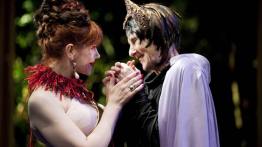
Die Feen Châtelet, Paris Ernest Bloch’s Macbeth Bloomsbury Theatre Wagner wrote his first opera Die Feen (The Fairies) when he was 19 and 20. It was never staged or performed at all in his lifetime, and first performed in Munich in 1888, Richard Strauss having conducted the rehearsals. It was a big success, but has only been revived rarely, and the production which I saw at the Châtelet in Paris last week, of which there are five performances, was the first I have seen. It was rapturously received, and rightly so. Wagner thought little of it, gave the score to Ludwig II for Christmas in 1865 — the only score of it then in existence — and Cosima records the composer’s deprecatory remarks about it in her diary.