More from Arts

How crazy was Louis Wain?

Before Tom Kitten, before Felix the Cat, before Thomas ‘Tom’ Cat, Sylvester James Pussycat Sr, Top Cat and Fat Freddy’s Cat, there were the cats of Louis Wain. The Wain cat came in a variety of breeds and colours: black and white, tabby, marmalade, white and blue (sky blue rather than Persian). But it always had the same disconcerting look in its wide, glassy eyes with the dilated pupils. It looked bombed out of its tiny mind. The original Wain cat was a black-and-white kitten called Peter belonging to a young late-Victorian magazine illustrator and his sick wife. In 1884 the 24-year-old Louis Wain had married his sisters’ governess, Emily Richardson, only for his new wife to fall ill with breast cancer.

The art of the Christmas card

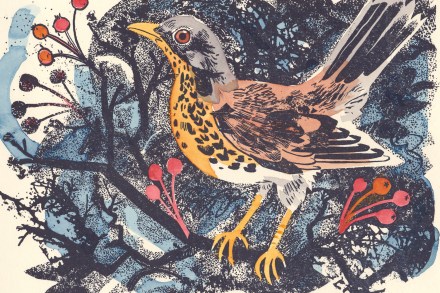
It’s the thin end of the wedge, the slippery slope, the beginning of the end of a civilised Christmas. It is the first week of December and I still haven’t started my cards. My friend Charlotte was at it in October. She signed up for a lino-cutting class, cut holly boughs and robin redbreasts and printed her own cards. She sent me photos of the fruits (berries?) of her labours and very merry they were, too. Usually, I am a Charlotte. By November, I have made cards, addressed envelopes, applied thumbs to 80 stamps. But after an illness in the autumn, I’m feeling as uncreative as a turkey. Could I cheat and send emails with a pious little homily about how, for the sake of the planet, I’m forgoing paper cards this year?

The supreme pictures of the Courtauld finally have a home of equal magnificence

When the Courtauld Gallery’s impressionist pictures were shown at the Fondation Louis Vuitton in Paris in 2019, the Parisian public was so bowled over by the exhibition that some were inclined to claim Samuel Courtauld as an honorary Frenchman. This was not completely unreasonable; after all Courtauld (1876–1947) was a Francophile from an old Huguenot family. But it was even more of a compliment to the magnificent array of French art he had put together. In this city of impressionism, home to the Musée d’Orsay and the Orangerie, half a million visitors came to see it.

The unseen Victoria Wood

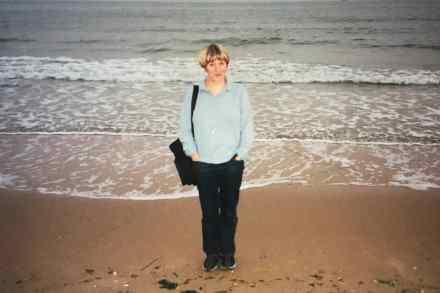
For a few years now I have been living with Victoria Wood. That sounds all wrong, obviously, and yet no more apt phrase suggests itself. Not long after her death I was invited to write her authorised biography, and in due course a vast collection of documents was delivered to my address. Packed into storage boxes, which I stacked in corners and stuffed under beds, her intellectual legacy became a physical fact. It was in sifting through this remarkable archive that I started to come across work — masses of it — that had never seen the light of day. At its core was a stash of 100 television sketches.

‘You should see some of the other scripts that come through’: Robert Carlyle interviewed

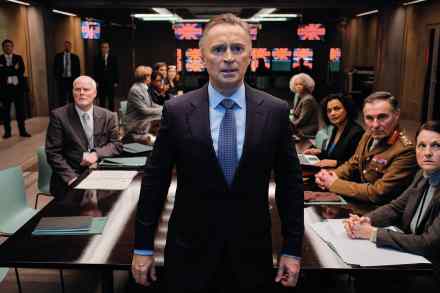
‘I always feel slightly sick when I hear actors talking politics,’ says Robert Carlyle — that polished Glaswegian burr sounding no less arresting over a slightly patchy Zoom connection. ‘I mean we’re all entitled to an opinion,’ he continues, sounding for a second as though he might be about to opt for a more diplomatic track. ‘I just find that too many actors find it difficult to get theirs across without sounding like a twat.’ It’s a fair point, you might think. But for Carlyle, it’s also been a good professional move. Reflecting on his career, he credits this aversion to mouthing off with inspiring his long-term commitment to keeping his head down.

Absurd and amusing, solemn and scholarly: Charles Jencks’s Cosmic House reviewed

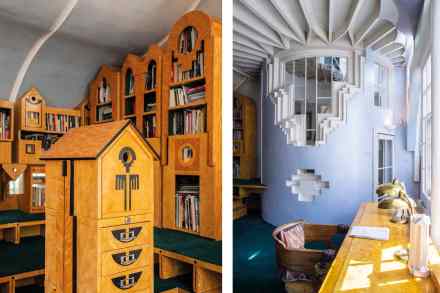
An editor once told me: always look at the loos. It was remarkable, she said, how many grand cultural projets, having spent a fortune on the atrium, the concert hall, the galleries, spent pennies on the bogs. The smallest rooms at Charles Jencks’s Cosmic House are among the loveliest loos in London with windows on to the garden and a ‘Jencksiana’ mirror over the sink. This was the Baltimore-born writer, critic and landscape designer’s take on the ‘Serliana’ window devised by the mannerist architect Sebastiano Serlio and it recurs throughout this mad and marvellous post-modern house. Jencks died in 2019 leaving his house on Lansdowne Walk in Holland Park as a stucco memorial. From the pavement, there isn’t much to distinguish No.

Sale of the century: the contents of the Sitwells’ mansion are going under the hammer

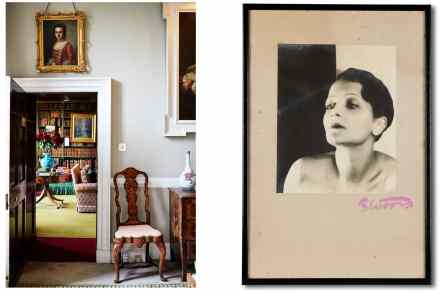
In my bedroom there is a small lidded laundry basket. It was designed by Geoffrey Lusty for Lloyd Loom, a company that has, since 1917, been producing surprisingly durable furniture made from lacquered woven paper fabric for the middle classes. The basket is globular and stands on three spindly legs. It is weatherbeaten, and slightly worn, because it was produced in 1957, at the dawn of the Space Era. Indeed, it is a Sputnik wicker linen basket, designed in the style of the famous satellite. Only 100 were ever produced. Why is this double design classic not in a museum? It may be that one is. As far as this one is concerned, however, I bought it at an auction in Bedfordshire last month for just over two hundred quid.

The vivid memory-scapes of Hong Kong master Wong Kar Wai

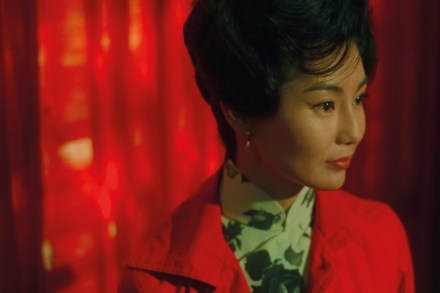
The films of Wong Kar Wai are a kind of map of Hong Kong. In them the city becomes a magnificent metropolis of missed connections, a tempestuous port where ill-fated lovers cross paths like ships in the night. And Wong has filmed the city from so many angles, with such spatial precision, that if the People’s Republic were ever to grow impatient with the territory’s seditious tendencies and raze it to the ground, Hong Kong could be reconstructed, flawlessly, from Wong’s films alone. A major retrospective on the Chinese film director is under way at the BFI and ICA. It couldn’t be more felicitous, since Wong Kar Wai is that most retrospective of filmmakers, always looking back, his characters ever in search of lost time.

The Turner Prize shortlist is an embarrassment

In 2019 I was asked to be on the jury for the Turner Prize. I was pretty happy about this. As an art critic, to be asked to judge one of the biggest art prizes feels like something of a professional endorsement. I even rang my mum to tell her. ‘But don’t tell anyone yet!’ I said over the phone. ‘It’s not been announced.’ A week or so later, home to see my parents, I walked into the village pub. One of my dad’s friends looked up from his pint and shouted: ‘I heard you’re judging the Turner Prize!’ Mum isn’t known for discretion. The rest of the evening was spent with various locals asking if I was going to give the award to ‘a pile of bricks’ or ‘an unmade bed’.

The art of the asparagus

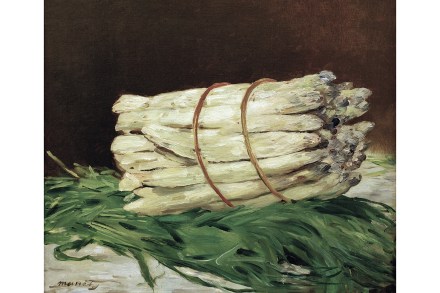
Manet’s ‘Botte d’asperges’ are probably the most famous asparagus in the world. The artist painted the delicious white- and lilac-tinged spears for the collector Charles Ephrussi in 1880 before invoicing him for 800 francs. Ephrussi was so delighted with them that he paid Manet 1,000 instead, to which Manet responded by sending a second picture. ‘One appears to have escaped your bunch,’ the painter quipped in his accompanying note. The new canvas featured a single asparagus. Manet was in the last decade of his life when he began sending small paintings of fruit and flowers to his friends.

The bizarre art of Scottie Wilson deserves to be better known

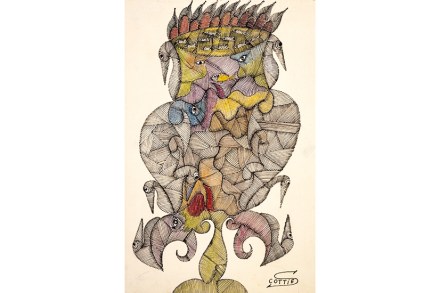
On eBay I have an alert set for ‘Scottie Wilson’. Nine times out of ten, it’s a diamanté Scottie dog from the jewellers Butler & Wilson. Once in a while, it’s a gem. Scottie Wilson didn’t think much of journalists. Art critics were ‘just jugglers — dodgers’. The sort of people who went to art shows — his or anybody else’s — could be counted on to go about ‘blabbing a lot of stupid muck. A lot of blah blah. They get paid for it too!’ Which makes it tricky to write about Scottie (always Scottie, never Wilson). You just know he’d light a cigarette and scowl. I came late to Scottie.

‘I’ve seen the bare bones of London’: street painter Peter Brown interviewed

‘I’ve been seeing the bare bones of London,’ explains the landscape artist Peter Brown, who is known affectionately as ‘Pete the Street’. We meet on the corner of St Martin’s Lane, where he is painting the view facing north, taking in the Coliseum, the Duke of York theatre and an Iranian restaurant called Nutshell. ‘The pandemic has been a good opportunity to paint all these West End theatre awnings.’ What has he noticed about London during the pandemic? ‘UPS vans, everywhere,’ he says. How about Deliveroo bikes? ‘I’ve spotted less of those.’ Has London changed over the past year? ‘I met a bloke on Old Compton Street who described how it feels really well to me,’ Brown says.

The artists ensnared by the capitalist system they affect to despise

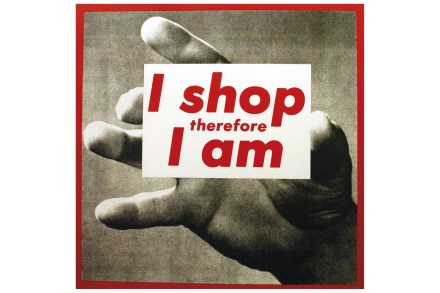
A few years ago, the American artist Barbara Kruger covered the façade of Frankfurt’s Kaufhof department store with a pair of huge eyes. It was as if Big Brother had come out of retirement. Above that unsparing gaze was the slogan, in Kruger’s signature Futura bold italic font: ‘You want it. You buy it. You forget it.’ It was a typical work of art by Kruger. She made her career from what’s called culture jamming, subverting media messages by transforming them into their own anti-messages and by indicting the business of capitalism.

Can VR help to sell art to kids?

Some pictures are now so mediated that their actual physicality has long been dwarfed by a million reproductions. The ‘Mona Lisa’, obviously. ‘The Haywain’ is the subject of countless cushion covers and trays. ‘The Birth of Venus’ has marketed trainers, hair dye and the New Yorker. Now, Georges Seurat’s ‘Un dimanche après-midi à l’Île de la Grande Jatte’, possibly the most famous painting to have inspired an entire musical and which has, along the way, inspired umbrellas, duvet covers, dresses, socks and face masks, is the subject of an ‘immersive’ creative experience. This does not mean paintballing outside the Art Institute of Chicago, where the actual art work resides.

Community music-making is the jewel in the British crown

Music is a universal language. The style that has enraptured me since childhood, classical music, has always had an international dimension, and has taken me around the world in the decades since. But even in those early boyhood encounters I became aware of music and musicians from many different lands and eras. Apart from the beauty and excitement of the music itself, the art form became an early gateway for me to languages, history, geography, philosophy, theology and much more. There were clearly a lot of Germans to grapple with (Bach, Beethoven, Brahms) — and some French (Debussy, Ravel) —as well as Italians (Vivaldi, Verdi) and lots of Russians too (Tchaikovsky, Stravinsky, Shostakovich). But where did my own country figure in all of this?

How 20th-century artists rescued the Crucifixion

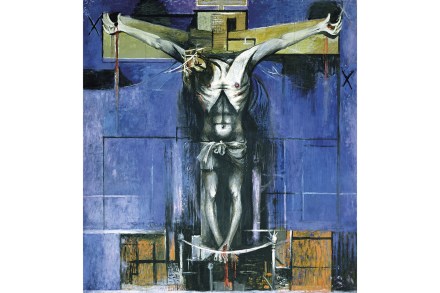
Two millennia ago, in the outer reaches of the empire, the Romans performed a routine execution of a Galilean rebel. Tortured and publicly humiliated in front of family and friends, Jesus of Nazareth was slowly asphyxiated over six hours. The Crucifixion is the centrepiece of Christianity. But artists have long adapted the devotional image of the Cross for their own purposes. As far back as the early 5th century, woodcarvers working on a door for the Basilica of Santa Sabina in Rome crafted a Christ whose palms are impaled with nails, but who is not hung on a cross. A devotional statue in Panama dating from the 17th century made Christ not Middle Eastern, but black African. James Tissot (c.

Why are the Oscars such a lousy guide to great cinema?

Chloé Zhao’s Nomadland, predicted to win big at this year’s Oscars, is not a terrible film. It’s a slight, sentimental Grapes of Wrath-ish journey through the Discourse, with essential Discourse stop-offs at an Amazon warehouse and the rust belt. It belongs in the New Yorker, not on screen. As with almost every film to win big since No Country for Old Men 13 years ago, you just think: the ‘highest honours in filmmaking’? For that? Amid all the change that’s being trumpeted at this year’s Oscars — more women directors, more ethnic minorities — the one thing missing is any discussion about why the awards are such a lousy guide to great cinema.

Clubhouse left me with one question: why am I here?

For my 13th birthday in 1995 I requested — and got — my own ‘line’. This meant that I could jabber all night without taking the phone out of service for everyone else. Getting your own line was a rite of passage for teenage girls in America back then, and everybody just sighed and let us get on with it. Talking on the phone all the time was simply something girls did. Women, meanwhile, at least according to film and TV, spent their time sitting by the phone eagerly awaiting calls from men that usually didn’t come. But then the feminised world of the endless, open-ended voice call dwindled with the arrival of mobile phones and a preference for texting, messaging, tweet-messaging, and the easy WhatsApp voice note.

How Algernon Newton made great art out of empty streets and dingy canals

Quite late in life Walter Sickert paid his first visit to Peckham Rye. He was excited, apparently, because he had often heard about it but never actually been there. Evidently Sickert had a sense of London as an unknown city, full of potential. And he was far from being the only artist fascinated by the hidden recesses of this vast urban labyrinth. Algernon Newton, another case in point, was equally fascinated by unfashionable byways of the metropolis. For Sickert it was music halls and dingy bedrooms in Camden that seemed full of visual possibilities; for Newton it was terraced streets and urban water courses, their banks empty of people. Not for nothing was he dubbed ‘the Regent Canaletto’.

Why is the smoky, febrile art of Marcelle Hanselaar so little known?

I first became aware of the work of Marcelle Hanselaar in a mixed exhibition at the Millinery Works in Islington. All I remember now about the show, and my review, is that I said she could teach Paula Rego to suck eggs. From the mischievous energy packed into her small figurative paintings I assumed she was young enough to be Rego’s granddaughter. That was in 2003; she was pushing 60. Born in Rotterdam in 1945, Hanselaar is essentially self-taught. She dropped out of art school in The Hague — it was the 1960s — and ran away to Amsterdam; what she learned about painting she picked up from the artists she lived with.