More from Arts

Eastern promise | 23 October 2010

The Singapore Symphony Orchestra is like a teenage athlete just about to hit peak form. This could be one of the great orchestras of the 21st century. So could its rival, the Malaysian Philharmonic. We all know that Asia produces dazzling soloists. But orchestras? I was sceptical until I heard the Singaporeans at the Southbank Centre this month. Accompanying Stephen Hough in Mendelssohn’s First Piano Concerto, they matched his virtuosity with their bouncy brio. The conductor, Lan Shui (above), had the sections swaying like stalks in a gale in Rachmaninov’s Isle of the Dead and Debussy’s La Mer. The encores: Bernstein’s Candide overture, taken at a lick that would have raised even Lenny’s eyebrows, and Stokowski’s arrangement of Air on a G String.


Postmodern spirit

Once upon a time, in America, a group of dancers and performance artists gathered in the Judson Church Theater and challenged long-held artistic tenets. The historical significance of their provocative aesthetics led scholars to label their art ‘postmodern dance’, even though there was more to their creations than just dance. A few decades later, their works have not lost their appeal, even though their principles have been regurgitated and tiresomely plagiarised. Take, for instance, Trisha Brown’s Flower of the Forest, the choreographic installation that greeted viewers outside the Queen Elizabeth Hall over the weekend.

Tales from Afar

If you heard Australian bluesman C.W. Stoneking’s first album, King Hokum, then you will know what to expect from his second: Jungle Blues. If you heard Australian bluesman C.W. Stoneking’s first album, King Hokum, then you will know what to expect from his second: Jungle Blues. If you didn’t, then let me point out that Stoneking is a prize mimic. With a banjo in his hands, and the wail of a Howlin’ Wolf or Robert Johnson in his throat, this 36-year-old (white) man (raised by American parents in an Aboriginal community) sets about recreating every lurch and inflection of 1920s blues and calypso music. The horns swoon, the drums shuffle — and you’d swear you can hear the crackle of old vinyl, dusty between its grooves.

Body language

The Dance Umbrella season has always been a unique window on international choreography, as well as a great platform for national talent. This year is no different, and the number of international visitors is delectably high. As always, blockbusters share the season with smaller but no lesser entities. Last week I went to see two from the latter category and was utterly intrigued, though not equally impressed. Those who have faithfully followed Phoenix Dance Company for the past decade might recall the Portuguese performance-maker Rui Horta and his somewhat mind-probing aesthetics. His Talk Show is a rather dramatic development of the formulae first seen and applauded in Phoenix’s performance of Can You See Me.

French foray

One surefire sign of maturity is the acceptance that you have friends who are more talented than you are. I learnt that lesson early, which, considering my manifold shortcomings, was just as well, frankly. I have mates who are better practical gardeners than I am, and ones who are more creative garden designers. I like to think that this is not so much a source of deflation or envy as a spur to my ambition. The spur pricked recently in France. I had been invited by Clare Whateley, of French Gardens Today, to join a very jolly small party of knowledgeable gardeners who were visiting gardens in northern Brittany. I was particularly pleased because I had worked with two of them at the Royal Horticultural Society’s garden at Wisley in 1975.

Faltering partnership

According to some, Onegin is the ultimate expression of John Cranko’s choreographic and theatrical genius. According to some, Onegin is the ultimate expression of John Cranko’s choreographic and theatrical genius. I disagree, for I think that other works are a much better testament to his unique creativity. But I like Onegin because it is one of those works in which choreography and acting go seamlessly hand in hand, thus creating a tension that makes one overlook and forgive much of the poor choreography — of which there is a good handful. That, though, is only when things work as they should. When they do not, the outcome can be dreary, like the performance I saw on the opening night of the new Royal Ballet season.

Age concern

English National Opera seems, at the start of the season, to be preoccupied, as we should all be, with how long we want to live, and in what kind of condition. In Janacek’s The Makropoulos Case the eponymous heroine is able, if she wants to, to live in a state of perpetual early maturity, but after 337 years decides to call it a day. In Gounod’s Faust the eponymous hero is feeling his years, and is offered back his youth by a diabolical force in return for his soul. Neither of these works, even in brilliant productions, advances the discussion much, but neither of the productions on offer is helpful, and Christopher Alden’s, of Makropoulos, seriously deflects attention away from where it should be directed.

Anti-depressant

‘Get inside the creative mind,’ urges the website of Studio 360, an innovative radio programme based in New York. ‘Get inside the creative mind,’ urges the website of Studio 360, an innovative radio programme based in New York. Set up by Kurt Andersen (of Spy magazine), it offers a weekly magazine programme about the arts, a sort of Front Row crossed with Night Waves. It’s intriguing, thought-provoking and just as good as anything produced by the BBC. The trouble is you have to be a wireless genius to work out how to listen to it if you’re driving through New England and don’t have access to a podcast or computer. Listening to radio in the USA is a frustrating business.

House rules | 2 October 2010

The other weekend the Fawn and I were invited to stay at Chilham Castle. Obviously, if you’re Charles Moore, this is no big deal because it’s the kind of thing you do 24/7, 365 days of the year. For us, though — me especially, the Fawn being slightly posher than me — it was a revelation. ‘Bloody hell!’ I thought. ‘This is totally fantastic. Why isn’t my life like this all the time?’ And I found myself wishing dear Hugh Massingberd were still alive. He would have understood perfectly when I rang him up to boast. Private Eye called him ‘Massivesnob’ but as Hugh knew snobbery has little to do with it. You don’t need to be grand to land an invitation to one of the great English (or Scottish) houses. Just interesting.

Blu-ray earns its stripes

Peter Greenaway’s A Zed & Two Noughts, recently released on Blu-ray disc by the BFI, proves that the high-definition format isn’t just for blockbusters: it could have been invented for the British director’s first collaboration with the legendary cinematographer Sacha Vierny, a partnership which made explicit Greenaway’s debt to French auteur Alain Resnais and introduced the meticulous colour-coding that would characterise later films such as The Cook, the Thief, his Wife and her Lover.

Mixed blessings | 25 September 2010

Jane O’Hara's Culture Notes What happens when you take a girl from Scotland and her acoustic guitar, and uproot them to the same studio in Berlin where U2 recorded Achtung Baby? Judging by KT Tunstall’s third album, Tiger Suit, the answer is a collection of moody, blackish songs. Tunstall made her name with the folk-pop jollity of Eye to the Telescope (2004) and Drastic Fantastic (2007). Here, electronic undertones and rock overtones are stirred into the mix to create a more complex sound.     Tunstall herself calls it ‘an eclectic album’ – and you can see where she’s coming from. The first track, ‘Uummannaq Song’, has a tribal feel to match its Greenlandic name.

Weaving a spell

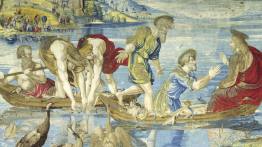
We tend to take for granted the fact that the V&A houses one of the great wonders of the Italian High Renaissance: Raphael’s remarkable tapestry cartoons celebrating the lives of St Peter and St Paul. We tend to take for granted the fact that the V&A houses one of the great wonders of the Italian High Renaissance: Raphael’s remarkable tapestry cartoons celebrating the lives of St Peter and St Paul. These tapestries were designed for the Sistine Chapel to be hung around the lowest tier of the walls on ceremonial occasions, and thus had to complement (if not compete with) Michelangelo’s awesome ceiling decoration.

Identity crisis

Astonishingly, I enjoyed The Town even though it is a heist movie with set-piece shoot-outs and car chases and even though it doesn’t break any new ground, which is just such a faff anyhow. Astonishingly, I enjoyed The Town even though it is a heist movie with set-piece shoot-outs and car chases and even though it doesn’t break any new ground, which is just such a faff anyhow. Have you ever tried breaking new ground? It’s exhausting plus, after a certain age, it is very hard on the knees. So this isn’t fresh, exactly, but it is tense and exciting and well performed and you do end up caring about the people you’ve been manipulated into caring about. I ask you: what more could you want from a trip to the cinema?

Friends reunited

Zanzotti’s in Soho: redolent of surreptitious lunches fondly remembered, with its red gingham cloths and crusted tricolore paintwork, its ‘chianti-in-a-basket./ Breadsticks you snap/ with a sneeze of dust...And Massimo himself/ touring the tables / with his fake bonhomie.’ An old haunt, and the setting, in Christopher Reid’s poem ‘The Song of Lunch’, for a reunion between former lovers, ten years on — or could it be 15? Zanzotti’s in Soho: redolent of surreptitious lunches fondly remembered, with its red gingham cloths and crusted tricolore paintwork, its ‘chianti-in-a-basket./ Breadsticks you snap/ with a sneeze of dust...And Massimo himself/ touring the tables / with his fake bonhomie.

Mad about the boys

Choreographic legacies are tough to handle; there is always the risk of turning a once vibrant dance into a theatrically dead museum piece. The preservation of choreographic milestones is certainly paramount, but so is the need to provide artists with new challenges, especially within those companies that, having formed and thrived around a prominent artistic figure, remain too attached to their long-deceased founders’ aesthetics. Luckily, renewal is in the air for Alvin Ailey American Dance Theater, as demonstrated by the 2010 piece The Hunt, choreographed by Robert Battle, who will become the company’s new artistic director in July 2011. The Hunt is a superbly fast-paced and powerfully engaging piece that moves away from the well-established canons of Ailey’s art.

Crime and punishment

As I descended, then descended again, then again, to get to my seat in the subterranean, uncomfortable Linbury Studio at the Royal Opera House, I thought gloomily of the number of miserable evenings I have spent there, and reflected that Philip Glass’s In the Penal Colony was probably all too apt a name for what I was about to experience. As I descended, then descended again, then again, to get to my seat in the subterranean, uncomfortable Linbury Studio at the Royal Opera House, I thought gloomily of the number of miserable evenings I have spent there, and reflected that Philip Glass’s In the Penal Colony was probably all too apt a name for what I was about to experience.

Hosed down with artificial cream

Highgrove: Alan Meets Prince Charles (BBC2, Thursday) brought us two men who are not quite national treasures, though who would certainly like to be. It’s interesting that ‘Alan’ apparently needs no surname, though ‘Charles’ requires the identifying title. But in spite of the implied matiness this was a deeply old-fashioned BBC royal slathering operation, in which no knee is unbent and no forelock goes untugged. Alan Titchmarsh could not get over how excited he was to be on his way to Highgrove and the prince’s garden: ‘its incomparable beauty and purity of purpose ...by the best royal gardener in history,’ he breathed, even before he’d got there.

Candid camera

A.A. Gill talks to his friend Terry O’Neill, whose iconic photographs captured an entirely new kind of celebrity I remember the first time Terry O’Neill took my photograph: he wore blue; I wore grey and the Great War helmet of the third regiment of Pomeranian Grenadiers. We were at the Imperial War Museum, and the nice curator gave me the tin hat with reverence. ‘They’re surprisingly hard to get hold of in good condition, considering how many were made,’ he said. This one had been lifted from a corpse in Arras. And I can pass on to Spectator readers — because I know how much you love this sort of thing — that the second world war version is slightly smaller than the first, to save steel. I donned the coal scuttle and a Teutonic demeanour.

Liquid gold

William Pye has observed, somewhat wryly, that he’s better known among architects and designers than he is by the art-loving public. William Pye has observed, somewhat wryly, that he’s better known among architects and designers than he is by the art-loving public. There is a simple reason for this: in recent years he has had very few exhibitions in galleries. His work used to be a regular feature of the Royal Academy Summer Exhibition, but he is not an RA, and an artist of his stature does not readily court rejection. After a run of showing at the RA for some 30 seasons, he was turned down twice in the hurly-burly of general submission. The panjandrums of Burlington House missed a trick when they passed over Pye.