Features

Could Iran shift to dynastic rule when Khamenei dies?

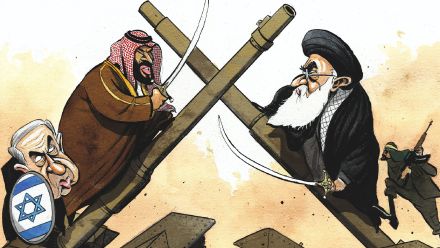
Who will rule Iran after Ali Khamenei? The question is being asked with increasing frequency and concern as the Supreme Leader approaches his 85th birthday amid rumours of ill health, and it will be raised again on 1 March, when Tehran holds elections to the parliament and the Assembly of Experts, the body which will determine his successor. Neither of the principal contenders is squeamish about shedding blood in the interests of regime survival Successions in dictatorships, or in Iran’s case an oppressive theocracy, are fraught with danger. Uncertainty and instability, with the prospect of great violence, are priced in.

The truth about ‘living with obesity’

It’s been brought to my attention that it is no longer done to describe a person as fat. Better, apparently, to say that they are ‘living with obesity’. This weasel construction makes obesity sound like a malevolent squatter who refuses to be evicted. Or like a bit of genetic bad luck, such as ‘living with ginger eyelashes’. It’s someone else’s fault. The western world has undoubtedly lost the plot with regard to diet, but before I say more, full disclosure: I am, according to the flawed metrics of BMI, obese. I reject the label, not because I’m in denial but because an index that ignores age, sex and muscle and bone mass isn’t really worth a light. I’ll stick with the Tightening Waistband Indicator.

Permanent stalemate in Gaza suits Netanyahu

Jerusalem After midnight on Thursday is dead-time for the Israeli media. The weekend editions have gone to print (newspapers don’t come out on Shabbat) and the Friday night TV news shows have been pre-recorded. The country’s journalists are yearning for respite from a long week covering the war. Benjamin Netanyahu chose that black hole of news, 2 a.m. last Friday, to leak his ‘Day after Hamas’ plan for post-war Gaza. There was no speech. No briefings. Just a page and a bit, double-spaced, presented to his cabinet for discussion. The plan has not been designed to end the war in Gaza. It is about Netanyahu’s own political survival But the plan is not a plan.

Blue tits vs willow tits: a lesson in subsidies

I last saw a willow tit on my farm about a year ago. I’m searching for them again this spring, listening for their ‘chair chair’ calls, but I am worried that they may be extinct here. They are dying out everywhere: down by 92 per cent nationwide in the 50 years from 1967. And the reason is not pesticides or climate change or agriculture or habitat loss. It’s blue tits. Willow tits have never taken to visiting bird tables, but blue tits love them. So come the spring, hordes of peanut-fattened blue tits fan out across the countryside looking for nesting holes and – hey presto – they find the little hollows that willow tits have been laboriously excavating in rotten birch trees and, being more aggressive, steal them.

Ukraine is in dire need – and the West must respond quickly

As the second anniversary of Russia’s full-scale invasion of Ukraine approaches, the fall of the key eastern city of Avdiivka is one more sign that Vladimir Putin holds the initiative. Ukrainian troops resisted the Russian forces for months, but the threat of encirclement forced Ukraine’s new army chief, Oleksandr Syrskyi, to retreat. The Russians were firing 10,000 artillery shells a day; the Ukrainians had been able to reply with about 1,500. Such an imbalance made defeat inevitable. There are risks in reading too much into a single military setback, especially in light of Russia’s extraordinary losses (more than 300,000 dead and wounded, elite special forces decimated, more than 2,000 tanks destroyed and 24 Russian warships sunk).

Cricket is one of the best anti-depressants

I love it when the England cricket team flies east in the winter. It means they’re playing in the early morning, UK time, and that’s just when I need them the most. Because cricket is a powerful antidepressant. Without the sound or sight of bat on ball, early mornings at the moment would hold their usual threat The fireworks of Bazball have been lighting up the sky for nearly two years now, and as that period has coincided with war and economic doom, the on-field heroics of Ben Stokes and the gang have been particularly welcome. But, thrilling as last year’s Ashes undoubtedly were, they still took place in the summer, the time of year when depression is at its least potent.

Putin’s British prisoner: Vladimir Kara-Murza is languishing in a Siberian jail

Opposing Vladimir Putin is a lethal business. The world was reminded of this last week after the sudden death of the opposition leader Alexei Navalny. The Russian authorities are blaming Navalny’s demise on ‘sudden death syndrome’, but whether it was outright murder or simply the result of three years spent in Russia’s penal system, the responsibility lies squarely with Putin. The danger of standing up to Putin is something the Russian-British journalist and author Vladimir Kara-Murza knows only too well. An active campaigner for Russian democracy, Kara-Murza was an ally of Navalny. He is responsible for convincing the West to sanction Putin-friendly oligarchs.

DNA profiling is a great British success story

Hardly a week goes by without a mention of DNA’s contribution to criminal justice. Last week Sandip Patel was convicted of killing a prostitute near Baker Street 30 years ago: DNA belatedly proved that his hairs were caught in her ring. A few days before, a double murderer, Colin Pitchfork, was controversially granted a parole hearing 36 years after being the defendant in ‘the first case of its kind in Britain to use DNA profiling’, as the Times put it. Only that’s wrong. Colin Pitchfork was not the first person in Britain to be convicted with DNA; he was the first person in the world. The story of how DNA profiling was invented and then applied to solving crimes is a truly remarkable, entirely British success story.

‘They’ve killed Blackpool’

It’s mid-afternoon in the Royal Oak pub in Blackpool and Liv has arrived to sell a bag full of stuff she’s stolen from the supermarket. She’s got fabric conditioner, soap, Creme Eggs and a large bar of Dairy Milk. She pulls in a few pounds and then leaves to score some crack. ‘Everyone struggles,’ says a man watching her sell. Lots of people here don’t work. People earn money however they can. Neither Labour nor the Tories come here for their conferences any more. They prefer big cities with nicer hotels In Blackpool, you see the worst of Britain’s welfare crisis. More than a quarter of the city’s working-age residents are on out-of-work benefits, the highest proportion in the UK and twice the national average.

Why Britain stopped working

What sent the economy into recession at the end of last year? The government blames higher interest rates, ushered in by the Bank of England. The Bank in turn points the finger at shocks such as Russia’s war against Ukraine. Both are plausible answers – and certainly part of the equation. But the Office for National Statistics has offered up another explanation, one that the Chancellor Jeremy Hunt will be grappling with as he prepares for the Budget in two weeks’ time: mass worklessness. ‘If more people were in work, consuming, producing,’ said ONS chief economist Grant Fitzner when the recession was announced, ‘we would have higher GDP numbers.’ Those numbers would be quite a bit higher, according to The Spectator’s calculations.

Britain can no longer defend itself

When the Berlin Wall fell, the British Army had 152,800 soldiers. Tony Blair’s government cut this to 110,000; David Cameron’s reduced it to 87,000. Plans to let that number fall to 82,000 were accelerated by the former defence secretary Ben Wallace. It’s generally accepted that by next year numbers will have dropped to 72,500. That’s a generous estimate: there are credible reports the army could soon number just 67,800. This week the British Army is playing a leading part in Operation Steadfast Defender, the largest Nato exercise in peacetime history. Yet it is smaller than it has been at any point since the 1790s. More importantly, it’s far too small and too badly equipped to deliver everything we’re promised it can do.

How to check in to a haunted hotel

The haunted hotel. It’s a definite thing, isn’t it? From Stanley Kubrick’s classic The Shining to the slightly less classic I Still Know What You Did Last Summer, the hotel with an unwanted and probably long-dead guest is a leitmotif in scary cinema. It can also be found in poems, plays, novels; possibly the first novel on the theme is literally called The Haunted Hotel, it’s by Wilkie Collins and it is set in, yes, Venice. But here’s the thing about haunted hotels. They are actually a thing. That is to say, there are places to stay which invoke a definite frisson of doom, dread or deep unease. And I know this because 1) I am a travel writer and I’ve therefore been to a few of these places, and 2) as I write this, I am sitting in a haunted hotel.

The Bishop of Oxford: why I support gay marriage

We all know the Church of England is ‘divided’ over homosexuality. But it’s not a very equal division. Reform is favoured by a clear majority of bishops, the clergy and Anglican worshippers. So how are the conservative evangelicals managing to hold back the tide? Perhaps the problem is a lack of leadership. The archbishops have not dared to reveal what sort of change they want, beyond saying that there should be blessings for gay couples. The other bishops have echoed the evasion. ‘I was seeking to be a focus of unity by not saying what I thought’ Only one senior bishop has articulated a clearer reformist vision. Just over a year ago, the Bishop of Oxford, Steven Croft, broke ranks and said what he really thought – up to a point.

How to choose a better death

In 1984 I was a third-year student nurse. The last secondment before my final exam was gynaecology. The wards were housed several miles away from the friends and familiar faces of the Edwardian general hospital where my training had been based. It was an unfriendly place. The staff had little time for outsiders and none for this skinny, ginger, idealistic student nurse. In those days, before accurate scanning equipment was widely available, the diagnosis of ovarian and uterine cancer was difficult and treatments much less effective than they are now. The outlook for many was bleak. Some of the patients on the ward where I worked were a deep ochre colour from jaundice, and were so emaciated it was a miracle their skeletal legs could carry them.

Ukraine’s spirit isn’t even close to broken

Rome and Kyiv have one thing in common – the distinctive whine of motor-scooter engines in the night. The difference is that in Kyiv the high, Vespa-like noise does not rise from the streets but drifts down from among snow-laden clouds. It’s the unmistakable sound made by Iranian-designed Shahed-136 suicide drones, essentially modern-day doodlebugs armed with warheads big enough to collapse a medium-sized building. Kyivans nickname these sky-borne menaces ‘mopeds’. Shaheds are slow-moving, low altitude and easy to spot, so Russia fires them after dark. With a great deal of noise and spectacular flashes in the night sky, Ukrainian anti-aircraft and Patriot missile batteries usually blow most of them out of the sky as they come in.

What I learned from my father’s life of crime

I was on my way home from sixth-form college when I heard about Dad’s arrest for his alleged involvement in what, at the time, was the biggest heist in history. Three tonnes of bullion, along with platinum, jewellery and traveller’s cheques, had been taken from the Brink’s-Mat warehouse at Heathrow in the early hours of 26 November 1983. Fifty police officers raided our house. Mum, pragmatic as ever, put the kettle on and even made a bacon sandwich for a WPC who complained that she’d missed her breakfast due to the early start. Dad’s subsequent trial and conviction at the Old Bailey made worldwide headlines. He was jailed for ten years for conspiring to handle stolen goods, and fined £200,000. It wasn’t in Dad’s nature to play by the rules.

Is Nato ready for a Russian invasion?

Tapa, Estonia In a pine forest two hours from Estonia’s border with Russia, preparation for war is under way. British, French, American and Estonian soldiers are rehearsing what Nato would do if Vladimir Putin invaded. They’ve brought Challenger II tanks, an F-16 fighter jet and Himars artillery systems – some of the best equipment the West has – for a fortnight of battle simulations. It means preparing for trench warfare, minefields, ambushes and mortar strikes in -20°C and a foot of snow. Not long ago, the idea of fighting a war against Russia was dismissed as a joke. When Mitt Romney ran for US president he said Moscow was a threat, and Barack Obama mocked him: ‘The 1980s are now calling to ask for their foreign policy back. The Cold War has been over for 20 years!

Why is everything in Antarctica so difficult?

‘Do you like to dig?’ That’s the first question seasoned Antarcticans ask when a scientist tells them he’ll spend winter on the white continent. Digging snow away from doors, windows and shipping containers saps your energy, but they’re not asking about that. Digging is a symbol for all the unglamorous physical tasks that will come to define your life. If you like to dig then you probably also like to wash, to sweep, to whittle and sand, to carry rather than drag, to find the right tool for the job, to fight a losing battle against the weather. Our drinking water is made from desalinated seawater. An impressive machine that smells like a swimming pool makes perfectly soft water with no taste.