Features

Meeting Marine Le Pen

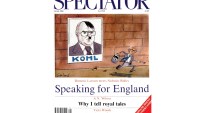
The Front National leader is keen to sound off on the EU, immigration and capitalism – but not on her party’s Vichy links There’s no mistaking the Front National’s headquarters in the western Parisian suburb of Nanterre. Outside the entrance stands a martial statue of a Joan of Arc in full body armour. Inside there is a garish, gigantic plastic coq gaulois. Further inside sits the party’s leader, Marine Le Pen, a handsome 42-year-old blonde in heels, tailored jeans, frilly blouse and no make-up. Bob Tyrrell, editor-in-chief of the American Spectator, and I have been granted what is (for foreign media) a rare audience with the most forceful new character in French politics. It is impossible to dismiss Le Pen or her party as a fringe force in French politics.

Mind the gap | 27 August 2011

It’s time to stop separating psychiatry and neurology In 1987, I went to work as a trainee psychiatrist at the National Hospital for Neurology in Queen’s Square in London. One of my jobs was to see a group of patients who were not popular with the neurologists who ran the place. The patients had symptoms that might have had a neurological explanation — muscle pain, inability to walk, being unable to think clearly, feeling exhausted after the most minimal physical or mental exertion — yet the neurologists thought that they were at best suffering from depression or at worst swinging the lead. They found it irritating that the patients insisted they had an illness called ME (myalgic encephalomyelitis).

Borneo Notebook

••• After a week in the jungle, it is perfectly clear to me that in any contest for creepy-crawly capital of the world, Borneo would be right up there with no questions asked. They tell you about the mosquitoes. What they don’t tell you about are the leeches, which are everywhere. The ordinary brown kind lie in wait on the path, rearing up like two-inch mini-Godzillas full of gangster attitude and the will to win. Used to chomping through boar and mouse-deer hide, they made short work of my hiking socks. They pump up from matchstick to chipolata size in a few minutes if you don’t catch them quickly, and inject an anticoagulant so you end up bleeding for hours after the bite.

Fight or flight

David Cameron now has the chance to be the Prime Minister he always wanted to be. Up to now, his premiership has, to his frustration, been dominated by the economic crisis that the country is facing. His cherished social reform agenda has not been the government’s animating mission but a rhetorical extra. But after last week’s riots, this has all changed. Broke Britain is now being forced to share its space at the top of the national agenda with Cameron’s specialist subject, Broken Britain. This crisis may have deprived Cameron of his summer holiday but it has given him back his political mission. Those present at the meeting in Downing Street before Cameron addressed parliament last Thursday say the mood was remarkably upbeat.

One day at Headingley

The cyclist sipping wine on the terrace of a Thames-side pub may not look much like an English hero, but anybody who loves cricket knows that he ranks only slightly lower than the angels. Thirty years ago Bob Willis bowled England to the most astonishing victory in the history of Test cricket, taking eight for 43 on a mad Monday in Leeds that held the nation entranced. Three decades later, not even the superb performances of the current England players, who are facing India at the Oval this week as the No. 1 team in the world, can efface the memories of ’81.‘Botham’s Ashes’, they call that series, with reason.

Keep the faith

How the Church of England can – and will – endure Though with a scornful wonder Men see her sore opprest, By schisms rent asunder, By heresies distrest, Yet Saints their watch are keeping, Their cry goes up, ‘How long?’ And soon the night of weeping Shall be the morn of song. Samuel Stone’s hymn, replete with already archaic spelling, expresses the Victorian hand-wringing over the supposedly dangerous heresies of John William Colenso, Bishop of Natal from 1853 to 1883. The first Lambeth Conference was called in 1867 to address the problem. Stone’s hymn, written a year earlier, sums up the mood of many. Everything is going wrong, the godless mock, and all we can do is hold out for ‘the consummation of peace for evermore’.

Box-set bullies

 ‘I saw this amazing film,’ people used to say at dinner parties, ‘you must see it.’ And it was nice to have their recommendations; pleasant to trot off to see The Matrix or Four Weddings and a Funeral and be the one to rave about it at the next party. These days, just the words ‘You must see…’ fill my heart with dread because they are invariably followed by not a film, but a whole TV series, available in a box-set: The West Wing, The Killing, The Wire. Nothing makes the heart sink more at the start of a villa holiday than the sight of a fellow guest arriving with 30 episodes of Mad Men under his arm.

The fascist vote

At the age of 72, I begin to wonder, for the first time in my life, if there might be a future for a fascist party in Britain. The thought has been provoked by the riots, or rather the response of many to them. The riots themselves were horrible, an outburst of callous criminality, doubtless enjoyable for those who took part in it. Yet they were comparatively unimportant. To say this is not to pretend that they weren’t frightening, that people weren’t killed, or that other victims did not suffer injury or damage to their property. Nevertheless, disturbances of this kind have happened before, and will happen again. Sometimes a fuse is lit, in this case by the shooting of Mark Duggan by the police, and then the tinder-box explodes.

Playing with explosives

‘Mps to vote on death penalty’, announced the front page of the Daily Mail earlier this month. This was a reference to a petition on a government website calling for the restoration of capital punishment, but the true significance of the story was buried in the small print. The e-petition in question was created by Paul Staines, the man behind the Guido Fawkes blog. Until recently, Staines’s influence was confined to uncovering political scandals, making him a must-read in the Westminster village but relatively unknown in the wider world. Now, it seems, he’s single-handedly put capital punishment back on the political agenda. ‘Harry reckons this is our Glenn Beck moment,’ says Staines, referring to his second-in-command Harry Cole.

WEB EXCLUSIVE: These rioters are Tony Blair’s children

Nihilism and disorder have been fostered by the state On the third day of the London riots I received a telephone call from Mash, a member of a Brixton gang who I befriended three years ago. He was standing outside an electronics shop in Clapham, watching the looting. I could hear shouts, glass breaking but never a police siren. I urged him to go home. ‘Harri man,’ he remonstrated, his voice hoarse with emotion, "You don’t get to do this every day. You do your thing, and you don’t get arrested. It’s wild and exciting. These few days, it’s our time." The riots engulfing areas of London and other cities this week are not about poverty or race.

A Tottenham notebook

Every reporter knows the feeling. I’m watching television at around 11.30 p.m. on Saturday night when my phone begins buzzing. It’s the distinctive number of the New York Times newsroom: 111 111 1111. Answering means being pitched into chaos. ‘We’re hearing of some unrest in Tottenham,’ says the voice. ‘Can you get there?’ I sigh, jump in a taxi and ask to go as close to the local police station as possible. I know I have arrived when I see a burning car with 20-foot flames jumping out. It crackles and hisses. There’s no fire brigade, no cordon around the car. What, I wonder, is going on? I ask a bystander, a man with gold teeth. He explains that ‘these people want justice’.

Forty years of funny money

The Standard & Poor’s headquarters, inside one of the biggest skyscrapers in New York’s financial district, houses just about every kind of brainiac that Wall Street money can buy. Mathematicians, computer modellers, economists and market strategists pooled their collective wisdom before making last Friday’s decision to strip the United States of its triple-A credit rating. It is a shame, however, that the ratings agency didn’t have a historian with a sense of irony on its team. If they had, S&P might have postponed the announcement, and the market turmoil it inevitably unleashed, for just a few days. The 15th of August would have been the perfect moment to unleash this particular bombshell. Why?

Is this the new Berlusconi?

Rome. A summer evening at the Colosseum. Snarling traffic and noisy crowds can be heard, but inside the arena the air is cool and still. On the dais, here to formally inaugurate the site’s restoration, which he is funding with a €25 million donation, is Diego Della Valle, ‘the shoemaker’, as the snooty Romans call him. He has built a fashion empire, transforming his father’s successful shoe business into a global brand, Tod’s, which continues to expand even in the depths of recession. His has plenty of other business interests, too, from the football club Fiorentina to the Corriere della Sera, Italy’s most respected newspaper.

The secret of self-help

This being summer, many of us are going to spend a lot of time in airports. So we may as well make the most of it. During half an hour in WH Smith in Dublin airport, I learned to take life one small step at a time, the importance of learning how to delegate, and the best way to make decisions. I picked up Warren Buffet’s cardinal rule, which is to make a list of everything you want to get done today, begin at the top and work down. I’ve learned the 43rd of Duncan Bannatyne’s 43 Mistakes Businesses Make... and how to avoid them (it’s the things you don’t do that you regret). In short, I hung around the self-help stand of the bookshop business section and filleted each of them in turn. I love self-help books.

The polar bear problem

They’re thriving – and they’re hungry The terrible story of the boys mauled by a polar bear in Spitsbergen has sparked a debate about the risks of adventure travel. But what does it tell us about polar bears? Some have claimed that this month’s tragedy is evidence that they are getting hungrier and more desperate as Arctic ice retreats. More likely, it shows that they are getting ever more numerous as hunting pressure relents. For years there was a skin of a bear hanging on the wall of the cafeteria in Longyearbyen, Spitsbergen’s capital village — maybe it is still there. By rights that bear should have eaten me, or my friend Charles Gillow.

America’s overdue financial crisis

When Congress went into deadlock on the debt ceiling, it was the culmination of years of bitterness and complacency – and there is worse to come Washington DC It’s obvious to me why the United States found itself so deep in debt that only an ugly compromise — rushed through Congress on Tuesday and Wednesday — could save it from failing to pay its bills for the first time in its history. The country is in the middle of a moral crisis. So often have Americans heard the tale of their forebears’ self-reliance and genius for political accommodation that they have grown complacent. If the crisis is new, the danger is of long standing.

Drought didn’t cause Somalia’s famine

War did. And food aid may well make it worse It seems wicked to question charity appeals for starving people in the Horn of Africa. Hunger is a terrible way to go, as I discovered when I once asked a dying Somali near Mogadishu to tell me what he was feeling. He was just passing into that zombie-like state with staring eyes. He said how the first ache was replaced by burning thirst that never leaves you. Marasmus turns children into martian-headed skeletons. Kwashiorkor swells their bellies. Glossy black hair turns reddish. Teeth fall out and ulcers like gunshot wounds eat into the cheeks. Inside, the body cannibalises itself, eating up fat reserves, then muscle proteins. Immune systems crash, diseases pour in and terminal release comes with organ failure.

Does everything give you cancer?

I'm sick of being scared by scientific studies Tall women are more likely to get cancer. As research findings go, this has to be among the most randomly vindictive scientific conclusions ever to spill out of a university research department into a screaming newspaper headline, and lord knows there have been a few. Women who breastfeed are less likely to have heart attacks or strokes. Women who don’t breastfeed are more likely to abuse children. Women who are stressed are more likely to have children with asthma (how stressful a piece of knowledge is that?). Men who are circumcised are more likely to suffer erectile problems. Children born to men aged over 35 are more likely to have a cleft lip or palate. Men are more likely to get cancer than women.