Features

Ed against the empire

Rupert Murdoch’s hold on British politics has finally been broken. The politicians who competed to court him are now scrapping to see who can distance themselves fastest. As the Labour leader, Ed Miliband, says when we meet in his Commons office on Tuesday afternoon, ‘The spell has been broken this week and clearly it will never be the same again.’ Miliband and his staff have just heard that the government will support their motion calling for Murdoch to withdraw his bid for BSkyB. They are trying to contain their excitement, but their grins give them away. The press secretary, normally a nervous-looking soul, is beaming from ear to ear. Their strategy, hatched late on Monday night, seems to have worked.

You’ll miss him when he’s gone

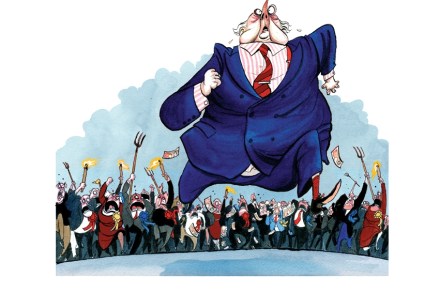
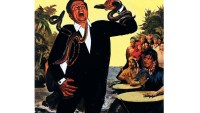
Ed Miliband was beaming when I saw him talking to Rupert Murdoch at the media magnate’s summer party at the Orangery, Kensington Palace, just three weeks ago. Ed Miliband was beaming when I saw him talking to Rupert Murdoch at the media magnate’s summer party at the Orangery, Kensington Palace, just three weeks ago. The Labour leader has since admitted that he did not raise the matter of phone hacking that evening. Of course not! He was trying to charm. But that is so last month. Now, Miliband is happily playing Pied Piper to the lynch mob against the lord of the evil empire whom the Labour party courted so long and so successfully. Mobs should never be trusted, let alone joined.

Summer of hate

For the past half a century, the Tunisian film director Nadia El Fani would have had no problem showing her new documentary, Neither God Nor Master, which explores her atheism and disdain for radical Islam. But before the Jasmine Revolution, Tunisia was the most socially liberal country in the Muslim world. Its Islamist extremists were where they belonged: in prison. A few weeks ago, however, during the film’s premiere, hundreds of bearded zealots smashed through the glass doors of the capital’s CinemAfricArt cinema, attacked the audience, and threatened ‘a massacre’ if the screening continued.

Written in the scars

What do you do if you want to upset your parents these days? Properly rebel, I mean. You certainly don’t get a tattoo. Tattoos won’t bother anybody — they’ve become a fashion accessory, adopted as widely as bangles and bracelets. Shrewd money is investing in the sector, because it’s going through a growth spurt: tattoo parlours are up 5.6 per cent since 2008. But this isn’t merely a fad: it reflects a deep underlying secular obsession with living for ever and, especially, staying permanently young. Young women are driving the boom in fashionable tattooing. My friend Alice, for instance, is 23, super-cool, and works in high fashion. She has several tattoos, including a shooting star on the delicate underside of her wrist.

Never trust an editor

Long before the phone-hacking scandal attained volcanic proportions, I scarcely knew a journalist in London unastonished to hear that last Christmas, the prime minister dined at the Oxfordshire home of Rebekah Brooks. Even were she Mother Teresa, which some evidence suggests she is not, it was plainly a lapse of judgment for David Cameron to be seen to accept Brooks’s hospitality, as he regularly did. This was on four counts: 1) The immensely sensitive issue of BSkyB’s future ownership was on the government’s plate, and Brooks is a senior executive of News International. 2) The News of the World phone-hacking scandal was ongoing, and Brooks was a deeply involved party. 3) Brooks’s access to Cameron was bound to feed jealousies elsewhere in the media.

Watch your step

Why can’t we have traffic laws for pedestrians? Imagine you’re driving down Piccadilly one day. Suddenly, without the slightest warning, you brake to a halt, causing the car behind to smash into you. Or you change lanes without indicating, right into the path of someone who’s overtaking. Or you change direction completely, executing a perfect one-eighty into the oncoming traffic. What sort of punishment would you expect? Forget points on your licence, you’d be scratching the days on your cell wall. Yet repeat these crimes in their two-footed versions on Piccadilly’s pavement and no one will say a thing. Not to your face, that is. Inside it’s different. Inside they’re dreaming of attaching you to the nearest lamppost à la Mussolini.

Failing the Test

County cricket ought to be important because it provides the players for Test cricket. You won’t find your budding Strausses, Cooks and Swanns playing on village greens or even in the estimable Lancashire and Yorkshire leagues. If they are really good they will be in a county side. The problem, however, is that when they are spotted by England they go off to become international players, and rarely seem to be anything other than special guest stars on the rare occasions they play for their counties. That is one reason why county cricket is so tedious now, and so little watched: you only ever see the also-rans, the wannabes, the has-beens and the never-weres.

What the papers won’t say

Let’s try a thought experiment. Let’s imagine that BP threw an extravagant party, with oysters and expensive champagne. Let’s imagine that Britain’s most senior politicians were there — including the Prime Minister and his chief spin doctor. And now let’s imagine that BP was the subject of two separate police investigations, that key BP executives had already been arrested, that further such arrests were likely, and that the chief executive was heavily implicated. Let’s take this mental experiment a stage further: BP’s chief executive had refused to appear before a Commons enquiry, while MPs who sought to call the company to account were claiming to have been threatened.

Middleton mania

Can I be frank? I can’t get enough of the Middletons. I am mad for them. Not just the Duchess of Cambridge, heroically staying awake throughout a cruelly protracted tour of Ottowa (you try it). Not just because of the fact that if you type the words ‘Pippa Middleton’ into Google, it offers you a remarkably narrow range of options from ‘underwear’ to ‘bottom’. Not just because of the Mail Online’s laudable efforts to get Prince Harry and Pippa paired off (before the advent of posh knicker-model ‘Flee’ Brudenell-Bruce). It is because the Middletons represent something we have not seen in proximity to the royal family since — well, perhaps ever.

Pushing back at Brussels

The most striking thing about David Cameron is how well rested he looks. You wouldn’t guess that he was the father of a ten-month-old baby, let alone Prime Minister. He has no bags under his eyes — unlike his staff. He also seems relaxed. He jovially beckons us in to his Downing Street office and then flops down into one of the two high-backed chairs and urges one of us to take the other: ‘the Chancellor’s chair’, he calls it, with a chuckle. The last time we interviewed him, during the general election campaign, he was a different man, tired and tetchy. High office evidently suits him better than scrambling for votes. He seems to relish the variety of items on his agenda.

Degrees of optimism

The speeches given to new graduates at American universities are a distinct literary form – and a measure of national mood To understand what is going on in America’s head, it is worth tuning in to the early summer hum of commencement addresses. These secular sermons, delivered by politicians, businesspeople, entertainers and other assorted worthies to those graduating from university, are a unique literary form which provides an excellent measure of the national mood. They offer the latest riffs on America’s great national themes, on ambition, equality, perseverance and optimism. In good times, they are giddy; in bad times, sober.

Krona capitalism

Sweden is iconic, like Marilyn Monroe or Karl Marx. It is supposed to stand for something special: a kind of paradise where socialism and a big welfare state go together with being a successful, rich country. The left use it as a triumphant example: ‘See! It works in Sweden! High levels of equality, a big welfare state, socialism — and it works!’ People think that Sweden proves it is possible for a socialist welfare state to be prosperous, happy and civilised. They think it shows that relatively high levels of tax do not make much difference to economic performance. In fact, for the left, Sweden demonstrates that all that they dream of is possible.

Thank God it’s Thursday

Whitehall’s four-day week ‘What you doing here?’ says a cheerful security guard as I walk through the Houses of Parliament at four o’clock on a Friday afternoon. ‘It’s early closing day.’ He’s right. The corridors are silent; the chambers are bare. There are a few tourists with their guides, some more guards, the odd cleaner … and that’s it. Where is everyone? Well, Friday is constituency day, as people in politics are quick to tell you. Our elected representatives and ministers are off running ‘surgeries’ with real people. What the insiders tend not to divulge, however, is that when the bosses aren’t around, their underlings sneak off early for the weekend.

Peckham Notebook

For the past 18 months, it turns out, I have slept in a former royal place of worship. This has been less picturesque than it sounds. The old chapel on my corner of Rye Lane, Peckham, south London — named the Hanover Chapel because two of George III’s sons supported its minister, W.B. Collyer — was demolished to make room for tram tracks early in the last century. I live in the building that replaced it, a three-storey affair containing four flats, a pawnbroker and a branch of a sandwich chain. We are a mixed bunch up here above the pawnbroker. On the day I moved in, one of the other tenants ended a domestic dispute by opening a window and warning shoppers in the busy street below that she might have to jump.

Web exclusive: Review of Spectator debate on secularism, Islam and Christianity

Secularism is a greater threat to Christianity than Islam Royal Geographic Society June 29th 2011 Chair Rod Liddle   Proposing Fr Timothy Radcliffe OP Damian Thompson Prof Tariq Ramadan   Opposing The Very Rev’d Patrick Sookhdeo Nick Cohen Douglas Murray   Fr Timothy Radcliffe, a Dominican friar based in Blackfriars Oxford, proposed the motion arguing that secularism appeared in ‘strong and weak’ varieties. Weak secularism meant the exclusion of religion from the public sphere. Strong secularism entailed a belief that the only valid truths are the verifiable and falsifiable propositions approved by science. ‘Strong secularism is dangerous.

Strike and counterstrike

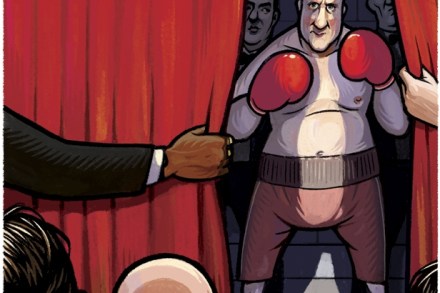
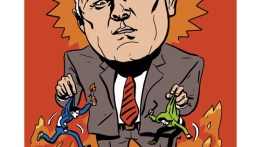
For years, David Cameron has known that he would have to fight the trade unions and that the outcome of the battle would define his premiership. But neither side expected to fight so soon. The unions had intended to wait until the cuts would be at their deepest and the government was at its least popular. But the Prime Minister is moving too quickly, and making faster progress than his predecessors. School reform now looks unstoppable. Pension reform is next. The union bosses, Christine Blower, Mark Serwotka and Dave Prentis, are not ready for a long conflict — but they believe they have little option other than to strike now. In public, they make blood-curdling threats about the greatest disruption since the General Strike.

I’ll be back

It has been confusing for anyone relying on the British media to fathom what has happened over the eight years of my persecution in the United States. And the volume of affecting messages I have received from the UK indicates that there remains some curiosity about it there. The short story is that a greenmailing shareholder who was trying to force the sale of the company (Hollinger International), and a quick realisation on the capital appreciation we had made in what had ceased to be a growth industry (newspapers), agitated for what is called in the United States a Special Committee, in 2003. This would look into all grievances of the requesting shareholder, and I agreed at once, as I had nothing to hide.

How did I get it right on the euro? Easy. I was racist

Do you remember the vicious debates back in the middle of the 1990s about whether or not we should join the single European currency? We don’t have that argument much any more; even the Liberal Democrats keep their traps shut about it these days and try to change the subject when any one mentions it. Do you remember the vicious debates back in the middle of the 1990s about whether or not we should join the single European currency? We don’t have that argument much any more; even the Liberal Democrats keep their traps shut about it these days and try to change the subject when any one mentions it. Anyway, the debate back then was remarkable because almost everybody except the entire British public was in favour of the single currency.