Features

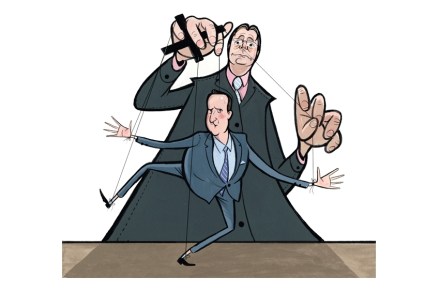
They are the masters now

I was on a plane once that malfunctioned as it was trying to take off from JFK Airport in New York. There was a horrible screeching noise and some smoke and the thing skidded to a halt with its nose poking out over Long Island sound. Trucks pulled up alongside us and sprayed stuff. I don’t think anyone had been particularly scared because the plane was still on the ground. The only thing that worries people about planes is when they fall out of the sky; if they blow up on the runway, that’s sort of OK. It was a scheduled KLM flight bound for London and the Dutch cabin crew told us we all had to stay where we were while somebody tried to sort the plane out. Presently, through my porthole, I saw an elderly man in dungarees hitting one of the engines with a spanner.

A traitor’s tale

Leaving the Labour party is uniquely traumatic, as Luke Bozier has just discovered – and I know all too well Even now, exactly 17 years later, I can still remember the sense of anxiety gripping me on that fateful morning. The storm was about to break. I had taken a step that would irrevocably change my life. It was a damp, drizzly Thursday in late January 1995 and the latest edition of The Spectator had just come out, carrying an explosive article by me in which I savaged Labour’s record in local government and warned that the same addiction to waste, bureaucracy and politically correct ideology would be followed at a national level if Tony Blair gained power at the next election. This was the first piece I had ever had published.

Free the Shetlands!

On Tuesday night in Lerwick, capital of the Shetland Islands, hundreds of men dressed as Vikings will parade through the centre of town, carrying torches to set fire to a wooden long ship in a festival known as Up Helly Aa. All will march to a repertoire of battle songs, with blood-curdling lyrics. ‘Our galley is the People’s Right, the dragon of the free’ runs the main hymn of the evening. ‘Sons of warriors and sages: when the fight for freedom rages, be bold and strong as they!’ And not even Alex Salmond would be bold enough to suggest that they are singing about Scotland. The people of Orkney and Shetland share little of Salmond’s enthusiasm for independence, as was reflected in the 1997 devolution referendum.

Model employer

Miles Bullough of Wallace and Gromit creators Aardman Animations on the pressure to move jobs abroad Shaun the Sheep is at the meeting too. I walk into the office of Miles Bullough, head of broadcast at Aardman Animations, and find him sitting opposite a four-foot model of the ovine superstar. I’m offered a seat, and an assistant comes in with refreshments. Tea for me, coffee for Bullough. Nothing for Shaun, whose sombre and kindly face is poised inquisitively over my tape-recorder. ‘Shaun was the star of A Close Shave,’ Bullough tells me, ‘which was Nick Park’s third film. [It was also the third film to feature perhaps Aardman’s most famous characters, Wallace and Gromit.] That was a breakthrough moment for Aardman as a studio.

Give – and you shall receive

Does the banker deserve his bonus? Of course he doesn’t, but the problem is that the wrong sort of people point it out. The envious and the angry combine at shaking their fists at the super-wealthy; the politicians rehearse the arguments more in sorrow than anger. The rich are impervious to criticism from the unlucky outsider: opprobrium doesn’t work and it hardens them, closing the fist around their wealth. What cannot be said effectively in anger can nevertheless be said in love. The great calling to mankind is that we love one another, and it is in giving that we find its clearest expression. It is more blessed to give than to receive — and the reason is that ‘where your treasure is, there is your heart also’.

Travel: The charms of le barroux 

If you are looking for an undiscovered part of Provence, then you can forget about Le Barroux. Apart from the fact that both Petrarch and Pope Clement V spent their summers nearby in the 14th century, the pretty hilltop village topped by its disproportionately large castle has been the holiday destination of members of the British social stratosphere for generations. The Anglo-French descendants of Axel Munthe, the Swedish author of the spectacularly successful Story of San Michele — perhaps the first example of escapist travel literature — have a very beautiful house in the village, as did Prince Charles’s godmother. The Dowager Marchioness of Salisbury is just down the hill. It is not difficult to see why.

Travel: Opened secret

Once, Avignon was hell to get to. Now it’s an easy train journey. Let Ysenda Maxtone Graham, who has known it for decades, show you around The interminable car journeys to Avignon of my childhood! Crammed into the back of the Mini with my sister. ‘Are we nearly there?’ when we were only at Dijon. Hard-boiled eggs and sausages in a polythene bag. The heart-sinking moment when my parents stopped the car for a few hours to have a ‘little sleep’. The bliss of a glace from the Elf petrol station. Not being nearly there even when you were going through the Lyon tunnel. Still at least two hours to go. Now, if you get the 07.17 Eurostar from St Pancras on a Saturday morning in summer, you can be having a late lunch in the square at Avignon at 2 p.m.

Is this Labour’s next leader?

In Yvette Cooper’s home, an entire room is given over to memorabilia of her husband’s life in politics. Pictures of Ed Balls hang on the walls and the room is kitted out with phone lines and computers so it can function as a nerve-centre for the shadow chancellor while he is working from home. Cooper’s office is a snug under the stairs. Anyone visiting might imagine that this was the home of a great political genius, dutifully supported by a mother of three. There is no indication that this impish, unassuming woman is herself now the bookmakers’ favourite to lead Labour into the next election. With Ed Miliband’s ratings down to a level from which no opposition leader has ever recovered, even the trade unionists who voted him in are beginning to give up hope.

What colour is Wednesday?

If you are one of that small band of people who happen to see days of the week, months of the year, even single numbers and letters in colour, you are considered either very peculiar or very lucky. It also means you are a synaesthete. I am one of them. Synaesthesia is a rare condition: few people have heard of it. To put it simply, synaesthesia is a psychological and neurological state concerning the visual and auditory areas of the brain. For those who have never known a yellow Friday, or a red July, it’s hard to understand how this curious phenomenon works. Most people have five senses: sight, touch, hearing, taste, smell. For synaesthetes, there is an overlapping of two or more senses. Aisthesis comes from the Greek word meaning sensation, while syn means together, or union.

Fear and loathing in Baden-Wurttemberg

Stuttgart Everyone is frightened of the euro. So said the sweet old lady who runs the small hotel where I am staying. She and her husband are Germans who came to Stuttgart from Slovenia 50 years ago. They have worked ‘day and night’ to build up their modest fortune, and now they fear their savings will be destroyed.The old lady explained how people are trying to guard against losing everything: ‘Those who have money want to put it in property. We’d rather invest money in our own country than send it to Greece. We’re worried we’re going to have to pay for others. But what can the small man do? Other people don’t particularly like the Germans. They want the Germans to pay for everything. This currency splits people ever more.

A yacht? Wouldn’t the Queen prefer a really nice soap?

Gove, a man so unsuited to the satanic machinations of high office that he looks like a permanently startled guppy, made a really strange boo this week by suggesting a collection of rich monarchists buy the Queen a £60 million yacht for her diamond Jubilee. Really? A yacht? Men just can’t buy presents, can they? Quite aside from the fact that a floating shagpad with a 12-person crew, a Jacuzzi, an indoor gym, and four on-board jetskis is the last thing anyone should spaff cash on right now, why did Gove think she actually wanted a yacht? That she wouldn’t prefer a really nice soap, or a charming footstool? A toy for the corgis, or a Learn How to Paint Watercolours step-by-step guide?

The age of achievement

Doctors say it’s all downhill from 45. History suggests otherwise A study in the British Medical Journal suggests that our brains begin to deteriorate from the age of 45. Examining the vocabulary, comprehension and memories of 7,000 45- to 70-year-olds, the researchers found a 3.6 per cent decline in the second half of their forties. This will come as a surprise to students of history. Men and women have achieved positions of power at all stages of life, but it is remarkable how many have lived in obscurity until their forties and gone on to do remarkable things. A good example was Oliver Cromwell, who only stepped into the public sphere in his late forties (he was born in 1599).

Web of tyrants

The internet can promote freedom and democracy – it’s a shame it also facilitates mob rule and witch-hunts Even those who are wary of the utopianism the net has generated tend to take it for granted that the new communications technologies have saved us from the need to worry about censorship. Sceptics fear that the web provides us with too much information, not too little. Enthusiasts see a future of unlimited free speech when all the old arguments about libel, official secrecy and blasphemy become redundant. To see how far the consensus spreads look at Is the Internet Changing the Way You Think?, a new collection of the views of 150 of the world’s leading minds on the technological revolution.

Cameron’s follies

Was a political brickbat from the left ever more elegantly lobbed than J.K. Galbraith’s jibe that conservative governments create ‘private affluence and public squalor’? It came to sum up perfectly the feelings of many people towards Britain in the 1980s, when Londoners would step over the homeless as they made their way back to flashy new homes. It is not an accusation David Cameron cares to risk being levelled at his own Britain. But this (partly) Conservative government is suffering from an equally pernicious problem: pointless, gimmicky public spending. We may be deep in austerity measures, but they seem destined never to reach the sports stadiums, the high-speed rail lines or any other pet public projects.

Free the press!

The Leveson inquiry has put fear into the feral beasts of the tabloids – and that’s not in the public interest Listening to Kelvin MacKenzie give evidence to the Leveson inquiry on Monday, the most striking thing was not his admission that he’d never given much thought to journalistic ethics nor even his impersonation of John Major, good though it was. Rather, it was his claim that News International should have been fined for lying to the PCC about the extent of phone hacking at the News of the World. ‘In the end newspapers are commercial animals,’ he said. ‘I would be in favour of fines — and heavy fines for newspapers that don’t disclose the truth to the Press Complaints Commission.

Even dogs prefer democracy

Recent research has shown a robust and positive correlation between the amount of democracy we enjoy and how happy we are. This is true for the Swiss, at any rate, for it was among the cantons of Switzerland that the research was conducted. If you believe the Swiss are a peculiarly unrepresentative group, you may be interested to know that the same rule holds true not only for melted-cheese-­eating neutrality monkeys, but also for dogs. Dogs prefer democracy? How can we possibly know?

The road from Damascus

Wafic Said is an exotic import, but a friend of Britain for 50 years. He has given roughly £100 million to philanthropic causes in this country, including founding and funding the Said Business School at Oxford. He also helped Britain secure with Saudi Arabia, Al-Yamamah, the biggest defence agreement in our history, which was signed in 1985. For this, he has repeatedly been called an arms dealer in the press. (As a result, he even got a letter from people who wanted to sell him a second-hand tank.) A reticent man, he said nothing at the time, but now regrets it. ‘I was promoting Britain. I should have challenged it when it came. If you don’t, it sticks,’ he says. Today, with his philanthropic projects here coming to fruition, he wants to talk.