Features

Tbilisi: The Edge of the Real

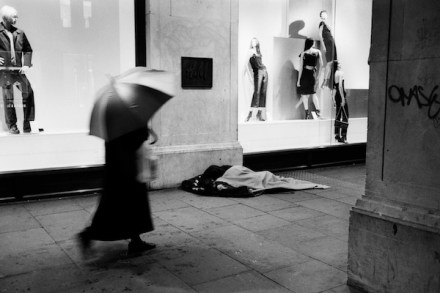
The electricity will be on in one hour, says my landlady. She tells me that it is dark out all over town (ignoring the glittering chrome bridge over the Mtkvari River, ignoring the casino that casts neon shadows on the banks at night). She calls me ‘daughter’ and evades specifics. Won’t I come upstairs for dinner at eight, or perhaps nine? (She is so busy; she works so hard; she’ll ring when dinner is ready.) The call never comes. So I eat out, in restaurants, but often I cannot seem to leave my neighbourhood. Whenever I think I’ve found the way, I am turned back on myself again. A street is closed off for reconstruction, a nameless alleyway is rerouted, crumbling buildings are bulldozed to make new paths.

Christmas Quiz

It’s time for the immemorial Christmas custom in which the family gathers round the iPad, cracks another walnut, and sharpens its competitive claws on the Spectator’s traditional challenge to suppressed memories of unlikely events, political gaffes, terrible films, old books and the Olympic opening ceremony. Weird world In 2012: 1 On whose painting, ‘Black on Maroon’, in the Tate, did a man scrawl ‘A potential piece of Yellowism’? 2 A three-year-old chicken nugget from McDonald’s, Dakota City, Nebraska, said to resemble which US president, sold for $8,100? 3 Name the MP who consented to 3,000 cockroaches and 5,000 crickets being poured on to her in an underground crate.

Export-only justice

In the last few years lawyers have begun to gush about the ‘Sumption effect’. They were not thinking of Jonathan Sumption QC’s fine legal mind — which was of such a quality that the Supreme Court elevated him straight from the Bar to a seat on the highest court in the land. Nor were they praising his history of the Hundred Years’ War, a conflict of such violence and duplicity that perhaps only an English lawyer could do justice to it. Rather, his peers gazed on his wealth in wonder, and hoped that his riches would flow into their pockets too. Sumption had collected about £7 million for representing Roman Abramovich in his fight with Boris Berezovsky.

Don’t watch The Hobbit

Once, I met Priscilla Tolkien, the daughter of J.R.R. Tolkien. It was at the Oxford Catholic chaplaincy, and she was giving a talk about her father. She was charming, something of a hobbit herself with her neat figure, and an engaging talker. But she seemed taken aback by some of her audience. It was divided into two distinct parts. Some were the ordinary Tolkien admirers, the normal, slightly shabby young people you get at chaplaincy talks, and the others were, well, a bit scary. They almost all had black T-shirts, pale faces and intense expressions, and there was a weird sort of obsessiveness about their questions. They read all sorts of things into the books, symbolic meanings that had never occurred to the rest of us.

The sick man of Africa

I dread attending meetings on Congo. At almost every one a Congolese will stand up and start to rail, then scream and weep. Some get very aggressive. The police were called to one meeting. For a while I was embarrassed and irritated. Now I think it is absolutely understandable, appropriate even. The Democratic Republic of Congo, the vast heart of Africa, endowed with some of the richest ores and most fertile land on the planet, lies broken and ungoverned. Congo has the lowest GDP per capita in the world and lies at the very bottom of the UN’s Human Development Index. The rest of Africa is now doing better. More and more Africans have a better life than they did ten or 20 years ago.

The Pickles plan

Some Cabinet ministers develop airs in office. Eric Pickles isn’t one of them. Sitting at the head of a conference table that looks like it’s been purchased from a discount office supplies catalogue, he explains his outlook on life. ‘There are two kinds of people,’ he says. ‘There are those who open that door and courteously speak to people, and there are those who bellow. There are those who write long memos on the temperature of your cappuccino and those who are just grateful if you get a warm beverage, and I’m the latter.’ He would place himself in an even rarer group: a minster who gets things done.

The human hand grenade

You can tell a lot about a minister from their bookshelves. Some display photos of themselves with the great and the good, others favour wonky texts. As you walk into Elizabeth Truss’s seventh-floor office in the Department of Education, the first thing you see is a think-tank pamphlet: ‘The Profit Motive in Education: Continuing the Revolution’. Knowing Truss, I half expect she put it there to provoke; a symbol of her radicalism. She grew up in a left-wing household and says, ‘My first political experience was going on a CND march, which taught me a certain political style.’ I’ve heard her nickname in the department is the human hand grenade. When I ask why, her response shows the hand grenade in action.

The Turner prize is boring

Inside Tate Britain on Monday night, a fashionable London audience will applaud the award of the £25,000 Turner prize to whatever is judged the best thing a British artist under the age of 50 can come up with. Standing outside will be a group of Stuckists protesting against the overlord who for nearly a quarter of a century has ruled this process. Sir Nicholas Serota chaired the prize until 2007, yet still retains his grip. It is he who has made figures such as Damien Hirst and Tracey Emin so famous and rich. Yet this year, for the first time, there are finally signs that the Serotan winter is beginning to thaw.

Not graphic and not novel

As someone who once spent a whole summer refusing to leave the house in anything except his Superman costume (to be fair, I was only 23 at the time), I was tickled to death by the announcement last week of a Costa Book Awards shortlist that included not one but two ‘graphic novels’, and the subsequent declaration by the chairman of next year’s Man Booker judges that he would be open to the idea of such things being submitted for that as well. Oh dear Lord above, the laughable, lumbering, creaky old juggernaut that is the British literary establishment. What, now you decide to accept comics as a literary form? Seventy years after they were last truly popular? Forty years since they were the genuine expression of the tortured poetic underground?

The edge of destruction

The world came closer to thermonuclear warfare during the Cuban Missile Crisis in October 1962 than ever before or since. Most Americans now aged between their late fifties and late sixties remember ‘duck and cover’ drills during the crisis which taught them to hide under school desks and adopt the brace position in case of nuclear attack. One man who at the time was a 13-year-old schoolboy in Buffalo, New York, told me how on the day after a drill, ‘I was sitting on the big yellow school bus thinking: Will I get home today? Am I going to die? Is this it? Just looking out the window at the world passing by and wondering...’.

A lifesaver’s lament

It was about as English as you can get. I saved a man from drowning, and ended up annoyed that he didn’t say thank you. The setting was a disused railway walk near the meadows of my local market town in Suffolk. I was out with my dog, enjoying one of autumn’s last sunny days. The walk is heavily lined on both sides with trees, and shielded from view of what few houses there are nearby. From the left, where a river runs alongside the track (again, shielded by the trees) came cries of ‘Help! Help me! PLEASE help!’ At first I assumed some kids were messing about. But after a couple more shouts it was clear this was genuine. Pushing my way through the trees and bushes I reached the river, which at that point is about 80 ft wide.

Save our speech

In 1644 John Milton appealed to parliament in the Areopagitica to rescind its order to bring publishing under government control by creating official censors. I wonder what he would make of Lord Justice Leveson’s report, due to be published next week, which is expected to re-introduce statutory control of the press into English law after a lapse of centuries. The wonder is that it has happened. Thirteen months ago, as the Leveson inquiry was gearing up, the Lord Chief Justice, Igor Judge, made a moving and passionate speech defending the independence of the press.

Backbench driver

The burdens of office can wear a man down. When Nick Herbert was the minister for policing and criminal justice, he looked exhausted; as if he was carrying the troubles of two departments on his shoulders. But having quit the government in the September reshuffle, he is relishing his newfound freedom. He says he can fit in an interview on Monday morning, between the bishop and his bank manager. Happy to come between God and Mammon, I stroll along to his office, which is still on the House of -Commons’s ministerial corridor. No longer limited by collective responsibility, he has much to say. Herbert’s first major intervention as an ex-minister will be on the European Court of Human Rights.

Cooking for freedom

A few days before I met Ahmed Jama in Mogadishu, three Islamist gunmen from Al Shabaab — al-Qa’eda’s Somali branch — burst into his new restaurant wearing suicide bomb jackets. They sprayed the place with bullets and then detonated themselves. One bomber set himself off in the dining room itself, killing 20 of Ahmed’s customers. Standing in that room, watching Ahmed’s workmen clean up, I realised what the term ‘pink mist’ really means. The bomber’s solid body had expanded outwards into an aerosol cloud of human particles that now covered every square inch of ceiling, walls and floor. The workmen were using trowels and shovels to clean up. ‘They’re scrubbing it, to get rid of the blood and human remains.

The great British wind scam

Almost everybody agrees that wind turbines are ugly and inefficient. But you’d think that the government, if it must persist in subsidising renewable energy, would do everything it could to incentivise wind power producers to create as much energy as possible while keeping the aesthetic damage to a minimum. Astonishingly, it is doing the opposite. Inquiries by The Spectator have revealed a scam known as ‘de-rating’. Green businesses are modifying large turbines to make them less productive, because perverse government subsidies reward machines that produce less energy at nearly double the rate of more efficient ones. It’s extraordinarily profitable for a few beneficiaries, even if it clutters the countryside and does little to save the planet.

House of stars

The Spectator’s Parliamentarian of the Year awards were held at the Savoy Hotel on Wednesday. Here are the winners: Newcomer of the year Andrea Leadsom (Con). For her work grilling bankers on the Treasury select committee and setting up the Fresh Start Group. Backbencher of the year Alistair Darling (Lab). His campaign for the Union has made Westminster more relevant in Scotland than at any time since -devolution. Campaigner of the year Andy Burnham (Lab). Our former ‘Minister to Watch’ did more than any other MP to press for the Hillsborough report, which gave parliament one of its most extraordinary moments. Inquisitor of the year Margaret Hodge (Lab).

Going overboard

What is it about islands that appeals to little men with big ideas? It’s Corfu I’m thinking about, primarily. Napoleon was obsessed with the place. Kaiser Wilhelm owned a summer palace here, the neoclassical Achilleion, where he installed a huge and hideous statue of Achilles. Can I add George Osborne to the list? Perhaps I’d better not. There’s a far better figure to complete the triumvirate, if that’s the phrase: the sly, off-kilter and phenomenally litigious founder of Scientology, L. Ron Hubbard. Last month, the Daily Telegraph ran an obituary of one John Forte, a former officer in the British Army, who had two claims to fame when it came to Corfu.

The fall of Petraeus

In the middle of a breaking news story, MSNBC’s Andrea Mitchell sounded like she was about to cry. Something had happened to the CIA director David Petraeus — but what? Andrea ticked off his accomplishments one by one, the phrase ‘personal tragedy’ echoing ominously over the airwaves. For the love of Mike, was he in a coma? Dead? It took a few more painful moments of this boilerplate obituary and Mitchell’s palpable grief for it to sink in: ‘King David’ had done something bad — an extramarital affair! — for which he apparently took responsibility, and so he had immediately resigned his post. Over the next days, the scandal spread. General John Allen was at it too, allegedly, sending ‘potentially inappropriate’ emails.