Features

The Pacific President

On Monday, as Barack Obama is sworn in again as President, his allies in the West will ask themselves the same nervous question they posed four years ago: how much does he care about us? The British, in particular, are worried. War looms in Mali, yet Washington seems happy to let the French take charge, showing even less interest than it did in Libya two years ago. Cheerleaders for the ‘special relationship’ accuse Obama of taking a back seat, of failing to show leadership and even of betraying his country’s oldest friends. They look back to that much-discussed episode when the new President removed a bust of Winston Churchill from the Oval Office and point out that he has steadily sought to disentangle America from its strategic partnerships with Europe ever since.

The mother myth

Here she comes again. Back at the top of the news, draped in the robes of the righteous, embraced by those who sanctify all things traditional: the ‘full-time mother’. As usual, she is the undeserved victim of something or other; in this instance, it’s the incoherent shake-up of the child benefit system, leading to headlines declaring that ‘full-time mothers are being penalised’, followed by an implacable wistfulness that war is once again waged against the finer values of a finer past, when women dedicated their whole lives to their children. The trouble with this lament, much as I hate to spoil the Hovis commercial, is that they did nothing of the kind; nostalgia is a notoriously unreliable witness and in this matter she surpasses herself.

My Venezuelan jail hell

There are two conditions British foreign correspondents must meet before they can consider themselves old hands. The first is having one’s work savaged by John Pilger; the second is spending time inside a cell somewhere abroad, preferably somewhere exotic and hot. It so happens that it was during a trip to sultry Venezuela that I came of age as a reporter and achieved the rare double. Not only did Mr Pilger describe my television work as a ‘one of the worst, most distorted pieces of journalism I have ever seen’, but I was also locked up, ordered to strip to my underpants, accused by a military prosecutor of espionage and threatened with over 30 years in a Venezuelan jail.

Chávez’s useful idiots

In the ranking of dictators, Hugo Chávez is in the welterweight class. President of Venezuela these past 14 years, he is supposed to be holding a ceremony of inauguration for yet another term of one-man rule and demagoguery. In anticipation, his supporters, the Chávistas in their uniform of red shirts, are singing and dancing in the streets of Caracas. But rumour has it that Chávez is on the point of death after surgery for cancer in a hospital in Cuba. Caution! The apparent popularity, the sympathy, the tenterhooks, the pseudo-Mandela image of the man, is largely the work of those strange modern-age political publicists known as fellow travellers.

America’s strategic stupidity

Every few months, America’s four-star admirals and generals gather at a military base not far from Washington to participate in what General Martin E. Dempsey, Joint Chiefs of Staff chairman, calls his ‘strategic seminar’. The aim is to foresee the future, anticipating security challenges that the United States will face in the coming years, thereby enabling the Pentagon to prepare itself accordingly. With that end in mind, Dempsey and his colleagues engage in what the New York Times has styled ‘a lethally earnest game of Risk’, participants striding across ‘a giant map of the world, larger than a basketball court’ as they posit various crises and speculate on the response each might entail. The enterprise invites derision.

A hit man at 13

After a long wait in the visiting room of the maximum security wing of the ‘Gib Lewis Unit’, Rosalio Reta finally arrived for our interview. He was only five feet tall, but even so projected an air of menace. The demonic face tattoos helped. That face was the last thing many people saw before they died, I thought. When he started talking, his voice was soft and mellifluous. Until his arrest in 2006 Reta was a sicario, a hit man responsible for at least 30 murders in the USA and Mexico. He started at the age of 13, when he executed a man as an audition to join the Zetas. His fluent Spanish and American citizenship meant he could operate on either side of the border without attracting attention. Reta boasted to police that he enjoyed killing: ‘I volunteered.

Stop the drugs war

‘They’re all bad, our politicians, all corrupt,’ said Maria, her cheery face dissolving into distaste. What about the new president, Peña Nieto? I ask. ‘That pretty boy? Ugh!’ It was late afternoon in Oaxaca’s central square, the Zocolo. Clouds were cruising in from the Sierra Madre and the dogs had begun to squabble and hump outside the cathedral. The news kiosk looked like a missing persons bureau, each front page full of mugshots: the latest victims of the drug wars. What about Calderon, the one before Peña Nieto, I asked Maria, who’s seen ten presidents come and go. Wasn’t he OK? At least he tried to fight the drug cartels. ‘He’s loco! Mad,’ said Maria, with a dismissive shrug.

Paying Osborne’s bills

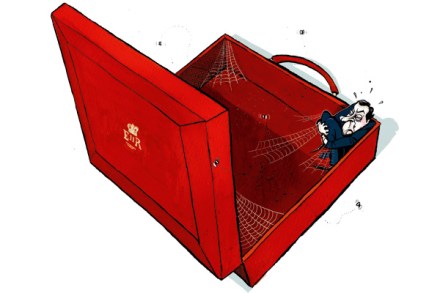
In her early campaigning days as Conservative leader, Mrs Thatcher had the gift of being able to relate the national economy to the domestic finances of ordinary voters. The battle against inflation commenced with her and her shopping basket, nattering away with voters over the cheese counter. It is a skill which David Cameron needs rapidly to discover. Now, as in the 1970s, a political leader who doesn’t understand the personal finances of ordinary people is going to be in deep peril. Four years ago, realising my income was going to fall, and with a little time on my hands, I started doing something I had never bothered to do before — and during the previous decade had never felt I needed to do: I started adding up every penny I had spent over the previous year.

Wedding hells

In the good old days of the gay liberation movement, in the 1970s and early 1980s, the excitement of challenging the orthodoxy attracted even the shy and apolitical to its cause. To those of us around at the time, it felt like a cultural insurgency: a rejection of compulsory heterosexuality and the lifestyle that accompanied it. But now battle, such as it is, has changed utterly. It seems to involve people like David Cameron inviting gay people to conform to what he rightly calls the profoundly conservative institution of -marriage. These new, well-spoken and self-appointed leaders of the gay rights movement want to rebel by conforming. To them, homosexuality is not really something to be proud of.

Greening’s challenge

At first glance, it looked like very good news when David Cameron appointed Justine Greening as Secretary of State for International Development in his September 2012 reshuffle. Greening is an experienced accountant, an alumna of Price Waterhouse Cooper, GlaxoSmithKline and Centrica, with zero tolerance for waste. She already proved herself an advocate of fiscal retrenchment in her first government post, as Economic Secretary to the Treasury, setting out the government’s case with clarity and zest. ‘There was a time when the Labour party had something relevant to say on the economy,’ she declared to the House of Commons. ‘That time has now passed.

The great aid mystery

One of the more bizarre mysteries of contemporary British politics is the ironclad, almost fanatical intensity of the government’s commitment to foreign aid spending and the activities of DFID, the Department for International Development. It is bizarre because the Prime Minister talks about foreign aid as if it’s all about famine relief and saving children’s lives. But he and his Cabinet are intelligent, worldly people and they know that the real world of aid rarely resembles the one celebrated in DFID pamphlets and Oxfam ads. They know that most aid is ‘development aid’ intended not to help in emergencies, but to foster prosperity. They also know that this development aid is at best useless and at worst counterproductive.

Wind farms vs wildlife

Wind turbines only last for ‘half as long as previously thought’, according to a new study. But even in their short lifespans, those turbines can do a lot of damage. Wind farms are devastating populations of rare birds and bats across the world, driving some to the point of extinction. Most environmentalists just don’t want to know. Because they’re so desperate to believe in renewable energy, they’re in a state of denial. But the evidence suggests that, this century at least, renewables pose a far greater threat to wildlife than climate change. I’m a lecturer in biological and human sciences at Oxford university.

Not-so-special relationship

‘Three things of my own are about to burst on the world,’ Dean Acheson wrote to his friend Lady Pamela Berry, the London hostess and wife of Michael Berry, later Lord Hartwell, owner of the Daily Telegraph. They were ‘a leader in the December issue of Foreign Affairs… a speech at West Point… and a piece about my childhood in the Connecticut valley.’ It was characteristic of Acheson’s self-regard that he should have thought the first and last of these would ‘burst’ anywhere, but he was more right about the second than he can have known. Just over fifty years ago, on 5 December 1962, two days after his letter to Lady -Pamela, Acheson gave that speech, and indeed it exploded across the Atlantic like an artillery shell.

The hunt for Cameron

On a perfect winter morning, I mount a dapple grey horse in an icy farmyard a few minutes from the Prime Minister’s country home and prepare to go hunting with the Chipping Norton set. David Cameron’s local hunt, the Heythrop, is meeting just round the corner from where the PM lives, in the Oxfordshire village of Dean, and the Cotswold elite are out in force. As we hunt, we will be skirting the estates of Jeremy Clarkson and Rebekah and Charlie Brooks. There are more socialites gathering on horseback than you can shake a hunting crop at, though at this stage I am not aware I might have to. The scene could hardly be more like a Christmas card. Ladies in quilted jackets offer the 50 or so riders glasses of mulled wine. But a strange atmosphere prevails.

Blood oath

The final instalment of the Twilight saga, Breaking Dawn: Part 2, premiered in Los Angeles last month, and the streets were thronged with its core audience of teenage girls and middle-aged gay men. But as the handsome cast strode up the red carpet, they were greeted by more than just hormonal screams. A group of religious conservatives showed up with placards and loud voices. The head of security rushed over to confront them, assuming they were there to protest against the film’s mix of ‘satanic’ vampires and dark eroticism. But he was wrong. The demonstrators had come to cheer the stars and promote the movie. It turns out that some on America’s religious right think that Twilight is one of the best tools they’ve got in the fight against legalised abortion.

This old House

‘If the Palace were not a listed building of the highest heritage value, its owners would probably be advised to demolish and rebuild.’ Heartlessly, this concludes the latest official report into the restoration of the Houses of Parliament. Four thousand miles away in New Delhi, it’s the same story. The Central Public Works Department has declared the constitutional masterpiece of Edwin Lutyens and Herbert Baker equally unfit for habitation. ‘We badly need a new parliament building,’ complains government minister Jairam Ramesh. ‘This one simply isn’t functional and is outdated.’ In the oldest parliament democracy and in the largest, the challenge is the same: what on earth to do with our Grade I* legislatures?

Who killed Newsweek?

So farewell then, Newsweek magazine, which published its last print issue this week. After 79 years — 15 of them as my employer — the venerable old rag is to disappear into an uncertain, web-only future. Many newspapers and magazines have folded as advertising shrinks and readers go online but Newsweek is perhaps the first of the titans to fall. Its demise is all the more resonant because it was one side of one of the great twin peaks of the press: Time and Newsweek, the New York Times and the Washington Post, the Times and the Daily Telegraph. In its heyday Newsweek was an essential part of America’s national conversation. It was controversial, liberal, usually half a step ahead of Middle America.