Features

Power struggle

It is ‘immoral’, asserted Michael Fallon at this week’s Spectator energy conference, to force basic-rate taxpayers to subsidise wealthy landowners’ wind turbines and the solar panels of well-off homeowners. It is hard to remember the last time a minister was so frank about something which had been government policy until a few hours earlier. As a result of changes announced by the government this week, consumers will save £50 a year compared with what their bills would have been. The cost of supporting energy bills for the poor will be shifted from energy bills to general taxation, and the obligation on energy companies to subsidise home insulation will be watered down.

David Cameron is betraying Scotland’s Unionists

With trademark grandiosity, Alex Salmond unveiled his white paper on independence this week as if he had retrieved it from the top of Mount Sinai. ‘This is the most comprehensive blueprint for an independent country ever published,’ proclaimed the First Minister. It was yet another reminder of an inexorable law of politics: the larger the document, the weaker the content. The American declaration of independence managed to fit on a page. The SNP’s plan for a separate Scotland is so bald that it needs to conceal its nothingness with 650 pages of flannel. You can look in vain in its pages for any sign of any policy that will make Scotland a better place. There will be more welfare, universal childcare, milk and honey. And income tax will not rise.

Rod Liddle: The truths you can’t tell in today’s Britain

My memory gets addled sometimes, so maybe I’m wrong about this. But didn’t it used to be the case that when politicians were caught out lying, they made some sort of shame-faced apology to the nation and begged for our forgiveness? I’m sure that was it, you know. So if I’m right, to judge by the case of our Attorney General, Dominic Grieve, things have turned precisely 180 degrees. Mr Grieve has just offered a full and unqualified apology for having told the truth. I thought that politicians were meant to do that — tell the truth? And what an apology. In an interview with the Daily Telegraph, Mr Grieve said the following: ‘We have minority communities in this country which come from backgrounds where corruption is endemic.

The Iran deal just shows how badly Obama has failed

‘Yes, we can heal this nation. Yes, we can repair this world. Yes, we can!’ With these exuberant assurances, the young candidate, buoyed by an unexpectedly strong showing in the Iowa caucuses, vowed to carry on his crusade. One year later, in January 2009, the candidate became president and set out to make good on his promises. That Barack Obama possessed the ability to heal the nation and repair the world seemed in many quarters all but self-evident. As he donned the mantle of the ‘most powerful man in the world’, the expectations that had lifted him into the Oval Office qualified as nothing short of messianic. A dark and depressing interval of American history, symbolised by place names such as Guantánamo and Abu Ghraib, was ending.

Don’t flog a dead parrot – leave Monty Python in the past

You can’t go home again, as the Americans say. It’s worth running that adage, taken from Thomas Wolfe’s unfinished novel of 1938, past those zealots who snapped up 20,000 tickets for Monty Python’s reunion at the O2 Arena in 43 seconds when they went on sale this week. Four more dates were immediately inked in, with more to follow, one feels certain, as Python fever covers the globe. What a horrible prospect. The Python team are not horrible. Goodness gracious, no. In four BBC series between 1969 and 1974 they were often outstandingly funny, in a way that nobody had been funny before.

Stuck for Christmas presents? Hit the museums

The plan to do last year’s Christmas shop at Peter Jones on 23 December was doomed from its sorry inception. I was soaked by the time I got there, my plimsolls waterlogged, kept going only by my expectation of a quiet and civilised department store, rammed to the skylights with perfect presents. Instead, I found myself spearing a path through the seething, teeming, hostile masses with my sodden umbrella, and, worse — finding its  stock all but decimated. The claustrophobia that ripped through me was so violent that I was forced to run to the toilets to hide — and even then I had to queue. I shivered in the stairwell and contemplated defeat. What do you do about all those uncles? In-laws?

Save our Van Dyck!

Why should a portrait of a Flemish painter by a Flemish painter be considered so important to Britain that the culture minister Ed Vaizey has slapped a three-month export delay on it, and the National Portrait Gallery has announced a £12.5 million campaign to keep it in the country? Moreover, why is it so important that after reading this article you should immediately go to www.savevandyck.org and make a generous contribution to save it from going abroad? The answer lies in four words: Sir Anthony Van Dyck. No other single artist has had such an impact on British art as Sir Anthony Van Dyck (1599–1641) not only in his own lifetime but also — as the 2009 Tate Britain’s exhibition demonstrated — right up to the 20th century.

What rhetoric can do for you – and what you can do for rhetoric

Listen to Mark Forsyth discuss what makes a political sound bite: [audioboo url="http://audioboo.fm/boos/1746136-mark-forsyth-inkyfool-on-the-importance-of-political-sound-bites"/] In December 2011, there was a major reversal of American policy and ideology. Barack Obama told a crowd of veterans: ‘You stood up for America. Now America must stand up for you.’ A U-turn! A flop-flip! Because, if you think about it, Obama was saying the exact opposite of JFK: ‘Ask not what your country can do for you, but what you can do for your country.’ And nobody noticed. Obama was still the heir to Kennedy, because he used the same rhetoric. Technically, it’s called chiasmus. The press and the public hate rhetoric.

The Revd Paul Flowers ticked all the right ‘progressive’ boxes — that’s why he could get away with anything

Listen to Melanie Phillips and Jesse Norman discuss Paul Flowers: [audioboo url="https://audioboo.fm/boos/1746120-melanie-phillips-vs-jesse-norman-on-revd-paul-flowers"/] Yet again, one particular question has formed on lips up and down the land. How in heaven’s name could so many people have failed to spot such a spectacular abuse of a public position? We heard it first in the Jimmy Savile scandal, when the posthumous discovery of half a century of predation left people incredulous that so many had known about but done nothing to stop his serial depravities.

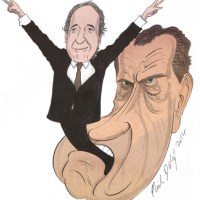
The 2013 Michael Heath Award for cartooning  — shortlist (part I)

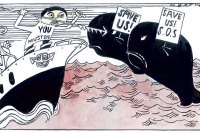
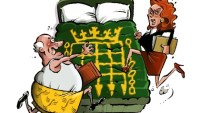
Nine cartoonists are shortlisted for the first ever Michael Heath Award for cartooning. The theme of the contest, sponsored by John Lobb, is ‘Man in Motion’. Work by four of the shortlisted artists is below. We’ll print four more next week, and the winner on 7 December. Thanks to all who entered — and congratulations to those on the shortlist.

Notes on…London galleries

Everybody knows that the London art scene is thriving, and so of course the big international commercial galleries have set up here: Gagosian, David Zwirner, Hauser & Wirth and Pace. This global razzmatazz puts pressure on the city’s home-grown independent galleries — especially those in Cork Street in Mayfair. Cork Street has been at the heart of London’s art scene for more than 90 years, and helped launch some of the most famous artists of modern times. It is now closing for redevelopment by international landlords, so let’s hope they appreciate the street’s cultural importance and welcome the galleries back. But we don’t have to lament too long for Cork Street — London’s gallery sector is always in flux.

Profumo. Chatterley. The Beatles. 1963 was the year old England died

Shortly before his death, David Frost rang to ask me to take part in a radio series he was making to mark the 50th anniversary of ‘the year, Chris, that I know is closest to your heart, 1963’. This was not because 1963 was the year when he and I worked together on the BBC satire show That Was The Week That Was (TW3), which overnight made Frost a television superstar. It was because he remembered the importance I had given to the events of that year in The Neophiliacs, a book I wrote long ago analysing the tidal wave of change which swept through British life in the 1950s and 1960s. By any measure the stream of scandals, shocks and sensations which poured through the headlines in 1963 made it as extraordinary a year in Britain as any since the second world war.

How Britain invented freedom – and why we need to save it now

The single most common reaction I get from Americans when they learn that we’re placing our newspapers under our politicians is: ‘Y’all need a Bill of Rights’. You can see their point. Absolute freedom of expression used to distinguish the English-speaking peoples from the run of nations. The restrictions which even other western democracies applied — prohibitions on Nazi symbols, for example — were inconceivable in the Anglosphere. Over the past quarter of a century, that has changed. Anglophone democracies now regularly prosecute people for saying the wrong thing, usually on grounds of putative insult to some minority group.

The death of Tory Anglicanism

This week the General Synod edged one step closer towards permitting the ordination of female bishops. The final outcome is likely to be some kind of compromise to appease traditionalists similar to that in 1992 when the ordination of female priests was passed. But unlike that occasion, one crucial voice will not be heard nor probably venture an opinion — the Conservative party, which has distanced itself from ecclesiastical affairs over the past 20 years. This was not the case back in 1992 when a band of Conservative MPs joined Anglican traditionalists in opposing female ordination.

Justice isn’t supposed to make a victim ‘feel better’, Damian Green

Coming next month to a courtroom near you: a bewildered young man, freshly convicted, trembles in the dock while awaiting his fate. But just before sentencing, a weeping widow stands, turns welling blue eyes to the bench and beseeches His Honour: ‘I cannot forgive him for his part in my husband’s death. My life is ruined. I beg you to punish him to the maximum.’ Murmurs of assent are shushed in the public gallery. ‘Well,’ says the judge, ‘I had planned leniency, in light of the coercion from older bullies and his mental age of six. However, since you ask so nicely — Officer! Take him down and throw away the darned key!’ And the gallery erupts in applause. All right... hands up to a smidge of exaggeration. But only a smidge.

Blackout Britain — why our energy crisis is only just beginning

BASF, the world’s largest chemical company, has been headquartered in Germany since before the country formally existed. Founded in 1865 by the industrial pioneer Friedrich Engelhorn, it still occupies the vast site on the banks of the Rhine at Ludwigshafen where its first dye and soda factories were built. A third of its staff are employed in Rhineland Palatinate. It is a global company, yet as German as Goethe and gummi bears. A few days ago Kurt Bock, the firm’s chief executive, warned that its Ludwigshafen plant may soon be forced to close, with BASF’s German jobs relocated elsewhere. The reason, he said, was Germany’s soaring energy costs and the crippling green levies being used to pay for ‘renewables’ such as wind farms.

Notes on… Motoring in Greece and Italy

‘Buy on the bullets’ is the cry of the most ruthless stockbrokers — invest just before a war, after the stock markets dive, before the recovery kicks in. In the same way, now is the time for us heartless continental drivers to head for poor, battered Greece. Maybe it’s not quite war-torn yet, but driving around the Peloponnese this autumn was like touring a post-apocalyptic ghost town. Once you get out of the sun-bleached concrete sprawl of Athens, the splendid motorway to Kalamata is eerily empty at all hours of the day. Rocketing along at 80 mph, I could afford to stare for several seconds at the Corinth canal below me, and the ancient acropolis of Corinth above, with little danger — there was no one to crash into.

The man who made it OK to talk about immigration

It takes a lot to make the subject of immigration respectable for liberals, at least if you’re pointing out its problematic aspects. But Paul Collier, an Oxford economist specialising in the world’s bottom billion, has, in the 270-odd pages of his new book Exodus, opened up the issue for the left — well, for all comers, actually. Which, for a book suggesting among other things that, left to itself, there is no natural limit to immigration, is quite something. ‘The overwhelming reaction I’ve had,’ he told me, from his Oxford berth at the Centre for the Study of African Economies, ‘is that people thank me for making the subject discussable.