Features

Diary of a revolution

In May 1968, civil unrest, bordering on revolution, exploded on to the streets of Paris. Student protesters and striking workers brought France’s economy to a standstill. President Charles de Gaulle warned of civil war. The Spectator’s then editor, Nigel Lawson, asked Nancy Mitford for a diary on the unfolding drama, which she followed from her house, about a mile from Versailles. This is an edited extract. 16 May We have heard the young leaders of the revolution on TV for three quarters of an hour. Having said how much they despised everything in life, especially money, they keenly gave the numbers of their bank accounts so that we could hurry out and send them some. There was a great deal of wailing about their treatment by the police. I despise them for it.

The Irish question

The Irish referendum on abortion takes place in just under three weeks’ time, and while the polls suggest a hefty majority in favour, the narrative of inexorable change towards a more liberal Ireland sometimes goes off script. At a feminist forum last month, the anarchic grande dame of Irish republican feminism, Nell McCafferty, 74, brooded out loud: ‘I’ve been trying to make up my mind on abortion. Is it the killing of a human being?’ She couldn’t answer. ‘But it’s not that I’m unable — I am unwilling to face some of the facts about abortion.’ You can’t imagine that kind of plain speaking in Britain. Yet the debate in Ireland revolves around first principles to an extent that would be impossible here.

Hooray for the adventuress

I’m keen on all sorts of my fellow females — broads, gold-diggers, career girls — but the best is the adventuress. According to Merriam-Webster, she is ‘a) a woman who seeks dangerous or exciting experiences; b) a woman who seeks position or livelihood by questionable means’. To me she is an admirable character who simply seeks to make life an awfully big adventure rather than be merely hatched, matched and dispatched as women historically were expected to be. If people are either radiators or drains, she is a blast furnace determined to use her youth and beauty as fuel to be burned rather than fruit to be preserved.

‘We need to get creative’

‘It was Plato who said storytellers rule the world,’ observes Mariana Mazzucato, her powerful voice tempered with a beaming smile, ‘But the stories we’re constantly told about how value is created are largely myths. We must rethink where wealth really comes from.’ An economics professor at University College London, Mazzucato is fast emerging as one of the world’s leading public intellectuals. From her high-ceilinged office in Bloomsbury, a host of grant-making bodies on speed dial, this 49-year-old Italian-American is determined to ‘replace our current parasitic system with a more sustainable, symbiotic type of capitalism’. Mazzucato emerged from the academic shadows five years ago, when she wrote The Entrepreneurial State.

Cricket, unlovely cricket

In 2005 I published a book called The Strange Death of Tory England, and a long article called ‘Cricket’s final over’, lamenting the decline of the game. The book appeared shortly before an election in which, although Labour easily kept its majority, the Tories gained seats, presaging a great revival, or so Charles Moore later claimed while genially deriding my book. The piece on cricket appeared, with even more faultless timing, in the September issue of Prospect, at the very moment when England had just regained the Ashes, with the victorious team, including a gloriously hungover Andrew Flintoff, touring London in an open-topped bus and inevitably bidden to meet Tony Blair, while a wave of enthusiasm swept the country.

Appetite for destruction

Have you ever thrown something away and then realised that you needed it? Surely all of us have done so. There is even a collective noun for such items in The Meaning of Liff by Douglas Adams and John Lloyd: ‘nottage.’ However, it is not just people who have nottage, but governments as well. Last week, we learned how the Home Office in October 2010 had destroyed thousands of landing card slips recording the arrival by boat of immigrants into this country. These slips, stored in the basement of an anonymous tower block, had been particularly useful for Home Office caseworkers when seeking to prove how long somebody had been resident in the UK.

Save the Scouts

A couple of years ago, Simon Barnes wrote a moving piece in this magazine about how his son Eddie, who has Down’s syndrome, had changed his mind about political correctness. Political correctness might be met with derision, he wrote, but it was also what made his son’s life bearable. In the not-so-distant past, Eddie would have been shut away and people like him made fun of in everyday conversation; now he is received everywhere with kindness and consideration. Simon was right. I am in the same position as him: I have a daughter, Eliza, who has grown up in a world of kindness that is a world away from that in which I grew up. I hate to think of the bullying and abuse she would have to endure if she were transported back in time to the 1970s classrooms I knew.

Brexit blunders

A few months ago, Britain’s most senior ambassadors gathered in the Foreign Office to compare notes on Brexit. There was one problem in particular that they did not know how to confront. As one ambassador put it, the English--language publications in their cities (it would be rude to name them) had become rabidly anti-Brexit: keen to portray a country having a nervous and economic breakdown. Their boss, the Foreign Secretary, later summed it up: many believe that Brexit was the whole country flicking a V-sign from the white cliffs of Dover. The job of his ambassadors is to correct this awful image. But how? Their plight has not been made much easier by the Prime Minister.

We’re not talking Eton

Private schools in the United Kingdom are affordable only to those on the highest incomes. But surprisingly to many, this is not true across developing countries, where low-cost private schools are ubiquitous and affordable to all. For nearly two decades I’ve been researching this phenomenon. I’ve visited low-cost private schools in more than 20 countries, from the vibrant slums of sub-Saharan Africa and South Asia to remote mountain villages in South-east Asia and the gang-dominated barrios of Central and Latin America. It truly is a global phenomenon, serving huge numbers of children. In Lagos State, Nigeria, alone, there are an estimated 14,000 low-cost private schools, serving two million children.

Let kids learn

Why would anyone who claims to care about the world’s poorest children try to shut down their schools? It’s strange and sad, but several British charities, in cahoots with some British unions, are making a concerted effort to close down hundreds of schools in Africa. They are doing this because they dislike private education, seeming not to care that this will destroy the life chances of thousands of desperate children, forcing them, at best, into state schools where the teachers are often absent, drunk or incapable. The campaign involves not only an alphabet soup of left-leaning charities from Action Aid to Amnesty International but also Unison and the National Union of Teachers (NUT).

The future of war

Imagine Peace. These were the words that appeared on an otherwise blank page in the New York Times on New Year’s Day 2013. They were paid for by Yoko Ono and they are of course an echo of John Lennon’s most famous song. A few days later, the Guardian conducted an opinion poll in which it asked its readers whether they thought the advert would produce world peace. Surprisingly, a third of the respondents thought that it would, though there was little evidence around the world to confirm them in that hope. By then, the civil war in Syria had already claimed the lives of nearly 200,000 people. It’s now about 400,000. Wouldn’t it be marvellous if war were just an idea, a very bad one, and that universal peace could be achieved by just imagining it?

Countdown to war?

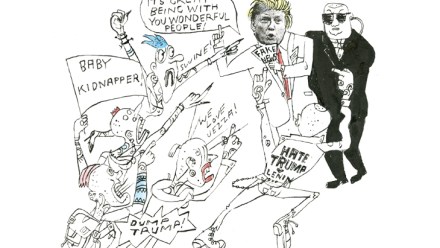
 Beirut ‘Gas!’ Bodies piled up grotesquely in a stairwell. No sign of injuries. A father cradles two small children. Still, pale as ghosts. A doctor says the victims died suffocating, foaming at the mouth. One man declares: ‘I could feel my lungs shutting down.’ Babies getting hosed with water in a makeshift hospital. These words and images from the Syrian town of Douma filled the rolling news channels on Monday. They capture the peculiar terror and moral repugnance of chemical weapons … if it is true, as reported, that these weapons were used. One viewer in particular was glued to cable news, as is his habit: Donald Trump.

Meeting the Mooch

When Anthony Scaramucci announced that he was writing a book about his time with Donald Trump, the joke was that it should be entitled ‘Ten Days That Shook the World’. This, he says, does him an injustice because he managed 11 days as White House communications director before being fired — after a lava flow of stories that seemed extraordinary even by Trumpian standards. But he remained loyal to the President, and has been speaking in his defence ever since. This book promises to reveal one of the deepest mysteries in American politics: how Trump’s mind works. ‘I’m almost done with the manuscript,’ he says, fresh from a meeting with his publishers in New York. ‘Obviously, my short stint in the White House won’t be a major drama.

Music and murder

A young man in a grey tracksuit and silver mask looks straight at the camera. He is flanked by others in black anoraks, heads jabbed sideways, moving to the beat. The young man raises his hand and curls it into the shape of a gun. ‘Bang, bang, I made the street messy. Bang, bang and I don’t feel sorry for his mum.’ Last year 80 people were stabbed to death in London, a quarter in their teens. Fifty have died already this year. The Met Commissioner, Cressida Dick, deployed 300 extra police at the weekend after six separate knife attacks last week, five of the victims being teenagers, one a 13-year-old boy. Welcome to the world of UK drill rap — the music behind the explosion of teenage deaths on London’s streets.

Bring back Girl Power

The recent news of a Spice Girls reunion will, I suspect, be greeted by some former fans with nostalgic longing and others with an embarrassed cringe. But whether you’re a fan or foe, I think it’s worth remembering that golden decade of Girl Power — the 1990s — when it was bliss to be young and female. With our present preoccupation with the abuses of male power, we’ve forgotten about Girl Power. It was a fun-fuelled feminism for the mainstream; a materialistic and hedonistic celebration of female assertiveness, ambition and self-reliance. Girl Power was Thatcherism in sexy underwear. OK, so maybe Girl Power didn’t produce much in the way of great pop music or feminist polemics.

Holy snowflakes

As well as writing about religion, I have always been an amateur religious artist. Recently I’ve been getting a bit more serious about it, and have made a few art works for churches. I recently created one for a City of London church. The vicar, a friend, suggested it might appeal to youngish people somewhat at odds with conventional church (his church hosts such a group). I made a large fabric collage depicting an exorcism: Jesus casting out a demon. I said a few words at its unveiling, which seemed to go well. But not everyone was happy. A few weeks later the vicar told me that the picture had been taken down, following a complaint. Well, my slapdash neo-primitive style is not for everyone, I conceded, a bit baffled.

Labour’s capital gains

Ever since last year’s general election, when Jeremy Corbyn inspired the strongest Labour surge since 1945, the Conservatives have been unsure if this was a freak occurrence or the start of something bigger. As they have learnt to their cost, opinion polls aren’t as reliable as they once were: only election results matter. There will be plenty next month, with seats on more than 150 councils all over England up for grabs. The Tories are nervous in lots of areas. But what terrifies them is London. The capital has served as the incubator of Corbynism, a brand of politics once laughed off as a niche Islington interest, yet now with an undeniable national appeal. All 32 London boroughs are up for election, and nothing is certain.