Spectator Life

Spectator Life

An intelligent mix of culture, style, travel, food and property, as well as where to go and what to see.

The disappointment of a National Trust café

In his novel Coming up for Air (1939), George Orwell has his benighted protagonist, George Bowling, bite into a sausage, only to discover that it tastes of something else altogether: ‘...pop! The thing burst in my mouth like a rotten pear. A sort of horrible soft stuff was oozing all over my tongue. But the taste! For a moment I just couldn’t believe it. Then I rolled my tongue round it again and had another try. It was fish!’  I thought of George Bowling as my disgruntled family sat outside Felbrigg Hall in North Norfolk last week, eyeing me balefully — and I envied him. At least his sausage tasted of something. For I had just spent £43.

San Sebastian is a culinary miracle

Across the border from San Sebastian, just down the beach, is France. I never got over that. San Sebastian is so effervescent, so tropical, so fast, that its proximity to the surlier Gauls seems strange. French cooking is the best in the world and there is no point arguing. But somehow it’s been eclipsed by its neighbour on the Basque coast. Biarritz and Bayonne have nothing on this Spanish city that’s pretty much universally called the ‘culinary capital of the world’. Of course, it isn’t quite: that’s still Paris or maybe Tokyo. But San Sebastian might be the best place in the world to eat. There’s a difference. You can’t go to Paris just to eat: even by day two, un autre confit duck leg begins to make you feel sick.

Ozempic has ruined Easter

It’s a funny thing, being a feminist surrounded by women on weight-loss drugs. As someone who recognises the health risks of being clinically obese, I’ve never been a fat liberationist – but pretty much all of us used to be against prescribed beauty standards. In practice this meant we would critique the harmful impacts of the ‘size zero’ or ‘heroin chic’ trends rather than obsess over having gained a few pounds over Christmas. Yet, with the rise of weight-loss jabs, skinniness has become a norm rather than a feminist discussion. And twee ideas about ‘being good’ or ‘cheating’ have been replaced by – well – feeling too nauseous to cheat at all.  Which is why Easter is a fascinating holiday in this era of weight-loss jabs.

Food to slake boredom: Le Café by Nicolas Rouzaud reviewed

Burlington Arcade on Piccadilly has a caff down from Charbonnel et Walker, where you can buy a box of chocolates as big as a cow, though I never have. Perhaps the time is now? I am being facetious of course: it is Le Café by Nicolas Rouzaud, who oversees the Maison de Haute Pâtisserie at the Connaught Hotel, and two unfortunate branches in Qatar. I wonder if the Hamas leadership visit and stick their fingers in pistachio gâteaux. The café is a marvellous construct, as the arcade is. It exists so that spoilt Regency women, the Chelsea hags of then, could shop without walking in horseshit. I know how they feel. It isn’t lunch in the common sense of it.

The scrumptious surge of unusual food pairings

When we describe something – or someone – as an ‘acquired taste’, it is rarely a compliment. If we say it of Sharon, for example, it means that she is a bit of a pain in the neck. It's the same with food: olives, anchovies and oysters are some of the finest foodstuffs on God's earth but sometimes, in order to truly enjoy them, you have to first quiet your inner doubts by tuning out all the reasons why other people don’t like them.  Those of us who like to devote time to thinking about matching food and booze get called snobs – but we all do it all the time. You would probably choose to have a mug of tea rather than a cup of coffee with fish and chips – and fair play to you if you do.

This Easter, eat rabbit 

Dissonance is necessary around Easter. Fluffy lambs and chicks are everywhere: on cards and decorations, in countless chocolate forms and adorning every Easter-adjacent craft, toy or activity. But, of course, we also traditionally serve roasted lamb or chicken on Easter Sunday. In some part, this is simply seasonality. We associate gambolling lambs and new chicks with spring. But that apparent seasonality is also something of an untruth: lamb, particularly, is not actually in season at Easter. I know, I know, as soon as the days start to brighten, our green and pleasant lands are filled with sentient woolly fluff wobbling about on little legs. But those cartoon-like lambs are far from ready for market.

Is it time for me to renounce the Devil?

As I spent much of January in dry dock in Tommy’s hospital (‘dry’ being doubly appropriate), other avocations were needed. One friend said that it sounded as if I had spent much of the time gazing at the glories of Barry and Pugin, reading poetry or teasing pretty nurses: all pleasant activities. But there was one disappointment. Geoffrey Elton helped to introduce the civilisation of the Rhineland to East Anglia Assuming that hospital wards were good stalking grounds for chaplains, I would have been happy to discuss the Trinity, the meaning of the first verse of St John’s Gospel, or whatever. But only one clergy creature appeared. There is a good old Scots word, ‘mouthless’ (pronounce ‘oo’); that poor fellow fitted the description.

Long live the bottomless brunch

Bottomless brunch: it sounds disreputable, to start with. There’s the suggestion of indecency; that lower garments are optional, perhaps on the part of the poor waiting staff, like those ‘Butlers in the Buff’. And ‘brunch’ is surely the louchest of meals, invented purely so that people could roll into a restaurant after a long lie-in and commence drinking before noon. There is none of the briskness of ‘lunch’ or the cosiness of ‘dinner’. No one’s going to go for a ‘constitutional’ after brunch. No, they’re going to have ‘just one more’… I’ve had some lovely brunches in my time.

Len Deighton taught British bachelors to cook

Men who cook Spanish omelettes look a bit gay. Or at least that is how American film executives reacted to Harry Palmer cooking in The Ipcress File. The cable said: ‘Dump Michael Caine’s spectacles and make the girl cook the meal. He is coming across as a homosexual.’ This was 1964, when London was the cultural centre of the Swinging Sixties. In the final cut, Palmer asks what she will report back about him. She replies simply: ‘That you like girls … you also like books, music, cooking.’ The Americans had misread the moment. This was a modern heterosexual man, self-sufficient, urban, and quietly competent, but one whose lifestyle still had to be explained.

Can London’s favourite restaurateur save Simpson’s?

When you think about Simpson’s in the Strand (never Simpson’s on the Strand), it is impossible to consider the 198-year-old restaurant without remembering its literary antecedents. P.G. Wodehouse praised it as ‘a restful temple of food’ in his 1910 novel Psmith in the City. It has popped up in everything from Sherlock Holmes to Howards End and, when that epitome of thespian Britishness David Niven wished, in the 1961 film The Guns of Navarone, to speak wistfully about a golden idyll to a dying friend, Simpson’s was the idyll he chose.  Yet all good things decline at some point. Before Simpson’s closed in 2020, another victim of the pandemic, it had been weakening.

How to make the perfect 15-minute chocolate mousse

There’s an inherent pleasure in having something by heart. Poetry at school. Lines in plays. Song lyrics. The things that stick tend to be those that we had by rote when we were young. We get out of the habit, and our gears don’t move as smoothly. When I was at pâtisserie school, we were expected to memorise countless different base recipes – crème pâtissière, brioche, pâte brisée, pâte sablé, pâte sucrée – and our termly theory exams required us to regurgitate these formulae. I spent hours learning the ratios and the quantities, the steps and techniques, convinced I would have them down pat for evermore.

I’m sick of London’s food scene

Do you remember the Cereal Killer Café? The year was 2014: a time of sleeveless plaid shirts, Mr Pringle moustaches, man buns and undercuts. This was the era of proto vapes and misplaced millennial hope, of the indie band Vampire Weekend and trilby hats mistaken for fedoras. When the Cereal Killer Café opened in Brick Lane that year to sell cereal and milk for stupid prices, it signalled the acme of hyper-gentrification and the ‘peak’ east London aesthetic. Many of us saw its pandemic-related closure in 2020 as a sign that sanity had returned to the capital’s restaurant scene. We were wrong. The Cereal Killer Café might be gone but the public’s credulity for overpriced Instagrammable restaurants is piping hot.

Gail’s is Pret for the super-rich

What do you consider the distinguishing marker of wealth in Britain today? Is it privately educating the kids? Is it the £60,000 Tesla parked out front with a black cable running to a gleaming box attached to the wall? Let me tell you what I think signifies real wealth today: it’s eating at Gail’s.  Because you can’t have failed to have notice the conspicuous unaffordability of Britain’s fastest rising bakery – the one that began life in London in 2005 and now has some 170 branches nationwide.   At Gail’s a box of five of their cookies costs £18. You can buy a kettle in Robert Dyas for that — and not a bad one either.

Al fresco dining is overrated

The daffodils are out, and so, therefore, are the optimistic diners. A couple of rickety tables and wonky chairs are dragged out from their storage and plonked on a bit of uneven concrete on what passes as pavement in London. They are a strange breed, this first flush of outdoor diners who think a tiny ray of weak sunlight breaking through the two-degree cold heralds the start of summer. I’m not talking about the people braving the elements under a leaky conservatory roof, crowded around outdoor heaters and wrapped in blankets, who are best known as smokers or vapers. No, I mean the hardy, ‘freezing fresh air is better than indoor air’ lot we are about to see shivering through their fake smiles as they push aside a bowl of freezing cold soup that can’t quite pass as gazpacho.

The cask ale revival is here

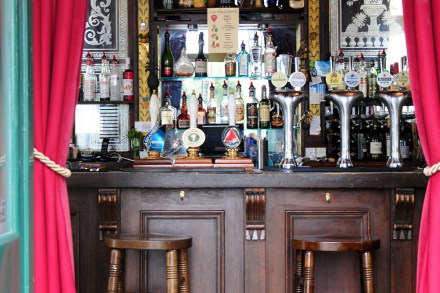
Anyone paying attention to the pumps at their local recently might have noticed something peculiar: a swathe of old-school logos. There’s the red triangle of Bass, the red right hand of Allsopp’s, the yellow bees and barrel of Boddingtons.   Despite fighting long-term decline, cask ale is having a moment. At some of London’s trendiest new pubs, like the Robin in Stroud Green, McIntosh Ales in Stoke Newington or the Pocket in Angel, cask makes up a significant portion of available beers.

My take on marry me chicken

I am not in the habit of bringing viral TikTok recipes here. It is a safe space, away from digestive biscuits submerged in yoghurt masquerading as cheesecake, baked oats, or sugary instant coffee whipped up like foam (if you don’t know what I’m talking about, ignorance is bliss). No, here we are in the realm of tried-and-tested vintage recipes. So why am I letting marry me chicken into this sacred place? For the uninitiated, it first popped up a decade ago on an American food website called Delish, but it became the most-searched recipe on the New York Times in 2023. It’s a simple concept: chicken cooked in a creamy, tomatoey sauce that is so delicious that the person to whom you serve it will get down on one knee.

Will Bradford survive Britain’s curry house crisis?

Bradford, West Yorkshire, is not known as the curry capital of Britain for nothing. The city is home to more than 200 Asian restaurants. In the main, these are Kashmiri and Pakistani – driven by the city’s Pakistani-Muslim population which is one of the most concentrated in the country – and much of the local economy relies on them for jobs and income. My memories of Bradford curry houses go back to the late 1990s when I worked at the university. Commuting from London and therefore living in student digs meant I would eat out more often than not. That meant curry almost every night I was in the city as it cost little more than a sandwich.  Bradford’s curry houses are known for their homestyle cooking, rather than fancy, westernised, Instagram-aesthetic grub.

Food influencers aren’t going anywhere

At Gordon Ramsay’s launch party for his new Netflix show, Being Gordon Ramsay, influencers could be found in every corner of the room. Soon after getting another ‘lemongrass cha’ and walking past Victoria Beckham, I came face-to-face with Eating With Tod, a man whose wide-eyed hand rubbing and hyperbolic cries for enormous dinners has earned him 2.3 million followers and counting – impressive however you bill it.   Next to Ramsay, near the pulled pork bao station, was Jesse Burgess, one half of Topjaw and the presenter on another one of the chef’s food programmes Knife Edge on Apple TV.

Hell is Dry January

‘Earth has not anything to show more fair.’ I have always believed that the notion of a Dry January must have been launched on the world by von Sacher-Masoch: one of his more obscene fantasies. I would no more subject myself to it than to any of the other 11 months. They all deserve better. This year, however, malign fate intervened. On 3 January I was strolling along (as it happens, stone-cold sober) when I suddenly felt rotten. I sat on a fence to work out what was wrong and promptly passed out, falling a few feet while bumping and bashing on the way. A neighbour spotted the fall and dialled 999 virtually before I landed. A few days later, on the phone, he told me: ‘When I first saw you, mate, I thought you was fucking dead.

I have a bad case of northern homesickness

I’ve long held firm to the adage that you can’t truly call yourself a local in the town, city or village you reside in until you’ve spent over half your life there.  By my own calculation, I’ve just tipped over into becoming a Londoner: as of this year, I have spent 24 of my 47 years in the capital.   Not only that, but I’m marrying into the clan too. My fiancée – whom I’ll be tying the knot with in the spring – is a born-and-bred Chelsea girl whose proximity to the sound of Bow Bells has never strayed further than Crystal Palace.

There’s no beating the comfort of cabinet pudding

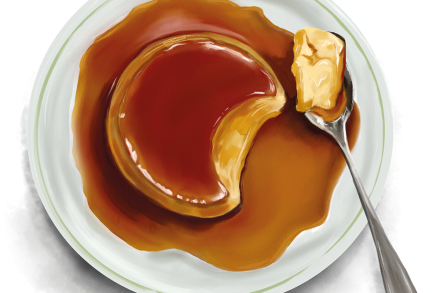
The British hold a steamed pudding close to their hearts. Like a culinary hot-water bottle, it may not be terribly elegant but it’s hard not to feel comforted and delighted by its presence. Most, however, follow a similar formula: a sponge cake mixture that is steamed into ethereal lightness and topped with a gooey, drippy sauce. This isn’t to decry them: I could never be fatigued by the spongy similarity of a golden syrup pudding and a bronzely glistening ginger one but they all come from the same sponge playbook, so I was intrigued to find one that doesn’t fit the mould.

Why is Greggs trying to sell me a matcha latte?

Last week I was in a branch of Greggs, in the small market town in north Wiltshire where I live. Behind the sausage rolls, steak bakes, corned beef pasties and trays of vanilla slice was something that almost made me drop my Tesco meal deal in shock. A machine dispensing matcha lattes.  Greggs, the last bastion of brown food in the post-Ottolenghi era is now retailing aspirational green, radioactive TikTok slurry … in Wiltshire. A cheerful, democratic, brute-force provider of cheap calories in culturally legible form has collided with a beverage whose main function is performative wellness. It felt less like innovation than a stitching error. Two incompatible worlds roughly bolted together, animated despite never quite cohering.

The battle for Britain’s oldest Indian restaurant

There are relatively few restaurants in London – or anywhere else, for that matter – that have made it to their centenary. There are even fewer that have been threatened with the closure of their premises in the precise year they are going to turn 100. And there are practically none so popular that news of their possible eviction has resulted in a petition with tens of thousands of signatures – which will be sent to the King in the hope he can reverse what would be a heritage-threatening disaster for one of the capital’s most historic establishments.  Such is the recent story of Veeraswamy, the country’s oldest Indian restaurant which was founded in March 1926 and has been a haunt of the beau-monde and demi-monde ever since.

The intoxicating illusion of Guinness Zero

Guinness Zero reminds me of the judge. I heard about him years ago. He was driving home from the golf club, seven G&Ts to the good. Or rather – he realised as he saw the flashing blue lights in his rear-view mirror – to the bad. This is it, he thought in horror, end of career. But he went through the motions, blowing into the breathalyser and, as he waited for the result, miserably contemplating how he was going to break the news to his wife. ‘Well, sir,’ said the policeman after a moment, ‘that all appears to be fine. Have a pleasant evening.’ Dumbstruck, the judge turned his car straight round and drove back to the golf club.

Why do guide dogs need ID to go to the pub?

I’ve long clung hold of one small crumb of comfort from my encroaching blindness. Namely that if and when my deteriorating vision (I have albinism and nystagmus) packs up completely, I can become one of those blokes who takes his guide dog to the pub and teaches it to drink beer from an ashtray.   But I won’t be doing that at any branches of J.D. Wetherspoon as things stand. As of this week, flyers alighting at Alicante airport can get a morning pint at the first branch of the chain to open on Spanish soil. Back at home, however, the issue facing the pub concerns hounds, not holidaymakers.

The secret to a good marriage is drink

Many years ago, when entertaining my then girlfriend (now wife) for our first Valentine’s Day, I spent a considerable amount of time and effort preparing an authentic beef bourguignon. With more than one bottle poured in during the slow-cooking process, it did not offer the lightness one might desire on such an occasion. After pushing it around the plate for an hour, she was less than delighted to then be presented with pudding – a sherry trifle. In the years since, not unreasonably, she has insisted on planning the menu. I have been left in charge of drink. For an excellent white wine, I would suggest Bodega del Abad’s San Salvador Godello 2021.

Rediscovering Dylan Thomas, pint by pint

It was the longest pub crawl of my life – visiting numerous boozers across 250 miles over ten days – in homage to one of Britain’s most infamous drinkers, Dylan Thomas. I’m not, I must qualify, a Thomas obsessive, as this enterprise might suggest. If exposed to Thomas at length, I find myself recalling Private Eye’s 1980s characterisation of Neil Kinnock: ‘The Welsh windbag.’ Although, in fairness, even Thomas himself described his own verse as ‘a steaming pile of Welsh whimsy’.

A Brit’s guide to Mexican food

I’m in Mexico City and spoilt for choice as to where to go for a lunchtime taco. Taquerias are everywhere, each entrance best described as a hole in the wall: you step in from the street into a dark, cavernous stone vault and go past the bar, stocked with dozens of bottles of spirits and a fridge full of beer. I honestly feel like I’ve never had Mexican food before, except once in San Francisco. On that occasion, I went to a canteen close to the border with a friend, where we were the only two non-Mexican people eating. The salsas were bright as traffic lights and there was charred corn doused with chilli and lime salt, fresh white cheese and lime butter. The tortillas were the soft corn ones, unlike any I’ve seen in UK outlets, with hard, U-shaped shells made of wheat.

Beloved by Chinese tourists – and the Labour party: Phoenix Palace reviewed

The exterior of the Phoenix Palace is cream with golden letters like the napkin and the Laffer curve, and it is squeezed below an Art Deco mansion block in Baker Street. The street is self-effacing, stuck between the Marylebone Road and the Sherlock Holmes museum, which exists because London is, among other things, morbid. The cuisine is Cantonese. Understatement is a feint here, though; the Phoenix Palace is famous, and always on the best dim sum lists. It is beloved by Chinese tourists and students, and, weirdly, the Labour party, whose grandees smile uneasily from photographs, like hostages to the economy, and rice. The food comes near instantly.