Spectator Life

Spectator Life

An intelligent mix of culture, style, travel, food and property, as well as where to go and what to see.

Primary dread: the horror of school plays, fêtes and trips

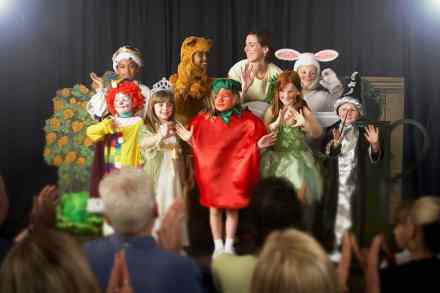
Primary school drama has a rule which is a variation on Chekhov’s gun principle: if your child has a part in the school play they won’t get to speak until the end of the final act. And you’ll have to sit through the part of every other child before their moment finally comes. You will have to go. You will have to go and sit on a very small chair for a very long time, watching other people’s children perform ineptly before you get your ten seconds of joy at your own darling’s turn (which you won’t get to see properly anyway as you’re tasked with filming it).
What would you make all children learn? A Spectator curriculum

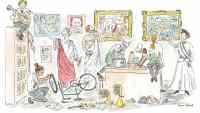
Matthew Parris My father was an engineer. As a child I enjoyed ‘creative’ writing: stories, poems and so on. Dad said: ‘Try writing something useful. You know how to mend a bicycle puncture. Write for me, on one page, instructions for mending a puncture, to be read by someone who knows what a bike is, and what things like “spanner” and “puncture repair outfit” mean, but has never tried to do the job themselves.’ To my own and Dad’s surprise, I really enjoyed this exercise, which demands not just an ability to write clearly, but the mental exercise of putting yourself into a different person’s place, so you can explain. It is really an exercise of the imagination.

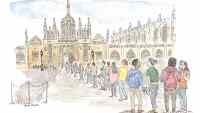
The truth about getting into Oxbridge

Liz Truss suggests that all students who score straight A*s at A-level should be interviewed by Oxford or Cambridge. They, and their parents, might well wonder why they would not be summoned for an interview if they can achieve such impressive results. But it’s not that simple. Post-A-level candidates are much fewer in number than pre-A-level ones, with most students offered places on the condition that they achieve the required grades. So various options have now been offered to address this. In one, all pupils predicted such grades would be eligible for an interview ahead of sitting their exams. However, it’s hard to see how teachers would resist the temptation to make generous predictions in order to catapult their pupils into interviews.

The Oxbridge Files: which schools get the most pupils in?

Oxford and Cambridge have released figures showing how many offers they gave to pupils from schools in the 2021 Ucas application cycle. We have combined the figures in this table. It shows how well state grammars and sixth-form colleges compete with independent schools. Over the years, both universities have increased the proportion of acceptances from state schools: 69 per cent, up from 52 per cent in 2000. Of the 80 schools, 35 are independent, 21 grammar, ten sixth-form colleges, seven selective sixth-form colleges, six comprehensives or academies, and one is a further education college. (Schools are ranked by offers received, then by offer-to-application ratio.

The dos and don’ts of school tours

There are moments in life that serve as a wake-up call to adulthood. Perhaps, the first was sitting in the beige office of a mortgage broker, wondering how my soon-to-be-husband and I had made the leap from meeting on a sweaty Durham dance floor to this airless room in Holborn. More recently, it was looking around a primary school for our four-year-old-son. Mindlessly staring at wall displays of woodland animals, you’re racking your brains as to how you will finish work at 3pm for pick up come September and scramble enough childcare for a six-week summer holiday. Goodbye 52-week-a year nursery.  But book yourself enough tours at enough schools, and you swiftly find yourself in the swing of things.

The hidden victims of lockdown: an interview with the Children’s Commissioner

When schools were closed during lockdown, it wasn’t only education that suffered. The classroom can offer an opportunity to identify children in danger of abuse, with tens of thousands of pupils on the at-risk register. Take away schools and this safety net vanishes. Now and again, stories emerged of just how badly things went wrong: for example, the murder of six-year-old Arthur Labinjo-Hughes at the hands of his stepmother. ‘If that little boy had been in school, I do believe there would have been an extra chance to hear him,’ the Children’s Commissioner, Rachel de Souza, tells me, when we meet at The Spectator’s offices to discuss her mission to help the hidden victims of lockdown.

The enduring appeal of school name tapes

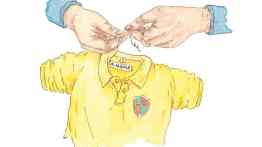
I hadn’t thought about Cash’s name tapes for many years. My mother used to sew them into clothes I planned to take to school. Occasionally I find one in a sock or a threadbare T-shirt and feel wistful for the years past. My name tapes were white, with a navy, serif typeface. The other day, I discovered a pair of tights in the bottom of a drawer which belonged (or perhaps still belong) to my school friend Alice. Her name tapes were woven in green, with a sans serif typeface that looked like the Johnston one used on the London Underground. How did our mothers decide what typeface and colour would best suit their daughters? My own daughter Lily has recently started nursery. Clothes will inevitably get mislaid. On the Cash’s website, there are all sorts of options.

Why handwriting still matters

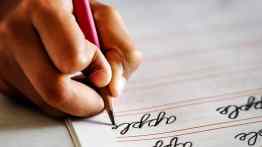
I work in learning support at a prep school in the South-East and have started teaching my pupils handwriting. It seems that the future of education, especially for children with special needs, is digital. But why should those who struggle to write legibly be given a laptop instead of extra lessons in handwriting? Faced with the obvious decline in the quality of handwriting, what are teachers to do? When in doubt, consult the English national curriculum. The handwriting curriculum for Key Stage 2 (aged eight to ten) is divided into three levels: working ‘towards expected standards’, working ‘at expected standards’ and working ‘at greater depth’.

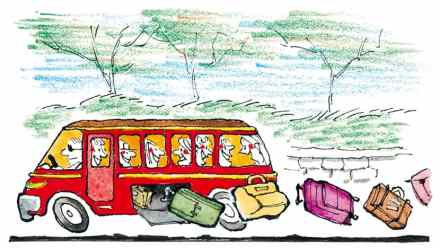
School trip: My déjeuner sur l’herbe

In 1966 we were 17 and about to do A-levels and leave our convent school for ever at the end of that summer term. Two girls were having a lesbian affair, another had been tempted to sleep with a boy, dramatically confessing this to our head nun, Mother Benedicta, in Mother B’s terrifying private room halfway up the staircase. Our head girl, Vanessa, had an older sister who would roar down to the school on the back of her boyfriend’s motorbike along with his friends, known as ‘leather boys’. Vanessa was worried about her sister living in sin. ‘The sins of the flesh are not the worst sins my child,’ Mother B wisely told her. (The sister was still married to her leather boy 50 years later while Vanessa married at least twice, and lived in sin.

From the brainiacs to the bluffers: a guide to public school stereotypes

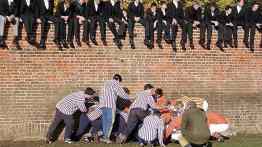
A Wykehamist, an Old Etonian and an Old Harrovian are in a bar. A woman walks in. The Old Etonian says: ‘Fetch her a chair!’ The Wykehamist gets it. The Old Harrovian sits in it. It’s the oldest public-school joke in the world — and it still has the ring of truth. (Though you might add these days: ‘And then the Old Etonian becomes prime minister.’) But what about the other public schools? Here are the classic characteristics of our most famous schoolboys — and schoolgirls. Charterhouse Artistic, literary, louche, political and on the make… the received wisdom about Old Carthusians was set in stone in the Alms for Oblivion sequence by Simon Raven (1927-2001), who was at the school in the 1940s.

The march of the middle-class apprentices

Tony Blair used to joke that he could announce the start of a war during a speech on skills policy and no one would notice. Like all the best jokes, it contained more than a grain of truth. Britain — or rather educated Britain — has never been interested in the parts of our education and training system that don’t involve doing A-levels and going to university. Blair did a great deal to entrench the social and cultural dominance of university with his aspiration that half of all school leavers should go into higher education. That was, on aggregate, the right policy for the country and its economy: the expansion of a great higher education sector has done much good for the UK.

We need more technology in classrooms – not less

The government has rightly identified that improving education will help ‘level up’ Britain. Higher-quality teaching is one tool to get there, but with roughly a third of teachers leaving the profession within five years of qualifying, better teacher training won’t be a quick enough fix to turn things around within its eight-year target. What’s needed is a massive roll-out of educational technology to provide teacher support. When I was a schools minister, I oversaw an agency that advised and procured technology. We had a school rebuilding programme that embedded effective technology in its design. We also managed to get half a million of the most disadvantaged children online at home with the Home Access Scheme. This was more than a decade ago, though.

The confused language of gender identity ideology

‘I think I might be transgender!’ How should schools react to such revelations? By the time they find out, the child may already be convinced that their identity lies on the LGBTQIA+ spectrum. Probably with its own multi-coloured flag. But while social media influencers are quick to dispense answers, schools are left to cope with the consequences, with little understanding of what is really going on. Stonewall and Mermaids — large publicly funded LGBT+ charities — would have us believe that we all have an innate gender identity that determines whether we are men or women, or perhaps neither. But that’s all it is — a belief.

The dark art of ‘off-rolling’ unwanted pupils

Sometimes a school wants to exclude a child but can’t. The student might have difficult needs that are costing money or taking too much time to deal with. Or their exam results might be looking likely to damage the school’s standing. But children can’t lawfully be excluded for getting bad grades or for needing more attention. Schools, though, have a way to get them off their books. They ‘off-roll’ them, a practice which is illegal. In 2017, in the first widely reported case of off-rolling, St Olave’s grammar school in London told 16 pupils that their places in Year 13 had been withdrawn because they did badly in their AS-level exams, even though they had reached the sixth form entry requirements the year before.

No screens, shared bathwater and ugly food: my life in a 1960s prep school

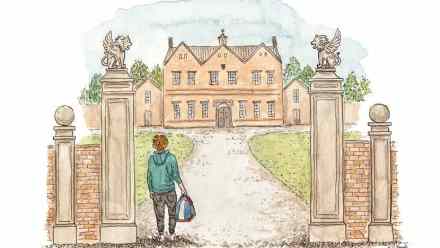
We were allowed one phone call, faint and crackling along the many miles of copper wire which connected Hampshire with Dartmoor. In those days (this was the early 1960s) the operator had to connect it. I had watched those wires, swooping alongside the train which had borne me all that way, wisps of smoke and steam drifting past the window. Now, with the September evening coming on, there was time for a few stilted words in the headmaster’s study with my parents. It would in many ways have been better not to bother, as it only emphasised the distance and the separation. Then it was term. I don’t want to complain about this. I had begged to go to boarding school because my brother was already there and I would have felt utterly left out and left behind if I had not gone too.

Schools portraits: a snapshot of four notable schools

Colville Primary School Based just off Notting Hill’s Portobello Road, Colville Primary School occupies a Victorian Grade II-listed building that was once a laundry. Today, it accommodates pupils up to the age of 11 who are taught under the school’s ‘three key values’: respect, aspiration and perseverance. Colville also says it believes in the British values of democracy, individual liberty and tolerance. The school’s performance has shot up over the past decade: three years ago, it was rated ‘Outstanding’ by Ofsted. Despite its setting in the heart of London, there’s plenty of area for play — the playground facilities are new, and there’s also a large ball court and running track.

Advertising feature: Preparing our children for a world that has not yet been imagined

It is our belief at Tadpoles Nursery School that if we want the world to change, we must begin with the teaching of the very young. Our early years are the moment when our minds are the most open and the most receptive; when we see the world around us with wonder and without judgement and when we are able to ask questions without fear or embarrassment. Equal Thinking, Ecology and Climate Change, Care and Kindness within our communities — the list goes on — can only be pursued if we educate our children from the very beginning, giving them the imagination, tools and skills at an early age. Allowing them to explore paths not yet taken and ideas without judgment.

Has Boris Johnson given up on free schools?

For the founders of the West London Free School, of which I was one, last Thursday should have been a moment of great pride. We gathered in the assembly hall, surrounded by the politicians and officials who’d helped us, to celebrate the school’s tenth anniversary and reflect on what we’d achieved. Not only has the school thrived — it is now part of a growing academy chain — but where we led, others followed. As the first school of its type to be approved by Michael Gove, WLFS showed what a determined group of volunteers could achieve, and there are now more than 600 free schools. Contrary to the predictions of the critics — too many to mention — this is one education policy that seems to have worked.

Embrace a change to higher education

The pandemic has sparked an entrepreneurial revolution as the business sector has adapted to consumers’ rapidly changing needs, with nearly half a million businesses launched in the UK between March and December last year. This national surge of entrepreneurs — enabled by ongoing technological development, together with a national shortage in practical skills — begs one to question whether the traditional university route will best prepare our young people for their future careers. There will undoubtedly always be an important place for traditional university degrees but a blinkered focus on this as the only viable option for further education will, I believe, disadvantage career and earning potential in the future. Recent statistics are already showing this.

Building an Ark of Remote and in-classroom learning

Although there is little scientific proof of the story of Noah’s Ark or the accompanying flood, we are told that building the Ark was no small task and Noah was working to a deadline. When UK schools were told to close classrooms and switch to remote learning back in March last year, many were caught by surprise by being forced to change teaching practices and administrative processes overnight. However many schools thrived under the extraordinary circumstances, continuing to offer the highest standard of teaching to their pupils. Staff and pupils at those schools who excelled during the pandemic were often already familiar with cloud platforms or had been employing remote learning platforms for hybrid learning or blended learning long before the lockdowns.

Books railing against private schools are actually the best marketing for them

When Michael Gove was selling his school reforms a decade ago he was asked to define success. ‘I hope that thanks to the reforms we’ve introduced the next Guardian editor but three will be a comprehensive school boy or girl.’ It was his little joke: that the loudest critics of private schools, the people who rail against the injustice of the whole system, tend to be people who went to these schools. There is a long tradition of books by public schoolboys decrying public schools. The latest is Sad Little Men: Private Schools and the Ruin of England whose author, Richard Beard, went first to Pinewood, a prep school on the Wiltshire/Oxfordshire border, and then the £41,700-a-year Radley College.

Zoom schooling sounded like fun – until reality kicked in

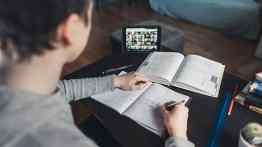
I never realised how much I enjoyed the sweaty, overcrowded journey into school until it was replaced with a half-asleep crawl from my bed to my desk, 30 seconds before my first lesson was supposed to start. It’s a routine which most of us students have had to get used to since March last year and it was a massive change. When we were first sent home from school, it wasn’t with a fanfare, but with a bleak mass email and assurances from our teachers that we’d be back after Easter. Our group chats on social media erupted in celebration. It took less than half a day for the excitement to die down as we each realised what the prospect of being locked inside indefinitely actually meant.

Our Sputnik moment: it’s time to revolutionise old teaching methods

Teaching methods today are no longer appropriate. The reasons are twofold. First, schools do not teach children how to think, they teach them how to parrot back the right answers. Second, exams define children’s futures. They tell them who they are, what jobs they can get and what their prospects in life will be. With such a narrow path to success, and deprived of cultivated reasoning skills, it’s little wonder that so many pupils are anxious and depressed. How did we end up here? The chemist and Nobel laureate (and inventor of the PCR test for Covid) Kary Mullis believed that schools today are a consequence of the space race. ‘In 1957 the Russians launched the space race by putting Sputnik into orbit around the Earth,’ he wrote.

Top notes: why does music make you cleverer?

Music is far older than language. The FOXP2 gene associated with speech has been recovered from Neanderthal fossils, yet rhythm and melody have been around for millions of years before that, as attested by the fossils of chirping crickets and singing birds. Sapiens evolved on the ape line, and our songs evolved from the vocalisations of non-human primates. One of the traits, however, which sets us apart from our chimp cousins (with whom we share 98 per cent of our genetic material) is that we continue to learn, develop and mature far beyond infancy. Humans may well be born with a musical instinct, yet music training changes the structure of our brains. A baby, as well as an adult with no musical training, processes music through the right side of the brain, which deals with emotion.

I banned mobiles. Should other heads?

In September 2018, I made the decision to ban mobile phones during the academic day at the school where I am head teacher in Scotland. I’m pretty sure we were the first British school to make this leap of faith. It made headlines across the country. How would everyone react? I knew that I needed to explain the thinking behind the decision to convince doubters and encourage support. It wouldn’t be a popular decision, so it was with a churning stomach that I rose to address the assembled pupils, having just pressed ‘send’ on a parent-body email. Fast-forward to August 2021 and the banning of mobile phones is now part of the national narrative. The Department for Education is spearheading a proposal that every school might be forced to adopt.