Spectator Life

Spectator Life

An intelligent mix of culture, style, travel, food and property, as well as where to go and what to see.

Bring back the handwritten school report

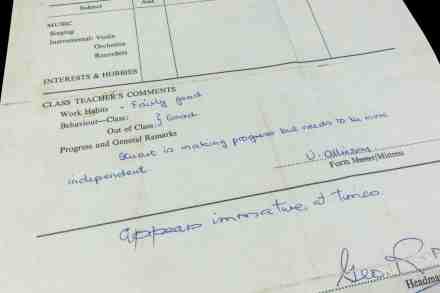
The end of term is here and parents up and down the country will be awaiting the arrival of their child's end-of-term report. But I hope they won’t be expecting too many pearls of wisdom from the impersonal emails that will ping into their inboxes shortly.   Ten or a dozen years ago (the exact date varied, school by school), in an act of educational vandalism, handwritten school reports were abolished. Edicts were issued by school ‘senior management teams’ and grudgingly, reluctantly, teachers put their fountain pens and little bottles of Quink back into their desks, never to be taken out again.   The personal touch in the reporting process disappeared with them.
What teachers really want for Christmas

As the end of term approaches parents may be wondering what to buy their child’s teacher for Christmas. It’s the season of goodwill, after all. It’s also a golden opportunity to win a way to Sir or Miss’s heart, so they’ll continue to take good care of little Olivia or Oliver in the new year. The days of apples left on desks are long gone, so what to give teacher might cause some confusion. Money is tight this year, an added complication – although at some of the independent schools where I’ve taught gifts seem to become more extravagant each December. So what kind of presents do we teachers really want? The short answer, especially at the end of a long, tiring term is: ‘Something alcoholic, of course – preferably wine or designer gin.

Carol Vorderman: My maths manifesto for the nation

A glittering TV career, an MBE, various honorary degrees, tens of thousands of TikTok followers and the only person to win the (now cancelled) Rear of the Year award multiple times. There are many accolades that Carol Vorderman has been afforded during her 40-year career, yet few mean more to her than her claim to having possibly taught more people alive in Britain than anyone else. Through books, tapes and online classes, the former Countdown star has – according, at least, to my remedial fag-pack maths – educated more than a million people since the late 1980s. She started when the national curriculum was introduced in 1988 with instructional classes on VHS, and she’s subsequently taught generations of adults and children.

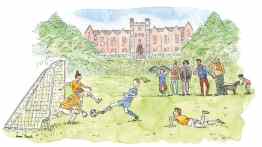
The long game: independent schools are coming round to football

Until recently, football was viewed with suspicion in independent schools – the poor relation to its big-hitting step-brother, rugby. That well known saying about football being ‘a game for gentlemen played by hooligans’ seemed to sum up independent schools’ attitudes perfectly. Well into the new millennium, promising young players would be cajoled into playing rugby or hockey: anything rather than – shock, horror – football. This aversion helps explain why professional footballers are usually state-educated. England’s rugby coach, Eddie Jones, may have lambasted public schools for ruining English rugby; he could never have said the same for football.

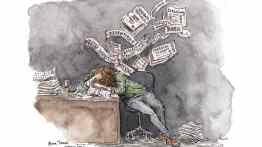
Why I’ve quit teaching

For the past four years I have worked at an academy in Hackney. I was deputy head of maths for three of those years, and head of maths for the final term, managing 16 staff. After nearly a decade teaching in the state sector, I’d finally worked my way up to a well paid and respected position. But this summer I walked away from it. I’m not alone. The profession is haemorrhaging talent: data from the National Education Union published earlier this year revealed that 44 per cent of teachers intend to leave the profession by 2027. Retention in London schools is particularly poor. The reasons why teachers quit are complex, but there are a few common themes. One is exhaustion.

How a skiing trip turned me into a megalomaniac

In the instant I first became aware of the unpleasant nature of the cosmos we all infest, my megalomaniac nature and a desire to marry Rupert Murdoch, I was on a school trip to Gstaad. Now and then the night train stopped at snow-capped stations, which I could see from my lower bunk. My teenage illusions of glamour were invested in that journey: echoes of Sidney Lumet’s Murder on the Orient Express – Hungarian counts looking like Michael York, imperious German princesses with toy dogs in the dining car… My expectations were rudely curtailed when someone threw up. Two splodges of vomit landed on my stomach, before sliding to the floor where they lay there staring at me. ‘Oh God,’ said the 15-year-old schoolgirl responsible. ‘Too many mixers.

How to get through a school reunion

T here’s no need for a mirror at school reunions. Just look all around you to see the cruel effects of anno domini on your old contemporaries – and don’t fool yourself that you alone have miraculously dodged the hair-thinning, waist-expanding horrors of middle age. Is that really the semi-divine girl who scored a modelling contract in her first term in the sixth form and was in a Nivea advert in Elle? Can that be the Brad Pitt of the Remove – the one who had sex before first lesson every morning? Where has the plumpness in her dewy lips fled to? How far back along his scalp have the golden ropes of hair retreated? I’m certainly not one to speak.

The struggle of summer with a disabled child

Day one of the school holidays this year set the tone for the sprawling six weeks ahead. My teenage son rolled out of bed at a leisurely 1.05 p.m., by which time my daughter had smashed her head repeatedly against the kitchen wall, bitten my leg and trashed our living room. And so began a typical ‘summer break’ for a family with a disabled child. The gap between holiday provision for children with, and without, special needs and disabilities (SEND) during summers has long played out under my roof because I have one of each. Before my non-disabled son reached an age when he could sleep in all morning, I would enrol him in play schemes and clubs or lean on loving grandparents to entertain him while his dad and I worked; the typical summer juggle of so many parents.

Primary dread: the horror of school plays, fêtes and trips

Primary school drama has a rule which is a variation on Chekhov’s gun principle: if your child has a part in the school play they won’t get to speak until the end of the final act. And you’ll have to sit through the part of every other child before their moment finally comes. You will have to go. You will have to go and sit on a very small chair for a very long time, watching other people’s children perform ineptly before you get your ten seconds of joy at your own darling’s turn (which you won’t get to see properly anyway as you’re tasked with filming it).

Gift of the gab: all children should learn public speaking

What is the secret to a billionaire’s success? When Warren Buffet was asked how young people could mimic his wealth, he said: ‘Hone your communication skills, both written and verbal… You can have all the brainpower in the world, but you have to be able to transmit it, and the transmission is communication.’ Buffet knows this is easier said than done. Early in his career he’d vomit before every speech. After graduating from Columbia Business School and the New York Institute of Finance, he took a public speaking course from Dale Carnegie. ‘It changed my life,’ he says. It’s the only diploma displayed on his office wall. Other businessmen also rank public speaking as a key driver of success.

What would you make all children learn? A Spectator curriculum

Matthew Parris My father was an engineer. As a child I enjoyed ‘creative’ writing: stories, poems and so on. Dad said: ‘Try writing something useful. You know how to mend a bicycle puncture. Write for me, on one page, instructions for mending a puncture, to be read by someone who knows what a bike is, and what things like “spanner” and “puncture repair outfit” mean, but has never tried to do the job themselves.’ To my own and Dad’s surprise, I really enjoyed this exercise, which demands not just an ability to write clearly, but the mental exercise of putting yourself into a different person’s place, so you can explain. It is really an exercise of the imagination.

The truth about getting into Oxbridge

Liz Truss suggests that all students who score straight A*s at A-level should be interviewed by Oxford or Cambridge. They, and their parents, might well wonder why they would not be summoned for an interview if they can achieve such impressive results. But it’s not that simple. Post-A-level candidates are much fewer in number than pre-A-level ones, with most students offered places on the condition that they achieve the required grades. So various options have now been offered to address this. In one, all pupils predicted such grades would be eligible for an interview ahead of sitting their exams. However, it’s hard to see how teachers would resist the temptation to make generous predictions in order to catapult their pupils into interviews.

The Oxbridge Files: which schools get the most pupils in?

Oxford and Cambridge have released figures showing how many offers they gave to pupils from schools in the 2021 Ucas application cycle. We have combined the figures in this table. It shows how well state grammars and sixth-form colleges compete with independent schools. Over the years, both universities have increased the proportion of acceptances from state schools: 69 per cent, up from 52 per cent in 2000. Of the 80 schools, 35 are independent, 21 grammar, ten sixth-form colleges, seven selective sixth-form colleges, six comprehensives or academies, and one is a further education college. (Schools are ranked by offers received, then by offer-to-application ratio.

The dos and don’ts of school tours

There are moments in life that serve as a wake-up call to adulthood. Perhaps, the first was sitting in the beige office of a mortgage broker, wondering how my soon-to-be-husband and I had made the leap from meeting on a sweaty Durham dance floor to this airless room in Holborn. More recently, it was looking around a primary school for our four-year-old-son. Mindlessly staring at wall displays of woodland animals, you’re racking your brains as to how you will finish work at 3pm for pick up come September and scramble enough childcare for a six-week summer holiday. Goodbye 52-week-a year nursery.  But book yourself enough tours at enough schools, and you swiftly find yourself in the swing of things.

The hidden victims of lockdown: an interview with the Children’s Commissioner

When schools were closed during lockdown, it wasn’t only education that suffered. The classroom can offer an opportunity to identify children in danger of abuse, with tens of thousands of pupils on the at-risk register. Take away schools and this safety net vanishes. Now and again, stories emerged of just how badly things went wrong: for example, the murder of six-year-old Arthur Labinjo-Hughes at the hands of his stepmother. ‘If that little boy had been in school, I do believe there would have been an extra chance to hear him,’ the Children’s Commissioner, Rachel de Souza, tells me, when we meet at The Spectator’s offices to discuss her mission to help the hidden victims of lockdown.

The enduring appeal of school name tapes

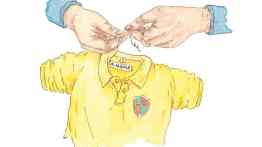
I hadn’t thought about Cash’s name tapes for many years. My mother used to sew them into clothes I planned to take to school. Occasionally I find one in a sock or a threadbare T-shirt and feel wistful for the years past. My name tapes were white, with a navy, serif typeface. The other day, I discovered a pair of tights in the bottom of a drawer which belonged (or perhaps still belong) to my school friend Alice. Her name tapes were woven in green, with a sans serif typeface that looked like the Johnston one used on the London Underground. How did our mothers decide what typeface and colour would best suit their daughters? My own daughter Lily has recently started nursery. Clothes will inevitably get mislaid. On the Cash’s website, there are all sorts of options.

Why handwriting still matters

I work in learning support at a prep school in the South-East and have started teaching my pupils handwriting. It seems that the future of education, especially for children with special needs, is digital. But why should those who struggle to write legibly be given a laptop instead of extra lessons in handwriting? Faced with the obvious decline in the quality of handwriting, what are teachers to do? When in doubt, consult the English national curriculum. The handwriting curriculum for Key Stage 2 (aged eight to ten) is divided into three levels: working ‘towards expected standards’, working ‘at expected standards’ and working ‘at greater depth’.

School trip: My déjeuner sur l’herbe

In 1966 we were 17 and about to do A-levels and leave our convent school for ever at the end of that summer term. Two girls were having a lesbian affair, another had been tempted to sleep with a boy, dramatically confessing this to our head nun, Mother Benedicta, in Mother B’s terrifying private room halfway up the staircase. Our head girl, Vanessa, had an older sister who would roar down to the school on the back of her boyfriend’s motorbike along with his friends, known as ‘leather boys’. Vanessa was worried about her sister living in sin. ‘The sins of the flesh are not the worst sins my child,’ Mother B wisely told her. (The sister was still married to her leather boy 50 years later while Vanessa married at least twice, and lived in sin.

From the brainiacs to the bluffers: a guide to public school stereotypes

A Wykehamist, an Old Etonian and an Old Harrovian are in a bar. A woman walks in. The Old Etonian says: ‘Fetch her a chair!’ The Wykehamist gets it. The Old Harrovian sits in it. It’s the oldest public-school joke in the world — and it still has the ring of truth. (Though you might add these days: ‘And then the Old Etonian becomes prime minister.’) But what about the other public schools? Here are the classic characteristics of our most famous schoolboys — and schoolgirls. Charterhouse Artistic, literary, louche, political and on the make… the received wisdom about Old Carthusians was set in stone in the Alms for Oblivion sequence by Simon Raven (1927-2001), who was at the school in the 1940s.

The march of the middle-class apprentices

Tony Blair used to joke that he could announce the start of a war during a speech on skills policy and no one would notice. Like all the best jokes, it contained more than a grain of truth. Britain — or rather educated Britain — has never been interested in the parts of our education and training system that don’t involve doing A-levels and going to university. Blair did a great deal to entrench the social and cultural dominance of university with his aspiration that half of all school leavers should go into higher education. That was, on aggregate, the right policy for the country and its economy: the expansion of a great higher education sector has done much good for the UK.

We need more technology in classrooms – not less

The government has rightly identified that improving education will help ‘level up’ Britain. Higher-quality teaching is one tool to get there, but with roughly a third of teachers leaving the profession within five years of qualifying, better teacher training won’t be a quick enough fix to turn things around within its eight-year target. What’s needed is a massive roll-out of educational technology to provide teacher support. When I was a schools minister, I oversaw an agency that advised and procured technology. We had a school rebuilding programme that embedded effective technology in its design. We also managed to get half a million of the most disadvantaged children online at home with the Home Access Scheme. This was more than a decade ago, though.

The confused language of gender identity ideology

‘I think I might be transgender!’ How should schools react to such revelations? By the time they find out, the child may already be convinced that their identity lies on the LGBTQIA+ spectrum. Probably with its own multi-coloured flag. But while social media influencers are quick to dispense answers, schools are left to cope with the consequences, with little understanding of what is really going on. Stonewall and Mermaids — large publicly funded LGBT+ charities — would have us believe that we all have an innate gender identity that determines whether we are men or women, or perhaps neither. But that’s all it is — a belief.

The dark art of ‘off-rolling’ unwanted pupils

Sometimes a school wants to exclude a child but can’t. The student might have difficult needs that are costing money or taking too much time to deal with. Or their exam results might be looking likely to damage the school’s standing. But children can’t lawfully be excluded for getting bad grades or for needing more attention. Schools, though, have a way to get them off their books. They ‘off-roll’ them, a practice which is illegal. In 2017, in the first widely reported case of off-rolling, St Olave’s grammar school in London told 16 pupils that their places in Year 13 had been withdrawn because they did badly in their AS-level exams, even though they had reached the sixth form entry requirements the year before.

No screens, shared bathwater and ugly food: my life in a 1960s prep school

We were allowed one phone call, faint and crackling along the many miles of copper wire which connected Hampshire with Dartmoor. In those days (this was the early 1960s) the operator had to connect it. I had watched those wires, swooping alongside the train which had borne me all that way, wisps of smoke and steam drifting past the window. Now, with the September evening coming on, there was time for a few stilted words in the headmaster’s study with my parents. It would in many ways have been better not to bother, as it only emphasised the distance and the separation. Then it was term. I don’t want to complain about this. I had begged to go to boarding school because my brother was already there and I would have felt utterly left out and left behind if I had not gone too.

Schools portraits: a snapshot of four notable schools

Colville Primary School Based just off Notting Hill’s Portobello Road, Colville Primary School occupies a Victorian Grade II-listed building that was once a laundry. Today, it accommodates pupils up to the age of 11 who are taught under the school’s ‘three key values’: respect, aspiration and perseverance. Colville also says it believes in the British values of democracy, individual liberty and tolerance. The school’s performance has shot up over the past decade: three years ago, it was rated ‘Outstanding’ by Ofsted. Despite its setting in the heart of London, there’s plenty of area for play — the playground facilities are new, and there’s also a large ball court and running track.

Advertising feature: Preparing our children for a world that has not yet been imagined

It is our belief at Tadpoles Nursery School that if we want the world to change, we must begin with the teaching of the very young. Our early years are the moment when our minds are the most open and the most receptive; when we see the world around us with wonder and without judgement and when we are able to ask questions without fear or embarrassment. Equal Thinking, Ecology and Climate Change, Care and Kindness within our communities — the list goes on — can only be pursued if we educate our children from the very beginning, giving them the imagination, tools and skills at an early age. Allowing them to explore paths not yet taken and ideas without judgment.