Politics

Read about the latest political news, views and analysis

Sunday shows round-up: Heseltine takes a pop at Cummings

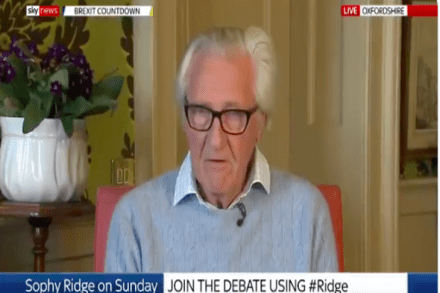
Michael Heseltine - The UK's agenda 'is on hold' Ed Conway took over the reins from Sophy Ridge this week, and began by interviewing Lord Heseltine, the former deputy prime minister and committed europhile. Heseltine has co-authored an article with former speaker Betty Boothroyd in today's Sunday Times, calling a no-deal exit 'the most grotesque act of national self harm committed in peacetime by a British government'. Heseltine expanded on this column: https://twitter.com/RidgeOnSunday/status/1160463646096547840?ref_src=twsrc%5Etfw MH: The union of the United Kingdom itself is at risk, as polls are now showing in Scotland. The economy has stalled, inflation is rising, and the pound is in serious difficulties and threatens to get worse.
Does Sadiq Khan think Brexit means cancelling Christmas?

‘I’ve heard he’s a great guy, this mayor,’ shouted Sadiq Khan to no one in particular as he arrived in the foyer of the Gilded Balloon at the Edinburgh Festival. He barged past me and headed for the auditorium. ‘Treat him gently, please. No heckling,’ he added, talking about himself. The audience moved into the sweltering venue where Khan answered questions from Iain Dale for 60 minutes. Some had been submitted in advance by the audience. ‘How confident are you of winning a second catastrophic term?’ That came from a disgruntled London voter. Khan looked a bit uncomfortable and muttered something about avoiding complacency. ‘It’s going to be very hard to win again.

Why a government of national unity isn’t going to happen

There’s been much talk this week of a so-called government of national unity (GNU) to stop Boris Johnson’s Brexit plan. The idea is that he’d be forced out in a vote of no confidence in September and replaced by a caretaker PM who would request an extension to our EU membership before resigning and calling a general election. But, as I say in The Sun this morning, it is hard to see this happening. First, this wouldn’t be a government of national unity as its sole purpose would be to extend our membership of the EU which would make it one of the more divisive governments in living memory. But more importantly, Jeremy Corbyn won’t back anyone else for Number 10 while Tory rebels and the Lib Dems aren’t prepared to support him.

With interest rates crashing, Boris is in luck – he can borrow his way out of any Brexit crisis

Is Boris Johnson the luckiest prime minister ever? This week, the Government can borrow money for ten years at 0.48 per cent and for thirty years at 1.16 per cent. At these rates, it would irresponsible not to borrow more. The age of austerity can be brought to an end at exactly the same moment we leave the EU, opening up vast new opportunities for investment in infrastructure and public services. The Cameron government had to cope with the aftermath of the great recession and lived in fear of being heavily in debt if real interest rates went up. No such fear need trouble Boris. If the Government issues more 30-year bonds it will not matter if interest rates go up in the future. For every 30-year bond valued at £100 the Government will receive £107.

The Remain alliance that could spoil Boris Johnson’s party

What George Orwell said of left-wing intellectuals now applies to Boris Johnson and his ministers: so much of what they propose is a ‘playing with fire by people who don't even know that fire is hot’. They may suspend Parliament and crash us out of the EU on 31 October or crash us out in the middle of an election campaign. Understandably, all the talk is of the threat to the conventions of democratic life. Yet if Johnson does not buckle, the autumn will not just bring a constitutional crisis but an economic and social crisis. No one knows how bad crashing out will be because no country has been stupid enough to tear up its main trading relationships without having an alternative in place.

Dominic Cummings won’t blink over no deal. But will Boris Johnson?

On the day Boris Johnson became Prime Minister, I said his most important appointment was that of Dominic Cummings – who had run the triumphant pro-Brexit, Vote Leave referendum campaign – as his most senior government adviser. It signalled Johnson was not bluffing when he pledged to extract the UK from the EU do or die, no ifs no buts, deal or no deal – because there are few political operators on the planet more ruthless, focused and remorseless than Cummings. I imagine he has OODA tattooed on his bottom (look it up). There has however been a bit of a misunderstanding about precisely what Cummings agreed to do for Johnson and for how long. So here are the terms of their compact.

Is Britain really heading for a Brexit recession?

The sense of excitement among some Remainers is almost palpable. Finally – after three years of waiting – a quarter of negative growth has materialised following all the grim warnings of Brexit-related economic turmoil. The Office of National Statistics (ONS) this morning released its first estimate for economic growth for the second quarter of this year, which has come out at minus 0.2 per cent. That counteracts unexpectedly strong growth in the first quarter of 0.5 per cent. Manufacturing, which shrank by 2.3 per cent, was the worst-performing sector of the economy. The dominant services sector expanded but only just, at 0.1 per cent.

The Spectator Podcast: beaches, Brexit, and Desert Island bores

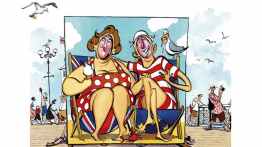
This week, our writers tell us about their favourite British beaches, from Cornwall to Northern Ireland (24:15). But before then, there’s of course some Brexit chat as we ask whether parliament can stop a no deal Brexit in the autumn (00:25), and – has Desert Island Discs lost the plot (15:05)? With James Forsyth, Catherine Haddon, Katy Balls, Michael Heath, Kate Chisholm, Douglas Murray, Laura Freeman, and Tanya Gold.

Breaking the deadlock

It is said that our political system is ‘broken’ simply because the passions aroused by Brexit have effectively created a hung parliament. So what to do about it? Athenians would have dealt with the problem by ostracism. Its purpose was to send one citizen into exile. Once a year Athenian citizens (all males over 18) meeting in assembly got the chance to vote for an ostracism. It was held by citizens inscribing the name of their candidate on a potsherd (ostrakon). As long as at least 6,000 votes were cast, the man with the most votes was sent into exile for ten years. He did not suffer disgrace, lose citizenship or property, just his ability to reside in Athens. About 10,000 such ostraka survive. Some citizens spoilt them.

Letters | 8 August 2019

We don’t cut God Sir: The Revd Dr Peter Mullen suggests (Letters, 3 August) that Boris Johnson told him my BBC Great Lives programme had cut from our broadcast treatment of Samuel Johnson an extended discussion of Christianity’s role in Dr Johnson’s life. Boris J championed Samuel J for our programme, and your correspondent has been persuaded that Mr J argued at length the centrality of religion to the great lexicographer. I am fascinated by religion. My producers would not relegate a person’s faith where it was claimed as central to their greatness.

Trading places | 8 August 2019

Comments by the former US Treasury Secretary Larry Summers this week, claiming that Britain will come off poorly in negotiations for a trade deal with the US, should not be surprising. He has previously declared that Britain’s vote for Brexit was ‘the worst self-inflicted policy wound that a country has done since the second world war’ so he would not want to be proved wrong by Britain doing well out of leaving the EU. But the reaction to his intervention has emphasised a peculiarity in attitudes towards free trade, from both Brexiteers and Remainers. Many of those who are keenest to assert the importance of free trade with the EU tend to retreat in fright whenever the prospect of a trade deal with the US is raised.

Diary – 8 August 2019

It is rare that losing a day at Lord’s for a Test match is welcome. I had expected to be watching England play Ireland with my wife and two of my children on the Thursday before last. Instead, much to my delight, Boris Johnson asked me to become Leader of the House of Commons and Lord President of the Council, so I had my first cabinet meeting, my first outing at the Despatch Box and first Privy Council meeting. Anselm, my fourth child, went to the cricket in my place so was equally pleased. The joy in joining the government is, naturally, in part personal but mainly because we will now leave the European Union on 31 October. Something that would not have happened with any other possible prime minister.

Labour MP: I think all countries should be abolished

'Imagine there's no countries,' John Lennon once sang. It seems that one Labour MP is taking that song literally. Paul Sweeney, who represents Glasgow North East, had this to say: Well, Mr S. has to admire the scale of Sweeney's ambitions, but he also wonders whether this plan might not be the best way to dig Labour out of the hole it found itself in yesterday. John McDonnell, the shadow chancellor, caused trouble for his party at the Edinburgh fringe festival by saying that Labour would not block a Scottish referendum if they won power. The comments went down badly with Scottish Labour MPs. Sweeney stepped in to clarify the party's position as a 'statement of basic democracy'. He then explained that: '...

Cardinal Pell and the lies of Carl Beech

This week's Holy Smoke podcast asks whether Cardinal George Pell, jailed in Australia for paedophile crimes, could have been the victim of a hoax. The possibility needs to be considered following the conviction in Britain of Carl Beech, formerly known as 'Nick', for inventing a non-existent Westminster sex ring in which VIPs supposedly raped and murdered children. He found a disgracefully gullible audience in the Metropolitan Police. Beech's serial lies were designed to destroy the lives or posthumous reputations of Lord Bramall, former head of the British Army, Sir Edward Heath, former PM, Lord Brittan, former home secretary, ex-Tory MP Harvey Proctor and Lord Janner, the late Labour politician. Beech has been jailed for 18 years.

Home and away | 8 August 2019

The epiphany came when I was standing in the oxymoron of a speedy boarding queue at Gatwick, waiting to have my ticket checked by Eva Braun, mewling middle-class brats squabbling beneath my feet, all of us en route to somewhere in the EU which is both searingly hot and supported by British taxpayer subsidies (for a while). I had been wondering where on the plane we would be seated. Almost certainly that very row in the middle which is the last to be served by the drinks trolley, and where the stale flatus tends to congregate. And probably behind some ignorant cow who will put her seat back so that I can inhale her rancid scalp while I’m trying to eat my sickly Thai chicken ‘wrap’.

Remember, remember, the first of November

The United Kingdom is a country governed, in large part, by convention —but in the heat of the Brexit debate, those conventions are beginning to evaporate. The Speaker of the House of Commons overturned long-standing procedure to limit Theresa May’s room for manoeuvre. The opposition used a humble address to the sovereign to force the publication of the government’s full legal advice on the withdrawal agreement, though the convention is that such advice is confidential. Parliament then impinged on the executive’s crown prerogative powers by passing a law dictating how the prime minister must behave at an EU summit. Under May, Downing Street sighed at such behaviour but grudgingly accepted it. Boris Johnson and his team have a different response.

Designer’s Notebook

‘Volcanic temper… suspicious of everyone… irritability, mood swings… terror stalking the shadows… devastating collapse of Europe’s economy… rampant insecurity, unbridled hypochondria…’ Trump? No, it’s Henry VIII, according to Robert Hutchinson. But the ‘king’ across the water is uncannily like the Tudor tyrant; the discarded wives, the wenching, the rival heirs, the fawning, the flattery, the broken treaties. Palm Beach is his jousting ground; Mar-a-Lago his gaudier Nonsuch.

Could Boris Johnson have to resign if he loses a confidence vote?

The argument about whether Boris Johnson would have to resign if he lost a confidence vote is continuing to rage at Westminster. There is, though, an angle to this argument that is being neglected. Right now, the Labour leadership is clear that it won’t back anyone other than Jeremy Corbyn to be prime minister. This means that even if Boris Johnson lost a no-confidence vote, it is not clear who could command the confidence of the Commons. With no alternative government ready to go, then an election would be the obvious answer.  Things become more complicated if an alternative government could somehow be formed. In these circumstances, there would be more pressure on Boris Johnson to resign.

The obvious failings of a ‘government of national unity’

So that’s that, then. Just as the backers of a ‘government of national unity’ appeared to have their tails up, along comes shadow business secretary Rebecca Long-Bailey to scotch it, saying that Labour will back no such thing. It should come as no surprise. Corbyn wants to govern on his own terms – and be Prime Minister. He doesn’t want to be a junior minister in some outfit led by Yvette Cooper, Hilary Benn, or any of the other backbenchers who have spent the past three years trying to unseat him as Labour leader. He wants national disunity, followed by a general election.