Arts Reviews

The good, bad and ugly in arts and exhbitions

Breaking the spell

Fidelio, once regarded as an uncomplicated celebration of what its title suggests, and of freedom, especially political freedom, has become a problem work, and most productions of it amount to uninterestingly complicated attempts to circumvent issues which shouldn’t have been present in the director’s mind in the first place. Fidelio, once regarded as an uncomplicated celebration of what its title suggests, and of freedom, especially political freedom, has become a problem work, and most productions of it amount to uninterestingly complicated attempts to circumvent issues which shouldn’t have been present in the director’s mind in the first place. This has been a bad season, until Opera North broke the spell

One man and his dog | 7 May 2011

My Dog Tulip is a tender and exquisite animation about one man and his dog which gets as close to what it is to love dogs as I’ve ever encountered, and goes a considerable way to making up for what dog-lovers have had to put up with at the cinema in recent years (Hotel for Dogs, Beverly Hills Chihuahua, Marley & Me; utter tripe). My Dog Tulip is a tender and exquisite animation about one man and his dog which gets as close to what it is to love dogs as I’ve ever encountered, and goes a considerable way to making up for what dog-lovers have had to put up

Farewell, Sarah Jane

There’s a brilliant moment in the 1975 Doctor Who storyline The Ark In Space when Sarah Jane (Elisabeth Sladen), on a vital mission to save Earth from the evil insectoid Wirrn, gets stuck in a ventilator shaft. There’s a brilliant moment in the 1975 Doctor Who storyline The Ark In Space when Sarah Jane (Elisabeth Sladen), on a vital mission to save Earth from the evil insectoid Wirrn, gets stuck in a ventilator shaft. The Doctor (Tom Baker) hits on the ingenious ruse of goading her across the last few inches by telling her how thoroughly useless she is. At least, brilliant is how I remember it being when I

In a jam

Trust a radio critic, she who is paid to listen, not to rely on the wireless set in her car for information when stuck on a highland road miles from anywhere in a jam that stretches far into the horizon in both directions. But when a forest fire closed the road we were travelling on back across the mountains I realised I hadn’t a clue how to retune our southbound radio from the preset buttons and so couldn’t find the local station, Moray Firth Radio. After three hours, in the gloaming, we turned back along the road we had travelled. If only we had waited — or listened to MFR.

Moonbat redux

There was a very funny joke told by the slightly weird American comedian Emo Philips a dozen or so years ago. He was talking about his German girlfriend, and how she loved being in New York. What she loved best, he said, were those New York bagels, she couldn’t get enough of them. “And you just can’t find them anywhere in Germany,” she added, to which Philips replied: “Well, whose fault is that?” Another slightly weird comedian, The Guardian’s George Monbiot, provided the opportunity for precisely the same punchline in his column this week. At the start of what was, I have to admit, a very well written and cogently

Garden delights

There were two John Tradescants, father and son, operating in the 17th century as travellers and gardeners from a base in south London. Their family tomb is at the heart of the garden surrounding the Garden Museum in the former church of St Mary-at-Lambeth in Lambeth Palace Road, a garden designed as a Tradescant memorial 30 years ago by the Dowager Marchioness of Salisbury. This hallowed place has been the principal subject for the past year of the painter Charlotte Verity (born 1954), the museum’s first artist-in-residence. The initiative has been generously funded by the Cochemé Trust, and the results of Verity’s year-long residency are now on show in the

Wilton’s Music Hall – The good old days

John Major is half way through a book about the rise and fall of the music hall. His father, Tom, was a song-and-dance man who formed a double act with his wife, Kitty. John’s brother Terry was a trapeze artist, and the former prime minister must have come close to going into the family trade. Parliament’s gain was, in John Major-speak, showbiz’s not inconsiderable loss. Oh, yes.   Tom Major was a name in his day, although the fag-end of the music hall he knew is deader now than even the madrigal. The generation of halls that emerged in 1850 were very rapidly gone. Only one survives, in the East

We are the mockers, too

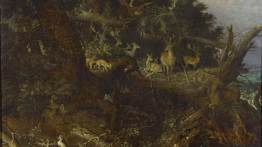
Hieronymus Bosch had a distinctive view of our debased humanity, most distinctly expressed in his paintings of Christ’s Passion, says Michael Prodger Carl Jung described the painter Hieronymus Bosch as ‘the master of the monstrous…the discoverer of the unconscious’. He was, however, only half right. While it is true that Bosch has no peers as a conjurer of phantasms and grotesques, he was no proto-psychologist: he was a man of his times. Bosch lived c.1450–1516 so his times were the late Middle Ages and there was no such thing as the unconscious then — there was the Bible. All human behaviour, good or ill, could be ascribed either to God

Me and my spoon

‘We have a spare place at a silver spoon-making workshop. Would you be interested?’ asked the Goldsmiths’ Company. I most certainly was, which was why I turned up (with my pinnie) at the Camberwell workshop of silversmiths Howard Fenn and Steve Wager. ‘We have a spare place at a silver spoon-making workshop. Would you be interested?’ asked the Goldsmiths’ Company. I most certainly was, which was why I turned up (with my pinnie) at the Camberwell workshop of silversmiths Howard Fenn and Steve Wager. Howard and Steve are both Freemen of the Worshipful Company of Goldsmiths with work in private, public and royal collections, yet these master craftsmen were prepared

Russian revenge | 23 April 2011

The Tsar’s Bride is Rimsky-Korsakov’s tenth opera, give or take various versions of some previous ones, but you’d never guess it. The Tsar’s Bride is Rimsky-Korsakov’s tenth opera, give or take various versions of some previous ones, but you’d never guess it. The production at the Royal Opera, which is exemplary in most respects, suggests a fairly talented newcomer to the genre, who isn’t yet in a position to boss his librettist around in the necessary ways. The Overture sets no scene, and is anyway tiresome and undistinguished; there are lots of stereotypical choral scenes; the central set of characters and their motivations sometimes get submerged in superfluous sidelines. But,

Triumph of goodness

Two films, this week, because I spoil you — what can I say? It’s in my nature — and not much to choose between them apart from the fact that one is good (Cedar Rapids) and one is so bad (Arthur) that just thinking about it makes me want to weep for myself, for remakes, for film audiences, for the state of cinema today, for humankind and for dogs that are cruelly treated, which is not especially relevant but, if I am weeping anyway, I might as well include them. Two films, this week, because I spoil you — what can I say? It’s in my nature — and not

Laid-back fantasy

This is how heavily Game of Thrones (Sky Atlantic, Monday) is being promoted: the preview discs came with a big, wider than A4, stiff-backed glossy book containing pictures of the actors and the settings, plus a glossary and a guide to the programme’s fantasy land — more than any lonely schoolboy in his bedroom could wish for. This is how heavily Game of Thrones (Sky Atlantic, Monday) is being promoted: the preview discs came with a big, wider than A4, stiff-backed glossy book containing pictures of the actors and the settings, plus a glossary and a guide to the programme’s fantasy land — more than any lonely schoolboy in his

In Praise of Alastair Sim

There is, I confess, little pressing need to post this clip from The Happiest Days of Your Life beyond the fact that a) it is always good to see Alastair Sim in action and b) this thought was triggered by this, entirely unrelated, story* in the Scotsman which quotes the head of Universities Scotland – a chap named Alastair Sim. The Happiest Days of Your Life, you will recall, is a splendid caper during which the exigencies of wartime demand a girls’ school be sequestered at a boys’ boarding school. Alastair Sim is the much put-upon headmaster and Margaret Rutherford the splendid headmistress. As always, Sim is the real star

Spring round-up

Perhaps to contradict the shocking fade-out of sculpture post-1970 in the Royal Academy’s Modern British Sculpture exhibition, just ended, there are a number of good sculpture shows in the commercial galleries. Perhaps to contradict the shocking fade-out of sculpture post-1970 in the Royal Academy’s Modern British Sculpture exhibition, just ended, there are a number of good sculpture shows in the commercial galleries. A survey at Waddington’s of Bill Woodrow’s witty recycled works from the 1980s ends on 16 April, but over the road is a fine display of recent prints and sculpture by Ivor Abrahams (born 1935), entitled Suburban Encounters (Mayor Gallery, 22a Cork Street, W1, until 28 April). Abrahams

Royal treasures

Some schoolboys used to know about Alexander the Great (356–323BC), how he extended the Macedonian Empire from Greece to India, cut the Gordian knot, and wept when there were no more worlds to conquer. Fewer schoolboys — or grown-ups — will know how skilled, and moving, the art of the Macedonian court was. Now they can, thanks to an exhibition at the Ashmolean, Heracles to Alexander the Great (until 29 August). Some schoolboys used to know about Alexander the Great (356–323BC), how he extended the Macedonian Empire from Greece to India, cut the Gordian knot, and wept when there were no more worlds to conquer. Fewer schoolboys — or grown-ups

Tale of the unexpected | 16 April 2011

Now, children, are you all sitting comfortably? Good, then I’ll begin. Now, children, are you all sitting comfortably? Good, then I’ll begin. Once upon a time, not so very long ago, the lady who directed the first Twilight film (Catherine Hardwicke) decided it would be a good idea to turn the traditional story of Red Riding Hood into a teen horror/fantasy thriller and no one thought to stop her which, children, is what happens when you already have one box-office hit under your belt. ‘Yes, yes!’ everyone probably said, before offering to park her car. At no point did anyone say, ‘But, Catherine! What lousy ideas you have!’ There is

Short cuts | 16 April 2011

One of the troubles with opera is that since creating and putting one on involves so many people many composers write as if for eternity, or at least for a sizeable segment of it. It’s been a great boon in recent years that some companies, notably Tête-à-Tête, have encouraged the creation and production of operas-in-progress and of short pieces which enable composers and librettists, and the mainly young performers they recruit, to find out what they might be good at. It’s a great boost for the spirits of the opera-goer to realise that, if he is being bored rigid by a piece, there is only 20 or so minutes of