Arts Reviews

The good, bad and ugly in arts and exhbitions

Love joust

Throughout his career Clifford Odets was overshadowed by Arthur Miller. Nowadays, his plays tend to be classified on a topsy-turvy scale beginning with the least completely forgotten. One of the lesser forgotten, A Rocket to the Moon, is a flawed, steamy, bourgeois melodrama. At first it seems crammed with gestures that don’t quite gel. The setting, a New York dental practice, seems to symbolise the American dream with the handbrake on. The characters’ names hint at their function. Belle is a flouncing beauty, Mr Prince is jolly rich, Willy Wax is a slippery, priapic seducer. There’s an earnest deadbeat dentist, Ben Stark, whose name vividly evokes the lead in his

Carry on camping | 16 April 2011

Britain’s Next Big Thing (BBC2, Tuesday) is another reality show in which members of the public risk humiliation for the chance of brief success and even briefer fame. Britain’s Next Big Thing (BBC2, Tuesday) is another reality show in which members of the public risk humiliation for the chance of brief success and even briefer fame. It’s Masterchef with craftwork. In the first episode, various people tried to pitch their designs to Liberty, the department store in London that resembles a mock-Tudor country-house hotel. The kind where the rooms have names instead of numbers and there are tortuously worded notices telling you not to steal the dressing-gowns. The chief buyer

Modern miracles

Five clever updates of Old Testament stories filled Radio 3’s late-night speech slot this week and revealed just how difficult it is to make these stories work in a contemporary setting. Five clever updates of Old Testament stories filled Radio 3’s late-night speech slot this week and revealed just how difficult it is to make these stories work in a contemporary setting. Without the cadences of the Authorised Version, the rigour of the language, its powerful rhetoric but also its inflated poetic style, Noah and his ark, or Samson and Delilah, can appear quite ridiculous. How do you make sense of miracles in our enlightened times? A young man who

Hell Comes to Dublin

No one can accurately imagine Hell. In Terminus, a magical paean to the art of storytelling, playwright Mark O’Rowe wisely does not try. No one can accurately imagine Hell. In Terminus, a magical paean to the art of storytelling, playwright Mark O’Rowe wisely does not try. The one soul in his universe who does manage to escape the place, finds himself, like Old Hamlet, unable to unfold its horrors to the youthful melancholic he encounters in a run-down corner of Dublin. But Miltonic questions of salvation, punishment and survival are infused through every phrase of the language his characters inhabit. Hell, or its earthly echo, an inner-city sink estate, may

Politics ahead of plot

Sad to hear of the death of Sidney Lumet, whose films, for the most part, I enjoyed. His most famous – 12 Angry Men – was certainly compelling, claustrophobic and actorly; a little like a very early version of the wonderful Glengarry Glen Ross, in its reliance upon dialogue and nuance. Hardly a surprise that Lumet later worked with the writer and director of Glengarry Glen Ross on his best – rather than most famous – film, The Verdict, a courtroom drama with a who bunch of performances to cherish – Newman, Mason, Milo O Shea.. But the plot of 12 Angry Men was a nonsense, wasn’t it? Quite clearly

Personal vision

At the beginning of Richard Ingrams’s book on John Piper (1903–92), he quotes the artist as saying: ‘The basic and unexplainable thing about my paintings is a feeling for places. At the beginning of Richard Ingrams’s book on John Piper (1903–92), he quotes the artist as saying: ‘The basic and unexplainable thing about my paintings is a feeling for places. Not for “travel”, but just for going somewhere — anywhere, really — and trying to see what hasn’t been seen before.’ It’s a good description of what makes Piper’s best work special and memorable, that feeling not just for identifying the spirit of a place, but for depicting it as

Little big man

A museum dedicated to Charlie Chaplin will open soon. William Cook gets a preview and talks to the star’s son Michael about life with a legend Standing in the deserted drawing-room of Charlie Chaplin’s Swiss château, waiting to meet his eldest surviving son, Michael, I remember something Auberon Waugh once said to Naim Attallah. ‘A lot of sons of famous fathers seem to be upset by the circumstance, even destroyed by it,’ said Waugh. ‘But I don’t think they need be. It entirely depends on the personality.’ However, Waugh was merely the son of the best British novelist of the last century. The man I’ve travelled here to meet is

Acting up | 9 April 2011

‘We’re asked to console with each tremulous soul who steps out to be loudly applauded. Stars on opening nights weep when they see their names in lights. Though people who act, as a matter of fact, are financially amply rewarded, it seems while pursuing their calling their suffering is simply appalling.’ The mummers couldn’t deceive Noel Coward. The Master knew all their ways, for he lived among them, as dramatist, actor, director and — as we have seen — songwriter. What a shame he’s not still with us, for the furore surrounding the ‘savage cuts’ announced last week by the Arts Council of England might have prompted him to add

Underneath the arches | 9 April 2011

The Elephant and Castle shopping centre is more of an oddity than an eyesore. It lies like a stricken container ship opposite the dignified columns of the Metropolitan Tabernacle and the sweep of porticos leading to Kennington on the other side of the gyratory system. It was to be demolished as part of a redevelopment plan, but the recession has given it a stay of execution. Retailers have stayed away, which has created an opportunity for Corsica Studios, an organisation that uses dilapidated buildings and dead urban space to host art exhibitions, live album launches and club nights. Corsica Studios adapted some former loading bays behind the shopping centre and

Cheating the noose

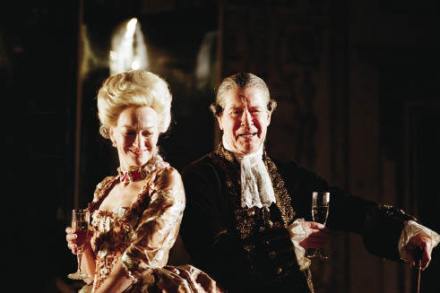
Incredibly boring. That’s how a cracking courtroom drama seems at first. Case closed. We know whodunnit already. Alma Rattenbury, a luscious middle-aged nympho, has bashed in the skull of her deaf old husband with the help of a teenage builder, George, who shares her bed. Incredibly boring. That’s how a cracking courtroom drama seems at first. Case closed. We know whodunnit already. Alma Rattenbury, a luscious middle-aged nympho, has bashed in the skull of her deaf old husband with the help of a teenage builder, George, who shares her bed. Newspapers carry lurid reports of a drunken Alma dancing in her husband’s blood and trying to seduce the policemen who

Bird watching

Rio (3D) is a perfectly average kiddies’ flick, although, as it’s Easter and the kiddies are off school, anything that might amuse them and get them out of your hair should not, I suppose, be sniffed at, and this should do the trick; this is something you can park them at on the days you can’t dump them at grandma’s (grandmas love looking after their grandchildren. Rio (3D) is a perfectly average kiddies’ flick, although, as it’s Easter and the kiddies are off school, anything that might amuse them and get them out of your hair should not, I suppose, be sniffed at, and this should do the trick; this

Two faced

It’s a two-way genre, radio, Janus-faced, going forwards while at the same time looking backwards, flexible enough to adapt to the internet world but also still wallowing in the wealth of its archive. It’s a two-way genre, radio, Janus-faced, going forwards while at the same time looking backwards, flexible enough to adapt to the internet world but also still wallowing in the wealth of its archive. Just as the arrival of Radioplayer was announced in an up-to-the-minute presentation at the top of the Centrepoint building in the heart of London, of which more later, Radio 4 Extra launched its new weekday magazine, The 4 O’Clock Show, which sounds surprisingly, and

Cultural surrender

When I was a teenager I used to upset my father by telling him I thought it would be really glamorous to die young in a car crash. The stupid thing was, I believed it. The corollary of feeling immortal is that you have no real understanding of the finality of death. That’s why you can count on the fingers of one hand the number of 40-plus suicide bombers. In My Brother, the Islamist (BBC3, Monday), a likeable Dorset tree surgeon called Robb Leech set out on a quest to discover why the blond, perfectly normal-seeming stepbrother Rich with whom he’d grown up in Weymouth had ended up as a

In A Forest, Dark and Deep

Neil LaBute is hard to like but easy to admire. So goes conventional wisdom on the subject of one of America’s most verbally violent playwrights. It’s a shame, therefore, that in this new tale of Hansel and Gretel grown up and gone wrong, there’s still plenty to discomfort but little to impress. Fortunately, Hollywood stars Matthew Fox (Lost) and Olivia Williams (Rushmore, The Sixth Sense) lend real wit and power to LaBute’s depiction of sibling warfare. In their capable hands, LaBute’s rehash of clichés about the opposition of educated woman to working class man becomes highly entertaining, if never quite enjoyable. LaBute seems to delight in the role of macho

Lines of beauty | 2 April 2011

So far, 2011 has been a good year for drawing. The great Pre-Raphaelite drawings show at Birmingham is still fresh in my mind as I write this review of a superb Watteau exhibition at the Royal Academy (supported by Region Holdings) and a select survey of Victorian drawings and watercolours at the Courtauld. Watercolours are often described as a form of drawing, though they are in fact made with paint. So they occupy a hybrid category, allowing rather too great a laxity of definition, as can be seen in the Tate’s current watercolour compendium. But there is no uncertainty about the Academy’s show: this is all drawings, and of a

The art of giving | 2 April 2011

The investor Jonathan Ruffer reveals why he is spending £15 million to buy 12 great paintings from the C of E – and give them back ‘It’s the pearl of great price,’ says Jonathan Ruffer. Like the merchant in the Gospel, he is selling all that he hath. With the proceeds, he is buying the 12 Zurbaran paintings of Jacob and his Brothers at Auckland Castle, the palace of the Bishop of Durham. And when he has bought them from the Church of England, he will give them back, keeping them in the castle, thus bestowing them upon the people of the north-east in perpetuity. The price is £15 million.

A Cause for Celebration

We theatre hacks are running out of superlatives to describe the current flowering of Terrence Rattigan revivals around the centenary of the writer’s birth. Notorious in his own day for his ability to dissect the morality of the midcentury Establishment, Rattigan follows in the grand tradition of Wilde and Coward in crafting witty, sexually ambiguous and quintessentially English social dramas, scored through with darker, more urgent concerns with the search for a moral existence. It would be a cruel irony if this run of productions were to have the effect of lifting Rattigan’s oeuvre out of a temporary unpopularity, only to leave it suffering from overexposure. But with revivals as

A pair of shockers

Michael Attenborough, the spirited maverick who runs the Almeida, has lavished a first-rate production on David Eldridge’s new play. Michael Attenborough, the spirited maverick who runs the Almeida, has lavished a first-rate production on David Eldridge’s new play. All that’s missing from this slick, visually pleasing show is any thought or utterance worthy of adult scrutiny. The script introduces us to a TV presenter, Lucy, recently dismissed for smoking heroin in her dressing-room. Skint, hooked on drugs and profoundly depressed, she follows a predictable downward spiral into theft, prostitution and homelessness and from there to counselling and the delusional ‘contentment’ of abstinence. Eldridge is remarkably uncritical of the drug myths