In the summer of 1992, the Times sent me to Orkney to interview the poet George Mackay Brown. He was notoriously wary of media interest – perhaps the only author ever to have asked his doctor for anti-depressants when shortlisted for the Booker prize – and I could hardly get a word out of him. His council flat didn’t yield much either: a sofa, a table – a Formica surface which Brown cleared of crumbs after breakfast and then wrote on till lunchtime. But behind his rocking chair, a huge banner, embroidered in bright wools, blazed out across an otherwise monochrome room:
O let them be left, wildness and wet
Long live the weeds and the wilderness yet.
These words from Gerard Manley Hopkins’s poem ‘Inversnaid’ demonstrate that if you want readers to care about wildness and wilderness, beautiful language, the sort that Yeats called the articulation of ‘sweet sounds together’, can carry them a long way. We are blessed with some exceptional authors – Robert Macfarlane, Adam Nicolson, George Monbiot, Chloe Dalton – who can lure readers into sharing their environmental concerns through their lyrical prose, whether they are writing about rivers, birds, crops or hares.
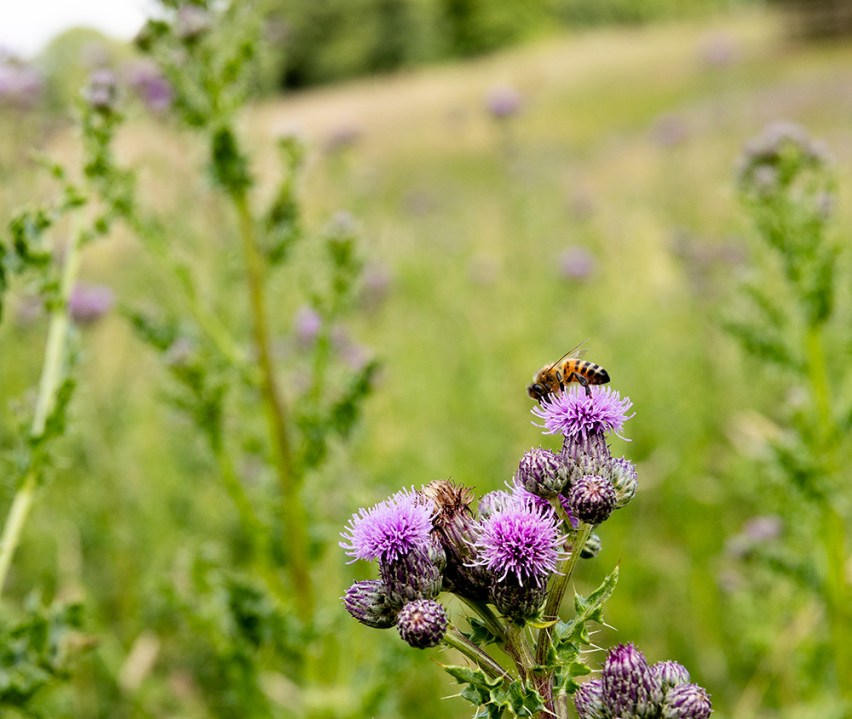
John Wright’s lifelong passion is for grasslands – specifically ‘semi-natural grasslands’. If you look at a pair of adjoining fields, one glowing bright emerald, the other muted and scrubby by comparison, it’s the second that gets Wright going. His aim is to draw our interest away from the ‘surface-level’ shine of monoculture to fields buzzing with biodiversity, with a ‘veritable world of bees, butterflies, crickets, flies, moths, spiders and so very much more’.
Grasslands, Wright says, is ‘a love story’, especially when he is writing about Hog Cliff in Dorset, the place dearest to him in the world. But love is balanced by a desperate fear. We have lost 97 per cent of all priority grasslands over the past century, and the future is bleak. So Wright invites us to become Lilliputians, to take a ‘bug’s eye look’ at grassland life and to learn to care about it.

His enthusiasm is winning. When he’s not at his desk he’s out and about staring at otherwise invisible lifeforms through his loupe or leading ‘fungus walks’ (he has a special affection for fungi). I would like to join one of these walks because, hard though I tried, Wright’s zeal never lifted off the page for me. The publishers have cunningly made the book look very like his hugely popular The Forager’s Calendar. But whereas that had a clear appeal to the common reader, Grasslands, with its lists and tables and academic references, feels as if it is aimed more at what Wright calls ‘good amateurs, in possession of perhaps 50 (expensive) books to aid identification, plus a chemistry lab of reagents… a good microscope and the skill to use it’.
He doesn’t want, obviously, to bore his readers. If you struggle with the ‘long taxonomic names of fungi’, he urges, ‘let them wash over you’. But sentences such as ‘Lichens are fungi that form an obligate relationship with algae’ or ‘All bryophytes are non-vascular’ made me feel I was sitting in a school science lesson, longing for the bell.
Still, the book is full of gems. I’ll not forget that an anthill is likely to be older than my grandmother and I will never again look at an apparently unthrilling field and think: ‘It’s just a patch of grass.’
From wildness to wilderness, a word which conjures for me the magnificence, fear, yearning and rich solitude found in the Cairngorms by Nan Shepherd, described by her in The Living Mountain. But that was 80-odd years ago and, as Cal Flyn suggests in her subtitle, wilderness has evolved – and is evolving still. Spending time in landscapes as diverse as Mount Sinai, Romania, sub-Saharan Africa and the Amazon rainforest, she ties us in ethical knots and exposes troubling paradoxes.
The US Wilderness Act of 1964 defined wilderness as a region ‘untrammelled by man, where man himself is a visitor who does not remain’. But the ‘democratisation of wilderness’ means that the wildernesses Flyn seeks out are often over-populated. In 1950, there were 33 million visitors to America’s national parks. By 2024, there were 331 million, trampling rare plants and feeding junk to animals. In Antarctica, tourists nose between icebergs on city-like cruise liners. Few tourists reach the Yanomami people deep in the Amazon rainforest, but the reception they give Flyn is chilly until they have hammered out a price for her visit. Her time with them feels compromised.
Environmentalists and social justice campaigners should, you’d think, be natural bedfellows. But on an overcrowded planet, the question is ‘Who gets elbowed off the ark?’ In Uganda, in order to safeguard gorillas, the Batwa forest people have been forced out of the ‘impenetrable forest’ where they’ve lived since time immemorial and are now trapped in a cycle of extreme poverty.
Flyn’s stamina is matched by acute sensitivity. She has the travel writer’s gift for living an experience and simultaneously pinning it to the page. Her research is phenomenal, and she writes compellingly of the history of the places she visits. But it is best to be with her in the present, in Transylvania, for example, waiting silently behind a Perspex shield as a huge, heavy-pelted bear emerges from the forest: ‘She was shaggy-haired, flat-footed. Bulky. Unsettlingly human: like a man in a bear costume, but with the heft of a pony.’
At the heart of the book is a personal quest. Flyn seeks ‘the interconnectedness of all things’ and her place ‘within the web’. But she raises more questions than she answers. Is wilderness simply a state of mind? And when is a wilderness not a wilderness? At the monastery of St Paul the Anchorite in Egypt, Flyn is aware that the vocation of the Coptic monk showing her around is to seek ‘an uncluttered connection with the divine’. Fearing she may be disturbing this, she takes her leave. But as Salib turns away, he reaches into his deep habit pocket and draws out a phone.


Comments