The godson of a friend of mine started at Eton last Michaelmas, and she recently told me how wonderfully it was suiting him. He’s a boy who has suffered from some academic and behavioural challenges, but very quickly these seem to have been ironed out. That school really knows its onions, my friend said.
Of course I was pleased for the boy; but my reaction was mixed. Good old Eton, I thought, working its magic again. But why is this magic available to so few – for the most part, only those able to raise fees just shy of £65,000 per year – and none of them girls?
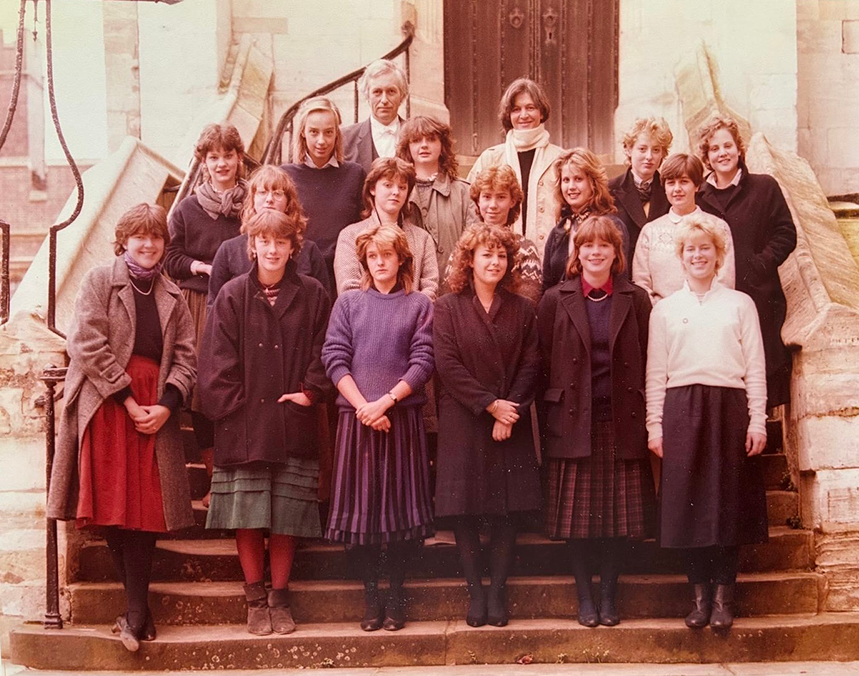
Well, not quite none. You might think my reaction somewhat ungrateful if I tell you that I was briefly a girl at Eton, and that it changed my life.
‘Perhaps it is the peculiar fault of the boys to pretend to knowledge in fields where they have none at all’
Forty-plus years ago, sixth-formers who wanted to try for Oxford or Cambridge were required to stay on after A-levels for a ‘seventh term’, and work towards a daunting entrance exam. Most posh Berkshire girls’ schools weren’t equipped to prepare girls in this way and so, for a few years from the late 1970s, they were dispatched to Eton instead.
It was, even for the toughest of us, a baptism of fire. My older sister was in one of the first batches of girls, and Eton wasn’t prepared for them at all. There were, for example, no girls’ loos. Far too embarrassed to articulate this problem, my sister and her convent friends spent much of their time walking over the bridge into Windsor, to visit the ladies’ at the Theatre Royal.
Three years later, when I arrived, there was a loo. But there were still challenges. We had, for example, to learn a whole new language. Lessons were ‘divs’ and for each ‘div’ we were ‘up to’ a different ‘beak’ (master), referred to by his initials. For European history I was ‘up to’ JSBP, a housemaster. He was an outstanding teacher and a sweet man, rather smitten, I thought, with the Heathfield girl who also joined his divs.

Not surprising: she was beautiful. In letters sent out during the summer holidays, we girls had been asked to dress in a way that was ‘decorous but unobtrusive’. Some, like the girl who came in each day by motorbike, usually in a mini-kilt, managed this nicely. But for me, one of a big family entirely dependent on hand-me-downs, it was hopeless. I was obtrusively indecorous and acutely conscious of it.
Even the most ordinary Etonians, meanwhile, looked glamorous in their tailcoats. By the time they reached ‘A Block’, most were wearing ‘stick ups’ and many were in ‘Pop’ waistcoats. During divs one of them, now a distinguished architect, used to tip back precariously on his chair so the sides of his tailcoat fell open, revealing an expanse of crimson gorgeousness. But perhaps the most classy was the boy who later ended up with a five-year prison sentence. He’d arrive late for divs, unshaven and exhausted-looking, wearing a white silk scarf. Had he spent the night in Tramp?
‘Perhaps it is the peculiar fault of Etonians to pretend to knowledge in fields where they have none at all,’ one beak wrote in my report. ‘Maggie was the complete opposite.’ None of us girls could believe the confidence of the boys – ‘I think I’ll get an award, sir. Don’t you?’
Through most divs I stooped over an exercise book, scribbling, hoping to look zoned-out. The beaks weren’t fooled: ‘In discussions in school Maggie doodled compulsively, with the abstract expression of someone listening intently.’ It was one of the most impressive things about an Eton education that there was nowhere to hide. Rather than write an essay after a div on a particular topic, as we’d been used to doing at our girls’ school, we’d be given a question and sent off to cobble together an answer. This was decades before the internet, of course, so I spent hours and hours in the Eton library (am I right in remembering it was pink?) and came to love it.
Each of us, meantime, had a private tutor, whom we saw once a week for an hour, on our own. My tutor had asked me to read Middlemarch over the summer, and at our first session he asked whether I’d enjoyed it. I responded with full convent gush: ‘I thought it was AMAZING!’ He stared at me, and asked: ‘Why?’ We sat in painful silence for what felt like a good while. Eventually, he rescued me: ‘Might it simply be that Dorothea is a wonderful woman?’ It was a revelation to me that it passed muster to respond to a great work of literature so simply. It has stood me in good stead all the decades since.
After I left Eton, I did sometimes wonder how much more boldly I might have entered the adult world if I’d had that education for five years rather than one term (a ‘half’). Then one evening I was invited to a dinner at the Garrick, in honour of the Middlemarch beak. I braced myself to square up again to this formidable intellect. But when it came to my turn to sit next to him, he didn’t seem to want to talk about George Eliot, or to revisit ‘the loss of faith in Victorian Britain’, on which I’d toiled in a long and turgid essay.
Instead, he told me how much he was loving his rural retirement, what pleasure it gave him to help children at the local state primary with their reading, the joy he got from his orchard, the prospects for the quince harvest and the delights of growing rhubarb. When I broke into his reverie to ask about Eton, to which he’d devoted pretty much his whole working life, and how he felt about it now, he paused, then admitted he thought of the old place with mixed feelings. And so do I.



Comments