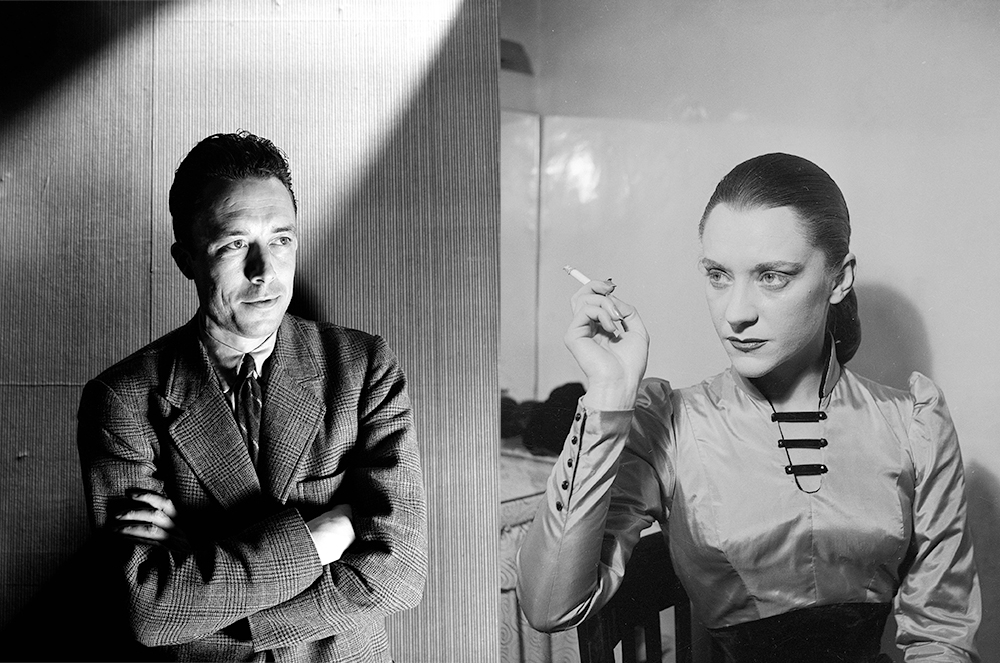
The extraordinary correspondence between Albert Camus and the love of his life Maria Casarès must rank among the most passionate ever written. Rarely can two lovers have expressed with such fervour a comparable range of emotions, from ecstasy to darkest despair. At times one shies away from the letters’ raw, searing intimacy, feeling like an intruder; but the sheer force of the feelings expressed and the finesse with which they are articulated propel one through.
These letters were first published in France in 2017 by Camus’s daughter Catherine, who was given them for safe-keeping by Casarès shortly before her death in 1996. Realising their power and significance, she had them transcribed and dated, and they were greeted with great acclaim, forming the basis of several theatre performances and a tele-vision documentary.
To read the letters is to experience a vertiginous roller-coaster between transcendent joy and abject suffering
Casarès was not Catherine’s mother. Camus was married to Francine Faure throughout the span of his great affair with Casarès. But they were separated by war when Camus and Casarès first became lovers, on 6 June 1944, the start of France’s liberation. Camus was in the Resistance and often in hiding; Francine had remained for safety in her native Algeria. They were due to be reunited in October that year; meanwhile a coup de foudre brought Camus and Casarès together on the set of his play The Misunderstanding. Casarès was 21 to his 30, and already making waves as a talented actress of Spanish descent. Camus was feted as the author of The Outsider and editor-in-chief of the Resistance journal Combat. Theirs was an attraction of body and soul, all the more magnetic for being illicit. And it could only remain that way, as Camus would never abandon Francine, despite his many infidelities. ‘I will try to make Francine happy,’ he wrote to Casarès, who did break off the affair on Francine’s return to Paris, whatever it cost her. Four years to the day later, on 6 June 1948, she ran into Camus on the Boulevard Saint-Germain and from that moment on they were inextricably bound together.
They were frequently parted, however, by his family life and the demands of their careers, and yearning is the leitmotif of their letters. As Casarès’s fame blossomed she took on a punishing schedule of performances, radio broadcasts, films and world tours. She worked with some of the great names of French theatre and cinema – Jean Cocteau, Robert Bresson, Jean-Louis Barrault among them – and starred in Cocteau’s Orphée and Marcel Carné’s Les Enfants du Paradis. She was ravishing and intense and everybody wanted a part of her, admirers hanging on her coattails. Camus’s celebrity – which he experienced as a curse – pitched him into exhausting book and speaking tours abroad, while recurrent TB also confined him to retreats and ‘cures’ away from Paris. He was also now the father of young twins, whom he adored. Each railed against these separations and poured out their longings, fears and rare recriminations into letters suffused with passion.
Each correspondent has their own translator: Sandra Smith took on Camus, and Cory Stockwell, Casarès. The voices are distinct, and Casarès is certainly a match for Camus: more mercurial, brighter, dramatic – she was an actress after all. She scolds him for losing heart, as he does, and for taking for granted the light and ease of the south when she is left behind in Paris, ‘a wasteland of noise, gasoline, smoky street corners’, despite the glitter of her life. He struggles with ‘pointless demons’ in her absence, with guilt about Francine (to whom he barely alludes, to spare Casarès’s feelings), with writer’s block, with his parlous health, with missing her painfully. His love, he assures her, ‘is my life, and beyond it I am merely a dead soul’. He could be drily humorous, too, about his travels, his encounters and the absurdity of life. He teases Maria, chides her for overworking, yet revels in her success; and he gives his views on authors – Dostoevsky, Balzac, Proust, Hemingway (‘a phony’) and Orwell (‘one of a very small number of men with whom I shared something’).
Few will read all 865 letters, but to dive into them is to experience a vertiginous roller-coaster between transcendent joy and abject suffering – the anticipation of togetherness, the pain and bewilderment of parting – and the impossibility of making a life together as they would have wished. As Camus puts it:

Even if I gave up everything to live with you, there would still be a part of my life that was separate from ours, a part that could not be destroyed, and which you would always feel pulled me away from you… You will suffer, I will suffer, but we will never give each other up.
Nor did they, for their mutual adoration and complicity ultimately prevailed.
Enormous courage was demanded, as Casarès admitted:
Now I’m at the midway point of my life, or almost, abruptly cast into the blinding light of a world without tomorrow, and it’s difficult for me to bear these new departures with any courage… Now darkness is falling and I don’t have the weapons I need to battle its cruelty.
They held nothing back, and it is the candour with which they address their insoluble, absurdist dilemma (largely of Camus’s making) that gives these letters their universal relevance and cannot but touch the heart.
If not too glib a claim, whereas Camus’s Notebooks (reviewed here recently) present the engine room of the writer’s mind, the Letters reveal the workings of his heart. A heart that would and yet wouldn’t betray his marriage vows but which, in complete harmony with that of Casarès, inspired his daughter to prepare these letters for publication on the grounds that they ‘make the Earth more vast, space more luminous and the air lighter simply because they exist’. Camus’s death in a car crash in January 1960 deprived Casarès of the light of her life. It would be 18 years before she eventually married a life-long friend, and she had no children. But her voice lives on in this lyrical, searing dialogue that traces one of the great love affairs of the 20th century.



Comments