
France is intensifying its counter-offensive against what it calls misinformation. Earlier this month, Paris prosecutors confirmed they have opened a criminal investigation into Elon Musk and X. Musk had ignored a summons to appear for a voluntary interview on April 20. The French state requested Musk assist in an investigation into algorithmic manipulation and the spread of AI deepfakes on X. Musk responded to the criminal investigation by labeling the prosecutors “faker than a chocolate euro and queerer than a pink flamingo in a neon tutu!”
On the same day, Paris unveiled its “French Response” strategy. The head of the Ministry of Foreign Affairs, Jean-Noël Barrot, posted a video on X (where else?) in which he rallied the Republic’s diplomatic corps to join battle in the “information war.” It is a war, he says, that will be won by “panache,” “imagination” and the linguistic skills of French to combat the lies spread by the malignant and the mischievous.
Paris is no longer an open city. Jews are increasingly afraid to venture out, women are also fearful
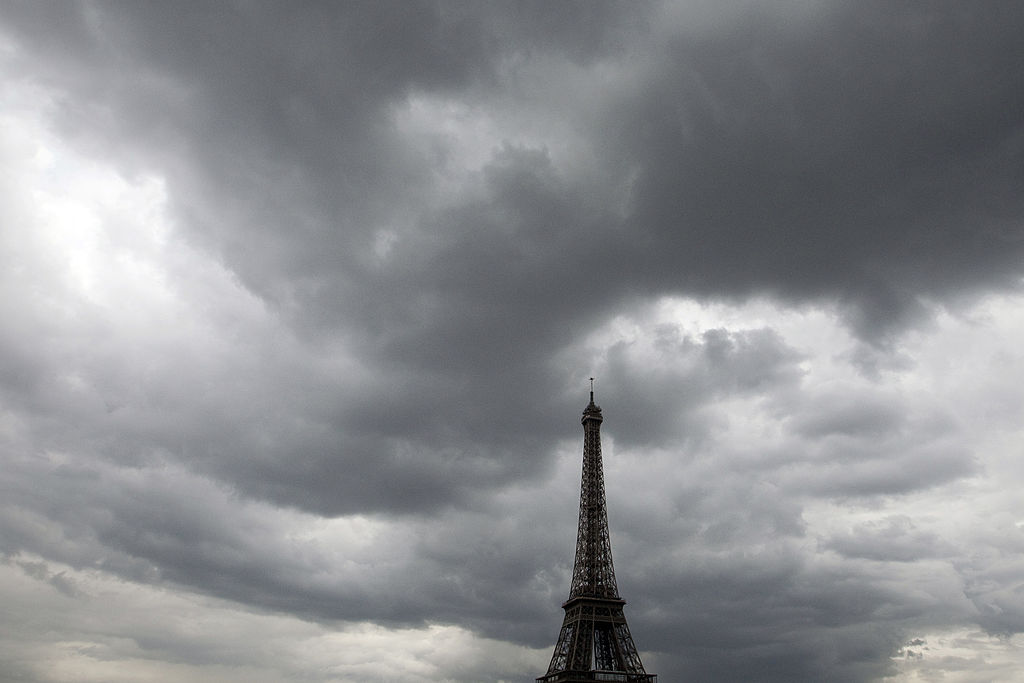
To illustrate the point, the Ministry of Foreign Affairs posted an image on its Instagram account. It contrasted two views of the Eiffel Tower. In one, a young man admires France’s most famous landmark towering over a bustling Parisian street on a glorious summer’s day. In the second, the same young man is wearing a MAGA cap, and has just put on a pair of glasses. This time he sees the Eiffel Tower set against a stormy sky and the street is battle-scarred with a demoralized man slumped near a burned-out car. “Divide, scare, reduce,” ran the accompanying caption. “It’s time to step into this battle and tell the stories that make us strong.” The Ministry of Foreign Affairs explained that it was launching a “counter-offensive” across the social networks and that “the battle of narratives is in full swing.”

Poor Monsieur Barrot. His timing could not have been worse. On the same morning that he launched his counter-offensive, swaths of Paris really did resemble the image seen by the man in the MAGA hat. The previous evening, the city’s soccer team Paris Saint-Germain beat Bayern Munich to reach the final of the Champions League, Europe’s most prestigious soccer tournament. Locals celebrated by rioting. Police made more than 120 arrests and, in doing so, 23 of their officers were injured. Cars and buses were torched and stores were vandalized. Most of the perpetrators come from the Parisian suburbs – the banlieues – and judging by the images, the bulk are of North and central African origin. This demographic was also largely responsible for the riots of 2023, when the entire country experienced a week of urban unrest after police in western Paris shot dead a teenage car thief of Algerian extraction.
The riots were similar in scale to those of 2005, which also began in Paris and originated after police attempted to apprehend two teenagers. In between these two events, France experienced a wave of Islamist terrorism, much of which was centered on Paris.
One of the targets for this month’s rioting was the Place de la Concorde – a stone’s throw from the American Embassy – where a temporary photographic exhibition was smashed up. The exhibition was entitled Vivre Ensemble, which translates as “Live Together.” It is the French expression for multiculturalism, a concept the political class has foisted on the public for years. If ever there was a metaphor for the failure of “vivre ensemble” it was the sight of the upended exhibits that littered the Place de la Concorde. What we are seeing here is an eruption of violent anti-politics, an expression of alienation and a hostility to the fabric of French life. Donald Trump has been warning about Paris’s decline for more than a decade. In 2017, he was mocked by the then mayor, Anne Hidalgo, when he said “Paris is no longer Paris.” She tweeted a photo of herself with Mickey and Minnie Mouse inviting Trump to visit Disneyland to “celebrate the dynamism and spirit of openness of Paris.”
But Paris is no longer an open city for many. Jews are increasingly afraid to venture out wearing anything that may give their religion away; women are also fearful. Last year, there were calls for female-only carriages on the rail network. Seven out of ten women in Paris say they have experienced some form of physical or verbal sexual abuse. Crimes such as theft and assault have also soared; in a moment of rare honesty in 2022, President Emmanuel Macron admitted more than half the crimes committed in Paris were the work of “foreigners, whether undocumented or awaiting residency permits.”
Trump is intensifying his criticism of Europe. In December, his administration warned the continent faced “civilizational erasure” because of uncontrolled mass immigration. He expressed concern that Europe was becoming an “incubator” for “violent left-wing extremists.” Those of us who live in France have seen the violence and mayhem with our own eyes. Paris’s elite has reacted with little more than indifference. For them the greatest threat will always be the “far-right,” which these days includes everyone from Jordan Bardella to Giorgia Meloni, and Nigel Farage to Trump. This is why we see the symbolic criminal case against Musk and a few lame memes about MAGA. The real problem is those who point out French dysfunction.
Earlier this year, a spokesman for France’s Ministry for Foreign Affairs outlined the objective of the “French Response” strategy in a radio interview. “Our interests, our image is being attacked in the information sphere,” Pascal Confavreux said. “We instinctively feel we’ve got to turn up the volume and raise our voice to defend ourselves,” he said, explicitly referencing Russia, the US and parts of Africa. It’s true that in some African countries, notably Algeria and Mali, there have been concerted attempts to undermine France’s reputation with false information. Many of the consumers of this anti-French rhetoric now live in France’s banlieues. It is believed Russia is involved in much of this propaganda war.
America is different. Far from wanting to destabilize France, Washington hopes to strengthen the Republic and Europe at large by drawing attention to the enemy within. The “French Response” would be better directed at tackling its extremists, Islamists and illegal immigrants rather than throwing a tantrum at Trump for telling the truth.




Comments