Letters

French letters – Albert Camus’s great epistolary love affair

From our UK edition

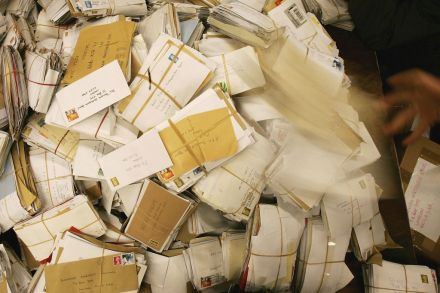
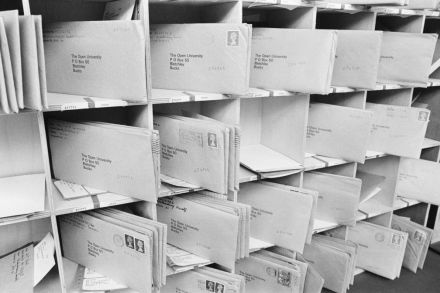
The extraordinary correspondence between Albert Camus and the love of his life Maria Casarès must rank among the most passionate ever written. Rarely can two lovers have expressed with such fervour a comparable range of emotions, from ecstasy to darkest despair. At times one shies away from the letters’ raw, searing intimacy, feeling like an intruder; but the sheer force of the feelings expressed and the finesse with which they are articulated propel one through. These letters were first published in France in 2017 by Camus’s daughter Catherine, who was given them for safe-keeping by Casarès shortly before her death in 1996.

The citizens of nowhere adrift in the West

From our UK edition

We all know that an Englishman’s home is his castle, or at least it was. Looking back, it is easy to see how the castle walls were breached – first by mobile phones and wifi, then by the smart speakers and other gadgets that help and also harvest us. The idea that our homes are inviolate seems quaint nowadays. We know there are many other ways in which we are being uncastled, not least by government agents acting with impunity. And if you think that’s a problem, wait till you read the other home truths delivered by Ece Temelkuran in a book you’ll ignore at your peril. Temelkuran is a writer of rare gifts with an urgent message. Her first books, including the award-winning Women who Blow on Knots, appeared in her native Turkish.

The art of the transatlantic liner

From our UK edition

Some time in the next few weeks, a great ocean liner will be lost at sea. One of the greatest, in fact. When the SS United States made its maiden voyage in July 1952, it was the last word in transatlantic liner design. In an age of ocean-going elegance, the ‘Big U’ was the newest, the sleekest and the swiftest. To this day, it holds the Blue Riband – the all-time record for the fastest transatlantic crossing by a passenger ship. Now, after five decades rusting in dock, and a series of unsuccessful preservation attempts, the United States is about to make its final voyage. Stripped of masts, fittings and its massive red, white and blue funnels, it will be towed out and sunk as a diving reef off the Florida coast. It’s heartbreaking to admit that this might be for the best.

‘I’m tired of your ridiculous lies’ – the wrath of Muriel Spark

From our UK edition

Few among Muriel Spark’s circle of friends would have disputed the judgment of Storm Jameson when recommending Spark to the publisher Blanche Knopf in 1963: ‘I warn you, or remind you, that you are taking on a tartar. She has worn out two Macmillan directors already.’ Even tartars are forgiven, however, when they exhibit a touch of genius. ‘On the credit side, she is a good writer.’ Spark was a good writer of letters, too. They were often a joy to receive, as this fascinating first volume of her correspondence shows. (Jameson to Knopf is quoted in an editor’s note.

Letters

Letters from Spectator readers, September 2024

The cunning of the Democrats’ lawfare Wow! A tour de force of snark! But wonderful for it. My late father-in-law would have said that instead of brushing his teeth in the morning, the author gets a file and sharpens his tongue. As depressing as this article is, it is likely an accurate assessment of what’s going on. Particularly the image of Trump and Biden essentially playing the roles of Walter Matthau and Jack Lemmon in the Grumpy Old Men movies. Carry on, America. Down Under, we have our own problems, as well as being affected by yours, same as every other country. — David Gerber Tellingly prescient. The 800-pound gorilla the next generation will be forced to address will be unsustainable entitlement transfer payments.

‘I’ve taken to sleeping in my teeth’ – the wartime admissions of T.S. Eliot

From our UK edition

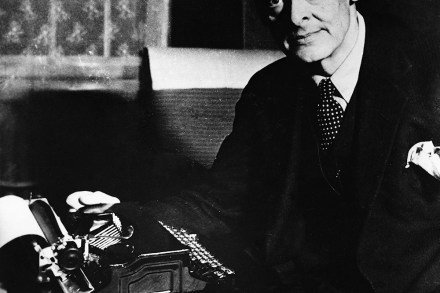
In 1944, T.S. Eliot is 56 years old. He seems older: ‘I am getting to be a wambling old codger.’ He is war-worn: ‘I have taken, when in London, to sleeping in my teeth.’ As a fire-watcher sharing shifts, his sleep is hampered by understandable pudeur: ‘I haven’t got enough phlegm to undress completely, and I think it best to sleep in my truss, in case of sudden blasting, which is not very comfortable.’ He knows, too, that his letters are dull. To Anne Ridler, 19 June 1942, he confesses: ‘If I had any small gift for letter writing, it has been ruined years ago by the pressure of the kind of correspondence I have to practise most of the time.’ Namely, the business letter, where you can see Eliot now and then resorting to the formulaic.

Alexander Pushkin – Russia’s greatest letter-writer

From our UK edition

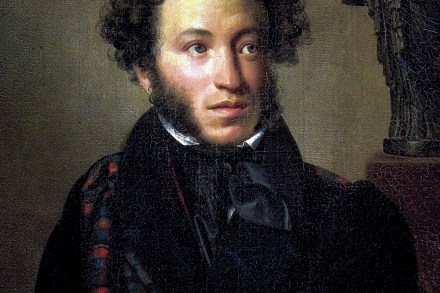
Alexander Pushkin was brought to ruin by his letters more than once. When the Russian postal police intercepted a letter suggesting that atheism was ‘the most plausible’ philosophy, he was exiled to his mother’s bleak estate in the rural north-west. But his own temper was far more dangerous. In the autumn of 1836, he received a series of anonymous letters taunting him about his coquettish wife’s affair with George-Charles d’Anthès-Heeckeren, a French officer and the adopted son of the Dutch ambassador. Pushkin, imagining the ambassador himself had written them, fired off a furious letter of accusation. He and d’Anthès-Heeckeren duelled the next day, and Pushkin was fatally shot. Aged just 37, the most famous poet in Russia had thrown his life away on a few scribbled taunts.

The boundless curiosity of Oliver Sacks

From our UK edition

Oliver Sacks, who died in 2015, first came to public attention with his descriptions of fascinating neurological conditions in accessible articles and books. He was one of the first doctors to attempt to break down the barriers between the medical profession and the layman by eschewing esoteric jargon and explaining complex brain pathology simply while never losing sight of the patient as a human being. He exuded compassion and honesty. He brought attention to little-known illnesses such as encephalitis lethargica, or sleeping sickness, of which there was an epidemic after the first world war.

Letters from Spectator readers, November 2024

The rise of BlueAnon The adults on both sides have checked out completely and it shows. We are an empire on the decline and there is no denying that now. — Virgil Hilts As a basic foundation for this story you could do no worse than to recall an incident that occurred during LBJ’s campaign for senator in Texas in 1948. He proposed to accuse his opponent of “fornicating with a goat.” When an aide asked if he truly believed it, LBJ reportedly said, “Of course not. I just want to hear him deny it on the radio.” — Richard Lindo The academic legacy of Donald J. Harris It’s astonishing that Kamala will probably win with a true Marxist theoretician in the family — I guess the time is right for the US to get its very own socialist “utopia.

letters

The troublesome idealism of Simone Weil

From our UK edition

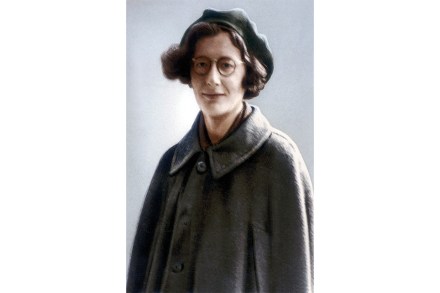
The French philosopher Simone Weil, who died of self-starvation and tuberculosis in a Kent sanitorium in 1943 at the age of 34, remains a conundrum. ‘Mais elle est folle!’ had been the spluttering response of Charles de Gaulle the previous year, during her short wartime period analysing reports for the Free French in London. Her simple brief was to précis the ideas coming in from the Resistance movement on how to reconstruct France after liberation. The result – which was posthumously published, as were most of her writings – turned out to be a major work of original philosophy, Enchainement (The Need for Roots), running to hundreds of pages, a testimony to Weil’s lifelong need to go further than anyone could ever have required into what she saw as the truth of things.

Letters from Spectator readers, October 2024

The Californication of the Democratic Party At the risk of taking a Marxian perspective, California has become exactly what could have been predicted in 1993, with the loss of its manufacturing base to the 1990s defense cuts and much of its agricultural base to environmental regulation and foreign competition under the WTO. The state’s economy is now based on some of the most unequal industries on the planet: software, entertainment and hospitality. Plus, in the case of entertainment, an industry that has always tolerated and quietly celebrated what may politely be called decadence, or less politely, degeneracy. Just look at who has all the discretionary money and how they got it, and almost everything else follows. — M.

letters

A romantic obsession: Precipice, by Robert Harris, reviewed

From our UK edition

London in the long hot summer of 1914. A city of gold sovereigns, chaperones and muffin men, but also a place where war looms, paranoia breeds and secret papers mysteriously disappear. The world that Robert Harris brings to life in Precipice is both close to that of Buchan’s The Thirty-Nine Steps and simultaneously very far away. In place of rugged heroes giving dastardly spies what for, he offers a subtle drama about the distasteful and ultimately destructive love affair between a young aristocrat, Venetia Stanley, and a man 35 years her senior who, not coincidentally, happens to be the prime minister H.H. Asquith.

Letters from Spectator readers, August 2024

Can the GOP do normal? I switched from Dem to Rep in 2014 after the disasters of the Obama presidency and the Dems’ loony hatred of the West and the US became clear. Since then I’ve not voted for the Rep nominee for president once, although I have voted for Reps down the ballot and have written in a Rep for president each cycle. I’m looking forward to the day when the GOP’s weird swooning over the orange one is over. - Thomas Nienow ‘Justice’ and the fall of a republic Great article and I hope you’re wrong.

letters

Letters from Spectator readers, July 2024

The cunning of the Democrats’ lawfare On the right flank the aristocrats of the conservative intelligentsia dominated by the likes of Max Boot, David Frum, David French, Bill Kristol and George Will would rather compromise than soil their false pride; the haughty intellectual snobs are thus perfect targets for Alinsky’s “Make the enemy live up to its own book of rules” — aristocratic intellectual elites that would rather die than support a judicial and policy juggernaut with bad table manners. As Victor Davis Hanson observed, Marquess of Queensberry Republicans would rather lose nobly than win ugly. — Adler Pfingsten Will Cherelle Parker become the next ‘America’s mayor’ in Philadelphia?

letters

Letters from Spectator readers, June 2024

The rise of reverse gaslighting Sir — To an otherwise excellent article, I have a small correction. In 1860, the Southern states did not keep Lincoln off the ballot. Unlike today, where voting ballots are printed by the states, in 1860, voters were not presented with official ballots at polling stations that allowed them to check off which candidate they were voting for. Instead, a nineteenth-century ballot or “political ticket” was a slip of paper, provided by each party, listing their candidates for whatever offices were up for election. This allowed voters to easily “vote the ticket” for their party without having to know the names of every candidate and office.

letters

‘There are an awful lot of my paintings I don’t like,’ admitted Francis Bacon

From our UK edition

In 1959, Edvard Munch’s ‘The Scream’ was hanging above the bed where Francis Bacon nursed a fractured skull after falling downstairs drunk at his framer Alfred Hecht’s house on the King’s Road. It was there to be re-framed – a circumstantial detail Mark Stevens and Annalyn Swan report neutrally, en passant, in their 2021 biography Francis Bacon: Revelations. An inadvertent cry, nay a scream, for attention? Or a frame-up? It was a decade after Bacon painted his first screaming pope, a palimpsest obviously based on Velázquez but equally in hock to Munch. Francis Bacon: A Self-Portrait in Words is an annotated compilation by Michael Peppiatt of statements, letters, studio notes and selected interviews.

Emily Dickinson was not such a recluse after all

From our UK edition

This is fanciful, I know, but I can’t help wondering about the great poetry that will surely be written in the early 2060s. Think about it: in the early 1960s, Sylvia Plath had her great creative outpouring, waking at 4 a.m. each day to work on the ‘Ariel’ poems that would make her name. Exactly 100 years earlier, Emily Dickinson was in full spate, writing 295 poems in 1863 alone. (Her total oeuvre amounts to nearly 1,800 poems, most of them unpublished during her lifetime.) The concentrated intensity with which these two women produced their best work has the quality of a natural phenomenon: a butterfly migration, or a swarm of plankton ablaze with bioluminescence. To read The Letters of Emily Dickinson is to experience this phenomenon in real-time.

Lord Byron had many faults, but writing dull letters wasn’t one of them

From our UK edition

In 1814, at the height of his fame, the poet, libertine and freedom fighter Lord Byron had his head examined. Not by a proto-psychiatrist but by the German phrenologist and physician Johann Spurzheim, who, after making a detailed study of the no doubt amused Byron’s cranium, pronounced the brain to be ‘very antithetical’ and said that it was an organ in which ‘good and evil are at perpetual war’. Two centuries after Byron’s death, this dichotomy is as pronounced as ever when it comes to analyses of the poet. His defenders point to his wit, his poetic genius, his heroic efforts in defence of Greek liberty and his personal flair; not for nothing has the word ‘Byronic’ entered the vocabulary as a largely admiring adjective.

Music was always Anthony Burgess’s first love

From our UK edition

Anthony Burgess, a professional to his finger- tips, knew how to write an arresting first sentence. The locus classicus is his opening to Earthly Powers. But try this for size, a lapel-grabbing start of a piece about William Walton in The Listener: Waking crapulous and apothaneintheloish, as I do most mornings these days, I find a little loud British gramophone music over the (a) bloody mary and (b) raspberry yoghurt helps me adjust to the daily damnation of writing. Apo-what? I have just enough Greek to know that it’s something to do with death; a helpful footnote reminds us that ‘άπο ϴανεΐν ϴέλω’, or ‘I want to die’ are the closing words of The Waste Land’s epigraph.

An insider’s account of the CCP’s stranglehold on China

From our UK edition

All families have secrets, but few family histories are classified by the state. After the death of Snow’s father, his study is cleared out by officials from the Chinese Communist party; but Snow discovers letters and unmarked hard drives hidden in hollowed-out dictionaries that they’d missed. The material reveals that her father was a high-ranking intelligence officer in the party, handpicked to build China’s intelligence service after the founding of the new People’s Republic. He’d hidden them for his family to find. Jie provides a rare insider account showing just how much the CCP knew and how much it covered up This isn’t the set-up for a new spy novel, but a true story.