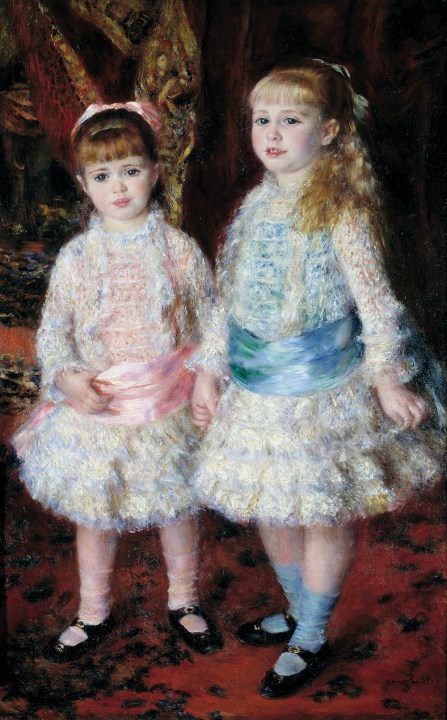
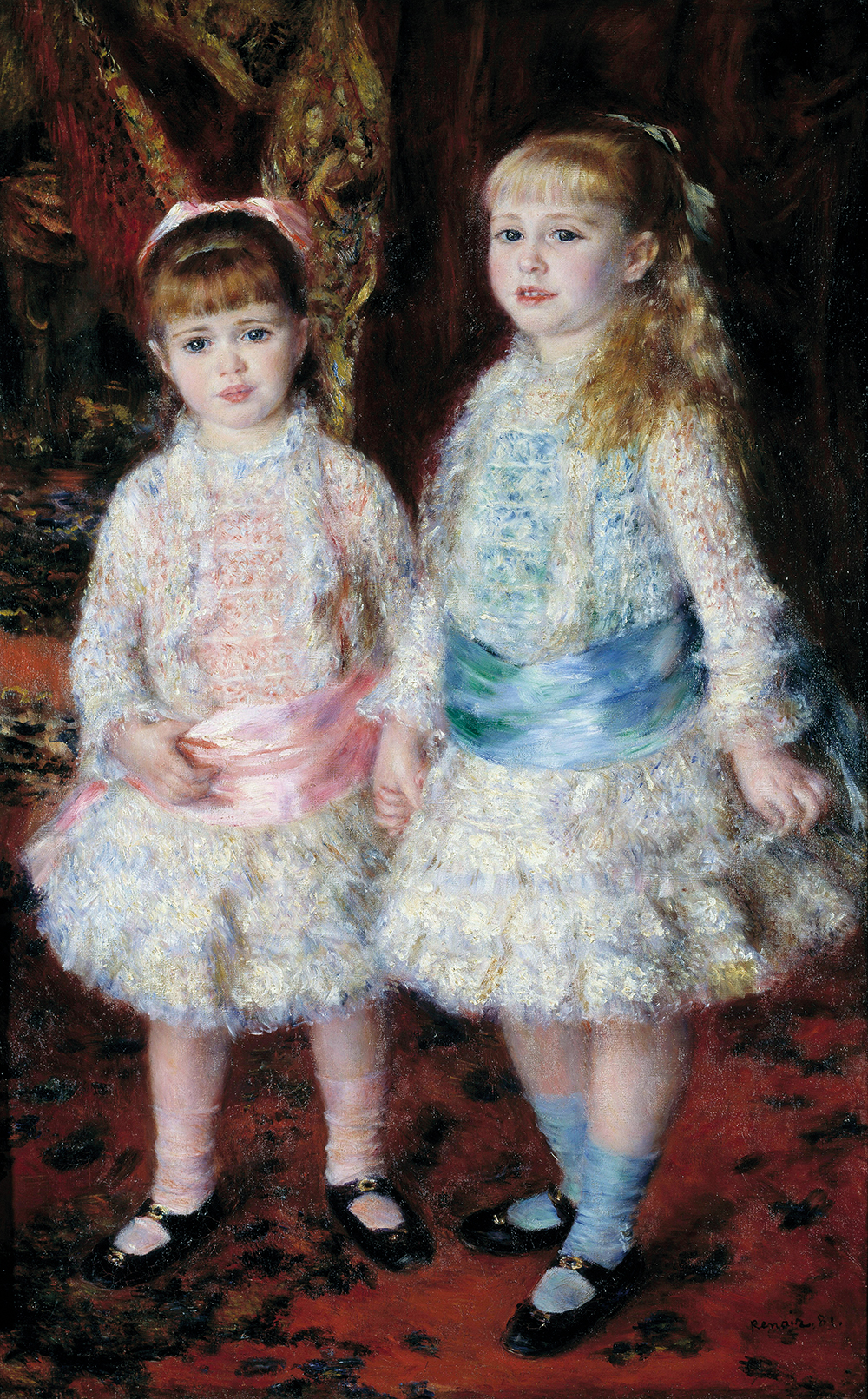
Shimmering off the cover of The Renoir Girls are sisters Alice (aged four) and Elisabeth Cahen d’Anvers (six), portrayed in all the promise and innocence of a pampered childhood by Pierre-Auguste Renoir. Aged 40, Renoir was then the coming portrait painter for the gratin of Paris, as he struggled to make ends meet with smart commissions from wealthy sponsors – a network of Catholic and Jewish banking families that included the Ephrussis (memorialised by Edmund de Waal in The Hare with Amber Eyes), Camondos, Rothschilds and Cahen d’Anvers. The gulf could hardly have been wider between the painter’s rough-hewn artisan origins and his moneyed, leisured patrons, immortalised by Proust, a frequent visitor at their dinners and soirées; and one gathers that Renoir was not overly impressed.
Could one of the girls depicted in Renoir’s painting not be a Cahen d’Anvers at all?
He quickly fades from view, however, as Catherine Ostler takes up the story of these sisters and the wider Cahen d’Anvers family, which united two European fortunes. Louis, the paterfamilias, was the scion of Ashkenazi Jews from the riverside ghetto in Bonn. They had made their way via Antwerp to Paris, ‘the capital of the 19th century’, along with the profits from their pigeon post and banking (later BNP Paribas) businesses, to which Louis’s Jewish wife Louise, a Morpurgo from Trieste, added her railway and shipping fortune. By the time Louise commissioned Renoir to paint her younger daughters in 1881 the family were fully assimilated into Parisian high society, living a whirl of a life from their magnificent hôtel particulier in the Avenue Montaigne, where Louise became one of the capital’s most glamorous salonnières.
Mysteriously, the painting languished thereafter in the servants’ hall, unloved and largely unacknowledged: why should that be? Too ‘Impressionistic’? Too ‘modern’? Or caught up in the swirl of rumours about Louise’s intimacy with her cousin Charles Ephrussi, the collector, aesthete and model for Charles Swann in À La Recherche du Temps Perdu? Could one of the girls depicted not be a Cahen d’Anvers at all?
This tantalising suggestion sets us off on a hectic journey in pursuit of the truth. The ensuing pages feel like an animated Almanach de Gotha, as we follow the beau monde from ball to salon, race to regatta, opera to fete, while love affairs and even marriages bloom and unspool between a bewildering network of distant cousins and foreign notables. We learn what they are wearing, even eating, but never alas what they feel or think; presumably there was no evidence. Marriages (if not arranged) appear to be contracted and dissolved almost at whim by young people often intent on advancement and unperturbed by emotion. Fortunately, there are four family trees and a five-page cast list to help the reader keep tabs.

In 1895, the hand grenade of the Dreyfus trial landed, sharpening the latent anti-Semitism that had been gathering among those resentful of Jewish influence and fuelled by the ravings of the journalist Edouard Drumont. It coincided with the purchase by the Cahens d’Anvers of a château once owned by Madame de Pompadour, which would seem to seal their position at the peak of society but heralded an unravelling that no fortune or privilege could stem. Then Elisabeth, aged 20, converted to Catholicism, and both sisters chose to ‘marry out’ – Elisabeth to a playboy aristocrat, whom she swiftly dumped, and Alice for love, to an engaging British soldier whom she met in north Africa, where he had been sent to relieve General Gordon at the siege of Khartoum.
Charles Townshend, for all his gallantry and decorations, was a hapless soul. The poor relation and would-be heir to Raynham Hall in Norfolk, he was always caught in the wrong battle on the wrong side of the world, his finest hour being his desperate last stand at the siege of Kut during the Great War (though he was forced to surrender).
That war did indeed bring out the mettle of the Cahens d’Anvers and they emerge as variably resourceful and courageous, qualities that would be much needed in the coming decades as the noose tightened. The whole glossy edifice came tumbling down, and a desperate cat-and-mouse game ensued to evade at all costs the moniker of Jew. Alice escaped the Nazis and lived on until 1965, ending her days, as Renoir had done nearly 50 years earlier, in Cagnes-sur-Mer. An older sister, Irène, also painted by Renoir, survived, too, though was forever accused of collaboration. Elisabeth was sheltered in la France profonde by her former chauffeur and his wife, but was betrayed in 1944. Crippled by rheumatoid arthritis, she was transported to Auschwitz, and may have died along the way.
The final reveal – which makes one gasp – only underlines the artifice of the world Ostler has portrayed, where almost limitless wealth, privilege and familial connections proved in the end no match for the overwhelming evil of anti-Semitism.




Comments