Paris

France is throwing a tantrum at Trump

France is intensifying its counter-offensive against what it calls misinformation. Earlier this month, Paris prosecutors confirmed they have opened a criminal investigation into Elon Musk and X. Musk had ignored a summons to appear for a voluntary interview on April 20. The French state requested Musk assist in an investigation into algorithmic manipulation and the spread of AI deepfakes on X. Musk responded to the criminal investigation by labeling the prosecutors “faker than a chocolate euro and queerer than a pink flamingo in a neon tutu!” On the same day, Paris unveiled its “French Response” strategy. The head of the Ministry of Foreign Affairs, Jean-Noël Barrot, posted a video on X (where else?

France misinformation

‘Invalid’ has become invalid

“They should ask me. I’m a complete cripple,” said my husband, heaving himself from his chair with great determination to reach the whisky. Britain’s Department for Transport is asking disabled people whether the term invalid carriage in legislation should be changed and what term they might prefer was used instead. “Language has moved on and changed,” the UK government says, since 1970, when the legislation was first drafted. One problem is having to keep changing terminology. No one, even my husband, should be called a cripple. No one should be called handicapped. Now it has been decreed that no one should be called disabled, but rather a person with a disability. These changes are paralleled in the languages across Europe.

invalid

Yes, Europe’s civilization is being erased

Last week the Trump administration expressed its fear that Europe faces "civilizational erasure." Its concern was articulated in a 33-page National Security Strategy that outlined Donald Trump’s world view and how America will respond economically and militarily. The sentence that caused the most reaction on the other side of the pond was the assertion that, if current trends continue, Europe will be "unrecognizable in 20 years or less." Those trends are mass immigration and what conservative French commentators call the "Islamification" of Europe. If Europe doesn’t address these trends, the Trump administration predicts the continent’s "civilizational erasure.

Are America’s women heading for the exit?

Life is apparently so disagreeable in Donald Trump’s America that 40 percent of women aged between 15 and 44 want to leave. That is four times higher than the 10 percent who wanted to quit the US in 2014. According to Gallup, which conducted the poll, nearly half the nation’s younger women have “lost faith in America’s institutions.” This disenchantment accelerated after the Supreme Court’s 2022 decision to overturn Roe v. Wade, which enshrined the constitutional right to abortion. Younger American men are bearing up better. Only 19 percent share women’s distaste for the Donald, a 21 percent differential which is the largest recorded by Gallup since it began asking the question in 2007.

Women
Surrealism

Reconciling dreams with reality

Should you be waiting in line at the Philadelphia Museum of Art to see the exhibition Dreamworld: Surrealism at 100, don’t be put off by “Tête” (1974), a sculpture by Joan Miró that is big and ugly and plopped down directly at the entrance. Be aware that Miró’s true métier was painting; “Tête” was cranked out long past his prime. You can’t blame an old man for cashing in on his reputation, particularly when his formative years were burdened by poverty. You can blame a curator for including a flagrant piece of product as a how-do-you-do to a centennial celebration.

Monet

Monet’s Venetian moment

If you crave art that will envelop you, book a ticket, pronto, to Monet and Venice at the Brooklyn Museum. Enveloppe was the term the French impressionist artist Claude Monet (1840-1926) used to describe the “beauty of the air around” the objects and landscapes he painted. “Other painters paint a bridge, a house, a boat… I want to paint the air in which the bridge, the house, and the boat are to be found – the beauty of the air around them, and that is nothing less than the impossible,” he said.

Is this the end of the French croissant?

Occasionally, a French person reveals – without any malice or superciliousness – that they run on an alternative operating system from us Brits. And on an entirely different motherboard from our American cousins. Over the years of gathering supporting anecdotes, a surprising theme has emerged: butter. Take my first visit to Paris, more than 30 years ago. I innocently asked for butter with my croissant. Simple answer: “Non.” Naturally, I remonstrated. The waiter retorted: “A croissant eeez butter!” And, in fairness, he had a point. Upon biting into said viennoiserie, I had to concede: it was nothing like the dry grocery store versions I was used to. Moments later, a small pot of raspberry confiture was graciously placed on my table.

croissants

Did the Louvre robbers want to get caught?

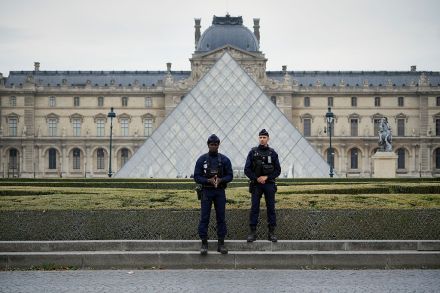
It is more than a month since thieves stole the crown jewels from the Louvre and the chances of recovering the loot, worth an estimated €88 million, diminish with every passing day. The robbery was initially dubbed the “heist of the century,” a brazen theft in broad daylight as visitors strolled through the world’s most famous museum. There were up and down the ladder and in out of the museum in seven minutes, giving the impression that this was the work of villains well-versed in daring robberies. But soon details emerged that suggested the gang of four weren’t quite of the caliber of the thieves immortalized in the Hollywood movie Ocean’s Eleven.

Is DEI to blame for the Louvre heist?

Police in Paris have arrested two men after the "heist of the century" at the Louvre museum. According to the French press, the pair were arrested separately as they prepared to leave the country on Saturday evening; both are in their 30s and from Seine-Saint-Denis, the sprawling suburb north of Paris. As yet there is no indication that police have recovered any of the crown jewels that were stolen from the museum in seven sensational minutes last Sunday. The search for them and the two other gang members goes on. The 88 million euros ($102m) heist has been deeply embarrassing for France, and the fact that those responsible appear to be local villains as opposed to the international criminal masterminds that some had suggested will only further redden the Republic's face.

Laurence des Cars

What is Charles Kushner doing in Paris?

When Charles Kushner took up his appointment as American ambassador to France this summer, his first official visit was to the Shoah Memorial in Paris. As a child of Holocaust survivors, he tweeted, “fighting anti-Semitism will be at the heart of my mission.” So it has proved. Last month, Kushner published a letter in the Wall Street Journal in which he accused Emmanuel Macron of insufficient action in the face of soaring anti-Semitism in the Republic. The ambassador was summoned for a dressing down. He didn’t attend as he was on vacation Kushner also castigated the French President for his imminent recognition of Palestinian statehood.

Kushner

How to café hop like a Parisian

You will be familiar with the 1930s line, “Whenever I hear the word culture, I reach for my gun.” Whenever I hear the word culture I reach for the nearest restaurant. Culture makes me hungry and there is no better place to post-mortemize the latest exhibition or concert than from a comfortable seat in a local joint. For 19th-century progressives, railway stations were the most in-your-face examples of a new and better world. “The railway station is the highest monumental and artistic expression of the industrial and commercial genius which so specially characterizes the era in which we live,” César Daly proclaimed in 1861.

Café

The last bullfighters

In May of last year, at the Saturday corrida of the Feria de Pentecôte in Nîmes – “no hay billetes” – I had the traveler’s luck to find myself seated next to the son of one of the late, great French toreros of the 1970s. We were seated high in the Arènes de Nîmes, the city’s Roman amphitheater completed around 100 years after the Crucifixion – a structure far superior in function and beauty to Rome’s defunct and messily eviscerated Colosseum. In Nîmes, as in neighboring Arles, the French have triumphed over the Fall of Rome in restoring these structures to something of their original purpose: hosting feats of gladiatorial courage tamed by a strict protocol. But that inheritance has once more been threatened by legislation that contests its place in the Fifth Republic.

bullfighting

Could the French Revolution have been avoided?

In the middle of the 18th century, on the north side of the Palais Royal gardens in Paris, there stood a magnificent chestnut tree called the Tree of Cracow. In his presidential address to the American Historical Association in 2000, Robert Darnton explained that the name Cracow probably derived from the heated debates that took place in Paris during the War of the Polish Succession, but also from the French verb craquer: to tell dubious stories. News-mongers or nouvellistes de bouche, agents for foreign diplomats and curious members of the public gathered round the tree, which was at the heart of Paris’s news network, a nerve center for transmitting information, gossip and rumors.

Darnton

The Caviar Kaspia experience

It’s been almost 100 years since Arcady Fixon, a refugee from the Russian Revolution, opened the doors of Caviar Kaspia on Place de la Madeleine in Paris, and began beguiling his fellow exiles and the crème of Paris society with the exotic flavors of his homeland: shiny black caviar, served with blinis or potatoes, and ice-cold vodka. After being passed down through family hands, Caviar Kaspia is now owned by the charismatic entrepreneur Ramon Mac-Crohon, who has ensured that the place has lost nothing of its prerevolutionary charm: Nicolas II’s seal sits alongside antique porcelain in a display cabinet, and Nicolas Swertschkoff’s Troika, depicting a Russian horse-drawn sledge moving through snow, still hangs in the dining room.

Is Paris the world’s most bookish city?

After I ventured to New York in May 2024, bound for a discerning literary journey round the city’s bookshops, libraries and hotels, I received some lively and constructive feedback from Spectator readers. Many, thankfully, agreed with my arguments about its bookish charms, but a consistent theme in the comments I received was, “How can you claim that New York is the quintessential literary city? Have you forgotten Paris?” To which my reply was reasonably simple: “What about Oxford, London, Rome, Edinburgh, Dublin, Santiago or San Francisco?” All of them hugely distinguished citadels of the written word, both present and historic alike. Yet I felt uneasy at my response.

Paris

The life and legacy of Mavis Gallant, an American in Paris

"God help the English if she ever starts on us,” remarked Jonathan Keates in a blurb for Mavis Gallant’s Paris Notebooks. Far from being the ubiquitous “love letter” to a city, the essays and reviews within revealed people and their lives as they were, not as ideals. What Keates didn’t realize was that in Gallant’s short stories, everyone, regardless of nationality or gender, was fair game for her sometimes vicious, often dryly funny, always unblinking gaze. When she died in 2014, aged ninety-one, an obituary noted her profound irritation at her critics’ focus on The Collected Stories of Mavis Gallant: “Everyone who has reviewed it so far mentions exile.

Gallant
Paris

Catching my breath in Paris

September felt like a long month — and I needed to escape London. The Spectator had just been sold — and while the transition from one editor to another brought excitement, it was also exhausting for everyone. Paris felt like the perfect retreat. And of course, the Eurostar is the fastest — and most enjoyable — way to get there from London. A friend of mine lives near the Gare du Nord, and as she was in London for a night, I borrowed her keys, jumped on the train and arrived in Paris as evening fell. Alone and hungry, I made my way to Les Deux Gares, a stylish hotel nestled between Gare du Nord and Gare de l’Est. Designed by Luke Edward Hall, whose aesthetic is unmistakably English, the restaurant inside is quintessentially French — and superb.

Everything is under (crowd) control: the evolution of riot response

Worldwide unrest is great for those in the riot-gear business. Shields and batons have historically cornered the market as the cutting edge in crowd control, but in recent years it’s evolved to include robots, armored trucks and drones. Milipol Paris is the homeland security expo of all expos. This is the kind of giant showroom where you will find law enforcement and private security agents checking out the newest innovations in robot dogs, armored vehicles and unmanned turrets as if they’re going from painting to painting at the Louvre. The Milipol expo comes around every two years. In 2023, you would have seen men plugged into VR headsets killing terrorists with a pistol.

crowd

This month in culture: July 2024

The Bear, season three Hulu, June 27 America loves a misanthropic, depressive chef. How else would we know the chef is a real artist? The Bear returns for its third season with the trailer promising lots of arguing, screw-ups, failures and everything else you’ve come to expect from the beloved show. We’re not sure why you would take a perfectly good beef-sandwich shop in Chicago and try to turn it into a Michelin-starred restaurant, but we hope Carmy and the gang give us some sort of good reason. — Zack Christenson Jeremy Allen White in The Bear Wimbledon ESPN and ABC, July 1 You know summer has arrived when the brilliant green grass of the All-England Lawn Tennis and Croquet Club lights up your screens.

culture
Paris

Paris: a gold-medal minibreak

As the Olympic Games descend on the French capital this July, the contest that really matters for this sports-shy travel writer is where to stay. From historic heavyweights to new contenders, these Parisian properties stand head and shoulders above the rest. Best for wellness: Shangri-La Paris The cool marble interiors of Shangri-La’s Parisian outpost feel a world away from the tumult of the Champs-Élysées (in fact, it’s only a fifteen-minute walk). If the Grecian frescoes, silk wallpaper and sweeping, gilded staircase all seem distinctly regal that’s because the nineteenth-century building was originally the pied-à-terre of Prince Roland Bonaparte, Napoleon’s great-nephew.