Culture

Culture

The good, the bad and the ugly in books, exhibitions, cinema, TV, dance, music, podcasts and theatre.

Lily Allen: No Shame

More from Arts

Grade: B+ Here we go again, then, I thought — another gobbet of self-referential, breast-beating respec’ me bro sputum against a backdrop of the usual overproduced r&b pop schlock. What used to be called ‘indie’ singer-songwriters are always moaning about how utterly useless they are, taking Radiohead’s ‘Creep’ as a kind of self-flagellating worldview. Chart singer-songwriters, meanwhile, can’t stop telling everyone how absolutely bloody marvellous they are, despite being traduced, which fits right in with the extraordinary narcissism of our current youth culture, its bovine #MeToo grandstanding and exquisite sensitivities. I don’t mind Allen, despite her irritating sub-adolescent Corbynista politics.

d/Deaf and dumb

Music

All my life I’ve wanted to compose music, and now I’ve done it. I’ve written a sonata for solo flute that boasts two highly original features; it’s five hours long and must be performed by a badger. Though it took me only five minutes to write, my opus one is guaranteed to get through to the second round of the next competition for new composers sponsored by Sheffield University and the Centre for New Music. That’s because they operate a ‘two ticks’ policy, as the Scottish pianist Philip Sharp — possibly the only classical musician in Britain who calls himself a classical liberal — revealed in his blog earlier this year.

Mad about the girl

Music

Imagine living Taylor Swift’s life. She has been staggeringly, life-dominatingly famous since she was 17. Not for a single moment in her entire adulthood (she’s now 28) has she been able to do any of the everyday things the rest of us take for granted. No wonder, then, that so much of what surrounds her seems so peculiar. No wonder her last two albums (2014’s fabulous 1989, last year’s rather less fabulous Reputation) have been dominated by songs about how other people perceive her life: every thing she does, as she is well aware, goes through a filter. She sings not about her love life — her relationships with the actors Tom Hiddleston and Joe Alwyn, the DJ Calvin Harris —but about how her love life is reported.

Playing dirty?

Music

A young Korean, 22 years old, won the Dublin International Piano Competition last month. Nothing unusual about that. Koreans and Chinese, raised in a school of hard knocks and rounded off in western conservatories, are winning most prizes. A few — like the phenomenal Lauren Zhang who made child’s play of Prokofiev’s second piano concerto in the BBC Young Musician of the Year — are prodigious talents with bright futures ahead. Dublin’s winner Sae Yoon Chon is probably not one of them. His Prokofiev, an effortful shadow of Zhang’s electrification, trundled along at pedestrian pace with one or two stumbles. I was therefore surprised to see that Chon won. I also noticed that he is a student of the jury chairman.

Father John Misty: God’s Favourite Customer

More from Arts

Grade: A+ While the young bands plunder the 1980s for every last gobbet of tinny synth and hi-hat, the singer-songwriters remain happily anchored in that much more agreeable decade which came directly before. The 1970s was the era of the introspective, self-pitying, prolix, hairy and winsome singer-songwriter — both the good ones (Young, Martyn, Buckley) and the, ahem, less gifted (Taylor, Forbert, Stevens). Father John Misty, aka Joshua Tillman and once the drummer in the most boring and epicene band I have ever seen (Fleet Foxes), is all of those adjectives I mention above. On this album the production values are purloined from mid-1975, right down to the occasional spasm of glam guitar, the tasteful piano, the strummed acoustic, the strings.

The big chill | 7 June 2018

Music

The picnic hamper’s open, the bubbly is chilled, and country house opera is starting to eat itself. When you arrive at the Wormsley Estate you enter a fantastic, baffling world. Figures in black tie stroll between topiary hedges in obedience to unstated rules, while serving staff hover a few paces behind, gliding silently in to reassert neatness and order. Children dressed in red (they’re from a local Scout group) pop up to help and guide. Then the new production of Die Zauberflöte begins and with a deft, surreal spin, the director Netia Jones bowls it all straight back at you. That’s a big part of the fun here. Jones has designed the production herself, and she clearly has quite a DVD collection.

Trivial pursuits | 7 June 2018

Music

‘Is there an end [to this opera] that is not trivial?’ asks the Countess in her final bars of Richard Strauss’s last opera Capriccio. Given the previous two and a half hours, the answer would seem to be a decided no. It is a frothy confection even by the standards of his later operas, the better parts reminiscent of the Prologue to Ariadne auf Naxos and some of Arabella. One thing to be said in its defence is that Strauss’s writing it in 1941–2 is no criticism of him or of the work. People make a fuss about that, but do they think he should have produced an heroic piece — something he had already done, unfortunately — or another work in favour of peace, like the disastrous Friedenstag of 1938?

Chvrches: Love Is Dead

More from Arts

Grade: B Another load of SJW moppets keening over 1980s synths. ‘It only takes two seconds to say: I don’t agree with white supremacy,’ they told the Guardian. Chvrches, a Scottish trio relocated to New York, are led by the elfin and relentlessly concerned Lauren Mayberry. The Eurythmics fronted by Owen Jones, then, kind of. Just what you wanted, isn’t it? Chvrches have never had a hit but they do have a presence and reputation, acquired through endless gigging. They haven’t had a hit because their songs are not very good, if we’re honest. With this new album they have tried very hard indeed to change that by bringing in shiny producers and delivering a set that sounds, at times, like the most witless Europop (especially on ‘My Enemy’).

The lost boys

Music

One by one, cathedrals have succumbed to the inevitable. In blazes of publicity, with front-page photographs of girls in cassocks in the cloisters, most deans and chapters have signalled their drive for equality of opportunity by inaugurating a girls’ choir to run alongside the boys’ one. So now, at the vast majority of our cathedrals, instead of boys singing up to eight services per week, the two top lines take turns, in varying ratios, with girls aged from eight to 18. The scheme has been working for 27 years, since Salisbury started the trend in 1991, and let me say from the outset: some of the girls’ top lines are extremely good and the boys’ top lines have adapted pretty well to the enforced job share.

War on waste

Music

No wonder we have a problem with classical music in this country. The week started in celebration. The stats are in and it turns out that Radio 3’s breakfast show has enjoyed a rise of some 64,000 listeners — a not-to-be-sniffed-at11 per cent increase on last year. Meanwhile Classic FM’s listenership is also up significantly, including a startling 43 per cent rise in under-25s. Champagne (or perhaps something a little less effervescently elitist) all round. Why are all these new people tuning in? Musical diversity, apparently. That and a preference for music over chat, for radio that offers an escape from the emphatic, combative everyday of John Humphrys and his ilk over on Radio 4. Escape. Retreat.

Arctic Monkeys: Tranquility Base Hotel & Casino

More from Arts

Grade: B+ Oh, terrific — a concept album about a 1970s hotel somewhere in space, plus an attack on our over-technologised world. Just what I wanted. There is no restraint on self-indulgence if you have a sufficiently remunerative back catalogue. This is also a Bowie tribute album, which fits in nicely with all that outer-space business. I have never heard any performer clamber so comprehensively into the skin of a dead rock star as Alex Turner does with Bowie here, in the writing and even more so in the mannered singing with its characteristic falsetto swoops. This is pure Bowie from the era between The Spiders of Mars and David Live, and especially Aladdin Sane.

Natural selection | 17 May 2018

Music

‘All fish in flood and fowl of flight/ Be mirthful now and make melody’ writes the poet William Dunbar in the verses that Sir Charles Hubert Parry set to music as Ode on the Nativity. In David Matthews’s new Ninth Symphony, one particular fowl does exactly that. The symphony’s central movement begins on strings: an idyll of grey skies and shivering leaves. Matthews gradually introduces blocks of woodwind and brass, including a heavily stylised burst of birdsong.

Why this deluded affection for the Palestinians?

Columns

The worst entry for this year’s Euro-vision song contest was that vast cater-wauling aboriginal. I can’t remember her name, only that her performance convinced me still further that Australia might not, technically, be a part of Europe. But then I was a little worried by the winner too. The song ‘Toy’, sung by Israel’s Netta Barzilai, was easily the most musically imaginative in the contest and so probably deserved its victory. But the lyrics were the usual deluded, self-aggrandising victimhood rot. ‘I am a beautiful creature,’ she sang, despite fairly compelling evidence to the contrary, right there in front of our eyes.

Hype and anti-hype

Music

Apparently it’s called ‘expectation management’. Pollux, Esa-Pekka Salonen’s new work for the Los Angeles Philharmonic Orchestra, takes its name from Greek myth. But as Salonen explains in his programme note, there’s more: lots more. It’s intended to form a diptych with a second piece called (naturally enough) Castor. It’s also part-inspired by Rilke’s Sonnets to Orpheus, and an image (Salonen compares it to Salvador Dali) of a tree growing out of an ear. And finally there’s a ‘mantra rhythm’, which Salonen heard played by a post-grunge band ‘during dinner in a restaurant in the 11th arrondissement of Paris’, which all sounds very civilised.

Belly: Dove

More from Arts

Grade: B+ One of my favourite songs from the 1990s was about a Chinese adulteress forced to walk around town with a decomposing dead dog on her back. ‘Slow Dog’, from Belly’s debut album Star, was mental and frenetic and possessed the kind of berserk and glorious chorus most bands would kill for. The rest of the album wasn’t bad either — the sincerely odd ‘Gepetto’ and the lowering, nagging almost-hit ‘Feed The Tree’ the best of a very good bunch. How would you define Tanya Donelly’s oeuvre, other than as delightfully idiosyncratic? Alt-rock, obvs. Maybe neo-psychedelic post-grunge shoegazey power pop. Either way, it was too good to last.

Hot and seedy

Music

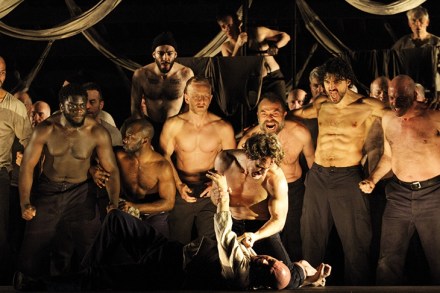
Salome is my favourite opera by Richard Strauss, the only one where there is no danger, at any point, of his lapsing into good taste, which there is to some degree in all his other operas, even if only momentarily. With Salome, from the opening quiet clarinet slithering upwards, and the luckless young Syrian Narraboth, later in the work to stab himself to death without anyone noticing, remarking for the first of many times how beautiful the princess Salome is tonight, we know we are in for a mischievous orgy of lust and violence. The work’s chromaticism isn’t used to make particular expressive points but to create and sustain an atmosphere so hot and seedy that we are prepared for anything to happen.

By ’eck, petal, it’s gorgeous

Music

The opening of Mark Simpson’s new Cello Concerto is pure Hollywood. A fanfare in the low brass, an upwards rush and suddenly the screen floods with lush orchestral sound — as confident in its onward sweep as Star Wars or ‘Tara’s Theme’. Waiting, poised, in the middle of it all was the soloist Leonard Elschenbroich, for whom Simpson has said that he wanted to write a concerto that celebrated the cello’s ‘expressive and lyrical force’. He has, too. From the instant Elschenbroich entered, it felt right. The cello soared over a chiming marimba, like in Walton’s Cello Concerto. It lingered over its farewells, like in Elgar’s.

Kylie Minogue: Golden

More from Arts

Grade: D– Kylie has a place in my heart for having made the second-best single to feature the chorus ‘na na na na na na na na’. The best was Cozy Powell’s ‘Na Na Na’ (all the better for being capitalised), but Kylie’s magnificently vacant synth pop disco lament ‘Can’t Get You Out of My Head’, written by the ubiquitous Cathy Dennis, ran it close. Everything else the pouting Aussie sockpuppet chanteuse has done has been utterly excremental, so credit to the lass for maintaining a certain consistency with her latest album Golden. It has received half-decent reviews in some quarters, but only, I suspect, from people who have either had their frontal lobes removed with a soupspoon or areso jaded they have forgotten up from down.

Bringing in the trash

Music

Imagine the National inviting RuPaul to play Hamlet. Or Tate giving Beryl Cook a retrospective. The London Sinfonietta offered a similar cocktail of mischief and insanity in devoting the opening concert of its return to the Queen Elizabeth Hall, after a three-year refurbishment, to the nihilistic drag act David Hoyle. It had me grinning from ear to ear. Mostly from watching the other critics squirm. The woman next to me, an off-duty member of the Sinfonietta, was spitting words into her hand: ‘Patronising bollocks’. It was one of those nights. Half the audience stony-faced and tensed with anger. The other half creased double and whooping.

Mozart’s diminuendo?

Music

Glenn Gould used to say that Mozart died too late rather than too early. The remark was intended to get up the nose of Mozart-lovers and it succeeded. What a nerve, coming from a pianist whose own reputation peaked in his early 20s, with his first Goldbergs, and was especially tarnished by his Mozart piano sonatas, which he butchered in order to demonstrate their supposed faults. But still... Gould wasn’t the first person to wonder if there was a slight diminuendo in Mozart’s creativity in the couple of years before he died in 1791 at the age of 35. The last concerto, for clarinet, has a wistful, naive perfection that doesn’t fire up the neural pathways to the same extent as say, the C minor Piano Concerto of 1786.

Composers should be incensed that their music is taking a back seat to their race or gender

The slow but certain conquest of all public life by those promulgating the politics of identity has achieved a new victory in the realm of classical music. Cloaked in claims of benevolence and good intent, it arrives as a divisive force, screaming equality but in reality delivering nothing of the sort. Much of our public discourse is focused on identity politics. Our news cycle is replete with tales of gender pay-gaps, unmet inclusivity quotas and the great struggle for the elusive goal that is equality, so perhaps it should come as no surprise that we now find these issues played out in the classical music industry. The dark heart of all this is to be found in the (sadly) niche area of contemporary classical music.

The sound of Iceland

Music

The lur is a horn, modelled in bronze after a number of 3,000-year-old instruments discovered at various archaeological sites across Scandinavia. Its unrefined yet distinctive sound — penetrating, direct and rough-edged — seems to rise up through the body rather than enter through the ears, like the stirring of a long-forgotten memory. The instrument, whose long neck reaches high above the heads of its players, is the first thing one hears in Jon Leifs’s second Edda oratorio. Two of them intone bare, open fifths, resonating against sustained low notes in the woodwind, rising up through the orchestral texture as it fills out. When the choir enters, they too sing in fifths, lurching from one bare harmony to another, incanting the coming of the Aesir, the Norse Gods.

Judas Priest: Firepower

More from Arts

They’re still alive, then. Chuggedy-chug, grawk, screech screech, chuggedy-chug. First mention of demons — line one, song two. Song one is about blowing people to bits with firepower, cos they’re really EVIL. There are spurts of lead guitar that sound like knives slashing at an empty plate and those strange, pompous, strangulated vocals — operatic diva meets Freddy Krueger — common to most UK heavy metal. Anything to hide the Brummie accent, I suppose. Thank you, the West Midlands, for foisting on the world the blind alley of HM, blues with the rhythm, wit and soul replaced by volume and bellowing and posturing and almost continual references to the poor fucking devil (who clearly didn’t get all the best songs).

The last radical

Music

A spectre haunted the first weekend of the City of Birmingham Symphony Orchestra’s Debussy Festival: the spectre of Richard Wagner. Debussy’s relationship with Wagner began with infatuation, and ended (as so often) in open rebellion. The young decadent who declared Parsifal ‘one of the loveliest monuments of sound ever raised to the serene glory of music’ later ranted that ‘30 million Boches cannot destroy French thought’ even while, tormented by cancer, he laboured to complete three late sonatas of near-infinite subtlety and grace. But there’s always the sense, as Debussy put it as early as 1890, that ‘I don’t see what can be done beyond Tristan’.

Evensong

Notes on...

When Palestrina wrote his Mass settings and motets, or J.S. Bach his cantatas and passions, they could not have imagined the ways in which their music would be heard today. We can now access sacred music in our living rooms, at work and on the commute: an hour-long compilation of the choir of New College, Oxford performing the Agnus Dei has four-and-a-half million views on YouTube. Spotify and smartphones may eliminate the need to visit a church or chapel to hear these works, but visit we still do. While overall church attendance has fallen by two-thirds since the 1960s, attendance at traditional choral worship in the UK is on the rise, and has been for the past two decades.

Vince Staples

More from Arts

Grade: B+ Another ex-Long Beach crip replanted in pleasant Orange County via the conduit of very large amounts of record company money and thus now able to draw on his time as a gangsta, while telling us all it was a very naughty thing to have done. The difference between Staples and much of the similarly uprooted West Coast hip-hop crew is twofold. First, off-stage the man is thoughtful, articulate and refuses to hunker down beneath the comfort blanket of black victimhood. Further, he eschews all drugs and alcohol and loathes the glorification of gang culture — something he calls coonery — and is a Christian. (Although it is hard to imagine Jesus Christ cheerfully singing along with this little number.) And second, he has words.

The making of the Moody Blues

Music

Rarely has one irate punter so affected a band’s trajectory. Without the anger of the man who went to see the Moody Blues at the Fiesta Club in Stockton in 1966, the band would never have reinvented themselves, never have transformed into psychedelic pioneers, and next month they would not be travelling to America to be inducted into the Rock and Roll Hall of Fame, the honour bestowed annually upon those the US music business deems the most significant artists of all. The Moody Blues had been a moderately successful group — everyone who has ever listened to an oldies radio station knows their version of ‘Go Now’, a No. 1 single in 1964 — but by 1966 they were on the skids.

Bat squeaks and red herrings

Music

Blue Gadoo is one of those cats whose face looks like it’s been bashed flat with a wok. He lives in New York, apparently, and his bulging eyes goggle out from Gerald Barry’s programme note for his new Organ Concerto. Check him out: the Guardian published the full note a day before the performance, which is only right because a Gerald Barry world première really ought to be national news. ‘I saw a photograph of him with a book called Sex and the Sacred in Wagner’s Tristan und Isolde,’ explains Barry. ‘By his expression I knew he was mourning the loss of atonality.’ There’s heaps more like that.

Gallic pieties

Music

My two attempts to see Poulenc’s Dialogues des Carmélites at the Guildhall School were frustrated by the weather. Forced back on to my DVDs and CDs — vinyl, even — I took the opportunity to survey some of the manifestations and investigations of religious feeling in 20th-century French music. I began with Vincent d’Indy’s Fervaal, an opera he composed in 1895 which used to be referred to as ‘the French Parsifal’. Refreshing my memory of the plot by looking it up in The New Grove Dictionary of Opera, I was struck by the writer’s insistence that, while the work is heavily influenced by Wagner, ‘[d’Indy] had a better sense of dramatic pacing than Wagner, and more essential humanity’.