Culture

Culture

The good, the bad and the ugly in books, exhibitions, cinema, TV, dance, music, podcasts and theatre.

Nils Frahm: All Melody

More from Arts

Grade: A Here we are in that twilit zone where post-techno and post-ambient meets modern classical, a terrain that has its fair share of tuneless charlatans and chancers. Frahm is not one of those. There are of course the repetitive synthesiser arpeggios familiar to anyone who has had the misfortune to sit in some achingly hip Dalston café: slightly too many for my liking on ‘#2’, which Frahm may consider the centrepiece of this album. But the German is obsessively attuned to nuance. Beneath those Glass-like riffs there is plenty going on: descant melodies, counterpoints burbling up out of the ether.

Spectator competition winners: Sonnets as the Beatles (or Abba) might have written them

The invitation to take a song by Abba or the Beatles and rewrite the lyrics as a sonnet went down a storm and drew a large, clever and funny entry. John Lennon once said, in an interview with Rolling Stone magazine: ‘…that’s been my hang-up, you know— continually trying to be Shakespeare…’. So perhaps it’s not surprising that the overwhelming majority of you plumped for Beatles tunes as your starting point. Having said that, Paul McCartney’s raucous ‘Why Don’t We Do It In The Road?’ — in which he pretty much repeats the same line (the title) over and over again — wasn’t the most obvious choice, so props to Edward Graham, who managed to tease a creditable sonnet out of it. We needn’t be ashamed.

Barometer | 1 March 2018

Barometer

Ageing rockers The Rolling Stones announced their first live shows for five years. Mick Jagger, Keith Richards (both 74), Charlie Watts (76) and Ronnie Wood (70) are not alone rocking on into their eighth decades. Other septuagenarians you can hear live in 2018: — Elton John (70) unveiled a farewell tour. Paul Simon (76) says that four concerts in the US this year will be his last. — Bob Dylan (76) announced 15 European concerts. — Rod Stewart (73) has six live shows booked for Las Vegas. — The Who’s surviving members Roger Daltrey (73) and Pete Townshend (72) will be playing 18 dates in 2018, quite possibly belting out Townshend’s famous line: ‘Hope I die before I get old.

Sound judgment

Music

I’m unlucky with Beethoven’s Appassionata Sonata. Twice in the past year I’ve bolted for the exit as soon the pianist crossed the finishing line. The first performance was phoned in to the Royal Festival Hall by a washed-out Maurizio Pollini. The second was musical chloroform, so dreary that it would be cruel to name the perpetrator. Cruel but fair, since I paid 30 quid for the ticket: Piers Lane. Fortunately he’d programmed it before the interval. By the time he’d moved on to Chopin I was back home listening to an Appassionata from another planet — simultaneously thoughtful and daring, the finale taken at such a perilous speed that it’s a miracle it didn’t come off the rails. The venue was Carnegie Hall, the year 1960.

Franz Ferdinand: Always Ascending

More from Arts

Grade: A Yay, people with a modicum of wit. They come along so very rarely these days. A decade on and that punky, guitar-driven power-pop funk has long since been expunged. Singer Alex Kapranos expressed a wish for Franz Ferdinand to reinvent themselves — and has turned to the same source inspiration as did their recent collaborators Sparks when they, too, needed a swift reboot at the end of the 1970s: Giorgio Moroder. But Kapranos and co. have laced those metronomic German beats with camp glamour and swirling, unpredictable melodies — and, of course, the frequent touch of Bowie. This is a disco-pop album.

MGMT: Little Dark Age

More from Arts

Grade: B Horrific memory, flooding back, halfway through the track ‘TSLAMP’ (Time Spent Looking at My Phone). It was the nastily burbling bass guitar that did it. I had been wondering what I was listening to and then it dawned — a Level 42 tribute band. Naffer than T’Pau. Whitey does bland, tuneless funk. And this from a duo who were once so effortlessly cool. But then the rest of the album similarly pillages that godawful decade: ‘One Thing Left To Try’, which is at least tuneful, brings to mind Tears for Fears. Elsewhere it’s Japan, the Human League and A Flock of Seagulls. Why do you like the 1980s so much, you sweet and tender young lefties? It was eight years of Reagan and one of Bush Snr. Really you should hate them.

No sense of direction

Music

The new production of Bizet’s Carmen at the Royal Opera has received mixed reviews. It shouldn’t have done. They should have been unmitigatedly hostile, indignant, outraged — except that all those reactions would almost certainly have delighted the director, Barrie Kosky. What might please him less is the accusation of tedium, of making what often seems an unsinkable work into a colossal bore. This Carmen lasts for three-and-a-half hours and feels as long as that after the first 20 minutes. The whole and only set is a stage-wide flight of 16 steep stairs, up and down which the cast has to run at frightening speeds. As Jakub Hrusa, the conductor, dashed into the opening bars, hectic rather than brilliant, one wondered what might be added on-stage.

Justin Timberlake: Man of the Woods

More from Arts

Grade: B– Hey, here comes Justin, the ‘President of Pop’ and ‘one of the greatest all-around entertainers in the history of show business’, according to the Hollywood Reporter. Sheesh, shows how far a white man can go by pretending — pretending very, very hard — to be black. Maybe there’s a market in the States for the black and white minstrels after all. ‘Off to Alabamy with a banjo on ma knee’, etc. It’s at times like these I’m with the SJW kids on the subject of cultural appropriation — but only because I can’t stand this tripe. This is Timberlake’s first album in almost five years and it’s awful, of course, but not quite as gut-wrenchingly awful as I had expected.

Get Carter | 1 February 2018

Music

Das Rheingold at the Royal Festival Hall was, all told, a disappointment, but it might not have been had there been one or two more rehearsals, and a replacement of one of the singers. Vladimir Jurowski plans to perform the whole Ring cycle in due course with the LPO, but he needs to remember that memories are still very fresh indeed of Opera North’s transcendently wonderful performance at the same venue in 2016. That showed, among other things, that you can semi-stage the Ring cycle with some imaginative lighting, a minimum of meaningful movement and no props.

Craig David: The Time Is Now

More from Arts

Grade: D– You’re in a minicab, on the way home from some bash that was considerably less pleasing than you had anticipated. The driver has the radio on and this limp, witless, landfill R&B crap is hammering into your sinuses. You want to tell him to turn it off right now but don’t because you are too polite, too aware of sensitivities. You want your driver to like you. I don’t know why. You sort that out with yourself. But anyway, that stuff on the radio — it’s actually Portsmouth’s gift to the world of music, digging like a maniac into the enamel of your teeth. Craig David, recently reinvented (as being slightly more boring than he was originally) and back with a new album: The Time Is Now.

Les Troyens

More from Arts

Grade: A-   Berlioz’s Les Troyens, one of the greatest operatic masterpieces, manages to be neglected even if it is quite often performed. The vast reputations of the most popular operatic composers seem to grow ever larger with the years, but Berlioz somehow always needs defending. Listening to this latest CD set, ‘live’ from Strasbourg, I was struck as always by the magnificence of much of the music, and the characteristic lurches into banality or irrelevance that account, I suspect, for the work being so often underrated.

2017 and all that

Music

This has not been an appalling year for pop music — it was better than 1984, for example, and 1961. Simply put, it was a year in search of a direction, one foot planted in 1980s cheese or bombast, the other still dipping its toe into the now mind-sapping boredom of EDM, with the occasional nod to a middle-class version of hip hop, a once garish and interesting subculture now utterly subsumed by the mainstream. And so everything rather swathed in both blandness and uncertainty — a year, then, without edge. Odd, really, considering the political climate. The biggest-selling albums of the year so far have come from the ubiquitous and unspeakable Ed Sheeran, Drake, Kendrick Lamar: folk, rap and hip hop assuaged into a kind of saccharine pap for the sake of mass acceptance.

Sugar rush | 7 December 2017

Music

To get a flavour of Joseph Marx’s An Autumn Symphony, picture the confectionery counter in a grand Viennese café. Beneath the glass lies sweetness beyond imagining: towers of sponge cake, billows of whipped cream, and icing that shines red and orange. You wander down the display: there are Sachertortes, petits fours, candied angelica and glacé cherries. It goes on — dark chocolate glints over golden pastry and pink marzipan cushions swell beneath tangles of spun sugar. At which point you realise that what you really want is an espresso and a bread roll. And it looked like it would be such a treat, too.

Coming up for air | 30 November 2017

Music

The musicians of Ensemble Grizzana are arranged in the usual way for their concert at St Paul’s Hall in Huddersfield. Another player, the percussionist Dmitra Lazaridou Chatzigoga, sits among them. The table beside her holds a small and rather beaten-up zither and a tray of the kind of objects you might find at the back of a spare kitchen drawer: two filter baskets from stove-top espresso machines, a tea-strainer, letter opener, a cog, a nut and bolt. Visitors to Huddersfield’s annual contemporary music festival, now in its 40th edition, are used to eccentricity. The presence of such a tray on the Wigmore Hall stage would raise eyebrows well beyond their usual range, but here it’s pretty much business as usual.

Björk: Utopia

More from Arts

Grade: A A dimbo pop reviewer for one of our national newspapers suggested that on this album, her ninth, Björk was ‘continuing her exploration of structurelessness’. It doesn’t sound wildly enticing, does it? Do go on, etc. It is true that on Utopia there is nothing that has the glorious, simple, pop sheen, and hook, of ‘Venus As A Boy’ from all those years ago. It is true, too, that she looks like a mental on the album cover and cavorts in her videos like a member of the smafolk — dwarfish and ethereal winged creatures from Scandinavian folklore. But then she was never going to act like Bachman-Turner Overdrive, or Kasabian, was she? This is Björk, as she always was.

How the music of Bach can teach us how to die

Imagine if we had access to over a hundred Shakespeare plays in which the Bard was at or near the top of his game – but we didn't bother to watch them and couldn't even remember their names. Bach has as good a claim as any composer to be the Shakespeare of music, yet a vast proportion of his work is little known even by music-lovers. He left us more than 200 sacred cantatas (many more are missing), most of which are miraculously inspired. So, why their neglect? Is it their supposedly dour and frightening Lutheran theology? The latest Holy Smoke podcast suggests that, if we take the plunge, the music and texts of the cantatas help us address the central questions of existence – even if we're not Christians.

Inviting Jansons to the Barbican was like pouring vintage Pol Roger into a throwaway plastic cup

Bavarian Radio Symphony Orchestra / Mariss Jansons Barbican NDR Radiophilharmonie Hannover / Andrew Manze Symphony Hall At the end of Prokofiev’s Fifth Symphony Mariss Jansons asked the Bavarian Radio Symphony Orchestra to stand up, and they refused. That’s not something that occurs in every concert; in fact, you might never see it happen. But this act of low-key mutiny is about the highest tribute an orchestra can pay to a conductor – to decline credit for the applause, handing it over in its entirety to the old maestro standing in their midst, looking shattered. A few moments later, Mitsuko Uchida presented Jansons with the Gold Medal of the Royal Philharmonic Society, but that gesture from the band was the real accolade.

The Chinese are coming

Music

On a bullet train out of Shanghai, a nuclear family catches my eye. The father, weather-beaten and wearing an ill-fitting suit, is clearly a working man. His wife, younger and city sleek, is dressed to impress. Their son, an only child, is four or five years old. Curious, I get talking and discover they are from a northern city, near the Russian border. What were they doing in Shanghai? Entering the boy in a piano competition. The number of children learning to play the piano in China varies from 40 to 60 million, depending on who you ask. Walk through a tower-block residential area in Shanghai at five in the afternoon and you can hear the clangour of many hands playing scales.

Man and boy | 23 November 2017

Music

In the last week of October, the middle-aged Baxter Dury and the boy Baxter Dury were brought together. The 45-year-old man released his fifth album, Prince of Tears, his best so far. The five-year-old boy, meanwhile, appeared on the cover of New Boots and Panties!!, by his father Ian Dury, released in 1977, but re-released in a bells-and-whistles deluxe edition the same day Prince of Tears came out. You wouldn’t listen to Prince of Tears and conclude that Baxter was Ian’s son, but once you know they are related it becomes hard not to hear generational echoes. The opening song, ‘Miami’, is the kind of wrong-un character study that the elder Dury used to engage in, but updated for a colder age, in which the drugs and the delusions have changed.

Morrissey’s Brexit love affair makes him the last true rock’n’roll rebel

Morrissey, Smiths frontman turned solo crooner turned novelist, has long taken pleasure in rattling the establishment. From mocking the monarchy on the 1986 Smiths album The Queen is Dead, to his lovely ballad about how much he wanted Margaret Thatcher to die, to his frequent foot-stomping over the meat industry, the music industry and industry in general, this Mancunian contrarian, this gobby quiff-sporter, has never been shy about shooting off his mouth at powerful people who irritate him. Now he’s at it again. Only this time he’s saved his ire for the new establishment: the PC, sex-panicking, Brexitphobic bores who make up the 21st-century chattering class.

Talking down to God

Music

‘There is something enviable about the utter lack of inhibition with which Leonard Bernstein carries on,’ wrote the critic of the Boston Globe after the US première of Bernstein’s Third Symphony, Kaddish, in February 1964 — and looking at the forces arrayed at the Barbican, he had a point. In addition to the full LSO there was the London Symphony Chorus, a narrator, a solo soprano and the Tiffin Boys’ Choir. It barely fitted on stage. And if you thought the set-up was extravagant, a glance at Bernstein’s self-written text would probably have sent you screaming from the hall. ‘Lenny’ was classical music’s original bleeding-heart superstar: the man for whom Tom Wolfe coined the phrase ‘radical chic’.

Taylor Swift: Reputation

More from Arts

Grade: D+ I was suckered in by the brio of Taylor Swift’s first big single, ‘Love Story’, despite the clunking lyrics, which one forgave because of her youth. Just a nice slice of maybe overproduced FM country rock with a simple, but effective, chorus. Forgive me. I did not see the monster she would become. The morphing, over nine years, into a hideous colossus, a purveyor of ever more derivative and anodyne Kardashian pop. Music built not upon a compelling melody or rhythm or slice of lyrical wit but upon the exploitation of the image she has built for herself (cleverly enough, it has to be said). She has spent the past few years on the front pages doing and then undoing a parade of slebdom’s most eligible and handsome men. Good, I have no objection to that.

Hearts and minds | 9 November 2017

Music

Debussy’s Prélude à l’après-midi d’un faune begins with a sigh: a long, languorous exhalation played on the lower notes of a solo flute. The flute’s usual brightness and brilliance is gone. It’s a dusky, breathy sound, made of half-shades and velvet: the musical embodiment of luxe, calme et volupté. And it’s completely impossible to imitate on a piano. Not so much because of the tone-colour — the best pianists can create wonders — but because no piano in existence can play an unbroken melody. Wind and string players, like singers, produce and control a near-continuous stream of sound. A piano, though, is essentially a box of hammers. It hits notes, and then they decay.

Liam Gallagher: As You Were

More from Arts

Grade: C+ There was a certain thrill to be had from that first Oasis album, Definitely Maybe. Liam’s yob howl and Noel’s magnificent pillaging of T. Rex, the New Seekers, the Pistols, Zep and, of course, the Beatles. By the time the second one came along, you could count me out, what with the asinine, boring, big-bollocked ballads and Noel trying to get terribly meaningful — all reaching a crescendo of stupidity on the dismal Manc whine of bloody ‘Wonderwall’. Their later stuff was snidely put down as ‘Quoasis’ by their rival Damon Albarn — but chance would be a fine thing. At least Quo had a bit of a laugh. So, fast forward20 years. The fractious brothers are, as ever, estranged.

Follow the lieder

Music

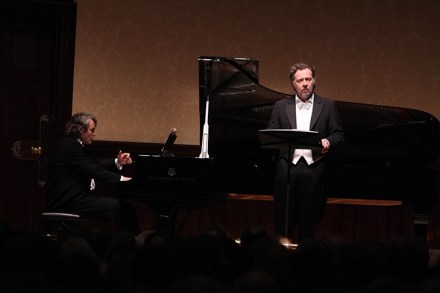
If a symphony is, as Mahler famously put it, ‘like the world’, then songs and lieder are like seeing that world in Blake’s grain of sand. Their span may be short, but their emotional horizon is infinite — a lyric window on to an epic landscape. And yet there’s something about a song recital that sets up quite a different expectation. Maybe it’s the venues. Entering the Wigmore Hall or Oxford’s Holywell Music Room still feels like stepping into another, older world. Politeness, not passion, is the overriding sensation of well-heeled audiences with their well-thumbed programmes, prepared for 90 minutes of just-enough-but-not-too-much musical excitement.

St Vincent: Masseduction

More from Arts

Grade: A The old Tulsa sound was a rather agreeable low-key, shuffling, blues-inflected rockabilly — primarily J.J. Cale and Leon Russell. Which then somehow mutated into the anglophile pop of Dwight Twilley. Here’s the third wave of it — probably the best yet, much though I admire all the aforementioned. A strange lady, St Vincent — in real life plain ol’ gender-fluid Annie Clark from Oklahoma. And this is another rather wonderful album from the woman. She may be this decade’s Prince, for the breadth of vision and the invention and crucial ability to wring melodies out of the dead ground. Here and there the listener must navigate around slabs of generic R&B, such as the tiresome title track.

Salon Strauss

Music

An opera without singers, a Strauss orchestra of just 16, and an early music ensemble playing Mahler: welcome to the Oxford Lieder Festival, where familiar repertoire is getting a reboot this year thanks to some brilliantly ambitious programming. When it comes to classical music, we’re used to living in a bifurcated world. On the one hand, you have the contemporary ensembles: the orchestras, choirs and quartets performing pretty much everything from Mozart onwards. And on the other the early music groups, whose territory is everything that’s left — Bach, Byrd, Hildegard of Bingen. It’s only fairly recently, and thanks to groups such as the Orchestra of the Age of Enlightenment, that this crude, artificial divide has been challenged.

Make mine a double

Music

If two concert pianists are performing a work written for two grand pianos, there are two ways you can position the instruments. They can sit side by side, an arrangement known as ‘twin beds’. Or they can be slotted together so the performers face each other. That’s called a ‘69’. When Martha Argerich and Stephen Kovacevich play together, they opt for twin beds. Appropriately, you might think, since they’re divorced — but really it’s because Kovacevich insists on sitting so low that Argerich can’t see his head if she’s opposite him. With everyone else she prefers a 69, as do most pianists: it’s easier to make eye contact.

Mourning glory

Music

  On the face of it, Nick Cave & the Bad Seeds aren’t exactly a natural fit with the O2. Cave’s songs range from the thrillingly cacophonous to the quietly lovely. But with their recurring themes of death, violence and religion, and a muse that rarely leads Cave in the direction of the mainstream, very few have ever seemed particularly arena-friendly. And that was before his latest album, Skeleton Tree, which forms the basis of his current tour — and which Cave completed after his 15-year-old son Arthur died falling from a cliff in Brighton. Cave has warned against seeing the album as a direct response to the tragedy, emphasising that many tracks were written before it happened.