Culture

Culture

The good, the bad and the ugly in books, exhibitions, cinema, TV, dance, music, podcasts and theatre.

Beautiful bleakness crowned with slivers of hope: John Cale’s Mercy reviewed

Pop

There’s a case to be made for John Cale being the most daring ex-member of the Velvet Underground. Lou Reed redefined the transgressive possibilities of literate three-chord rock’n’roll. Cale, arguably, has travelled even further. A Welsh miner’s son who won a scholarship to Goldsmiths, Cale engaged with the early flowerings of Fluxus before mixing with John Cage and La Monte Young’s Theatre of Eternal Music in New York’s downtown avant-garde scene. His droning viola, hammering piano and relentless bass brought the serrated edge to the Velvet Underground’s art music. More than anyone in the band, he rendered Reed’s whiplash words in sound.

Guiltily compelling: Spector, on Sky Documentaries, reviewed

Television

On 3 February 2003, the emergency services in Los Angeles received a call. ‘I’m Phil Spector’s driver,’ a voice told them. ‘I think my boss killed somebody.’ This was the inevitable yet still extraordinary starting point for Spector – a new four-part documentary on a man who, in the face of fierce competition, might well be the strangest figure in pop history. By that stage, he perhaps deserved the description of him in one news report as ‘a ghost, a phantom, a half-forgotten rock genius’. Except that – whether by coincidence or something more sinister – he’d recently granted his first interview for decades to the British journalist Mick Brown. ‘I have devils inside me,’ said Spector during their conversation.

Gobbets of bile and hard-bitten wisdom: Iggy Pop’s Every Loser reviewed

The Listener

Grade: A– James Newell Osterberg Jnr’s unexpected and unwarranted longevity on this planet has conferred upon him the status of irascible, but very loveable, grandfather of punk: it suits him just fine. A delightful contrarian in a profession otherwise staffed by vapid, guileless, liberals – Iggy actually meant it when he sang ‘I’m a Conservative’ – Iggy now sprays the profanities around with abandon while delivering gobbets of bile and occasionally hard-bitten wisdom in the direction of yoof. Which, given Iggy is now 75, means pretty much everyone. This album veers between the addled late-1970s pop rock of The Idiot and Lust for Life and the scabrous metal raunch of his earlier incarnation with the Stooges.

Eccentric triviality aimed at 1970s feminists: Orlando, at the Garrick Theatre, reviewed

Theatre

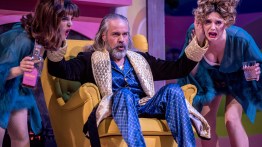
Orlando opens with a pack of Virginia Woolfs on stage. All wear the same costume of horn-rimmed spectacles, long tweed skirts and woolly cardigans, and they comply with current diversity targets. There’s a white Woolf, a black Woolf, a mixed-race Woolf, an East Asian Woolf, and a male Woolf with a deep voice who seems to have wandered in from Little Red Riding Hood. The pack of Woolfs chat away about how to tell the story of an English aristocrat, Orlando, who was a teenager in the 1590s. He enters the stage dressed like a girl. (Confusion over sexual identity is the show’s big idea.) After an opaque interview with Elizabeth I, Orlando moves to the Jacobean era, then to Charles II’s court, then to an embassy in Constantinople and so on.

Not everything Bowie did was genius – he was more interesting than that

Pop

I’m generally not a fan of New Year’s resolutions, but one occurred to me recently as the younger members of my family were blasting out a patchy David Bowie playlist: Stand Up Against Revisionism. It’s harder than ever these days not to succumb to printing the myth – reality can be so so-so – but critics have a duty to keep a clear head while others are losing theirs. Even around the dinner table on New Year’s Day. Bowie would have been 76 this week; he was born on 8 January 1947, and died two days after his 69th birthday in 2016. He’s not getting any less popular in posthumous old age. In fact, business is booming. At the end of last year, the latest hefty Bowie box set arrived, titled Divine Symmetry and covering the Hunky Dory era.

Do conductors have to be cruel to be good?

Arts feature

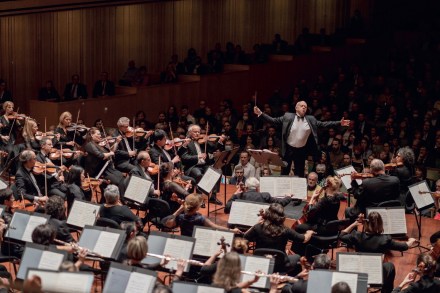
Playing under the baton of Arturo Toscanini must have felt a bit like fighting in the trenches. There are recordings of him rehearsing in the 1930s or ’40s. The orchestra is bowling along; there’s a low muttering, and then suddenly, out of nothing, the explosion. A scream of rage: a huge, operatic, animalistic roar. There’s a barrage of Italian profanities and what sounds like a fist smashing repeatedly on wood. Bernard Shore, who played under Toscanini in the BBC Symphony Orchestra, witnessed him hurling his baton at a cowering viola section. With the NBC Symphony, Toscanini threw his gold pocket watch to the floor and stamped on it.

Irresistible: Sky Max’s Christmas Carole reviewed

Television

What’s wrong with sentimentality? The answer, I’d suggest, could either be: a) its almost bullying insistence on us having emotions disproportionate to anything a particular story has earned; or b) nothing at all. And if you want to see how both of these are possible, two of this year’s big Christmas TV offerings provide handy illustrations. Firmly in category a) is The Boy, the Mole, the Fox and the Horse, an animated film by Charlie Mackesy, based on his own mega-selling book and with some impressively big-name actors doing the voices. Its methods are established immediately when a boy lost in a snowy wood happens across a cute talking mole (Tom Hollander). ‘What do you want to be when you grow up?’ the mole enquires. ‘Kind,’ says the boy.

Like bingeing on cheap chocolate: Matthew Bourne’s Sleeping Beauty, at Sadler’s Wells, reviewed

Dance

A Christmas revival of New Adventures’ ten-year-old production of Sleeping Beauty stirs up all my nagging ambivalence about Matthew Bourne’s work. I’ve mulled over this in print elsewhere several times, and I feel conscious that if Bourne reads reviews – perhaps he doesn’t – he might be groaning into his Corn Flakes. But his reputation is so securely high (a knighthood, Tonys and Oliviers galore), his popularity so ubiquitous, that an honest doubter can’t do him any harm. Here are the pros. He has invented a recipe of his own, hard to imitate, though many have tried – a mix of Kenneth MacMillan’s sexed-up ballet idiom, Cameron Mackintosh-Andrew Lloyd Webber theatrical spectacle, and the cinematic fantasies of Disney and Tim Burton.

Christmas songs that will reduce your gas bills

Pop

It’s unlikely that Irving Berlin was pondering the energy price cap when he composed the seasonal standard ‘I’ve Got My Love To Keep Me Warm’ in 1937. ‘I can’t remember a worse December, just watch those icicles form,’ he wrote, a sentiment many of us can surely relate to right now – but wait! ‘What do I care if icicles form,’ he continues. ‘I’ve got my love to keep me warm.’ Good for you, sir. Meanwhile, the rest of us are watching the digits ticking incessantly upward on our smart meter with the murderous fascination of a gun dog fixated on a fox hole. For the first time in my life, I’m actually hoping to get socks from Santa – and perhaps one of those natty woollen jumpers Shakin’ Stevens wore in the video for ‘Merry Christmas Everyone’.

What makes a Christmas song Christmassy?

Classical

Temperature records for Los Angeles in the summer of 1945 are patchy, but 90 in the shade seems to have been the norm. It was during one such scorcher, presumably, that the songwriters Jule Styne and Sammy Cahn pulled up at a red light on the corner of Hollywood and Vine. Cahn suggested going to the beach. Styne had a better idea: ‘Let’s go write a winter song.’ Driving over to the offices of their publisher Edwin H. Morris, Cahn commandeered a typewriter, glanced out the window and typed the exact opposite of what he saw: ‘The weather outside is frightful.’ The Great American Songbook had acquired another Christmas classic. And ‘Let it Snow!’ is no less classic – and all the more American – for omitting any mention of Christmas.

If Ravel’s Boléro makes you yawn, you’re not really listening

Classical

Only boring people are bored by Ravel’s Boléro. True, the composer – the slyest of wits – left his share of booby traps for the uncomprehending; take his comment, in a letter to Paul Dukas, that ‘I have written only one masterpiece, Boléro. Unfortunately there is no music in it.’ Yet Ravel was a sublime colourist; a master of the instrumental palette who makes Stravinsky’s orchestration sound coarse by comparison, and Boléro is one long twist of a fabulous kaleidoscope. Even its notorious repetitions are a red herring. Take the full score as a whole and you’ll struggle to find two bars that are identical (there are a couple at the start and a couple near the very end, but that’s basically it).

I’m very touched that Christine and the Queens has changed her name to Redcar

The Listener

Grade: B+ We are all very touched, up here, that the esoteric French artist formerly known as Christine and the Queens has changed her name to Redcar, in honour of our once vibrant beachside steel town. Perhaps she was impressed by the newish ‘vertical pier’, or enjoyed a nutritious meal in the Light of Asia. Or, better still, maybe she is planning to adopt a whole bunch of East Cleveland nom de plumes and will next call herself Liverton Mines, or Boosebeck. She may, of course, just mean a red car. Héloîse Letissier (her born name) is very good at simple, naggingly catchy, woebegone synth pop. The simpler the better – as with 2018’s wonderful ‘Five Dollars’ which once heard will never leave your head. She is much less good at ethereal electronic art-pop.

‘What happened in Russia can happen anywhere’: Pussy Riot interviewed

Arts feature

As she recalls a decade of infamy, Maria Alyokhina wanders one of the many anonymous apartments she has lived in since escaping Russia six months ago. ‘We didn’t expect a criminal case, we didn’t expect imprisonment, we didn’t expect international attention. We didn’t expect how many people would support Pussy Riot, would go to the street in balaclavas. We could never have predicted that.’ Alyokhina and Pussy Riot, a loose feminist collective who perform in brightly coloured balaclavas, came to international attention in February 2012 with their ‘punk prayer’, a guerilla music performance in Moscow’s orthodox Cathedral of Christ the Saviour.

Why I love Rod Stewart

Pop

Reader, I let you down. But I did so for the right reason: for love. On a night when all of London’s music critics were at the Royal Festival Hall for Christine and the Queens, I deserted my duty. But, honestly, I don’t regret it. The reports back from the RFH suggested some baffling melange of performance art, am dram, experimental pop and gender identity, wrapped up in a concept piece about red cars. Not me. I’ll stick with Rod, a man so comfortable with his gender identity that he’s a byword for male libido. Rod is a man so comfortable with his gender identity that he’s a byword for male libido My love for Rod Stewart is pure and noble.

The sonic equivalent of a Starbucks Eggnog Latte: ENO’s It’s a Wonderful Life reviewed

Opera

Whoosh! A digital starburst, a sweep of orchestral sound and the stage of the Coliseum is alive with dancing, whirling snowflakes. Floating in the heavens is the soprano Danielle de Niese; below her in the darkness, the truss bridge that we all know – because we’ve all seen It’s a Wonderful Life – is where the turning point of the story will occur, a couple of hours from now. That being the case, the only question is how composer Jake Heggie, librettist Gene Scheer and director Aletta Collins are going to close the circle and get us there. It’s evident from the off that they’re not going to stint either on spectacle or on sentiment. And quite right too: this is a Christmas opera, and there aren’t too many of those about.

Carries the whiff of a hotel-lounge pianist: Vikingur Olafsson’s From Afar reviewed

The Listener

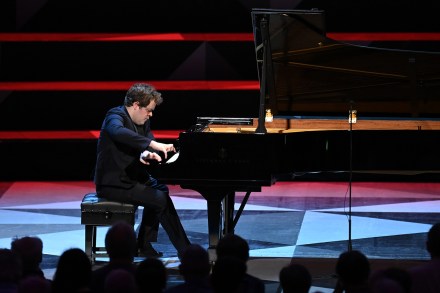
Grade: B+ The 38-year-old Icelandic pianist Vikingur Olafsson has an almost unique ability to make counterpoint sing, as his astonishing 2018 Bach recital for DG revealed. But his Proms debut last year in Mozart’s Piano Concerto K491 seemed over-thought, verging on the fussy. Now he’s been allowed the luxury of a concept double album, From Afar, in which he plays an eccentrically curated mixture of small pieces twice, once on a Steinway grand and once on an upright. It’s a revelation, though not perhaps the one Olafsson intended. He says the two instruments call for different approaches to his menu of Bach transcriptions, Schumann, Brahms and snippets of Bartok, Kurtag and Adès.

Like A-ha after an extensive rewilding process: Sigur Ros, at Usher Hall, reviewed

Pop

Plus: it's quite clear that MUNA are going to be huge What is it with Icelanders and mushrooms? Just weeks after Bjork releases a fungal-themed album, Fossora, Sigur Ros appear on stage with dozens of sporey lights illuminating the gloom. It’s boom time for mycophiles, but with Sigur Ros the link makes a certain kind of sense. Their aesthetic is not so much post-rock as glacial. For almost three decades the Icelandic quartet have been making large-screen, epically elemental music: celestial choral pieces, art-house concert films, ambient soundscapes and the occasional relatively conventional rock and pop song. Whether aware of it or not, you will have heard ‘Hoppipolla’ on numerous BBC nature documentaries. We won’t hear it tonight, though.

Rebecca Humphries is dynamite – pity about the play: Blackout Songs, at Hampstead Theatre, reviewed

Theatre

Viewers watching a good romcom need to fall in love with three things. The boy, the girl and the affair itself. The new Hampstead melodrama, Blackout Songs, scores just one out of three. Rebecca Humphries is adorably chic and sexy as the Soho seductress who drifts from bar to bar, picking up men. Her toyboy is a disappointment, a teenage deadbeat who has none of her louche gusto. And his character is a puzzle when it ought to be crystal clear. At the start of the action he wears a neck-brace and speaks with a stammer. In the next scene, his neck has healed and his stammer has vanished as well. Is he two characters? Or is he a con man who assumes different personalities, and if so why? He dresses in a paint-spattered tracksuit but he claims to be a welder, a rock star and a fine artist.

Exhilarating: English National Ballet triple bill, at Sadler’s Wells, reviewed

Dance

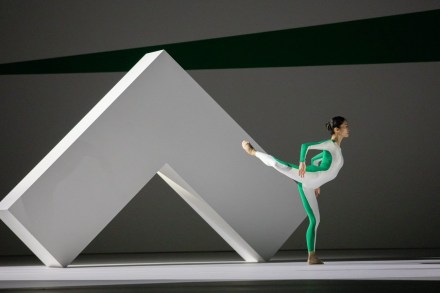
Headed for San Francisco, Tamara Rojo bows out of her directorship of English National Ballet with an exhilarating triple bill demonstrating her success in expanding the repertory and raising technical standards. If only the company could tour this class of work outside London.  The climax of the evening was a new version of The Rite of Spring by Mats Ek – his second stab at dramatising music so graphically vivid and violently aggressive that choreographers since Nijinsky have struggled to find imagery and movement to match its primal energy. Even Kenneth MacMillan and Pina Bausch didn’t quite hack it for me. Ek has avoided the clichés: nobody stomps about plastered in scary face paint. I wonder if his scenario was inspired by Ari Aster’s elegant horror film Midsommar?

What’s the point of these soul covers? Bruce Springsteen’s Only the Strong Survive reviewed

The Listener

Grade: B What’s the worst-ever cover version (after Madonna’s hilarious stab at ‘American Pie’)? I reckon Creedence Clearwater Revival’s interminable mangling of ‘I Heard It Through The Grapevine’, or maybe the J. Geils Band stamping over ‘Where Did Our Love Go’ in hobnail boots – two bands I otherwise adore. Jeff Beck boring his way through ‘Superstition’? The Stranglers wrecking ‘Walk on By’? All Saints ripping the guts out of ‘Lady Marmalade’? I think you catch my drift, because the lesson is pretty clear: no, really, do not play that funky music, white boy.

Odd, rich and adventurous: Erykah Badu, at the Royal Festival Hall, reviewed

Pop

You couldn’t call Erykah Badu one of the world’s most productive artists: it’s 12 years since her last album, and she’s released just five of them in 25 years, plus a couple of mixtapes. You’re more likely to see her name in the papers for something stupid she’s said – that she can see the good in everybody, even Hitler, because he was ‘a wonderful painter’, for example – than because she’s done something musical. Which is a shame because like her equally unproductive neo-soul contemporaries (Maxwell – five albums in 26 years; D’Angelo – three in 27 years), the music still sounds extraordinary.

The joy of B-sides

Pop

Paul Weller releasing a collection of solo B-sides is cause for mild celebration. After all, the Jam were one of the great B-side bands. ‘Tales From The Riverbank’, ‘The Butterfly Collector’, ‘Liza Radley’ – all A-list songs, relegated to the subs’ bench. Remember the B-side? That bijou, creative safe space which didn’t merely permit but positively encouraged artists to write parallel narratives of exploration, experimentation and extemporisation. I still remember the first B-side I fell in fascination with. It was called ‘Christ Versus Warhol’, a queasily psychedelic, wilfully odd indulgence on the wrong side of the Teardrop Explodes’ determinedly poppy ‘Passionate Friend’. I felt like the protagonist in Gregory’s Girl.

A towering achievement: ENO’s The Yeomen of the Guard reviewed

Opera

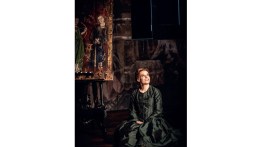
The screw may twist and the rack may turn: the Tower of London, in Jo Davies’s new production of The Yeomen of the Guard, is a dark place indeed, and that’s as it should be. ‘Men may bleed and men may burn,’ intones Dame Carruthers, as she delivers a magic lantern show about the history of the Tower, complete with colour slides of famous beheadings. In The Mikado Gilbert uses capital punishment as a particularly spiky punchline, but in The Yeomen of the Guard, sentence of death has been passed before the curtain has even risen. The shadows are lengthening from the off, and even Sullivan’s cheeriest melodies have a dying fall.

King Charles III’s love of classical music

Arts feature

The musical tastes of King Charles III are more sophisticated than those of our late Queen. That’s not being rude: it’s just a fact. Her favourite musician appears to have been George Formby, whose chirpy songs she knew by heart. No doubt she relished their double entendres – but the hint of smut meant that, to her regret, she had to decline the presidency of the George Formby Society. Our new monarch, by contrast, adores the Piano Concerto in E flat major by Julius Benedict (1804-85). He recommended it in an interview a couple of years ago. I’d never heard of the piece, which existed only in manuscript until Howard Shelley and the Tasmanian Symphony Orchestra recorded it for Hyperion in 2008.

The UK Drill Project, at The Pit, reviewed

Theatre

The UK Drill Project is a cabaret show that celebrates greed, criminality and drug-taking among black males in London. It opens with a septet of masked performers, sheathed in dark Lycra, singing a rhythmic poem while pretending to fire guns and stab people with knives. These sad young rappers are desperate to look scary because they’re scared themselves. And though they claim to be artists, their purpose in writing ‘drill’ songs and posting videos online is to protect their drug profits and to intimidate rival gangs. Musically, they lack accomplishment. They can’t play instruments and appear to own none. Harmony and melody are alien to them.

Arts Council England and the war on opera

Instructed by the Department for Digital, Culture, Media and Sport to move money away from London and reassign it to the regions as part of the Levelling Up strategy, Arts Council England has ended up making some very risky decisions. It has thrown funds at small untested groupuscules without a firm audience base and penalising major reputable institutions such as the Royal Opera House for their success and expertise. Given that the sector is struggling from the effects of the pandemic and the energy crisis – not to mention historic under-funding – the result could well be a catastrophic reduction in the quality and quantity of our cultural life, and a further blow to our international prestige. Opera is being particularly hard hit.

A total (and often gripping) theatrical experience: Scottish Opera’s Ainadamar reviewed

Classical

Do you remember Osvaldo Golijov? Two decades ago he was classical music’s Next Big Thing: a credible postmodernist with a lush and listenable tonal flair, and an Argentinian with an interestingly complex European heritage in a millennium where everyone agreed – for a while, anyway – that the future was Latin American. Major labels recorded his music as soon as it was premièred; he was popular. Too popular for some – I remember a contemporary music promoter lamenting, with the demeanour of a housemaster who’s just found the head boy smoking behind the bins, that Golijov ‘hadn’t developed as we’d hoped’. Anyhow, Golijov was big, and then something stalled. Commissions failed to materialise, there were rumours of creative block, and the parade moved on.