United nations

This extinction warning just doesn’t add up

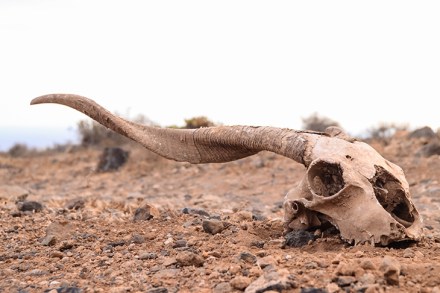
Anyone watching the BBC’s News at Ten on Monday would have been surprised to learn that economic growth poses a dire threat to the future of life on this planet. We’re used to hearing this from climate change campaigners, but I’ve always taken such claims with a pinch of salt, suspecting that the anti-capitalist left is distorting the evidence. Apparently not. ‘One million species at risk of imminent extinction according to a major UN report,’ intoned the BBC. ‘It says the Earth’s ecosystems are being destroyed by the relentless pursuit of economic growth.’ So does this mean the Extinction Rebellion protestors are right?

The United Nations and the fracturing of Western unity

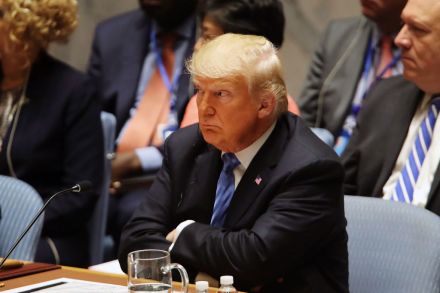
The United Nations Security Council was designed to, in a phrase, keep the peace. Life didn’t have to be brutish and short; if the great powers got into a room, they could wield their collective might and solve any problem.  The Security Council’s top priority—“the maintenance of international peace and security”—would prevent a third Great War from killing millions of people. Unfortunately, we don’t live in a utopian fantasy land. It turns out that the Security Council, populated by fifteen different countries with their own set of interests, can be just as dog-eat-dog as the world in which it represents. And in the age of Donald Trump, the top UN body is an even more divisive place.

The Berlioz problem

Hector Berlioz was born on 11 December 1803 in rural Isère. ‘During the months which preceded my birth my mother never dreamed, as Virgil’s did, that she was about to bring forth a laurel branch,’ he writes in his Memoirs. ‘This is extraordinary, I agree, but it is true… Can it be that our age is lacking in poetry?’ And so on, for nearly 600 candid, facetious, outspoken pages. Berlioz’s Memoirs are the inner voice of the Romantic generation as you’ve always imagined it, and everyone who’s interested in music in the 19th century — no, scrub that, everyone who’s interested in European culture — should read them.

Was Theresa May attacking Trump, or a blond populist closer to home?

From our US edition

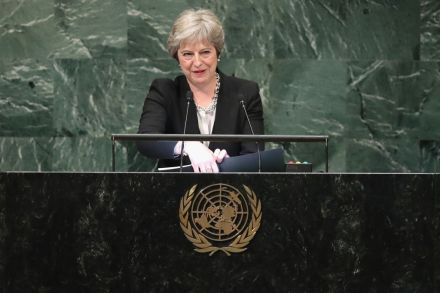
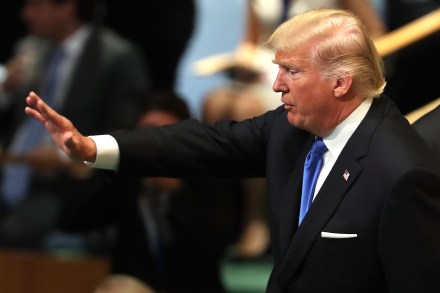
Did British prime minister Theresa May take a shot at Donald Trump in yesterday afternoon’s address to the UN General Assembly? It certainly sounds like it. Or was Trump a proxy target for another blond populist, Boris Johnson? It certainly looks like it. On Tuesday, Trump had rejected the ‘ideology of globalism’ and defended the nation state and its ‘doctrine of patriotism’.

theresa may attacking trump

Donald Trump’s UN press conference was frenetic, yet friendly

From our US edition

George Washington couldn’t tell a lie. Donald Trump can’t help telling a lie. At his press conference today Trump suggested that not only wouldn’t Democrats vote to confirm the father of our country to the Supreme Court, but that Washington may not have had a spotless record when it came to his private affairs. ‘He may have had some, I think, accusations made,’ Trump said. ‘Didn’t he have a couple of things in his past?’ Who will Trump exhume next to besmirch? Honest Abe? The Gipper?However outlandish, the presser was no laughing matter.  World leaders didn’t laugh at him, he said, but with him yesterday as he proclaimed that he was the greatest president in American history.

Donald Trump’s UN press conference
donald trump anti-globalism

Trump’s phony anti-globalism should fool no-one

From our US edition

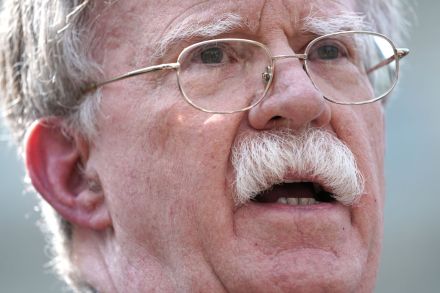
It was fitting that Donald Trump’s blustery speech at the United Nations this week, in which he defiantly denounced ‘the ideology of globalism,’ came just one day after his top adviser John Bolton vowed limitless American military commitment to yet another global conflict. Bolton had essentially declared that US forces would be in Syria for perpetuity, or ‘as long as Iranian troops are outside Iranian borders.’ Though this deployment was never formally debated, voted on by Congress, or subjected to a modicum of public scrutiny, Bolton saw fit to announce that US troops would remain there for an open-ended mission with no termination date.

Living with

I’m not at all sure about the formula a person living with, followed by something unwelcome, such as Alzheimer’s disease, HIV or psoriasis. Perhaps I should describe myself as a person living with my husband. The formula is recommended by many Aids organisations that follow the ‘terminology guidelines’ of the UN Programme on HIV/Aids. Instead of saying that someone is infected with HIV, we should call them a person living with HIV. It is meant to be less patronising and avoids suggesting someone is ‘powerless, with no control over his or her life’. No one should even be called a patient, but must be called a client, which is ‘more empowering’. Tell that to clients of Southern railways.

United Nations’ British racism report gaffe

Brexit Britain is a more racist country than before the referendum, according to the United Nations, whose inspector told us on Friday that anti-foreigner rhetoric has now become ‘normalised’. But how did Tendayi Achiume, the UN’s special rapporteur on racism, manage to make such a stark finding having spent just 11 days in Britain? After all, if her 'end of mission statement' is anything to go on, Mr S. thinks her conclusions might have been somewhat cobbled together. Achiume, it seems, didn’t even get a chance to run her damning report through a spellcheck before publishing it. Referring to a study by Warwick University, Achiume managed to misspell the university’s name as 'Warrick'...

Fact check: the UN Special Rapporteur’s report on British racism

The first instinct of many people towards Tendayi Achiume, the UN’s Special Rapporteur on Human Rights who finished her 11 day visit to Britain yesterday by claiming that Britain is in the grip of a Brexit-related upsurge in racial intolerance and discrimination, will be to tell her to keep her nose out of our affairs. I am not going to fall into the trap of offering material which could be used to try to prove her point.

Is Brexit a human rights emergency? The UN seems to think so

How easy it would be to be goaded by the visit of Tendayi Achiume, the UN’s “Special Rapporteur on Racism” to Britain. “My mission...will focus on explicit incidents of racism and related intolerance as well as attention to structural forms of discrimination and exclusion that have been exacerbated by Brexit,” she says, as well as “xenophobic discrimination and intolerance aimed at refugees, migrants and even British racial, religious and ethnic minorities”. How tempting it will be for some to tell her to bug off and deal with some real human rights abuses.

Syrians are paying a heavy price for the UN’s incompetence

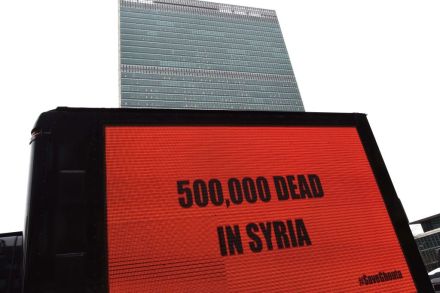
The United Nations Security Council has major responsibility in its job description: to maintain international peace and security. It is spelled out in Article 24 of the U.N. Charter, a tall task in normal circumstances but one that nonetheless underscores the core of the council’s very existence. Without it, the Security Council might as well be simply another distinguished debating society – a place where interesting, intellectually stimulating conversation occurs but where people leave without finding much consensus. On the subject of Syria, the top U.N. body has been anything but distinguished. Nor is there serious debate going on in the room.

Oxfam isn’t alone: UN peacekeepers also exploit women in their care

A Times investigation has uncovered the terrible fact that women and possibly young girls in Haiti have been exploited by the very people paid to keep them safe: the staff of Oxfam, which sucks up £300 million a year from us in public and private money.  It’s a shock — and it’s not. Under the cover of moral superiority, out of sight and out of the media, all manner of NGOs, charities, and the saintly UN have committed some of the most disgusting crimes against the world’s most vulnerable women and children, and got away scot free. Not even the hyper-sensitive  #MeToo movement seems to give the shadow of a damn.

Letters | 1 February 2018

Creeping repression Sir: John O’Sullivan is correct to argue that Europe’s centrist establishment often ‘does not really accept the right of its challengers to come to power. And when they do, it casts them as being illegitimate as extremists’ (‘A new Europe’, 27 January). We fear, however, that like a number of our fellow conservatives, Mr O’Sullivan’s enthusiasm to see elites get their come-uppance creates blind spots for creeping authoritarianism. At the end of a second term by its Fidesz government, Hungary performs worse on all of the World Bank’s Worldwide Governance Indicators than it did a decade ago.

America has sometimes stood proudest at the UN when it has stood alone

Outvoted on a resolution on Israel, on the wrong side of international opinion, the United States ambassador responded with an intemperate address to the UN General Assembly. America’s diplomat told the countries assembled: 'The United States rises to declare before the General Assembly of the United Nations, and before the world, that it does not acknowledge, it will not abide by, it will never acquiesce in this infamous act… A great evil has been loosed upon the world. The abomination of anti-Semitism… has been given the appearance of international sanction. The General Assembly today grants symbolic amnesty — and more — to the murderers of the six million European Jews.

There’s still some method to Donald Trump’s madness

Donald Trump’s speech before the United Nations General Assembly was both an echo of George W. Bush and something original. At times, one expected the president to lapse into a Texas drawl and warn about 'nuclear weapons'; at others he was distinctly The Donald. Despite the seeming contradiction, it was a fairly cogent and consistent address; it also overflowed with the customary bombast. Trump began firmly in carrot-top mode, gloating about how well the American economy had done since he was inaugurated. Then came an abrupt escalation: 'Rogue regimes represented in this body not only support terrorists,' Trump warned, 'but threaten other nations and their own people with the most destructive weapons known to humanity.

Donald Trump discovers his inner neocon

Donald Trump fully embraced his inner neocon before the United Nations today. He lashed out at North Korea, indicating that he was ready to 'totally destroy' it. He upbraided Iran as a corrupt and malignant regime that had taken America and its allies to the cleaners with the nuclear deal—'One of the worst and most one-sided transactions.' And for good measure, he scoffed at various socialist regimes around the globe. The only term missing in his dyspeptic assessment of the carnage around the world was 'axis of evil,' the phrase that George W. Bush made famous when he decried Iran, North Korea and Iraq after the 9/11 attacks. The language he deployed was seldom less than apocalyptic.

High life | 7 September 2017

After the heat in Greece, the Alps are cool and green and very comfortable. My sensei Richard Amos is over here and we squeezed two weeks of intensive karate training into three days. Nothing makes me feel better than the sense of total exhaustion after a hard day’s fighting. We do kihon, kata, and then we let fly in kumite. Except that recently I’ve caught him diving, as they call it in the ugly game. Fight like a man, I say, through gritted teeth. He picks up the tempo but my suspicions remain. The sensei (teacher) is taking it easy on the sempai (senior). I hate it but it’s the way of our world, the best one there is, the world of martial arts and of the bushido spirit.

Cypriot reunification still seems a distant prospect

In the early hours of this morning, the tired-looking Secretary General of the UN took to the stage in Switzerland to announce the first major failure of his tenure. "I'm very sorry to inform you that despite the very strong commitment and engagement of all the delegations and different parties, the conference on Cyprus was closed without an agreement being reached," said Antonio Gutteres. The week-long talks in the mountain resort of Crans-Montana were the culmination of two years of negotiations to try to stick Cyprus back together. It is a daunting task: although tiny, with an area less than half the size of Wales and a total population of 1.2 million, the island is deeply divided.

The lords of poverty

 Kenya I met Dr Tom Catena in Sudan’s Nuba Mountains — the site of an African war and famine few have even heard about — in a hospital overflowing with children. I saw bombs had ripped away their arms, flying shrapnel had taken out a baby’s eye, anti-personnel mines had shredded legs to jagged bone and ribbons of gangrenous flesh, infants suffering kwashiorkor and the other horrors of malnutrition. Inspired by St Francis of Assisi, ‘Doctor Tom’ has worked almost every day, all day, since he arrived as the only surgeon for the Catholic hospital in Nuba nine years ago. I asked him: ‘Why do you stay?’ He replied: ‘There’s no other option. You leave and abandon everyone here or you stay and keep going.

Persecuted Iraqi Christians ‘supported Trump 100 per cent’ because they felt betrayed by Obama

There's an extraordinary moment in this week's Holy Smoke podcast when the aid official supervising the resettlement of 12,000 Iraqi Christians says that the latter supported Donald Trump '100 per cent' in the US elections because they felt betrayed by the Obama administration. Stephen Rasche, legal counsel and head of resettlement programmes for the Chaldean Catholics of northern Iraq, confirms that this community – now on the verge of extinction, and due to run out of medicine in 45 days – has received no help from US aid agencies or the United Nations. We recorded the episode on Friday, the day after Rasche had addressed MPs and peers in Parliament. One hopes they listened carefully, having themselves just been the targets of an Islamist attack.