Ukraine

Europe’s last dictator: Lukashenko’s fate depends on Ukraine

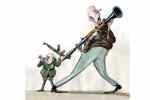
A young man wearing combat fatigues and an extravagant moustache, and carrying a heavy machine-gun over his shoulder, nods towards some burned-out armoured vehicles. ‘We smashed the orcs today,’ he says, using the Ukrainian soldiers’ term for the invading Russians, a reference to the sub-human legion in Tolkien’s The Lord of the Rings. He goes on: ‘Putin, you are a dickhead – your Greater Russia will die together with you.’ The soldier – his uniform has a badge saying ‘Ivanov’ in Cyrillic – is not, in fact, Ukrainian. He is one of a small number of volunteers from Belarus, next door, a country that is certainly part of the Greater Russian project.
Portrait of the week: Covid fines, cancelled flights and sunflower oil shortages

Home Jonathan Reynolds, Labour’s business spokesman, said that the government should be preparing for energy rationing, but Grant Shapps, the Transport Secretary ruled it out. Kwasi Kwarteng, the Business Secretary, asked the British Geological Survey to reassess the effects of fracking, Essex police arrested 192 people from Just Stop Oil in a weekend of protest at oil refineries. By the end of March, 4,700 visas had been issued from 32,200 applications to sponsor accommodation for Ukrainian refugees; under the family visa scheme, 24,400 had been issued from 32,800 applications. Britain’s biggest bottler of sunflower oil had stocks for only three weeks left and said that food manufacturers were turning to rape.

Putin’s war is a disaster for Russia

Strasbourg Europhobes will never have a better argument against European integration than the seat of the European parliament in Strasbourg. It’s not just the €200 million per year it costs to move MEPs to and from Brussels once a month at great inconvenience to everyone; the building itself is a disgrace. It feels like a prison: identical glass corridors look out over a useless inner courtyard, so you can go on walks without the danger of escape. The former president of the European Commission José Manuel Barroso once suggested turning the building into the headquarters of the European Institute of Technology, which was an excellent offer both for the country and the city, but to no avail.

Bucha and the dark echoes of Srebrenica

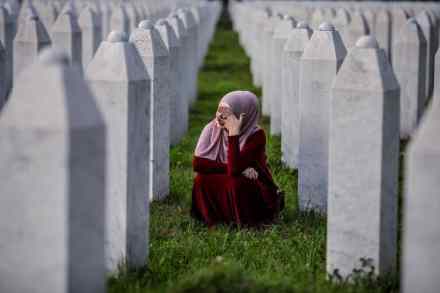
High on a hillside not far from the eastern Bosnian town of Srebrenica the remains of dozens of young Muslim men had been left to rot. By the time I found them most of the flesh had been eaten away by forest scavengers – bears, wolves, foxes and even stray dogs – but the skeletons and skulls remained, some with rags of clothing and scraps of hair still attached. Personal possessions lay among the remains: tobacco tins – one inscribed with the name Suljo, a pair of broken glasses, family photographs. Most of these photos were taken with Polaroid cameras – a status symbol in the old Yugoslavia. The black backings had peeled away but the faces were still visible, if faded.

Don’t blame the West for its Ukraine hesitance

From our US edition

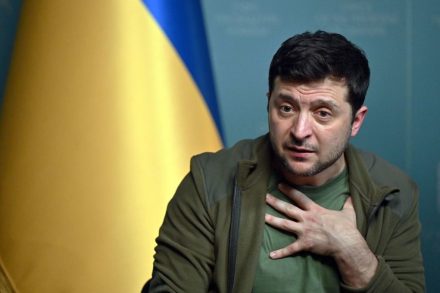
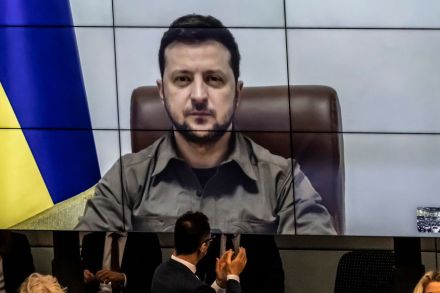
As Ukrainian President Volodymyr Zelensky addressed the UN Security Council today with all the anguish you would expect from a wartime commander-in-chief, he could nonetheless be relatively pleased about several things. Sure, Zelensky and his advisers are constantly making the point that Ukraine needs bigger and better weapons to resist Russia’s invasion, but the West has been quite responsive to Kyiv’s requests. The Biden administration’s latest weapons shipment, announced last week, adds to the $1.6 billion in military aid the US has sent to the Ukrainian military since the war broke out on February 24.

Viktor Orbán is no friend of the West

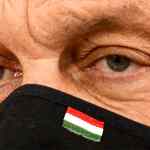
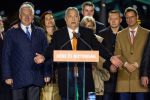
Viktor Orbán‘s victory speech in Budapest on Sunday night took a curious turn. Speaking after a fourth landslide win, he opined: This victory is one to remember because we had the biggest [opponents] to overpower. The left at home, the international left, the bureaucrats in Brussels… the Soros empire... and even the Ukrainian President. Orbán skipped over the challenge to regional stability caused by the Russian invasion of neighbouring Ukraine. Having refused military aid to Kyiv, and having exchanged barbs with President Volodymyr Zelensky, he reassured ethnic Hungarians in West Ukraine: ‘Don’t be afraid, the motherland is with you’.

Russia’s ‘denazification’ project is only just beginning

Truth, infamously, is the first casualty of war. But the truth, in modern Russia, was critically wounded before it got anywhere close to the staging grounds, let alone the battlefield. And still the disinformation project limps on. The most recent and blatant example of the Kremlin’s communications modus operandi is its instant write-off as ‘fake’ of photographs and video from Bucha, a quiet town outside Kyiv, now littered with civilian corpses and the broken machinery of war. Perhaps the invading troops left in a hurry, or perhaps Bucha was meant as some kind of warning, but the perpetrators didn’t care to clear up their handiwork.

How many refugees can Eastern Europe take?

From our US edition

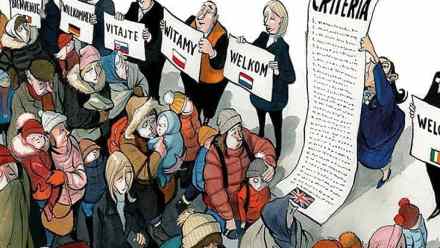
Hundreds of thousands of Ukrainian refugees have already streamed into Slovakia, Hungary and the Czech Republic. Head north to Poland, and the numbers go from the unprecedented to the jaw-dropping: two and a half million refugees have entered the country with a total population of 38 million since the war in Ukraine began. In the Czech Republic, where I live, official estimates put the current number of refugees at over 300,000, a figure expected to rise to between 500,000 and 600,000 in the coming months. In a country of less than eleven million, that’s five percent of the population. In Poland, a proportion closer to ten percent is possible. At the moment, most of the Czech Republic’s refugees are concentrated in Prague.

Are sanctions working?

When allied military operations go well or badly, we very quickly hear about them. But what about sanctions? It is about time that we started to ask: are they hitting their target, or are some of them slewing off, out of control, straight into civilian targets? Notionally, sanctions have been a success – or at least they seemed to be initially. The rouble and Russian stock market collapsed. But then the rouble recovered strongly, and the stock market, too, has staged some sort of recovery since it reopened. What seemed like a pretty comprehensive boycott by western companies turns out to be rather less complete than many might imagine.

Russian cruelty has been laid bare

It was 2 a.m. when Russian gunmen broke in and took away 21-year-old Milana Ozdoyeva. When Sara, her three-year-old daughter, tried to grab her mother's hand they shoved her aside. Milana's son, who was 11 months old, just stared uncomprehendingly. ‘They were wearing masks and camouflage,’ Milana's mother told me. ‘They forced us all to the floor at gunpoint. Milana was too terrified to speak. She just looked at me and mouthed the words “mama”. It was the last time any of us saw her.’ The kidnapping and subsequent killing of Milana took place in Chechnya on 19 January 2004. Her sin was to have been married to a man who was suspected of taking up arms against the Russian military.

Hungary’s Orbán remains a thorn in everyone’s side

From our US edition

Viktor Orbán has just won another election. The Hungarian prime minister has secured a hefty majority in his country’s legislative elections, and in his victory speech, Orbán revealed once again that he is a thorn: in the side of Europe most obviously but, if need be, in the side of all. I’ll leave for others the discussion of Hungarian democracy — whether Orbán has so manipulated national life that his continued electoral successes are unimpressive, even fraudulent. But Orbán, in his own mind, thought an “overwhelming force” ranged against him. “We never had so many opponents,” Orbán said.

No. 10 prepares decades-long energy plan

The government's delayed energy strategy is finally due to be released this week. The Prime Minister is due to unveil his plans on Thursday, which will supposedly ensure that the UK is self-reliant on energy supply after Russia's invasion of Ukraine. Not that the proposals will lead to much change overnight. Instead, they are focussed on ensuring self-reliance in the long term – with many of the plans likely to take decades to come to fruition.  So, what's on the agenda? Part of the reason the energy strategy has been delayed several times is a difference of opinion between the Department for Business, Energy & Industrial Strategy, No. 10 and the Treasury.

The next phase of the Ukraine war

From our US edition

The fog of war doesn’t just apply to generals, sergeants, and privates. It applies to strategists and outside observers, including the best-informed journalists on the ground. All are swamped by a confusing barrage of information, some accurate, some not, none of it complete or definitive. That’s why, after over a month of fighting in Ukraine, it helps to step back, consider the basic outcomes, and try to project what will happen next. Remember, though, the “fog of war” applies to these assessments, too. First, let’s clear away Russian misinformation. The Kremlin’s recent claim that their main goal was never to seize Kyiv but always to take eastern Ukraine is simply false.

Zelensky has saved Boris

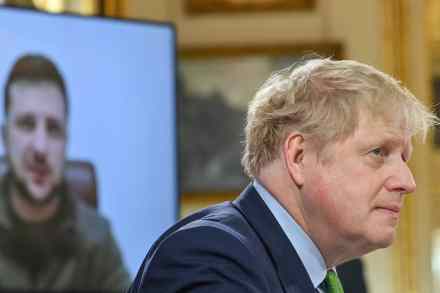
Labour will try all it can to bring up the subject at every opportunity; as will a few backbench MPs. But partygate just doesn’t feel likely to prove fatal to Boris Johnson anymore. War in Ukraine has changed the dynamic: fussing over lockdown parties seems trivial and out of date. Keir Starmer’s continued plugging away on the matter makes him look even duller than normal. Rishi Sunak’s stock has plummeted after what many saw as a bungled spring statement. But if Boris Johnson does stage a revival, the figure he will have most to thank is Volodymyr Zelensky. The Ukrainian President has made it quite clear on more than one occasion that he regards the British PM as a more helpful, more reliable ally than other European leaders.

Biden’s war: does he know what he’s doing?

Anyone could see that Joe Biden veered off-script during his big speech in Poland. ‘For God’s sake, this man cannot remain in power,’ he said of Vladimir Putin, which sounded a lot like a cry for regime change. Luckily for him, though, and perhaps for world peace, Leon Panetta, a former secretary of defence under Barack Obama, was on hand to explain the comment away: ‘I happen to think that Joe Biden – you know, he’s Irish – really has a great deal of compassion when he sees that people are suffering.’ To be sure, to be sure. Still, even if Biden’s threat to Putin can be wholly attributed to a Gaelic jig playing in his head, the fallout has been the same.

Ukraine’s most wanted – an interview with Dmitry Firtash

If you’ve heard of Dmitry Firtash, the odds are you’ll have the impression of a deeply controversial man. He was arrested in Austria in 2014 at the US government’s request on charges of ‘conspiracy to bribe’ in India. A warrant was then issued for his arrest in Spain. Last year, Firtash was sanctioned by Ukraine over claims that he was selling titanium products to the Russian military. In America, he has been called ‘Ukraine’s most wanted’. In Britain, he gave £4 million to Cambridge University and spent much more on other projects, and has since been held up as a classic example of an oligarch buying his way into our establishment.

Why the destruction of Ukraine’s churches matters

One small, deadly incident in the Ukrainian war proved memorable because it involved the ordinary things of life. A mother and two children trying to leave the town of Irpin on foot on 6 March died from Russian shelling. Their suitcases fell beside them and, miserably, a pet dog carrier. They lay on an ordinary road that could be in Surrey, on the steps of a memorial to Soviet dead from the second world war. That spot is opposite a little row of bells under a tiled roof in the grounds of the Ukrainian Orthodox church of St George. A neat hoarding was visible in 2015 on the building next to the modest unfinished church, showing what it would look like when the five domes were roofed and gilded.

The three stumbling blocks to a Ukraine peace deal

A month in, and the war in Ukraine looks very different to how anyone expected. On the first day of the invasion, western intelligence sources believed that Kyiv would fall to Russian forces within 72 hours, underestimating the Ukrainians’ ability to defend their territory and overestimating the Russian military’s capabilities. Among Vladimir Putin’s many errors was his underestimation of western unity. He did not predict the severity of the sanctions against Russia or that his act of aggression would snap Europe (most notably Germany) out of its complacency over defence spending. In some ways, Putin, by going for a full-on invasion, made it easier for the West to adopt a unified position.