Terrorism

Islamic State will flourish if the West picks sides in Libya

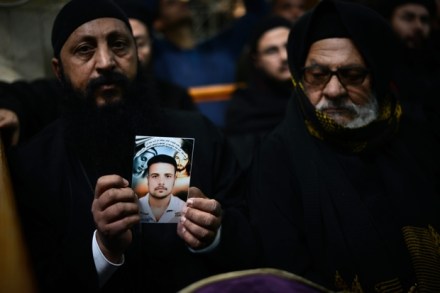
Conventional wisdom suggests that Islamic State and its affiliates have mastered social media. Yet the group's real talent lies in dominating the traditional media cycle and using sensational violence to goad its enemies into overreactions. Hours after Isis released one of its more gruesome videos showing the beheading of 21 Egyptian Coptic Christians on the shores of Sirte, Egyptian fighter jets pummelled several Isis targets in Derna. The Egyptians claim to be fighting the terrorists by propping up General Khalifa Haftar’s anti-Islamist Operation Dignity. However, if the Egyptians want a UN-resolution authorising international military intervention in Libya, this must be resisted.
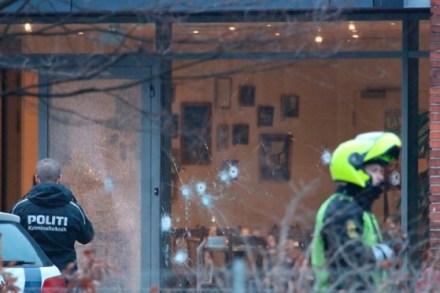
Copenhagen shooting: we debated free speech despite the gunfire – we will not surrender

I was invited to Lars Vilks* Committee in Copenhagen to present Passion for Freedom London Art Festival. The committee is organised annually, on the anniversary of Salman Rushdie's fatwa. The meeting started with a short introduction from one of the organizers followed by François Zimeray, the French ambassador, commemorating Charlie Hebdo and discussing the challenges that we face when it comes to the threats to freedom of speech and democracy in our countries. After a short introduction, Inna Shevchenko opened the panel and started to talk about Femen and her work. She also discussed her close friendship with Charb, the editor of Charlie Hebdo, and how they both stood strong exercising their right to freedom of expression.

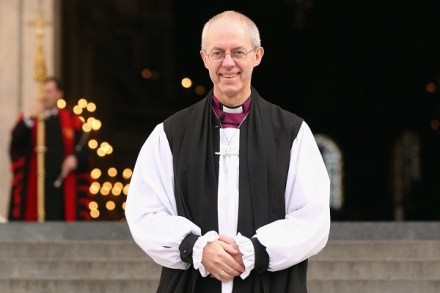
The Archbishop shows politicians a more honest way to answer the question

After Islamist terrorist atrocities, political leaders often rush to say that the attacks had nothing to do with Islam. One can understand why they feel the need to do this but the problem is the terrorists clearly do think, however mistakenly, that they are acting in the name of Islam. But if any politician wants to know how to answer the question about the link between terrorism and Islam, they should look at these answers from the Archbishop of Canterbury Justin Welby in an interview with The New York Times: There are aspects of Islamic practice and tradition at the moment that involve them in violence, as there are, incidentally, in Christian practice.

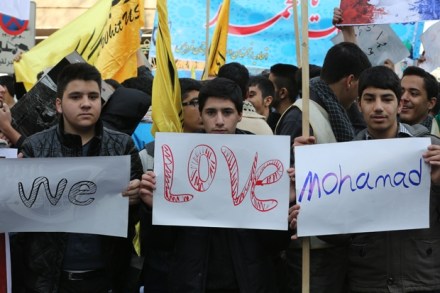
Tom Holland’s diary: Fighting jihadism with Mohammed, and bowling the Crown Prince of Udaipur

As weather bombs brew in the north Atlantic, I’m roughing it by heading off to Rajasthan, and the literary festival where you are most likely to be greeted by an elephant. The life of a writer is rarely glamorous, but for one week in January — should an invitation to Jaipur be forthcoming — it decidedly is. The festival is to India what a Richard Curtis film is to London: a fusion of all the fondest stereotypes that foreigners have of a place. The talks, which run the gamut from the Mahabharata to the future of the novel, are pure literary masala. The parties are visions of perfumed candles, shimmering saris and maharajas’ palaces. The last time I was in Jaipur, there was even a cricket match.

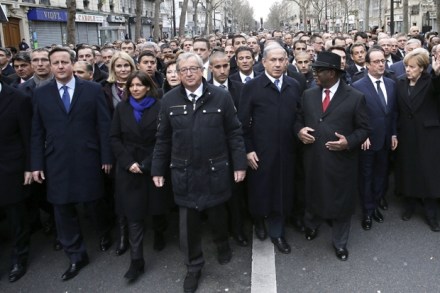
David Cameron has a very strange idea of freedom

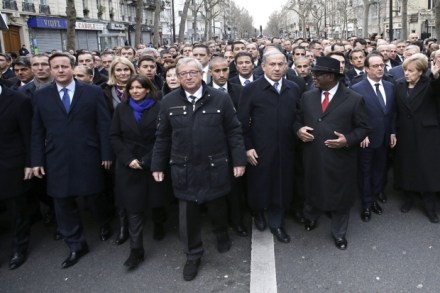
Last Sunday, David Cameron marched through Paris in solidarity, so it seemed, with those who stand up for free speech. Anyone who thought he meant it must now be crying out, ‘Je suis un right Charlie!’ Hardly had the march finished than the Prime Minister had rediscovered his other side: the one which reacts to terror by threatening yet more surveillance, more state control. He has promised to revive, in the Conservative manifesto, the ‘-snooper’s charter’ which would allow the state to retain indefinitely information about every email we ever send, every telephone call we ever make. Not only that. He added a further measure: he wants to ban all kinds of encrypted communications which the security forces struggle to decipher.

‘Religion of peace’ is not a harmless platitude

The West’s movement towards the truth is remarkably slow. We drag ourselves towards it painfully, inch by inch, after each bloody Islamist assault. In France, Britain, Germany, America and nearly every other country in the world it remains government policy to say that any and all attacks carried out in the name of Mohammed have ‘nothing to do with Islam’. It was said by George W. Bush after 9/11, Tony Blair after 7/7 and Tony Abbott after the Sydney attack last month.

How to save Islam from the Islamists

The terror attack in Paris last week represents Islamism’s most explicit declaration of war on free society. Non-Muslims were slaughtered in a non-Muslim country to avenge a so-called crime against a blasphemy law that is not even Islamic — but merely Islamist. If there’s any blasphemy here, it’s that of Islamism itself against my religion, Islam. At last, on New Year’s Day, the president of Egypt, Abdel Fattah al-Sisi, did what no other leader of the Muslim world has done to date: he named Islam’s real enemy. In a gathering of religious clerics at Cairo’s ancient Al Azhar University, he called for the rescue of Islam from ‘ideology’. His speech was given little coverage in the western press, but it is worth repeating at some length.

Only Muslims can stop more terror attacks

The targeted assassinations at Charlie Hebdo are triply repellent. Being planned, they are the product of considered decisions, not a moment of folly. Being aimed at journalists, they have deliberately chosen the vulnerable heart of the freedom that is fundamental to our values. Being gratuitously cruel in casually murdering an already wounded policeman, they display a chilling depravity. As such, attacks like this are intolerable: they must be stopped, and therefore they must be understood. The assassinations follow the random car-crash terrorism of December and the Syrian beheadings of November. All were perpetrated by young Muslim men. But what we are experiencing is not the product of a religion: it does not deserve to be so dignified.

The real danger of #CyberJihad is that anybody can get involved

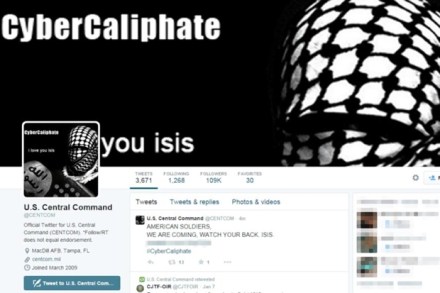
There was a certain irony to the news that @CENTCOM had been hacked yesterday afternoon. While President Obama was giving a speech on cybersecurity, the U.S. Central Command Twitter account was spouting pro-Isis propaganda. Nothing new here, though. Since day one, Isis have used the internet to threaten the West and in particular American soldiers. During a few days in August last year, my research group tracked eighty thousand tweets sent using the hashtag #AMessageFromISIStoUS from Isis sympathisers. Many of them contained grisly threats: images of US casualties and coffins with warnings not to interfere in the affairs of the Caliphate. Cyber-jihad is a natural evolution of terrorism. Islamic State seem to have caught the world unawares by their use of the internet.

The right to offend is nowhere near as important as the right to speak the truth

Last week I lost count of the number of times we've been told, pace the Charlie Hebdo murders, that we have no right not to be offended, that freedom of speech involves the possibility of criticism and ridicule of any religion; indeed, that it’s the flip side of religious liberty. Salman Rushdie, who has more right to make the point than most, said that 'religion deserves our fearless disrespect' and  people like Suzanne Moore in the Guardian seemed to suggest that we have a positive duty to disrespect religion, though I am still waiting for that paper to reproduce some of Charlie Hebdo’s finest on the subject of the prophet of Islam as opposed to its scabrous stuff about gay cardinals.

Islam had nothing to do with this (and other fibs you’re likely to hear)

I don’t always agree with Peter Hitchens but this is by far the best piece I’ve seen on the political reaction to the Paris attacks. As far as Cameron, Miliband and Clegg are concerned, we must all sign up to these shibboleths: The attack was nothing to do with Islam. Almost all Muslims, here and abroad, found those attacks repugnant. The attacks were perpetrated and supported by a minuscule number of people who can simply be defined as 'terrorists'. Immigration and multiculturalism were in no way contributory causes of either the Paris attack or the attacks which we might experience in the future or have suffered in the past. All four of those easy, expedient, shibboleths are palpably wrong.

Nothing to do with Muslims, of course

Utterly brilliant piece by Brendan O’Neill at Spiked on what would have happened if Charlie Hebdo had been published in Britain, rather than in France. It does not strike me as being terribly far-fetched. Meanwhile, the BBC, yet again, has misjudged the story in its news coverage, wringing its hands over the treatment of French Muslims, while at the same time insisting that the murders were nothing to do with Muslims – it was just mad terrorists.

Charlie Hebdo’s journalists were murdered for doing. Now people are being attacked simply for being

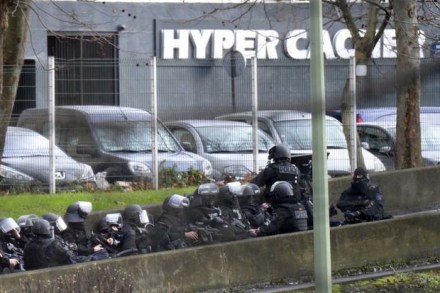
After Wednesday’s attack on Charlie Hebdo, an argument doing the rounds was that it would have been better not to publish cartoons that were deliberately provocative when the magazines had already suffered violent attacks. Why should the journalists put themselves and others, including Muslim policeman Ahmed Merabet, at risk of death? Now two people are dead in a kosher grocers in eastern Paris, perhaps those who thought that it unwise to publish aggressive cartoons can have a think again. Five or six people are believed to be being held hostage in the shop. The shop sells kosher food. Jews buy kosher food. The attackers appear to be killing people not for what they have been doing, but for who they are. Killed for being Jews.

Six key points from MI5’s Andrew Parker speech on the terror threat in Britain

A lot of rot is written about what MI5 thinks, because the spooks don’t talk –even to deny wrong stories (like the supposed Remembrance Day Plot to kill the Queen, etc). But now and again, they do speak. Andrew Parker, the agency’s director-general, gave a wide-ranging speech last night which worth reading in full. It makes the front pages today. Here are half a dozen points which jumped out at me: 1. The terror threat is heating up. ‘Terrorist-related arrests are up 35 per cent compared with four years ago. Since 2010, more than 140 individuals have been convicted for terrorist-related offences’. 2. Three Islamist plots have been intercepted ‘in recent months’. Since 7/7, police say the spooks have intercepted a major Islamist plot a year.

The attack on Charlie Hebdo is an attack on freedom

The French satirical magazine Charlie Hebdo lambasts, attacks and lampoons absolutely everybody. Its targets include all religions, all identity groups, minorities and majorities. In recent years it has been most prominent for its refusal to apply different treatment to Islam. It knew that carrying on with satire, in the name of free expression, carried a real danger — its office in Paris was firebombed three years ago on account of this, and it still carried on with its irreverence. On Wednesday morning, two gunmen went into the magazine’s office wielding Kalashnikovs and rocket-propelled grenades. Within minutes, 12 people were reported killed. The gunmen’s identity was unknown when The Spectator went to press, but there was not much doubt about what had happened.

The Islamic case for a free press

Last year, I watched the British brouhaha over my friend Maajid Nawaz, the prospective Liberal Democrat candidate for Kilburn and co-founder of the counter-extremism outfit Quilliam. Nawaz had tweeted a cartoon called Jesus and Mo. Jesus to Mo: ‘Hey!’ Mo: ‘How ya doing?’ The end. That was it. Two top-tier prophets swapping props. The problem for some Muslims is that, according to tradition, Muhammad cannot be depicted in image lest he become an object of worship. But by insisting that he cannot be drawn under any circumstances, these Muslims make the prophet off-limits to anyone who does not believe as they do. They thus turn Mo into, well, an object of worship.

Je Suis Charlie

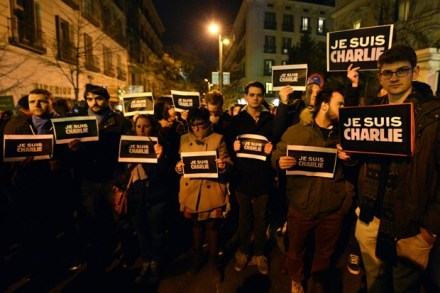
It is important, today especially, to remember that this is nothing new. We have been here before. On the 11th of July, 1991, Hitoshi Igarachi was murdered in his office at the University of Tsukuba. His crime? He had translated The Satanic Verses into Japanese. That was all. Eight days previously Ettore Capriola, the novel's Italian translator, had been fortunate to survive an attempted assassination in Milan. And in October 1993 William Nygaard, the Norweigan publisher of Salman Rushdie's novel, was shot three times. Mercifully and remarkably, he survived. In fact, it had begun before that. On Valentine's Day 1989 when the Iranian Ayatollah issued his fatwa against Rushdie. That was a test too many people failed back then.

Why do internet companies have one rule for paedophilia and another for terrorism?

Today’s Times investigation into how the Islamic State is encouraging young British women to marry into this terrorist organisation is chilling. It is also a reminder that social media is the jihadis’ recruitment tool of choice. What’s striking is that Facebook closed down the account of Aisha, one of the girls in the investigation, because of the material she was posting. Now, the crucial question is whether Facebook informed the authorities after closing these accounts. What riles the security services, as I said in a piece last month, is that this is not done routinely. Infamously, Facebook did not inform the authorities that it had closed down an account belonging to Michael Adebowale, the man who went on to murder Lee Rigby.

The CIA’s torture regime shames the United States. It will not be forgotten

We knew and we knew years ago. Anyone who has been paying attention has known for a long time that the CIA committed appalling acts of brutality in the years after 9/11. Anyone who paid attention has also long known that the agency's torture regime - not too strong a way of putting it - produced very little in the way of useful intelligence. It was sadism masquerading as detective work; depravity disguising impotence and, in the end, the kind of programme that shames a nation. There are still some people who think it fine and dandy, still some people who think it's a lot of fuss over not very much. Still too many people who lack the courage to confront the truth. But we know better than that. We know the truth.

When a cricket ball cost Britain an heir to the throne

A fatal shot The sad death of Australian batsman Philip Hughes was a reminder that a cricket ball can kill. A blow on the cricket field may even have cost us an heir to the throne. — One of the earliest suspected victims was Frederick, Prince of Wales, the son of George II, who is first recorded as having played cricket in 1733 when he put up a team against Sir William Gage, in a match played on Mouley Hurst, Surrey. — In 1751, a few weeks after his 44th birthday, he was said to be suffering from an abscess in the chest caused by a blow by a cricket ball, or possibly a real tennis ball. He then caught a chill and developed pleurisy. He died on 31 March after the abscess burst.