Restaurants

So boring it’s mesmerising: The Place to Eat at John Lewis reviewed

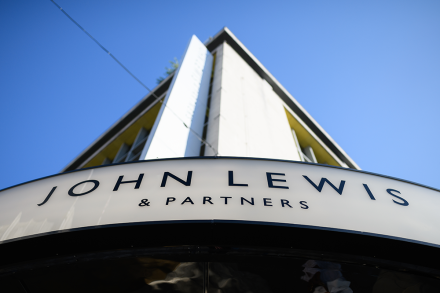
I am, like a strain of Withnail, in the John Lewis café by mistake. I meant to review the new Jamie Oliver café and cooking school on the third floor of John Lewis Oxford Street, but they have run out of food beyond pink cake. We have no choice but to go upwards to the fifth floor and the electricals. I have always felt safe in John Lewis, a despicable thing to think, let alone type, but that is done now. It is called The Place to Eat, which echoes, though unconsciously, Ecclesiastes 3. It is preeningly ugly. I wonder if this is another strain of common British humble-brag, like our teeth, our town centres and our clothes. Because this is ugliness by design: it’s too ugly to be anything else.

In praise of the Acropolis Museum Café and Restaurant

From our US edition

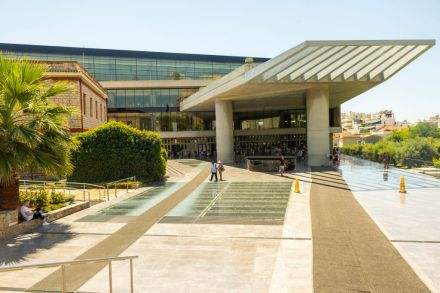
In the global poker game of cultural repatriation – otherwise known as who nicked what from whom – the Greeks seriously upped the ante with the opening of the Acropolis Museum in 2009. This lavish display of archaeological treasures in a light-filled building designed by the Swiss architect Bernard Tschumi is, alongside the recently opened Grand Egyptian Museum in Cairo, an exemplar of such a building’s mission to educate and inspire. In the tradition of polemic buildings, it is also a $200 million plea to return the Elgin Marbles from the British Museum to Greece.

Acropolis

Hell is a wine list

Wine lists give me the fear. I can still recall the prickle of adrenaline when my father handed me the leather-bound menu when I was in my early twenties because I had started working for a wine merchant after university. Should I play it safe or take a punt on something unusual that some people might hate? Perhaps it would be safest to pick the second cheapest. Their drinking pleasure was in my hands. Argh, the pressure. You’d think that after 15 years of writing professionally about wine this anxiety would have faded. It actually gets worse. The more I know, the more indecisive I become. Is the wine a bit too young? Was it a good vintage? Meanwhile the rest of the table is getting thirsty. One can ask the staff but in many places they’re just as clueless, if not more so.

A Mayfair brasserie for people who work, or at least pretend to: 74 Duke reviewed

There is an immaculate brasserie called 74 Duke at 74 Duke Street, Mayfair: this is postcode etymology. Duke Street runs from Selfridges to what used to be the American embassy in Grosvenor Square but is now (I assume) a paranoid hotel: the Chancery Rosewood, which has kept the monstrous eagle on the roof. If Duke Street was ever interesting – I like to imagine Mrs Dalloway having a panic attack in the road – it isn’t now. It sells the eternal detritus of the British rich – watches, capes, meat – who I suspect are into crypto these days. It is all a feint anyway: fake London for fake people, and life is at the edges now. A brasserie for the undead, then, and what to say? It’s very nice, but the last restaurant I reviewed near here was Mister Nice, which wasn’t nice at all.

With Andrew Turvil

28 min listen

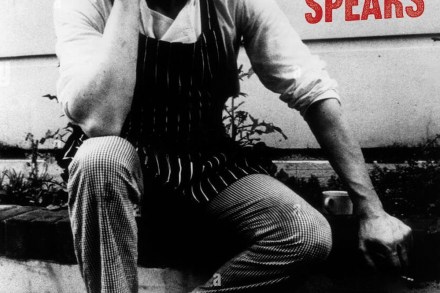
Writer Andrew Turvil is the former editor of the Good Food Guide, the AA Restaurant Guide and the Which? Pub Guide. His new book Blood, Sweat and Asparagus Spears: The Story of the 1990s Restaurant Revolution is out now. On the podcast, Andrew tells Olivia Potts and Lara Prendergast about how his journey began through journalism, the importance of Marco Pierre White's influence on food culture in the 1990s and which red flags he looks for when reviewing a restaurant. Plus: why did he decide to buy a pub?

Eleven Madison Park

Why Eleven Madison Park had to put meat back on the menu

From our US edition

Eleven Madison Park, perhaps the finest of New York’s fine-dining establishments, is adding select meat dishes back to its prix fixe menu after an ill-fated foray into veganism after the pandemic. Chef Daniel Humm announced the move in the New York Times, citing all the predictable reasons for ditching a plant-based menu. First and foremost: the finances. “It’s hard to get 30 people for a corporate dinner to come to a plant-based restaurant,” Humm told the Times, noting the negative feedback from diners over the years. Still, he framed the move in moral terms, explaining how he didn’t “realize that [the vegan menu] would exclude people.” To this, I can only muster an eye roll.

vegan

Why I was right to ban vegans

From our US edition

I remember the day I heard my culinary hero Daniel Humm had decided to make Eleven Madison Park’s menu plant-based. It was as profound as the day Princess Diana died and as pivotal as the birth of my first child, Lily Elvis. The news tore the joy from my heart as well as all the love and respect I had for Humm. The toil, tenacity and sheer stamina it took him to earn his three Michelin stars is extraordinary. Who am I to criticize one of the greatest chefs alive today? I’m a nobody. Yes, I’ve worked at three-Michelin-starred restaurants, served Queen Elizabeth II and starred in the BBC’s Great British Menu but I’m just a cook: nothing more and nothing less.

The no-choice rural restaurant with just two sittings a week

Long Compton is in the Cotswolds, but to the east, where there are no boutique hotels or shops selling artisan candles to tourists. Banburyshire and its surrounds are actual countryside. Fields roll away in the manner Germans call Kulturlandschaft, meaning landscape shaped by centuries of human care. This is the sort of country that makes people write poetry about hedgerows and choral music about sheep: lovely to live in but, by long British tradition, a dismal place to dine out. Discovering a truly great restaurant in Long Compton – population 764 – feels like finding in rural Warwickshire one of those bucolic la France profonde dining experiences that seemed nostalgic fantasies even when M.F.K Fisher described them.

I doubt there’s a better ravioli in London: The Lavery reviewed

The Lavery in South Kensington is named for Sir John Lavery, official artist of the Great War and designer of the currency of the Irish Free State, who lived here, though he died in Ireland and is buried in Putney. Lavery, of course, would no longer recognise South Kensington as his home, and his white, monumental mid-Victorian house – it’s too cold to be compared to a wedding cake, it’s a power cake – is now a fashionable restaurant and ‘event space’, which I put in quotation marks so you know I didn’t write the words ‘event space’, I just typed them out. In houses like The Lavery, I wonder how tall the Victorians were in their heads.

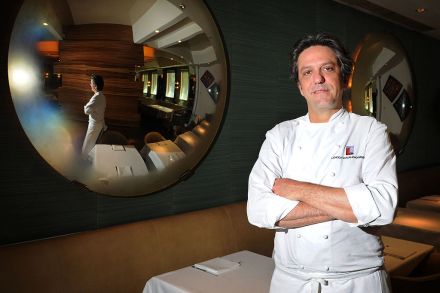
Locatelli has entered the premier league of museum dining

From our US edition

Does your museum feel tired and run down? Is the entrance unwelcoming? The bookshop shabby? The restaurant a mere café? If so, call Annabelle Selldorf, the German-American architect whose talent and sensitivity have made her the go-to person for reviving weary museums. Her recent transformation of the Frick in New York has been widely acclaimed and she will soon start work on the Wallace Collection in London. But the latest masterwork has seen Selldorf sprinkle her fairy dust on the Sainsbury Wing of London’s National Gallery. Those with long architectural memories will recall how in 1984, the then Prince of Wales christened the proposed new wing of the Gallery “a monstrous carbuncle on the face of a much-loved and elegant friend.

Locatelli

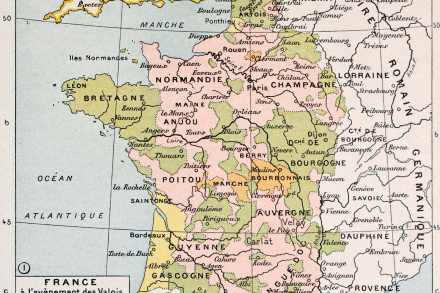
My gastronomic tour de France

On holiday in the Dordogne, I face an annual dilemma. My weekly Any Other Business column ruminates on the financial world with occasional restaurant tips to lighten the tone – and many readers tell me they frankly prefer the menus du jour to the boardroom dramas. My difficulty is that in a single page of The Spectator there’s never space to do justice to both. Last week, I ended up cramming seven restaurants into one short paragraph, a paltry snack where I’d like to have offered a banquet. So here’s my 2025 tour de France, as I called it, at somewhat fuller length, perhaps one of these days to be super-sized into an entire guidebook. This set of recommendations, I should explain, come mostly from British readers and friends in other parts of France.

A fictional Edwardian waif’s hungry fantasy: Fortnum & Mason’s food hall reviewed

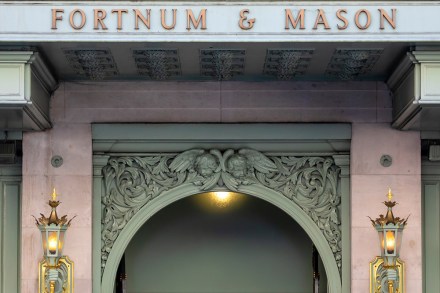
I like a picnic weighted with history and class terror, which means Fortnum & Mason on Piccadilly, which is historical re-enactment with dreaming. I have written about this for years or tried to: food is never just food, only fools say that. You can learn almost everything about people from the food they want. And here is St Narcissus in the form of a department store that works more powerfully as an idea than a mere shop, though it is a very effective shop. Fortnum’s sells a Great Britain that never was, designed for people who no longer exist, if they ever did. It has much to say to Brexiteers and worse, though in biscuit.

The deculturalisation of Britain

It has been a disastrous summer for France’s restaurants. On average, visits have dropped by 20 per cent on previous years, but at many coastal resorts they’re down by 35 per cent. ‘Consumption is well below previous years,’ says Laurent Barthélémy, president of a hospitality union. ‘Restaurant owners see customers passing by, but they don't come in to eat.’ Various reasons have been propounded to account for this decline. Barthélémy points to the cost-of-living crisis as a leading factor, as does Thierry Marx, one of France’s top chefs and president of the restaurant owners’ association.

Will one rotten rebrand spoil Cracker Barrel?

From our US edition

No one thinks the Cracker Barrel rebrand is a particularly good idea. The entire charm of Cracker Barrel lay in the farmhouse attic vibe, the nana’s candy dish assortment in the gift shop and the menu, which served up the best chicken and dumplings or biscuits and gravy and sweet tea possible from a fast-casual chain with horrible wooden chairs. Still, the melodrama surrounding this story, the rising and falling stock prices, the online mocking and gloating, seems a little overblown. Not everything has to be political. Cracker Barrel certainly doesn’t. For those of you who’ve been wandering around the fields with a bucket on your head this week, Cracker Barrel has streamlined.

Cracker Barrel

In defence of fat cats’ growing pay packets

News from the High Pay Centre – the revolutionary guard of left-wing thinktanks – that average FTSE100 chief executive pay rose 16 per cent to a record £5.9 million for 2024-25 comes as a double blessing for Rachel Reeves. On the one hand, she can cite executive greed as a pretext for her forthcoming autumn tax raid, while at the same time claiming that if rewards are soaring, then business conditions under Labour can’t be as bad as boardroom whingers say. On the other, she can rejoice that each UK-domiciled boss is contributing to the Exchequer a sum roughly equal to the tax take from 440 average earners. Meanwhile, is the near-£6 million benchmark justified in itself?

‘Italian that just works’: Broadwick Soho reviewed

This column sometimes shrieks the death of central London, and this is unfair. (I think this because others are now doing it.) It is not the city we mourn but our younger selves. Even so, the current aesthetic in restaurants is awful and needs to be suppressed: beiges and leathers, fish tanks and stupid lighting, all are nauseating. But I hated Dubai. You say Atlantis, The Palm, I say enslaved maid crying for her dreams. But there is refuge, at least from the aesthetic, and it is as ever the child of imagination and nostalgia. Broadwick Soho, the newish hotel in the street where typhus was chased down to a water pump, is a rebuke to desperate minimalism.

Lunch with Thomas Straker, the chef the restaurant world loves to hate

‘It was a heavy week,’ sighs Thomas Straker, explaining why he recently ended up on a drip in New York. He’s been nicknamed Britain’s ‘bad boy chef’, and his fans love him. He owns two restaurants in Notting Hill and has 2.6 million Instagram followers: not far off Nigella. Another restaurant is coming in Manhattan, so he has been spending a lot of time there. ‘Post-service, out late, every night,’ he says. ‘So I was in Soho at 3 a.m. the day before I ran the London marathon… I got carried away’ Straker Industries has many divisions: he runs a YouTube channel, has a butter range and is about to launch his own olive oil. On the day we meet, I spot him sauntering down Golborne Road towards his restaurant Acre for our interview.

The chef does not understand sandwiches: Raffles London at the OWO reviewed

I am mesmerised by the restaurants of Raffles London at the OWO (Old War Office) because war approaches and the Old War Office is now a stage set for food, floristry and linen. If this is civilisation – it isn’t really, but it thinks it is – who will protect it now? Will we even know if war has started – or care? It was a fine building when I first came – I have reviewed its chilly Mediterranean food, its manic Italian and its tepid French – and it still is. Grand hotels exist to suppress time. It is a preening Edwardian palace with crazed plinths, over-pliant staff and ever sillier restaurants, today’s being the Drawing Room. It looks like how people who are not posh imagine posh country houses to be.

Dogs have no place at my table

I love dogs. I love lunching. I love seeing dogs in restaurants where I’m lunching. But one thing I don’t love one bit is a dog being brought to a luncheon which I’m participating in – and, most likely, paying for. Luncheons are for humans – not for our furry friends. Let’s face it, it’s not like they’re particularly thrilled to be indoors while their owners indulge in a little light character assassination. They’d be having far more fun running around outside eating vomit and sniffing each other’s bums. They can be big dogs, like the one belonging to my friend K. His gentle nature is swamped by the physical reality of him being the size of a small horse and taking up enough room for two people in a snug bistro.

Picture perfect: Locatelli at the National Gallery reviewed

I feel for Locatelli, the new Italian restaurant inside the National Gallery, whose opening coincides with the 200th anniversary of the gallery and a rehang which I can’t see the point of because I want to watch Van Eyck in the dark. Locatelli must compete with the Caravaggio chicken, which is really called ‘Supper at Emmaus’ if you are an art historian or an adult. In the publicity photographs the chef Giorgio Locatelli is actually standing in front of the Caravaggio chicken. It looks as if Jesus is waving at Giorgio Locatelli but the chicken is unmoved. It stole all the gravitas.